Running a call center on traditional PSTN phone lines is expensive, inflexible, and increasingly unnecessary. A modern VoIP call center solution delivers carrier-grade voice quality at a fraction of the cost, and scales from 10 agents to thousands without changing your infrastructure.
This guide explains what a VoIP call center solution is, what it needs to include, how it compares to traditional phone lines, and why Brazil's BPO industry has made VoIP the standard for contact center voice.
What Is a VoIP Call Center Solution?
A VoIP call center solution is the cloud-based voice infrastructure that connects your agents to customers, replacing physical phone lines with internet-based SIP trunking. It includes:
- Inbound DID numbers: local or toll-free numbers in any country that route to your contact center platform
- SIP trunking: the protocol that delivers calls between your call center software and the public phone network
- Outbound termination: routing outbound agent calls to customers at carrier-grade quality and wholesale rates
- IVR and call routing: directing callers to the right queue or agent based on input or data
- Call recording: capturing calls for QA, compliance, and agent coaching
- Analytics and reporting: real-time and historical data on call volume, wait times, agent performance, and answer rates
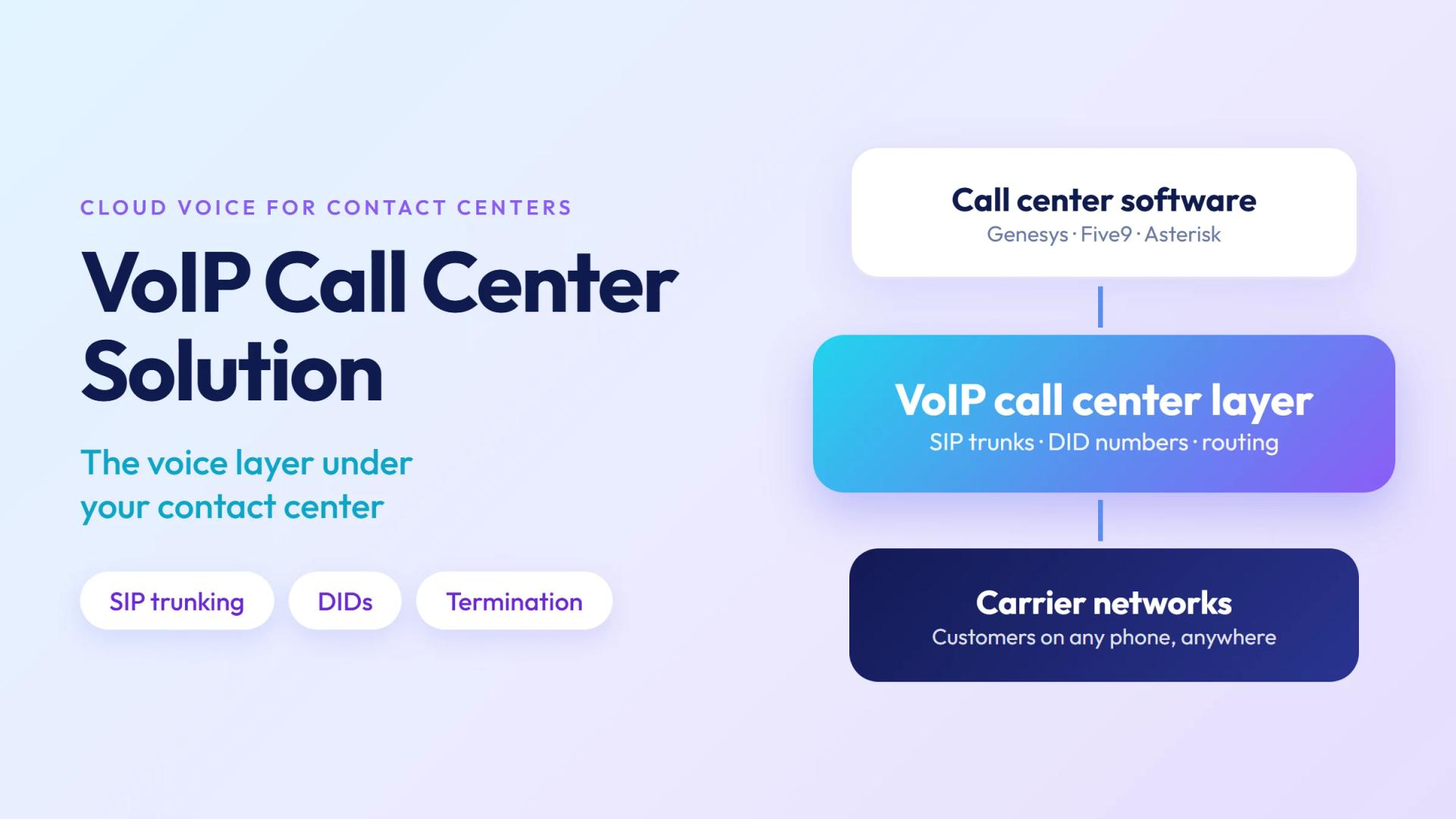
A VoIP call center solution is not the same as call center software (like Five9, Genesys, or Talkdesk). It is the voice layer that the software sits on top of. Some call center platforms include their own VoIP layer; others require you to bring your own SIP trunking from a provider like My Country Mobile.
For a broader look at how cloud communications power contact centers, see our comparison of UCaaS vs CCaaS, and our explainer on what UCaaS is.
How VoIP Works in a Call Center Environment
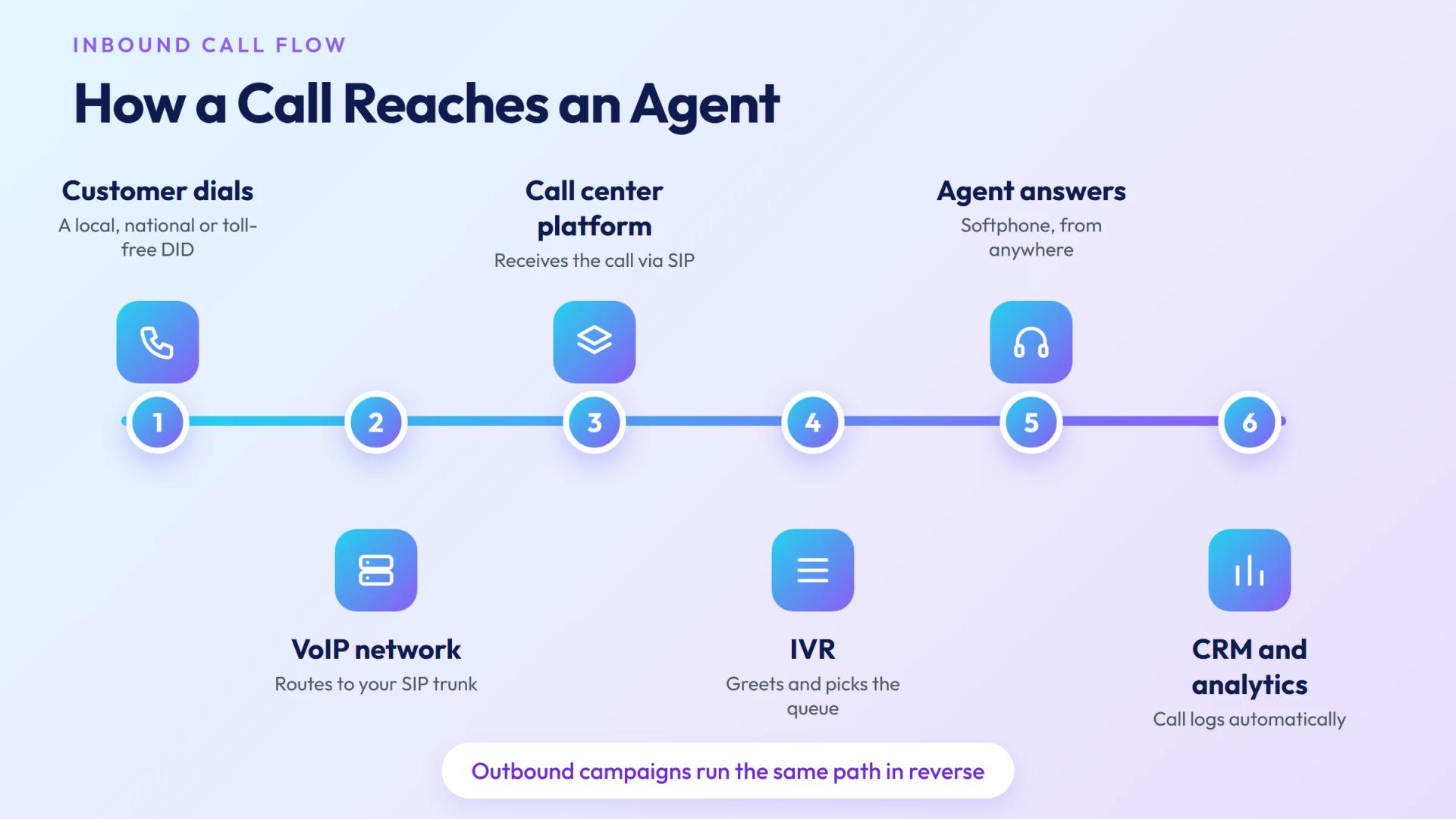
The call flow in a modern VoIP contact center works like this:
- Customer dials your DID number (local, national, or toll-free)
- The call hits your VoIP provider's network and routes to your SIP trunk
- Your call center platform (Genesys, Five9, Asterisk, FreeSWITCH, etc.) receives the call via SIP
- The IVR plays a greeting and routes the caller to the right queue
- An agent's softphone or IP phone rings, and the agent answers from anywhere in the world
- After the call, it logs automatically in the CRM and analytics dashboard
The same flow runs in reverse for outbound campaigns: the platform dials a list, connects answered calls to agents, and routes the call through the VoIP provider's termination network to reach the customer's phone.
The underlying technology is SIP trunking, the Session Initiation Protocol standard that every major call center platform uses to send and receive calls over IP networks.
Key Features Your VoIP Call Center Solution Needs
| Feature | Why It Matters |
|---|---|
| Elastic SIP channels | Scale simultaneous calls on demand, with no pre-ordering of fixed capacity |
| DID numbers in target markets | Local presence in customer markets improves answer rates |
| Redundant network routes | Automatic failover if a route degrades, so campaigns don't drop |
| Low-latency routing | Milliseconds of latency affect call quality and agent productivity |
| HD voice (G.722 codec) | Clearer audio reduces misunderstandings and repeat calls |
| Real-time call quality monitoring | MOS scores, jitter, and packet loss dashboards to catch quality issues fast |
| Wholesale termination rates | At high call volumes, per-minute rates are the biggest cost lever |
| CNAM and caller ID control | Display your brand name on outbound calls to improve answer rates |
| Call recording storage | Compliance recording with encrypted storage and retrieval |
| Uptime SLA | Call center downtime is direct revenue loss, so SLA accountability matters |
Elastic Channels: Why This Is Non-Negotiable
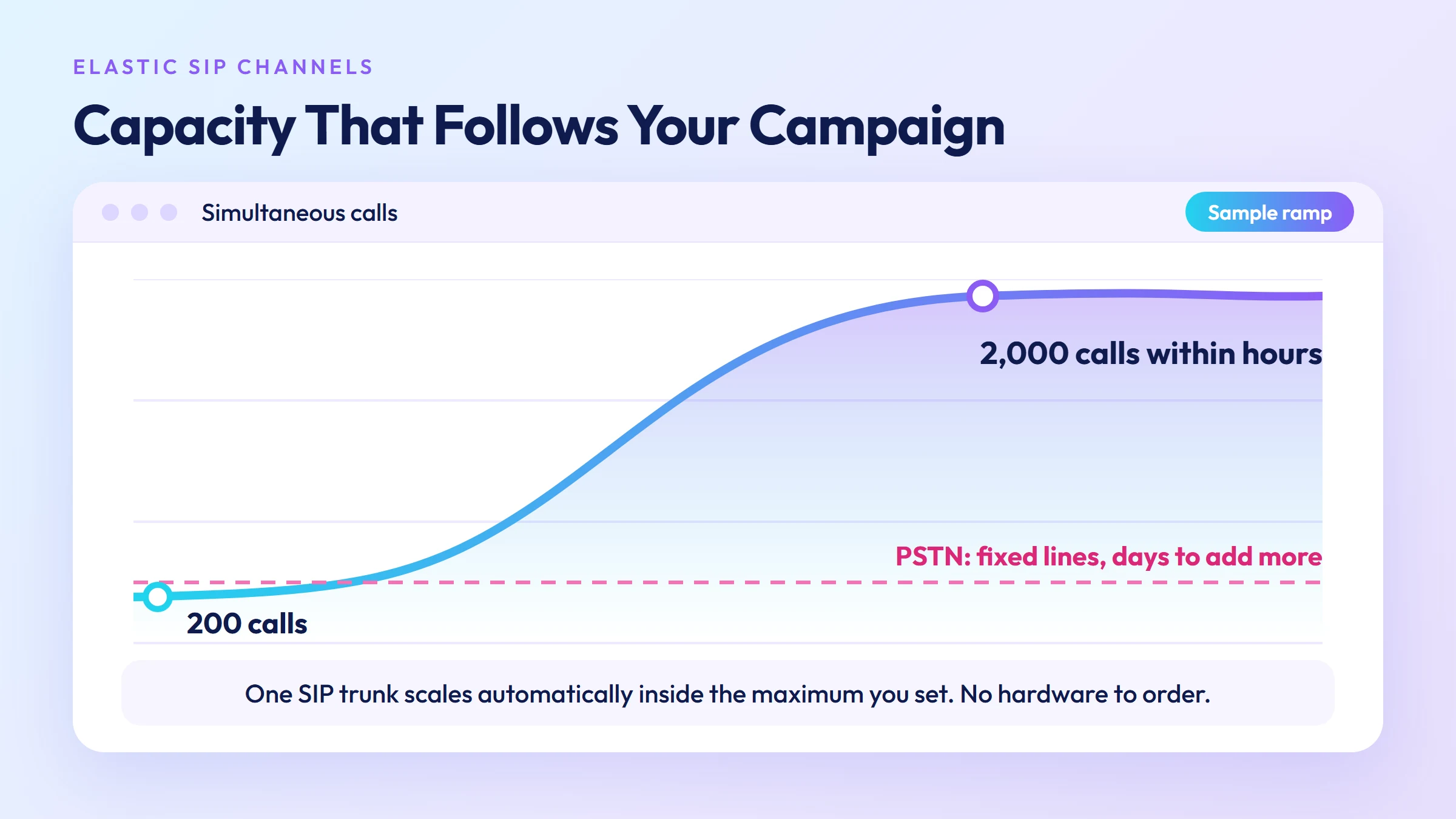
Traditional phone lines are fixed capacity: you buy 100 lines, you can handle 100 simultaneous calls. VoIP SIP trunks are elastic: you configure a maximum channel limit, and usage scales within that limit automatically. For BPO operations running outbound campaigns that ramp from 200 to 2,000 simultaneous calls within hours, this flexibility is essential.
A wholesale VoIP provider with direct carrier peering can provision new SIP channels without any physical infrastructure changes.
Redundancy and Failover
Call centers cannot afford voice outages. A proper VoIP call center solution includes multiple redundant routes: if a primary route experiences packet loss or latency spikes, calls automatically fail over to an alternate route with no agent disruption. This is the difference between a carrier-grade VoIP solution and a consumer-grade VoIP service.
Ready when you are
Protect your business line.
MCM's local numbers ship with verified caller ID and smart call filtering — customers always know it's really you, and spam never reaches your team.
VoIP vs Traditional PSTN Lines for Call Centers
| Factor | Traditional PSTN | VoIP SIP Trunking | Winner |
|---|---|---|---|
| Setup cost | High: physical line installation | Low: configure via portal | VoIP |
| Per-minute cost | $0.025–$0.08/min | $0.004–$0.015/min wholesale | VoIP |
| Scalability | Fixed capacity, days to provision | Elastic, minutes to provision | VoIP |
| Remote agents | Requires call forwarding workarounds | Native, agents work from anywhere | VoIP |
| International calls | Expensive international rates | Low wholesale termination globally | VoIP |
| DID numbers abroad | Requires a local carrier per country | One provider, many countries | VoIP |
| Call quality | Consistent but limited HD | HD with G.722 on good networks | VoIP |
| Analytics | Basic CDR only | Real-time dashboards | VoIP |
| Maintenance | Physical line maintenance | Provider managed | VoIP |
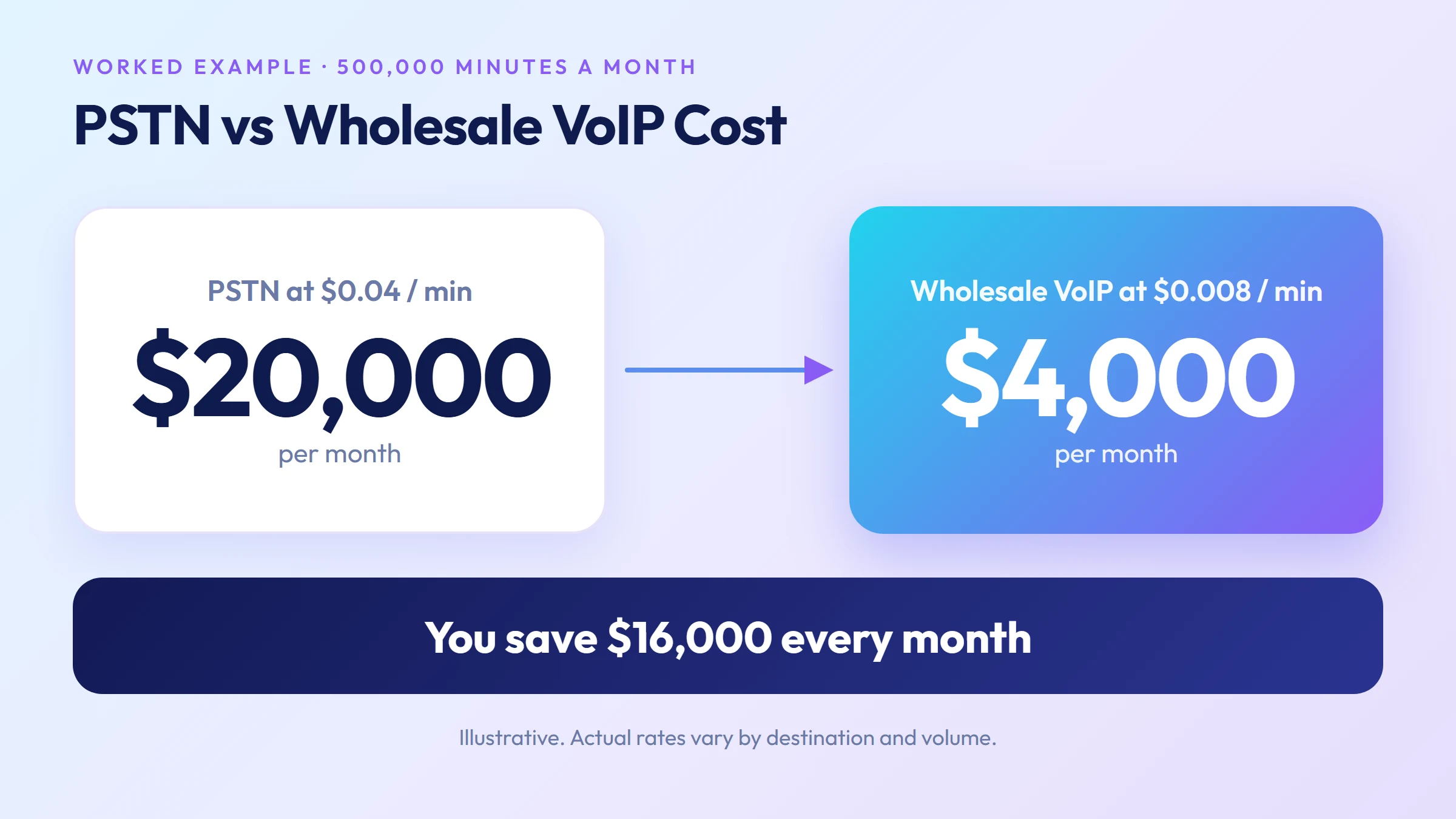
The cost difference alone justifies the switch. A call center handling 500,000 minutes per month on PSTN at $0.04/min pays $20,000/month in line costs. The same volume on wholesale VoIP at $0.008/min costs $4,000/month, a saving of $16,000 every month. Actual rates vary by destination and volume.
Why Brazil's BPO Industry Runs on VoIP
Brazil operates one of the largest BPO and call center industries in Latin America, with a very large contact center workforce and thousands of outsourcing companies serving domestic and international clients. VoIP has become the standard voice infrastructure for this industry for several reasons.
Cost at Scale
Brazilian PSTN rates for outbound calls are significantly more expensive than VoIP termination at volume. For BPOs running millions of minutes per month on domestic and international campaigns, the per-minute savings from wholesale VoIP translate directly to margin.
Work-from-Home Agent Support
Post-pandemic, Brazil's BPO industry shifted heavily toward home-office agent models. VoIP enables this natively: agents connect their softphone over any internet connection and appear on the same call center platform as in-office agents. No hardware is shipped to home offices.
International Campaign Capability
Many Brazilian BPOs serve international clients, handling customer service, collections, or telesales campaigns for companies in the US, UK, Europe, and other Latin American countries. VoIP with global DID numbers lets Brazilian BPOs present local numbers in any country, which improves answer rates for outbound campaigns.
ANATEL and Regulation
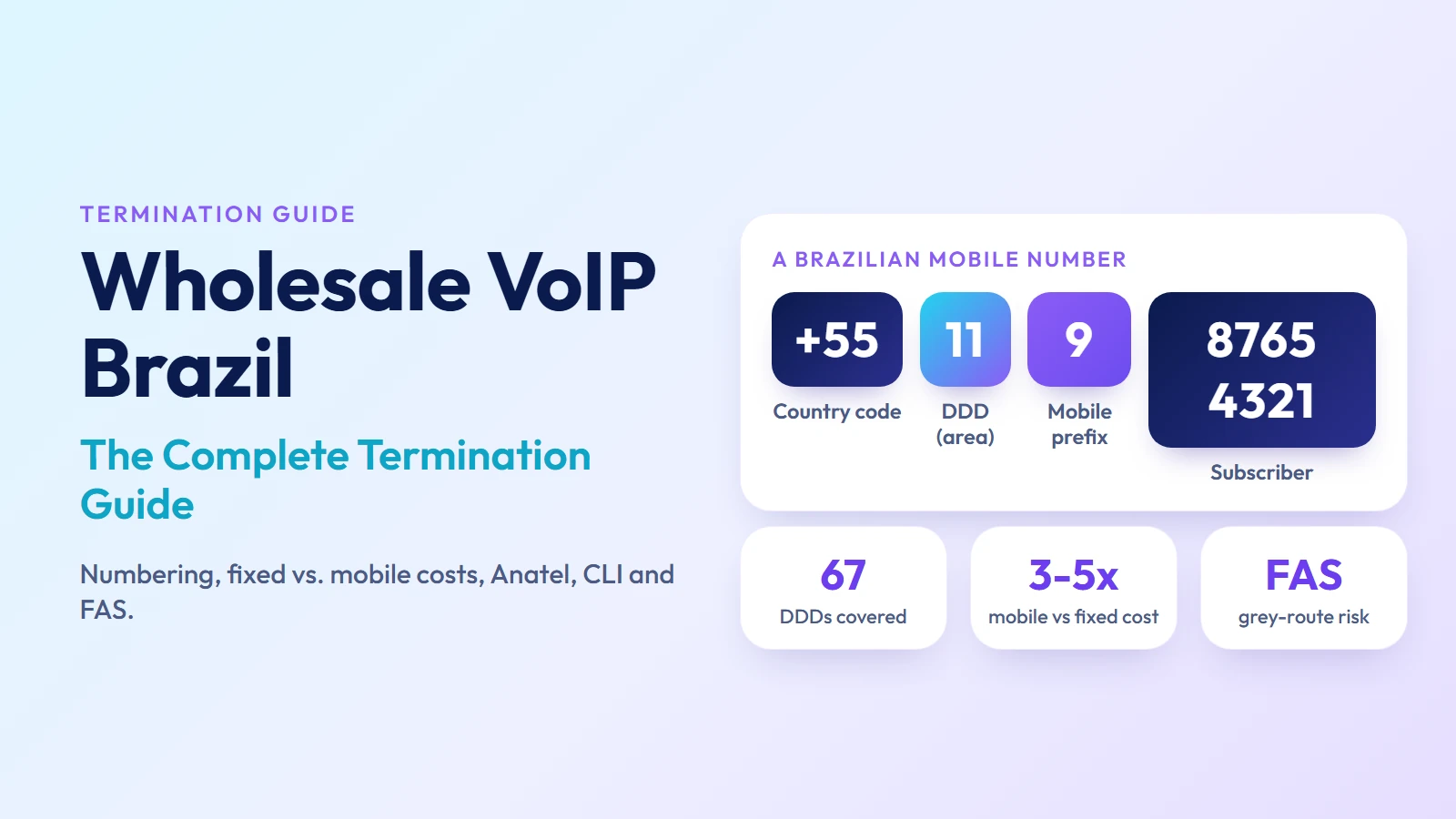
Brazil's telecom regulator, ANATEL, permits VoIP for business communications, and providers operating Brazil interconnects must follow local numbering plans and regulations. Confirm your provider's compliance position in writing before you migrate a regulated campaign.
See our in-depth guide to the wholesale VoIP market in Brazil for a full breakdown of infrastructure, regulations, and provider landscape.
What to Look for in a VoIP Call Center Provider
Not all VoIP providers are built for call center scale. Here's what separates carrier-grade providers from consumer-grade services:
1. Tier-1 Network or Direct Peering
Your provider should own or directly peer with Tier-1 carrier networks rather than resell from an intermediary. Each hop in the routing chain adds latency and reduces quality. Direct peering means shorter routes, lower latency, and fewer points of failure.
2. Brazil-Specific Termination Quality
Brazil has a complex telecom infrastructure with significant geographic and carrier variation. A provider with dedicated Brazil termination routes, not generic Latin America routing, delivers meaningfully better call quality and answer rates within the country.
3. Wholesale Rate Access
Call centers with high volume should not pay retail VoIP rates. Look for providers that offer tiered wholesale pricing based on committed monthly minutes. Rates drop significantly at scale (100K, 1M, 10M+ minutes/month).
4. Real-Time Quality Monitoring
Your provider should give you a dashboard showing live call quality metrics (MOS scores, jitter, packet loss) per route and per destination. This lets your team identify and escalate route quality issues before they affect campaign performance.
5. Compatible SIP Configuration
Confirm your VoIP provider is compatible with your call center platform. Most enterprise call center software (Five9, Genesys, Cisco UCCE, Avaya, Asterisk, FreeSWITCH) uses standard SIP, but codec support (G.711, G.729, G.722), DTMF modes, and NAT traversal settings must match.
How My Country Mobile Powers Call Center VoIP
My Country Mobile is a wholesale VoIP provider and UCaaS platform with carrier-grade infrastructure built for contact center scale. Key capabilities for call centers:
- Elastic SIP trunking: scale channels with your campaigns, provisioned via portal or API
- Brazil DID numbers: local Brazilian numbers across major cities and area codes
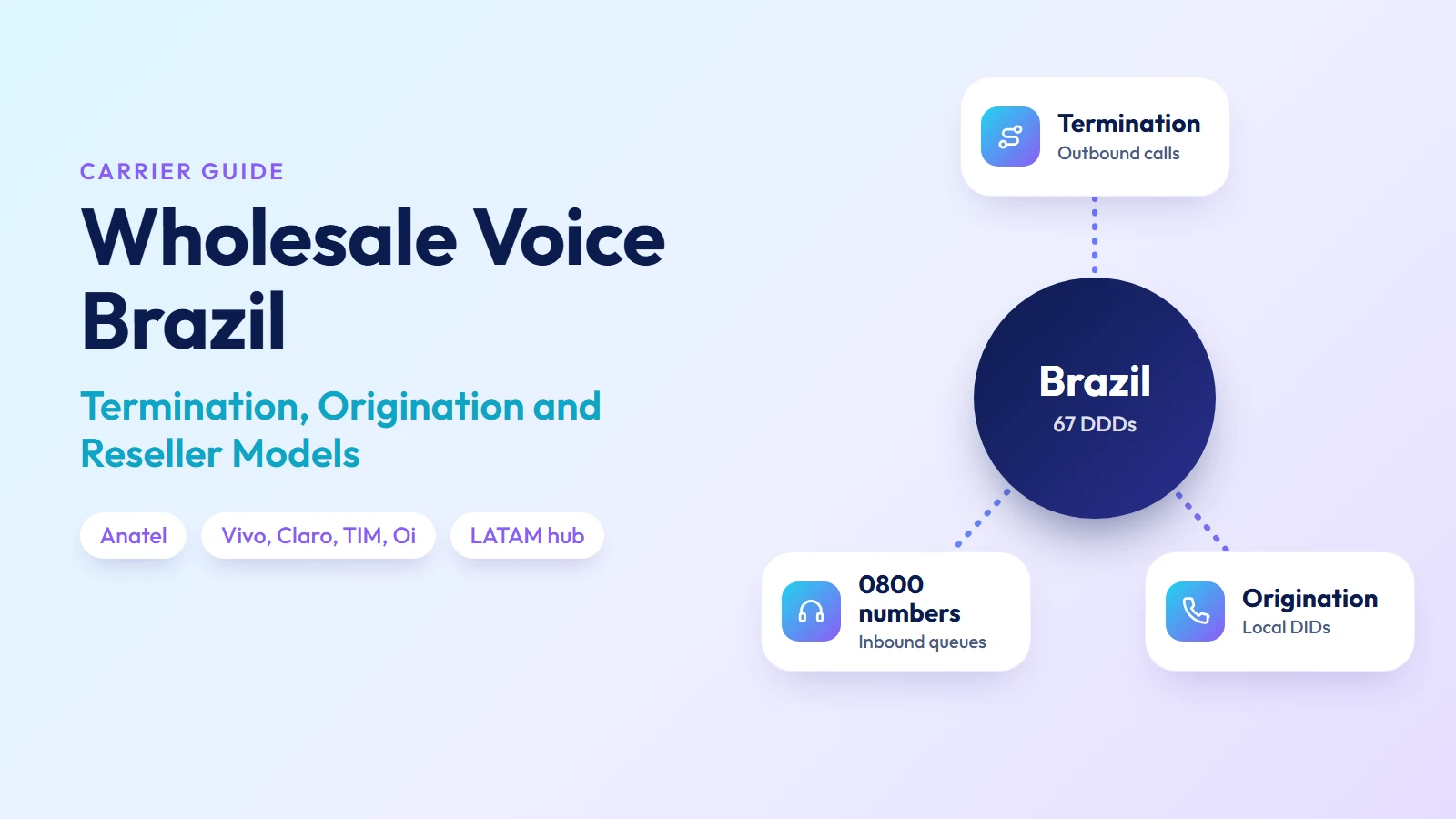
- Wholesale termination to Brazil: direct carrier relationships for quality, low-latency termination at volume rates
- Global outbound termination: wide international coverage for BPOs running campaigns from Brazil
- LCR routing: Least Cost Routing selects the best-quality, lowest-cost route per destination
- Network monitoring: live monitoring with escalation paths for quality issues
- API access: programmatic control of DIDs, SIP trunks, routing rules, and reporting
MCM integrates with major call center platforms via standard SIP. Whether you run Five9, Genesys Cloud, Talkdesk, Avaya, Asterisk, or a proprietary platform, the SIP trunk configuration is straightforward and supported by our technical team.
Carrier-grade VoIP built for contact center scale
Wholesale SIP trunking, Brazil DID numbers, global termination, and network monitoring. Whether you run 50 agents or 5,000, MCM's infrastructure scales with your operation. Get a rate quote →
Ready when you are
Ready to sound local everywhere you sell?
MCM activates business numbers in minutes, with call routing, analytics, and CRM-ready integrations. Start your trial — no card to browse inventory.
Frequently Asked Questions
What is a VoIP call center solution?
A VoIP call center solution is the cloud-based voice infrastructure that connects your agents to customers over the internet using SIP trunking, replacing traditional PSTN phone lines. It includes DID numbers, inbound and outbound call routing, IVR, call recording, and analytics. It sits underneath your call center software (Five9, Genesys, Asterisk, etc.) and handles the actual voice delivery.
How much does VoIP cost for a call center?
At wholesale rates, VoIP termination to Brazil costs approximately $0.008–$0.018 per minute depending on volume and destination. At scale (1M+ minutes/month), wholesale providers like MCM can offer custom rate decks well below retail VoIP pricing. DID numbers in Brazil typically cost $1–$5 per number per month.
Is VoIP reliable enough for a large call center?
Yes. Carrier-grade VoIP with Tier-1 network peering and redundant routes can match or exceed the reliability of most PSTN connections. The key is using a wholesale carrier with redundant routes and automatic failover, not a consumer-grade VoIP service. Ask any provider for its SLA and uptime history in writing.
What is the difference between VoIP and SIP trunking for call centers?
VoIP is the technology (sending voice over IP networks). SIP trunking is the specific service that connects your call center platform to the public phone network using the SIP protocol. For call centers, SIP trunking is the practical implementation of VoIP: it's what you buy from a carrier to deliver and receive calls on your platform.
Can VoIP handle 1,000+ simultaneous calls for a BPO?
Yes. Enterprise SIP trunking scales to thousands of simultaneous channels. Channels are elastic: they scale on demand within your configured maximum without pre-ordering hardware. This makes VoIP especially well-suited for BPOs with variable volumes, seasonal peaks, or rapid growth.
Why do Brazilian BPOs use VoIP instead of traditional phone lines?
Cost savings, scalability, and remote agent support are the three main reasons. Brazilian PSTN rates are significantly higher than wholesale VoIP termination at volume. VoIP scales elastically without infrastructure investment. And post-pandemic, home-office agent models require VoIP, since agents connect from any internet connection with no hardware changes. ANATEL regulations permit VoIP for business use, so regulation is not a barrier.