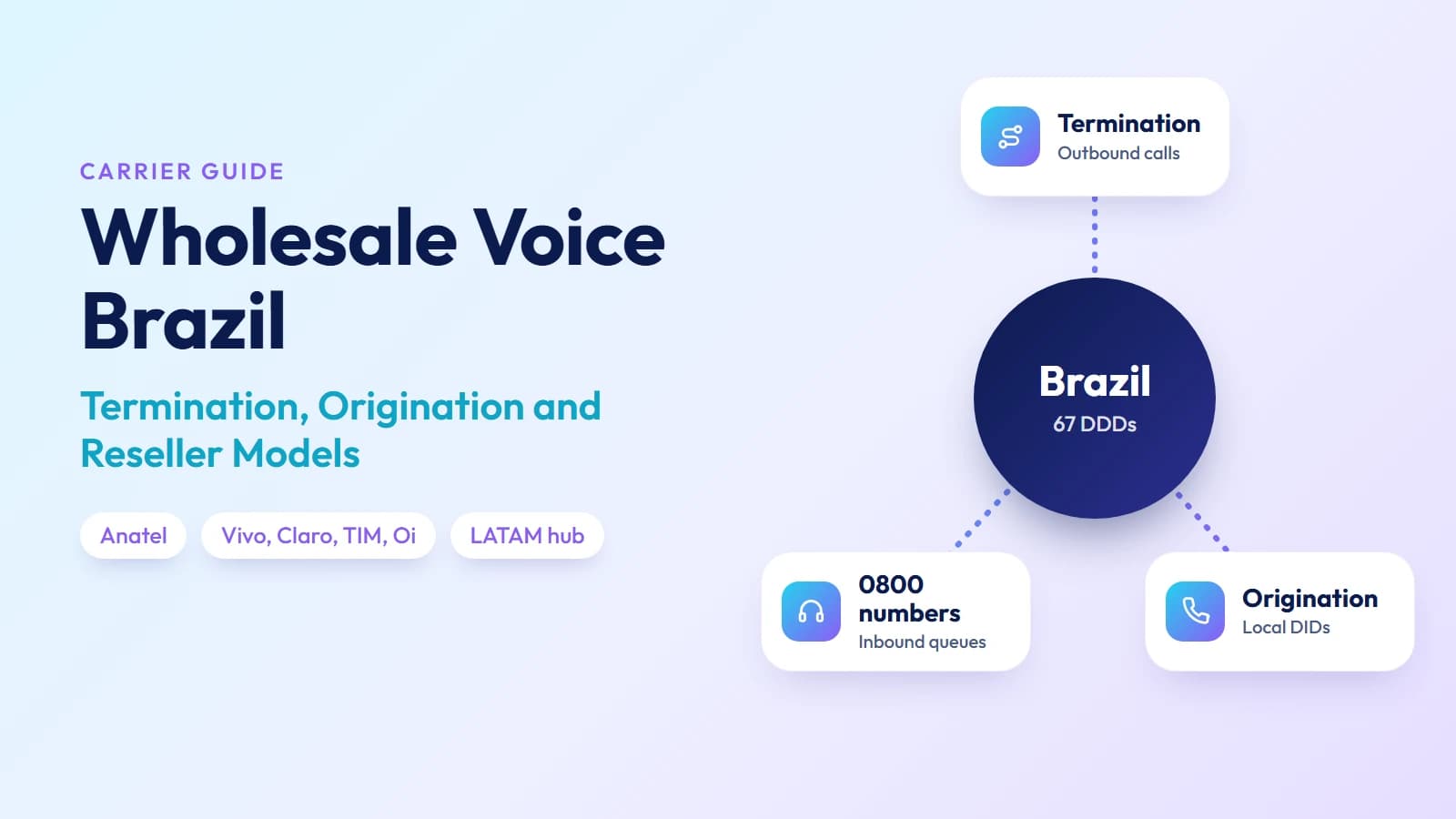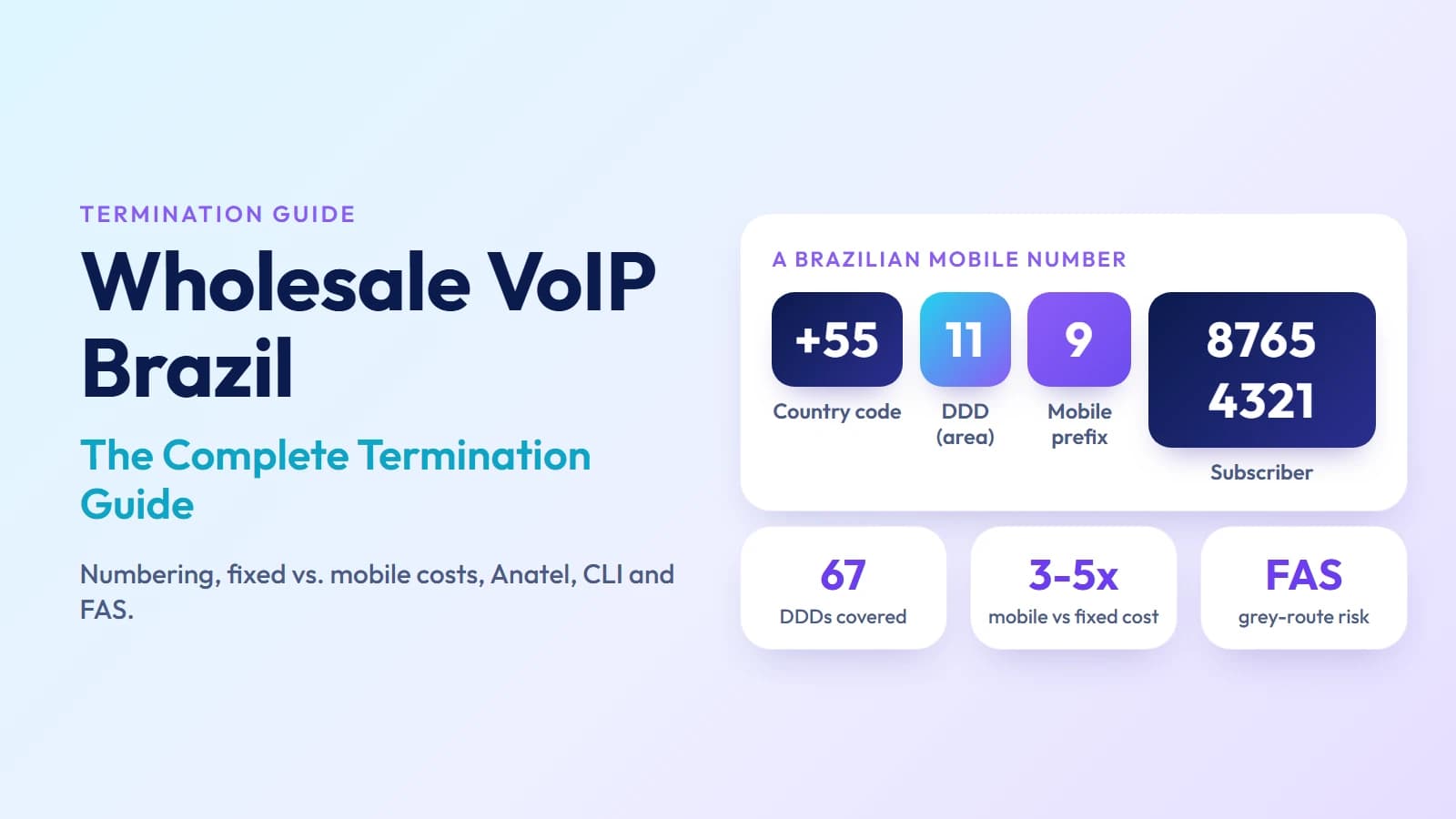
Brazil is one of the largest voice termination markets in Latin America — over 215 million people, roughly 67 distinct area codes (DDDs), and a contact center industry that handles a significant share of global BPO volume. It is also one of the more technically demanding destinations in the region: a wide price gap between fixed-line and mobile termination, a well-documented False Answer Supervision (FAS) fraud problem on grey routes, a mandatory numbering format that trips up carriers unfamiliar with the 9-digit mobile standard, and an Anatel-regulated interconnect environment that shapes what your termination partner can legally do on the final leg.
This guide covers the technical, commercial, and regulatory specifics you need before routing wholesale VoIP traffic to Brazil.
Brazil's numbering format — getting E.164 right
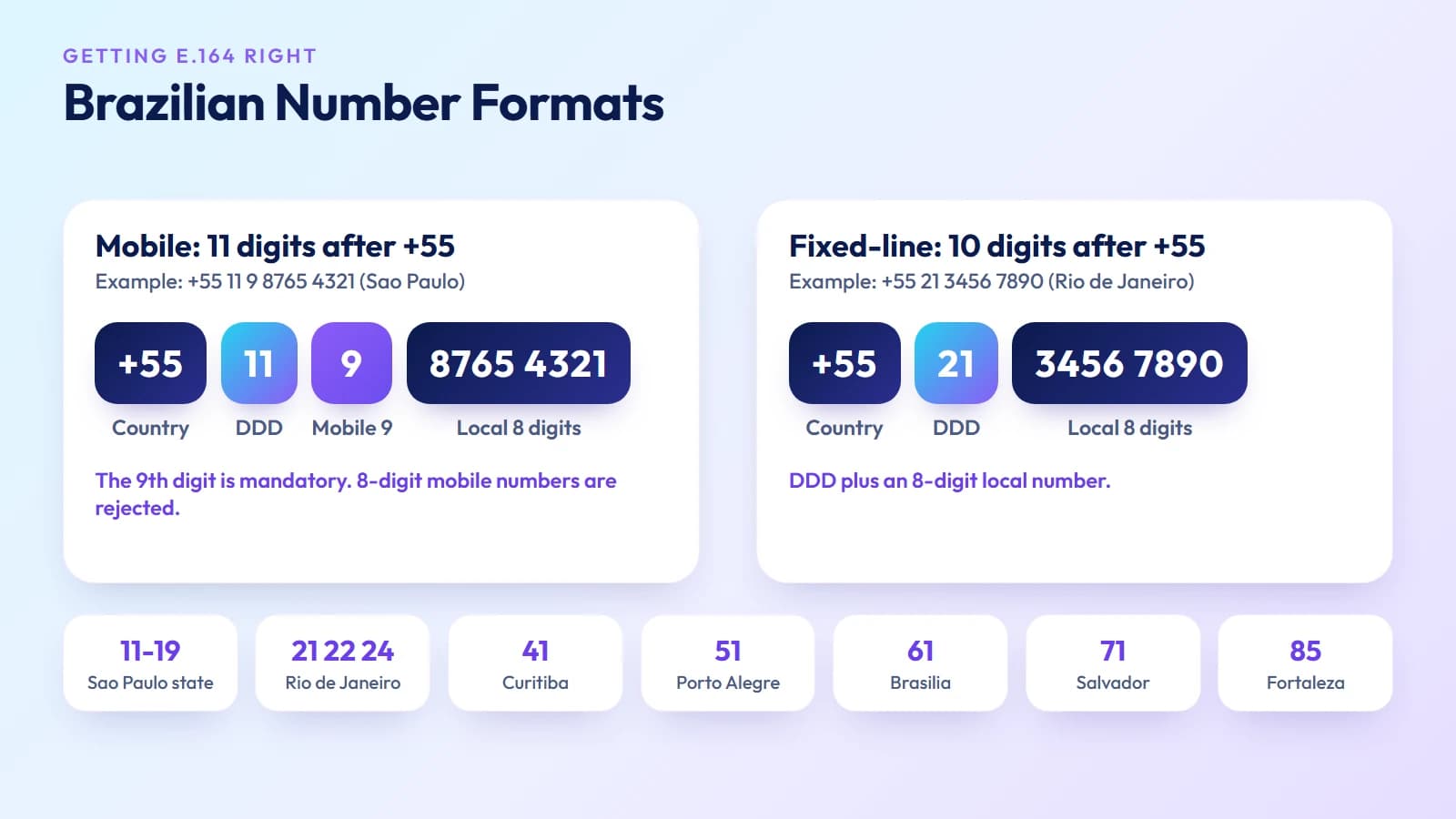
Every Brazilian number follows the pattern: +55 [DDD] [subscriber number].
The country code is +55. The DDD (Discagem Direta a Distância) is a two-digit area code assigned by Anatel. Brazil has 67 active DDDs — São Paulo state alone uses nine (11–19 for different metropolitan and regional zones). Rio de Janeiro uses 21, 22, and 24. Other major cities: 41 (Curitiba), 51 (Porto Alegre), 61 (Brasília), 71 (Salvador), 85 (Fortaleza).
The subscriber number length differs by service type:
- Fixed-line: 8 digits (DDD + 8-digit local number = 10 digits after +55)
- Mobile: 9 digits (DDD + digit 9 + 8-digit local number = 11 digits after +55)
Brazil added the mandatory 9th digit to all mobile numbers starting with São Paulo in 2012, with full national rollout completing by 2016. Any carrier or SIP trunk configuration still sending 8-digit Brazilian mobile numbers will get rejection from destination networks. Verify your dialplan handles the 9-prefix correctly on all Brazilian mobile DDDs.
A correctly formatted mobile number in São Paulo: +55 11 9 8765 4321
A correctly formatted fixed-line in Rio de Janeiro: +55 21 3456 7890
Fixed-line vs. mobile termination — the cost gap
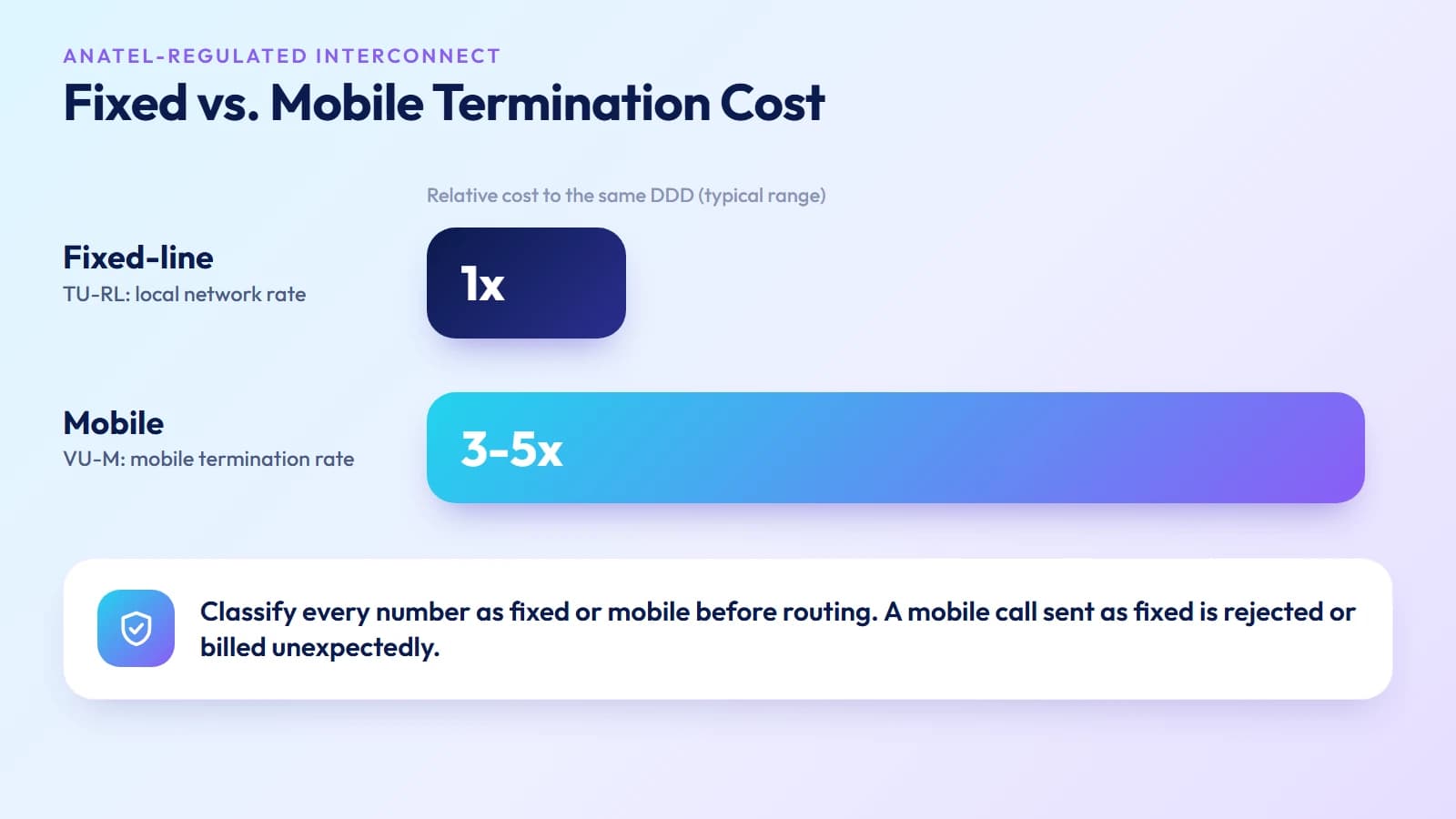
Brazil's interconnect cost structure creates a price gap between fixed-line and mobile termination that is larger than most other major markets.
Fixed-line interconnection uses TU-RL (Taxa de Uso de Rede Local) — the local network access rate regulated by Anatel. These rates are relatively low, making fixed-line termination to Brazil commercially competitive.
Mobile interconnection uses VU-M (Valor de Uso de Rede Móvel) — the mobile termination rate paid to Brazilian mobile operators. Anatel regulates VU-M, but rates are higher than fixed-line equivalents because mobile operators retain regulated interconnect revenue. The practical effect: mobile termination to Brazil typically costs 3–5× more than fixed-line termination to the same DDD.
For contact center operations routing outbound calls to Brazilian mobile subscribers — which account for the majority of Brazilian telecommunications traffic — the mobile-to-fixed price difference directly impacts per-campaign cost. Accurate number classification before routing (fixed vs. mobile) is not optional; misrouting a mobile call as fixed results in rejected calls or unexpected charges.
My Country Mobile's rate explorer at mycountrymobile.com/wholesale-voip-rates/ covers all 67 Brazilian DDDs across both fixed and mobile prefixes, with current pricing for Premium, Standard, and Call Center tiers.
Anatel licensing — what your carrier needs on the last mile
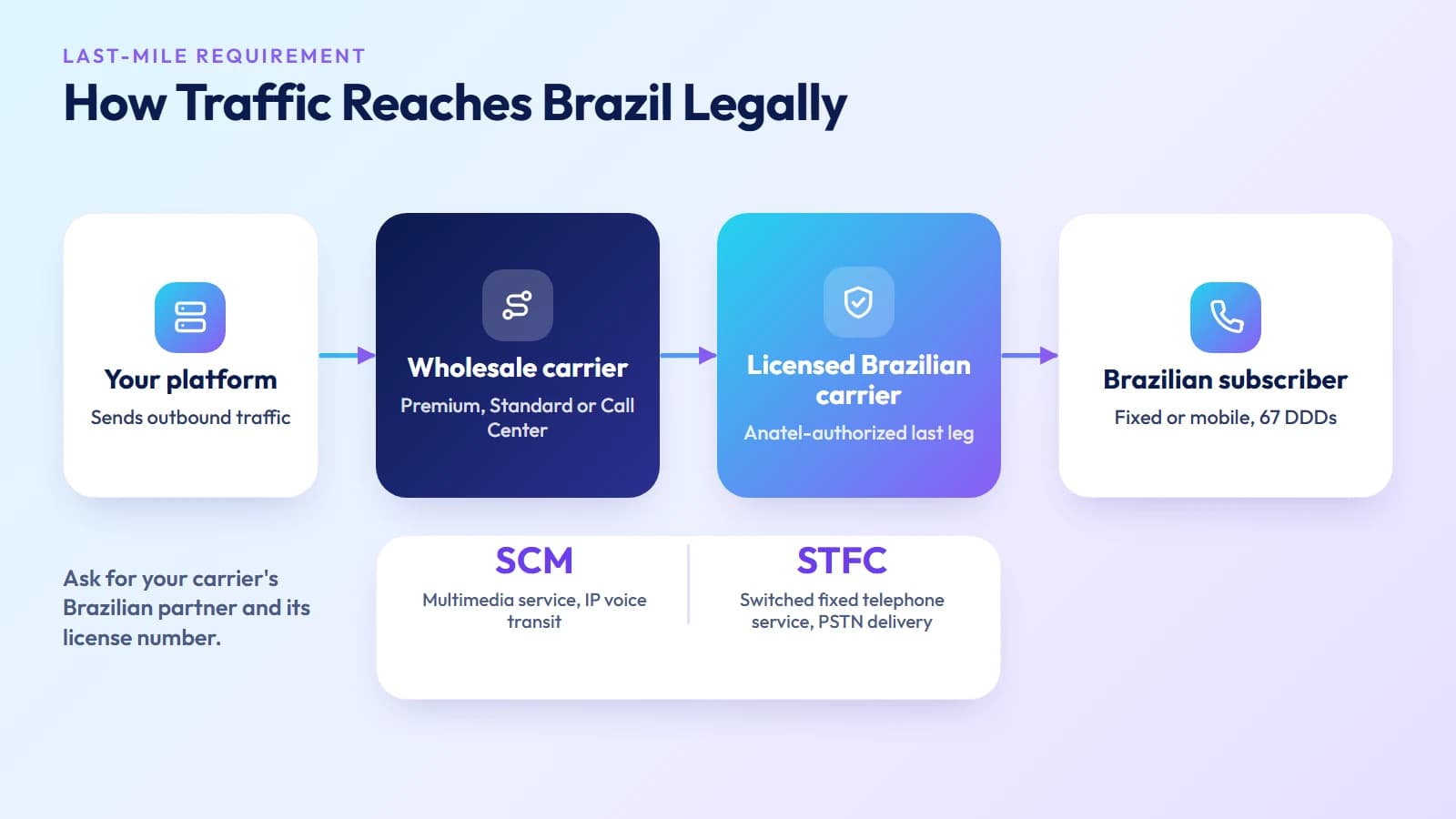
Anatel is Brazil's national telecommunications regulatory agency. It governs both the technology and the commercial terms under which voice traffic can terminate to Brazilian subscribers.
For a foreign wholesale carrier, the relevant point is the last-mile requirement: traffic entering the Brazilian public switched network for delivery to a fixed or mobile subscriber must be handed to an Anatel-licensed local carrier. There are two license categories relevant to VoIP termination:
SCM (Serviço de Comunicação Multimídia) — The multimedia communications service license, applicable to VoIP delivered within a corporate network or a licensed operator's network. This is the minimum license for IP-based voice transit inside Brazil.
STFC (Serviço Telefônico Fixo Comutado) — The switched fixed telephone service license, required for interconnection with the public telephone network and delivery to end subscribers. A carrier terminating VoIP calls to Brazilian fixed-line or mobile subscribers through the PSTN must hold, or partner with a carrier that holds, an STFC authorization.
Practical implication for buyers: When evaluating wholesale carriers for Brazilian termination, ask explicitly whether their Brazilian termination leg is handled through an Anatel-licensed local partner. Carriers routing traffic through unlicensed operators or grey-market SIM farms create both quality and legal exposure. A licensed Brazilian carrier interconnect is also a prerequisite for stable CLI delivery — unlicensed routes frequently strip or mangle CLI on the PSTN hand-off.
Ready when you are
Protect your business line.
MCM's local numbers ship with verified caller ID and smart call filtering — customers always know it's really you, and spam never reaches your team.
CLI delivery on Brazilian routes
CLI (Calling Line Identification) determines whether the called party sees your number, a proxy number, or nothing. On Brazilian routes, CLI delivery is more variable than in Western European markets because the number of interconnect hops between a foreign wholesale carrier and a Brazilian mobile subscriber is typically higher.
Three CLI handling modes matter for Brazil:
Pass-through CLI — Your original calling number is forwarded end-to-end. This requires proper E.164 formatting (country code + DDD + subscriber number) and a carrier chain that supports CLI pass-through without stripping. The most important option for outbound contact centers where caller recognition drives answer rates.
Normalized CLI — The carrier reformats your CLI into a valid local number before delivery. Useful when your originating numbers are not Brazilian and you need a Brazilian number presented at the destination. Requires a local DID or number block assignment.
Provider-assigned CLI — The carrier assigns a rotating CLI from their number inventory. Common on lower-cost routes; CLI changes per call or per session. Lowest answer rates. Avoid for branded outbound campaigns.
For contact center traffic where answer rates matter, Premium routes with pass-through CLI to a Brazilian DID you control are the correct starting point.
FAS fraud — a Brazil-specific risk
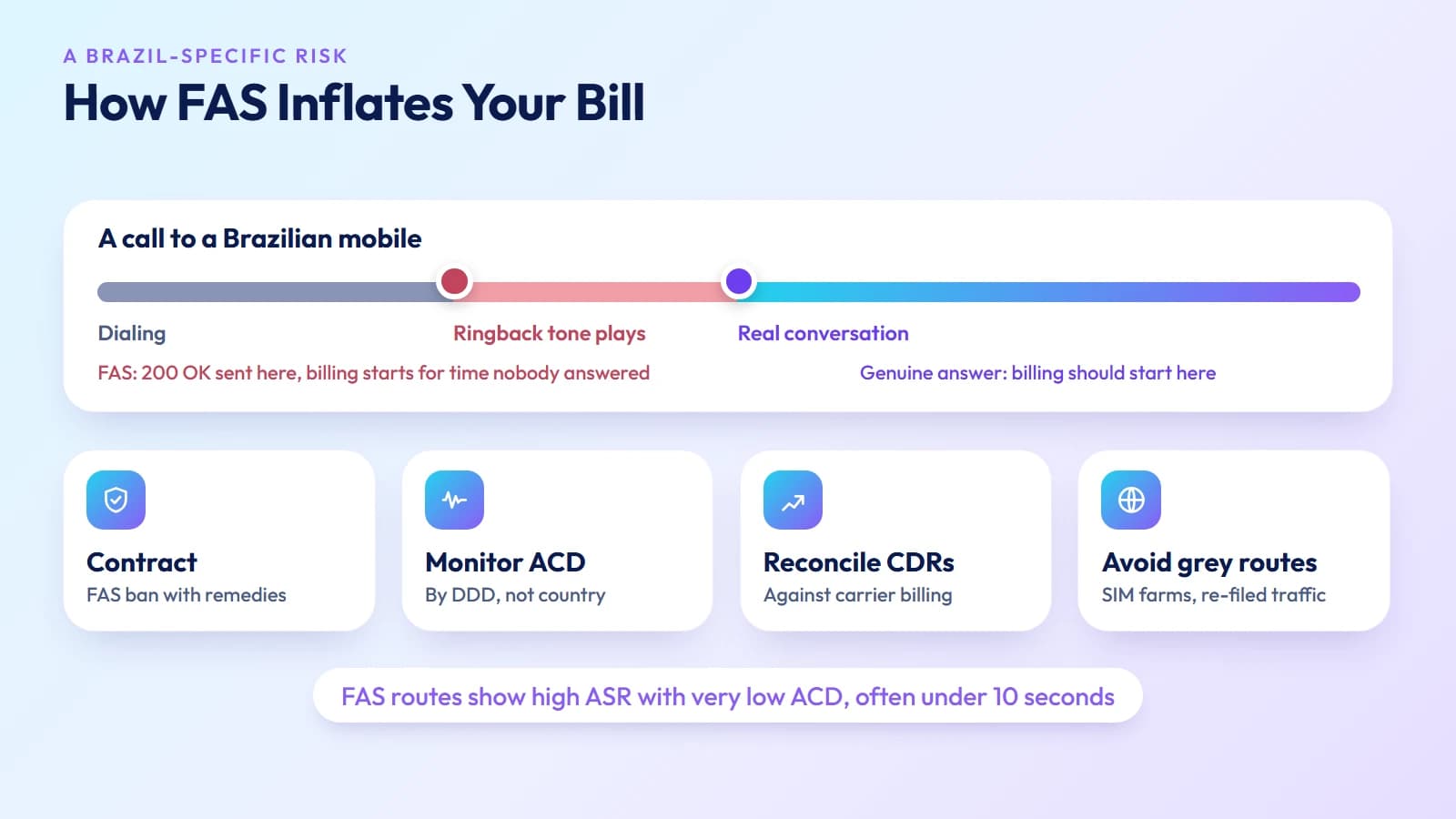
False Answer Supervision (FAS) is when a wholesale carrier's switch reports a call as answered — triggering your billing clock — before the called party actually picks up. The carrier collects the billed seconds; you pay for call time that did not happen.
FAS is documented as a systemic problem on Brazilian grey routes. The mechanism: some low-cost interconnects in Brazil send a SIP 200 OK when the network plays a ringback tone, not when a human answers. Your CDR shows a 45-second call; the actual conversation was zero seconds.
Protecting against FAS on Brazilian traffic:
Contractual FAS protection — Require explicit FAS prohibition in your carrier agreement, with remedies tied to CDR reconciliation. A carrier unwilling to commit contractually is likely running routes where FAS occurs.
ACD monitoring by prefix — FAS routes show high ASR with very low ACD — often under 10 seconds average. Monitoring ACD broken down by DDD rather than by country catches prefix-level FAS before it accumulates significant exposure.
CDR reconciliation — Compare your platform's CDRs against the carrier's billing records. Systematic differences in answered call duration that always favour the carrier's CDR are a FAS signal.
Avoid grey routes — Grey routes to Brazil (unregistered SIM farms, re-filed traffic) have a disproportionately high FAS incidence. The cost difference versus a compliant Premium route rarely offsets the fraud exposure and regulatory risk.
Route tiers for Brazilian traffic
My Country Mobile offers three route tiers for Brazil, matching the MCM global tier structure:
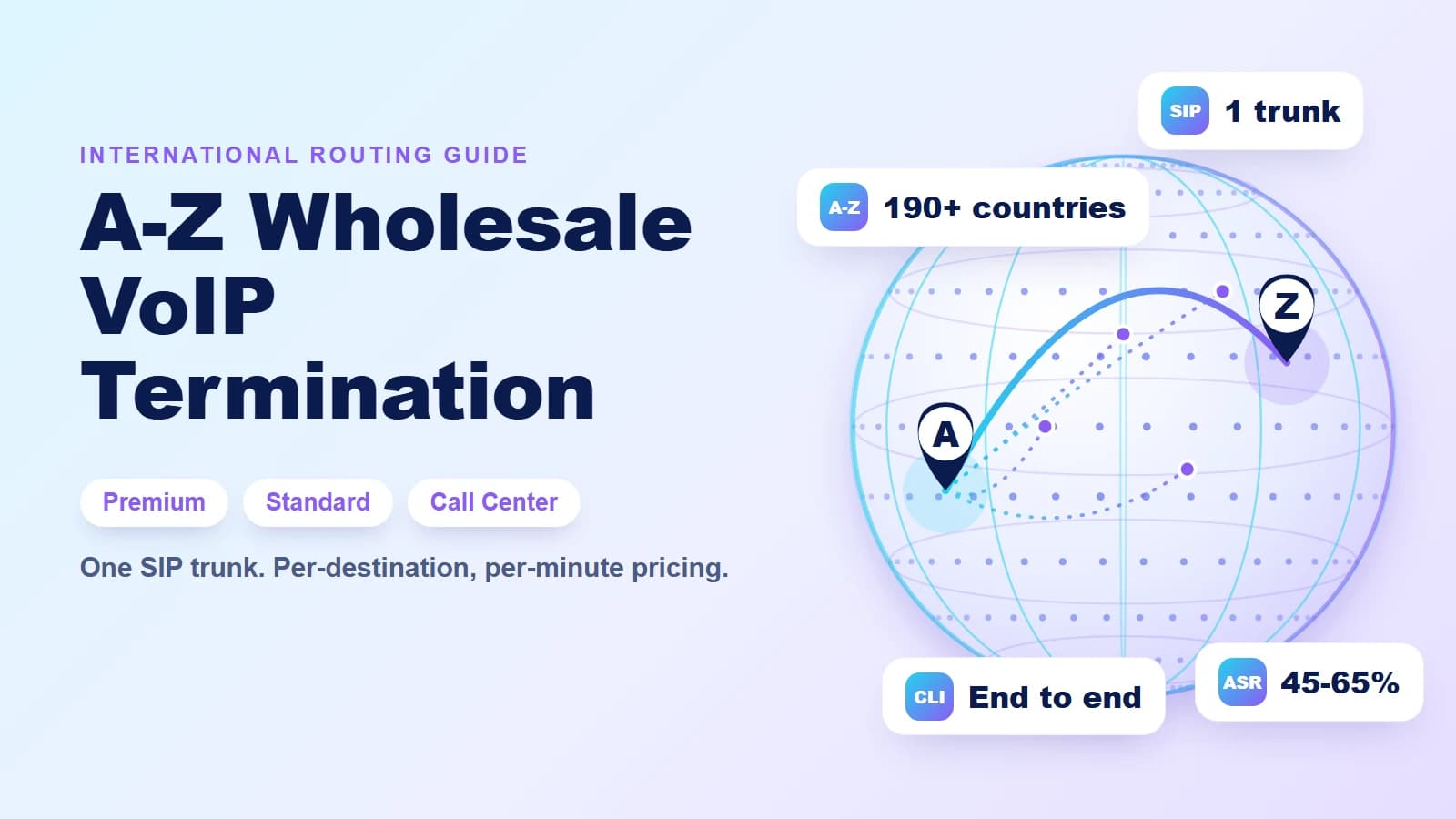
Premium routes use direct Tier-1 interconnects with Anatel-licensed Brazilian carriers. CLI is passed intact, FAS protection is contractually covered, and ASR/ACD targets are held to Premium standards. The right choice for outbound contact center campaigns, customer service lines, and any traffic where call answer rate and audio quality affect business outcomes. Both fixed-line and mobile destinations are covered across all 67 DDDs.
Standard routes blend direct interconnects with LCR-managed paths for cost efficiency. CLI delivery is maintained on most DDDs. Suitable for verification calls, high-volume internal communications, or destinations where volume and cost efficiency outweigh maximum quality headroom.
Call Center routes are structured for operations exceeding one million minutes per month of Brazilian traffic. Volume rebates, dedicated capacity on São Paulo and Rio de Janeiro prefixes, and priority routing during Brazilian business hours are part of the package. If your Brazilian dial volume qualifies, the effective per-minute cost drops substantially.
Explore current rates for all tiers across Brazilian fixed and mobile prefixes at mycountrymobile.com/wholesale-voip-rates/.
Quality benchmarks for Brazilian routes
Brazilian termination quality metrics differ by destination type:
| Destination type | Expected ASR | ACD floor | PDD target |
|---|---|---|---|
| Fixed-line, major cities (SP, RJ, BH) | 60–70% | 90 seconds | < 5 seconds |
| Mobile, major cities (SP, RJ, BH) | 50–65% | 75 seconds | < 6 seconds |
| Fixed-line, regional DDDs | 55–65% | 80 seconds | < 7 seconds |
| Mobile, regional DDDs | 45–58% | 60 seconds | < 8 seconds |
Mobile ASR runs lower than fixed-line not because of network failures but because mobile subscribers have higher rates of unanswered calls. This is normal for Brazilian mobile. Sustained ASR below 40% on mobile or below 50% on fixed-line after controlling for unanswered calls indicates a routing problem.
PDD to regional Brazilian DDDs is typically higher than to São Paulo and Rio because fewer carriers have direct interconnects to smaller markets, adding transit hops. If your traffic is concentrated in a specific DDD, ask prospective carriers for that prefix's direct interconnect coverage specifically.
Billing increment and its effect on Brazilian campaigns
Brazil's mobile termination cost makes billing increment selection more consequential than in low-cost markets. Common billing increments available from wholesale carriers:
- 1/1 — Billed per second from first second. Best for mixed duration traffic including very short calls.
- 6/6 — 6-second minimum, 6-second increments. Standard for most carrier agreements.
- 30/6 — 30-second minimum, then 6-second increments. Common but expensive on Brazilian mobile if average ACD is low.
- 60/60 — Full minute minimum, full minute increments. Worst value for short-ACD mobile traffic.
For Brazilian outbound contact center campaigns where mobile answer rates are lower and short-ACD calls are common, a 6/6 or 1/1 increment meaningfully reduces effective cost compared to 30/6 or 60/60 at the same headline rate. Negotiate increment terms explicitly; the default offered is rarely the most favourable.
Choosing a carrier for Brazilian wholesale VoIP
Evaluate Brazilian termination carriers against these Brazil-specific criteria:
Direct interconnect in São Paulo — Brazil's traffic is concentrated in the state of São Paulo (DDD 11–19). A carrier with a local PoP and direct interconnect in São Paulo delivers lower PDD and better ASR to Brazil's highest-volume market than one routing through Miami or Europe.
Anatel partner verification — Ask for the name and Anatel license number of the carrier's Brazilian termination partner. Verifiable licensed carriers are not a guarantee of quality, but unverifiable ones are a red flag.
Separate fixed and mobile rate decks — Any carrier quoting a single blended rate for "Brazil" without distinguishing fixed from mobile is either hiding the mobile surcharge or not covering mobile directly. Insist on prefix-level rate decks.
FAS protection in writing — As noted, FAS is a specific Brazilian route risk. A carrier that cannot put FAS protection in the contract is not the right carrier for Brazilian traffic.
Portuguese-language NOC support — Not essential, but useful for resolving Brazil-specific issues quickly. A carrier with local operations or a Brazilian NOC team can diagnose prefix-level outages faster than one routing all tickets through a global helpdesk.
My Country Mobile covers all 67 Brazilian DDDs across fixed-line and mobile, with Premium, Standard, and Call Center tiers, direct interconnects into São Paulo and Rio de Janeiro, and Anatel-licensed Brazilian termination partners. For a rate deck and technical configuration guide for your traffic profile, start at mycountrymobile.com/wholesale-voip-rates/.
For the wider picture, read our guides to A-Z wholesale VoIP termination and the best wholesale VoIP providers.
Ready when you are
Ready to sound local everywhere you sell?
MCM activates business numbers in minutes, with call routing, analytics, and CRM-ready integrations. Start your trial — no card to browse inventory.
Frequently asked questions
What country code and area code format does Brazil use?
Brazil uses country code +55 followed by a two-digit DDD (area code) and the subscriber number. Mobile numbers are 9 digits; fixed-line numbers are 8 digits. A formatted mobile number in São Paulo looks like +55 11 9 XXXX-XXXX.
Why is mobile termination to Brazil more expensive than fixed-line?
Brazilian mobile operators charge interconnect fees (VU-M) regulated by Anatel that are significantly higher than fixed-line interconnect rates. Mobile termination to Brazil typically costs 3–5× more than fixed-line in the same DDD.
Do I need an Anatel license to terminate calls to Brazil?
Foreign carriers generally do not need their own Anatel license if they partner with a licensed Brazilian carrier for the final leg. The Brazilian termination partner needs an SCM or STFC license. Verify your carrier's licensing status.
What CLI format does Brazil require?
E.164 format: +55 + two-digit DDD + full subscriber number (9 digits for mobile, 8 for fixed-line). Missing the 9th digit on mobile numbers causes rejection.
What is FAS fraud and how common is it on Brazilian routes?
FAS (False Answer Supervision) occurs when a carrier bills for call time before the called party answers. It is a documented problem on Brazilian grey routes. Require contractual FAS protection and monitor ACD by DDD prefix to detect it early.
What ASR should I expect on Brazilian Premium routes?
Mobile CLI routes to major cities: 50–65% ASR. Fixed-line CLI routes to major cities: 60–70% ASR. Sub-40% sustained ASR warrants carrier investigation.