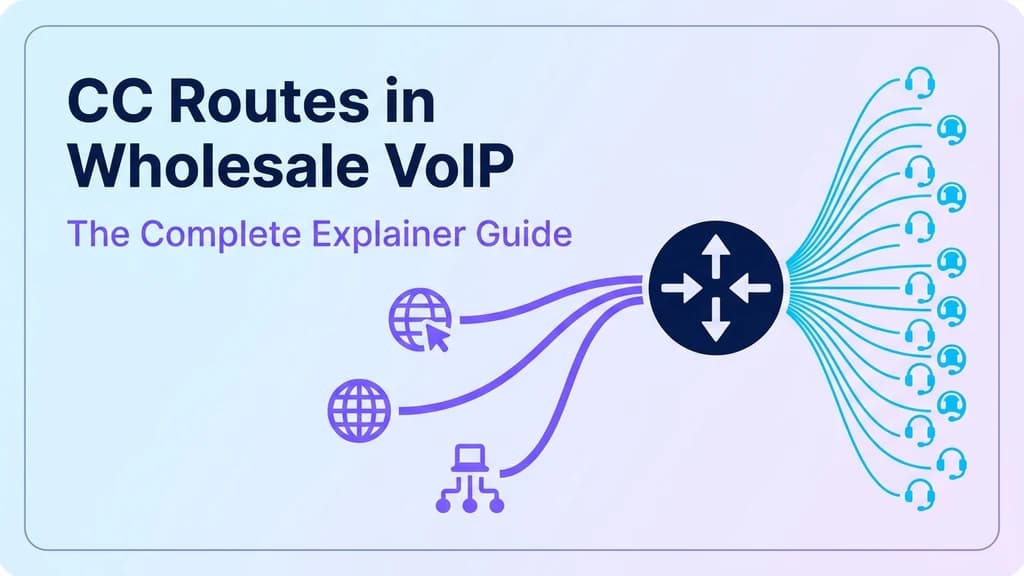
CC routes are a specific class of wholesale voice route built for high-volume outbound calling — predictive dialers, telemarketing, and contact-center campaign traffic — rather than the low-volume, high-quality routes a retail business phone system uses. The distinction matters because pricing a call-center campaign against a standard route class produces numbers that look great on paper and fall apart the moment real dialer volume hits the line.
This guide covers what actually defines a CC route, how it differs from standard and premium route classes, where CLI and Non-CLI fit inside CC routing specifically, and what to actually check before committing campaign volume to one.
What actually makes a route "CC"
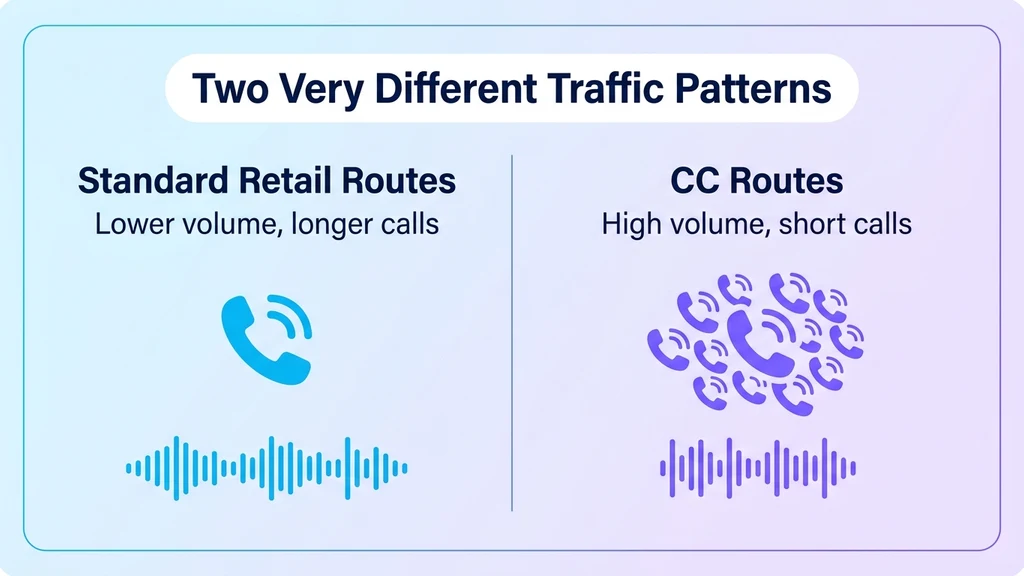
"CC" stands for call center, and a CC route is engineered around the traffic pattern a predictive dialer actually produces: extremely high call volume, short average call duration, and a tolerance for a lower ASR than a business would ever accept on customer-facing calls. Carriers price and provision CC routes differently from standard routes specifically because that traffic pattern behaves differently on the underlying network.
A standard retail route is optimized for the traffic pattern of a normal business line — moderate volume, longer average call duration, and an ASR that needs to stay high because every failed call is a real customer interaction lost. A CC route trades some of that quality ceiling for cost and volume capacity, which is the right trade for a campaign dialing thousands of numbers an hour, and the wrong trade for a support line.
CLI and Non-CLI within CC routing
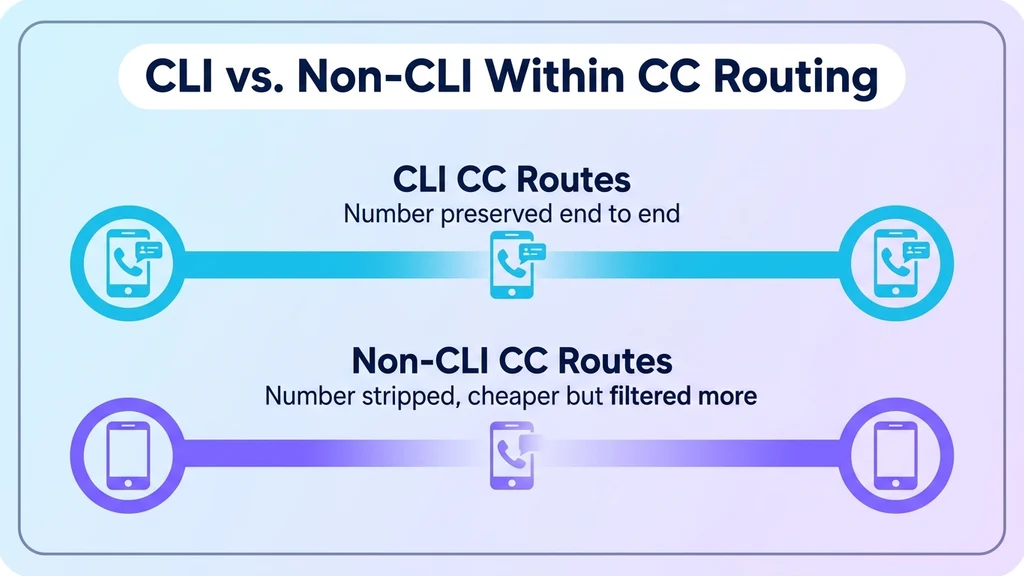
Both CLI and Non-CLI variants exist within CC route classes, and the choice matters more here than almost anywhere else in wholesale voice. CLI CC routes preserve the caller's real number, which matters for compliance in markets that require it and for campaigns that want callbacks to reach a real line. Non-CLI CC routes are cheaper and higher-volume but strip the outbound number, which increasingly triggers carrier-side spam filtering — a real cost even though it doesn't show up on the rate sheet, since a route that gets silently filtered isn't actually delivering the volume it's priced for.
The metrics that matter differently for CC traffic
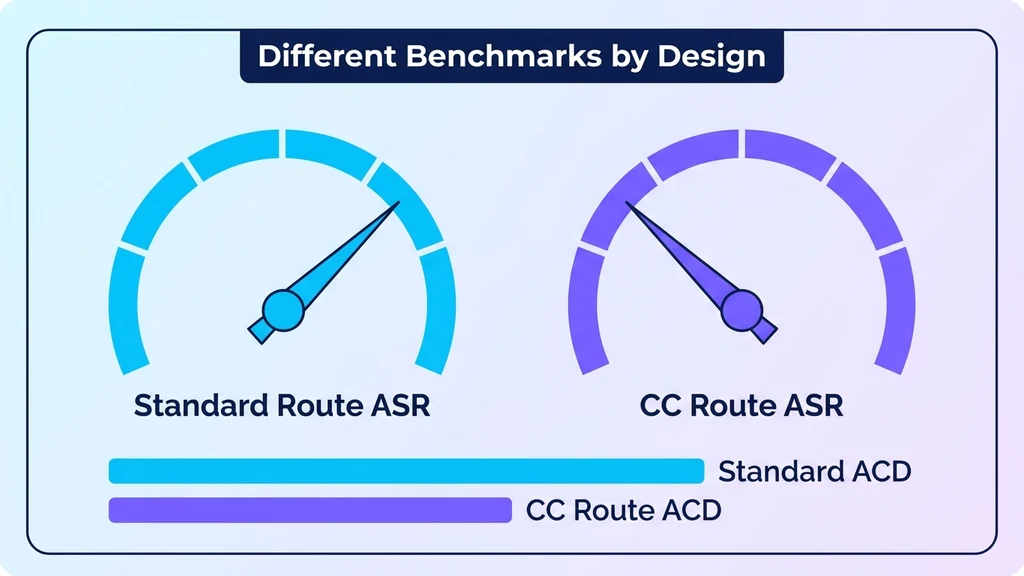
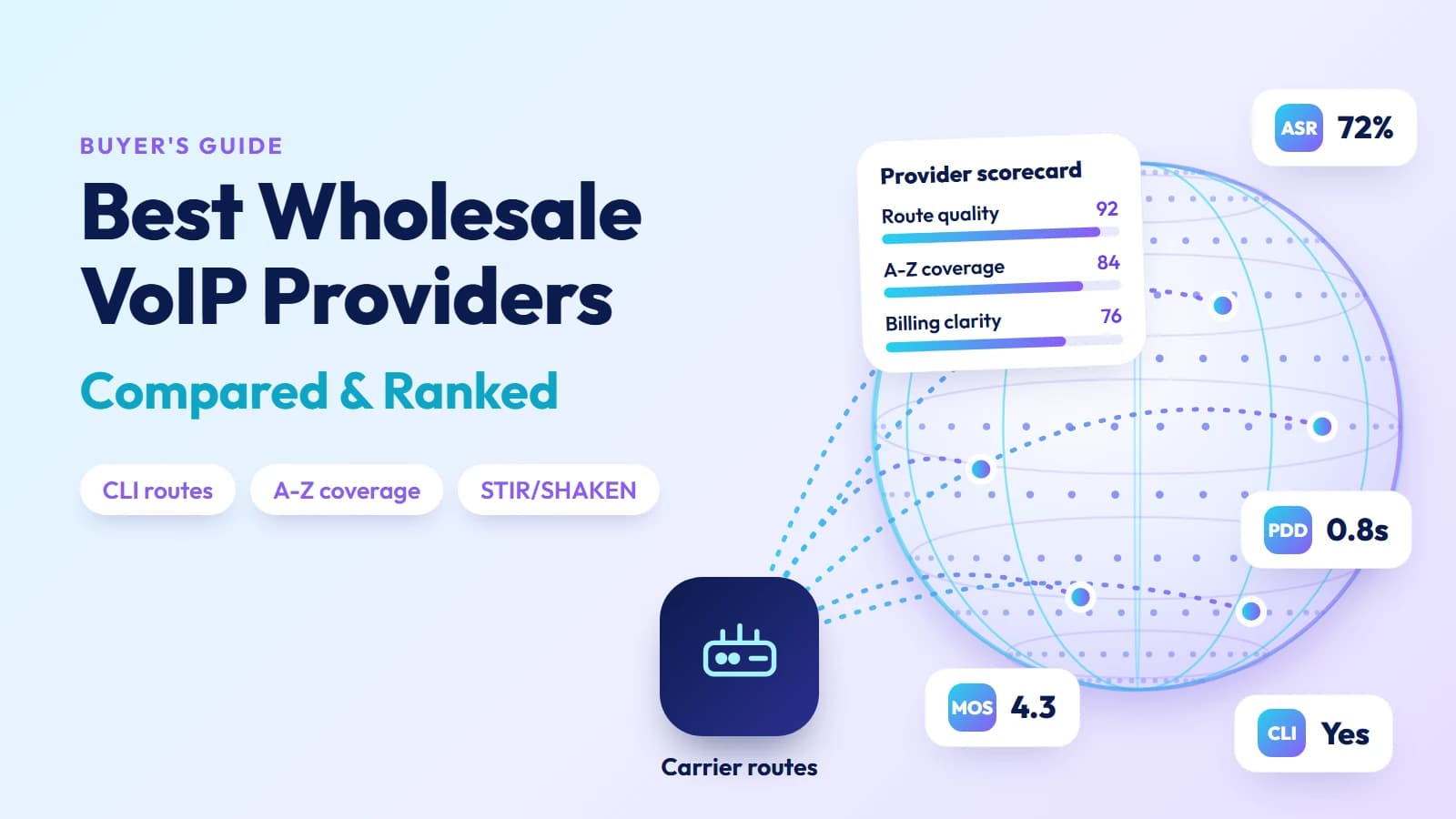
The same ASR, ACD, and PDD metrics that grade any wholesale route apply to CC routes, but the healthy ranges shift:
ASR on CC routes typically runs meaningfully lower than a standard route on the same destination, simply because predictive dialer traffic includes a higher share of calls that were never going to be answered by design — that's expected, not a red flag, as long as it's stable.
ACD on CC routes runs short by nature, often 30-90 seconds, since campaign calls are typically brief compared to a genuine support or sales conversation. An ACD that drops far below that floor, though, is the same false-answer-supervision warning sign it would be on any other route class — the carrier's network is marking calls connected before a person actually picked up.
PDD matters more on CC routes than almost any other metric, since predictive dialers use PDD data to calculate how many lines to dial ahead of agent availability — a route with inconsistent PDD throws off that math and either wastes agent capacity or increases abandoned-call rates.
Ready when you are
Protect your business line.
MCM's local numbers ship with verified caller ID and smart call filtering — customers always know it's really you, and spam never reaches your team.
Compliance considerations specific to CC traffic
CC routes carry regulatory weight that standard routes generally don't, because predictive dialer traffic is exactly what regulations like the US TCPA and FCC robocall rules are built to police. STIR/SHAKEN attestation matters even more here — CC traffic that can't attest cleanly gets flagged and filtered far faster than lower-volume standard traffic, since carrier spam-detection systems weight volume heavily. The FCC's robocall rules are the authoritative source on the compliance requirements that apply specifically to high-volume outbound dialing traffic like CC routes carry.
What to actually check before committing volume to a CC route
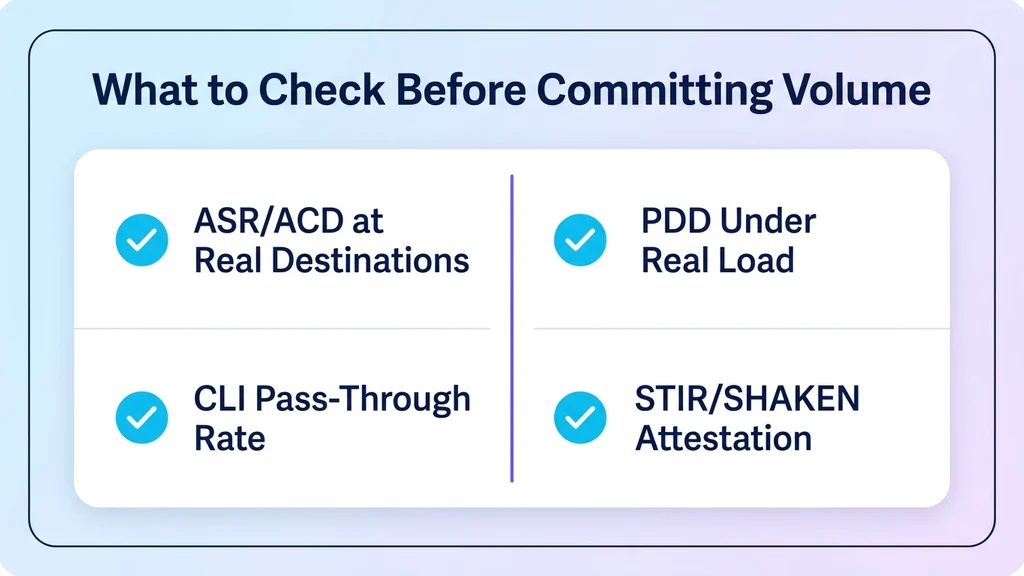
Run every CC route quote through the same checklist a standard route gets, with CC-specific weighting:
- ASR and ACD on the actual destinations the campaign will dial — not a blended national average, since CC traffic concentrates heavily on specific area codes and destinations.
- CLI vs. Non-CLI pricing and pass-through rate — confirm the carrier can show what percentage of CLI actually survives to the destination network, not just that CLI is technically supported.
- PDD consistency under real dialer load, not just PDD on a handful of test calls — CC route quality often degrades specifically under the burst-dialing pattern a predictive dialer produces.
- STIR/SHAKEN attestation level the carrier applies to CC traffic specifically, since some carriers apply a lower attestation tier to high-volume routes by default.
The same evaluation framework applies whether the traffic is running through a dedicated wholesale trunk or a broader UCaaS (Unified Communications as a Service) platform — a single cloud system for calling, messaging, and video — that happens to include an outbound campaign dialer, the same compliance layer covered from the SIP trunk side in our wholesale SIP termination guide. My Country Mobile provisions CC routes with per-destination quality reporting so this evaluation runs on real numbers. Contact us to test a CC route against actual campaign traffic before committing volume.
Conclusion
A CC route is a genuinely different product from a standard wholesale voice route, engineered for the volume and duration pattern a predictive dialer produces rather than the pattern of a normal business line. Evaluating one on standard-route benchmarks — expecting retail-line ASR, treating short ACD as a red flag — misreads what the route is actually built for. The real evaluation is ASR and ACD at the specific destinations a campaign will dial, PDD consistency under real burst load, and confirming the carrier's CLI pass-through and STIR/SHAKEN attestation hold up at volume.
Key takeaways
- A CC route is engineered for high-volume, short-duration predictive dialer traffic — a fundamentally different product from a standard retail route.
- Lower ASR and shorter ACD are expected on CC routes, not automatically red flags the way they would be on a standard route.
- CLI and Non-CLI variants both exist within CC routing, and Non-CLI increasingly triggers carrier spam filtering despite the lower rate.
- PDD consistency under real burst load matters more for CC routes than almost any other metric, since predictive dialers calculate pacing from it.
- STIR/SHAKEN attestation matters more on CC traffic, since high volume gets filtered faster by carrier spam detection.
Ready when you are
Ready to sound local everywhere you sell?
MCM activates business numbers in minutes, with call routing, analytics, and CRM-ready integrations. Start your trial — no card to browse inventory.
FAQ
What does "CC" mean in a wholesale VoIP route?
CC stands for call center. A CC route is a wholesale voice route class specifically engineered for high-volume, short-duration outbound traffic like predictive dialer and telemarketing campaigns.
Why is ASR lower on CC routes than standard routes?
Predictive dialer traffic inherently includes more unanswered calls by design, since dialers call ahead of agent availability. A stable, lower ASR is expected on CC routes and isn't automatically a quality problem the way it would be on a standard route.
Should a CC route use CLI or Non-CLI?
It depends on compliance requirements and campaign goals. CLI preserves the real caller number for compliance and callback purposes; Non-CLI is cheaper but increasingly gets filtered by carrier spam detection, which can silently reduce effective delivered volume.
Why does PDD matter so much specifically for CC routes?
Predictive dialers use PDD data to calculate how many lines to dial ahead of agent availability. Inconsistent PDD throws off that pacing calculation, either wasting agent capacity or increasing abandoned-call rates.
Are CC routes subject to different compliance rules than standard routes?
The underlying regulations (like TCPA and FCC robocall rules) apply to the calling activity, not the route class itself, but CC routes carry that traffic by nature, making STIR/SHAKEN attestation and compliant CLI handling more operationally important than on lower-volume standard routes.
How do I test a CC route before committing full campaign volume?
Run a small percentage of real campaign traffic through the route for one to two weeks and measure ASR, ACD, and PDD against what was quoted, the same evaluation approach used for any wholesale route class.