Global wholesale voice traffic crossed 700 billion minutes in 2025, and less than 10% of it rode genuine tier-1 routes end-to-end. The rest got squeezed through gray paths, transcoded twice, and arrived at the destination with false answer supervision or excessive post-dial delay. Choosing the wrong wholesale VoIP provider quietly costs you in failed calls, spoofed CLI, and margin you can't recover. This guide breaks down what separates the strong providers from the rest — and which to shortlist for your traffic profile.
Key takeaways
- Wholesale VoIP providers sell voice termination and origination in bulk at per-minute rates — the carrier capacity that powers resellers, call centers, and CPaaS platforms.
- The four factors that matter most are route quality (ASR/ACD/PDD), A-Z coverage, transparent billing, and network reliability — in that order.
- Watch for FAS (False Answer Supervision) — some providers bill for calls the destination never answered. CLI-certified routes and audit-ready CDRs are the safeguards.
- Cheapest is rarely best. Ultra-low rates usually mean gray routes, poor answer-seizure ratios, and CLI that doesn't pass — which costs more in failed calls than it saves per minute.
- US rates run $0.001–$0.004/min on tier-1 routes; Western Europe $0.005–$0.025; harder destinations can exceed $0.30.
- STIR/SHAKEN attestation is now a hard filter for US traffic, not a bonus feature.
What Is a Wholesale VoIP Provider?
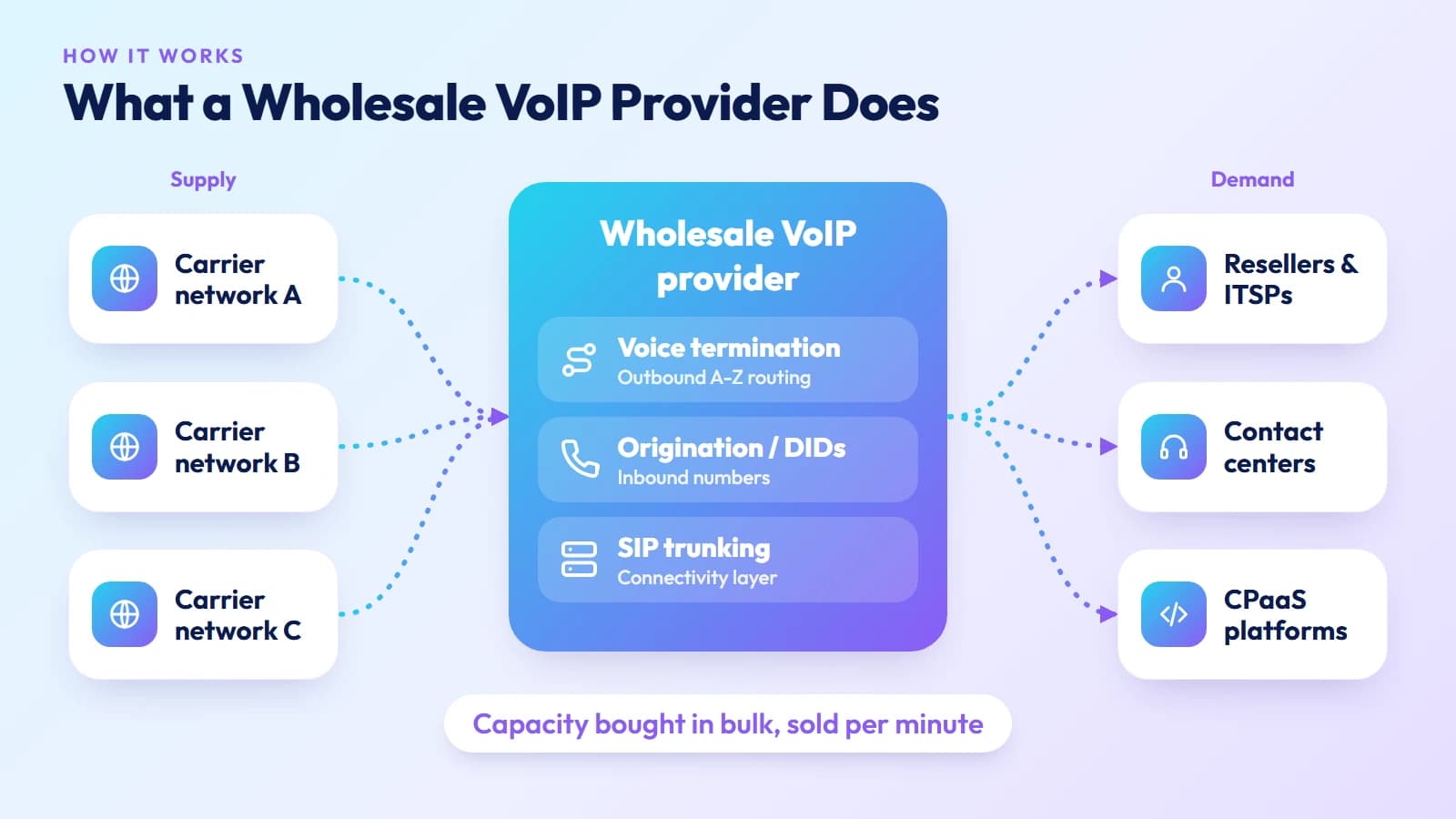
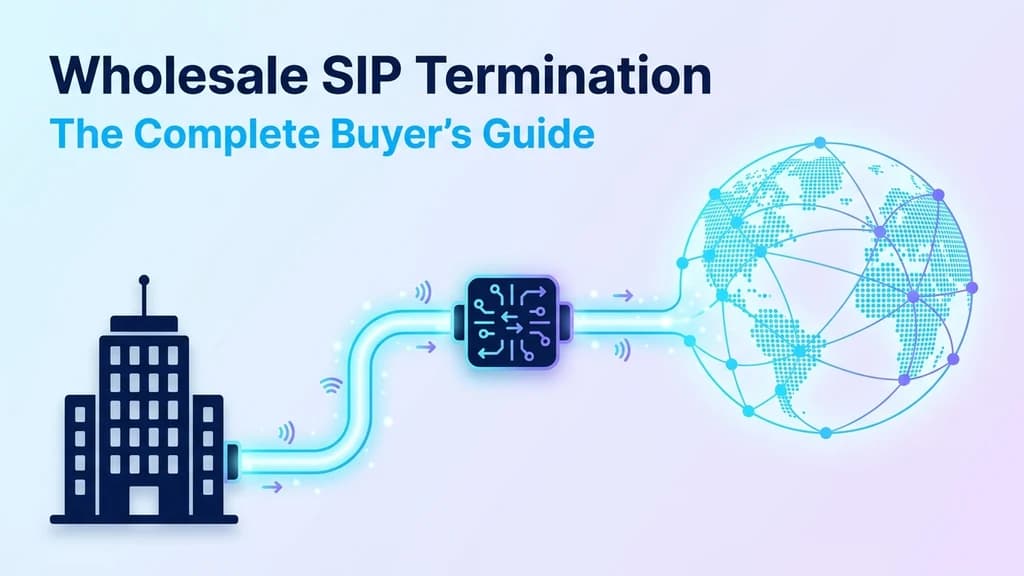
A wholesale VoIP provider delivers voice connectivity in bulk — buying and aggregating capacity across carrier networks and reselling it as termination (outbound) and origination (inbound) at per-minute wholesale rates. Instead of serving one business's phones, a wholesale provider supplies the underlying minutes to the companies that do: VoIP resellers, ITSPs, contact centers, calling-card operators, and platform companies that need to route large call volumes cost-effectively and reliably.
The core products a wholesale VoIP provider offers are:
- Voice termination — routing outbound calls to their destination networks worldwide, also called A-Z termination.
- Voice origination / DIDs — inbound numbers and the ability to receive calls in local markets.
- Wholesale SIP trunking — the SIP connectivity that carries that traffic between a platform and the provider's network.
How Wholesale VoIP Works: Routes, CLI, and Quality Metrics
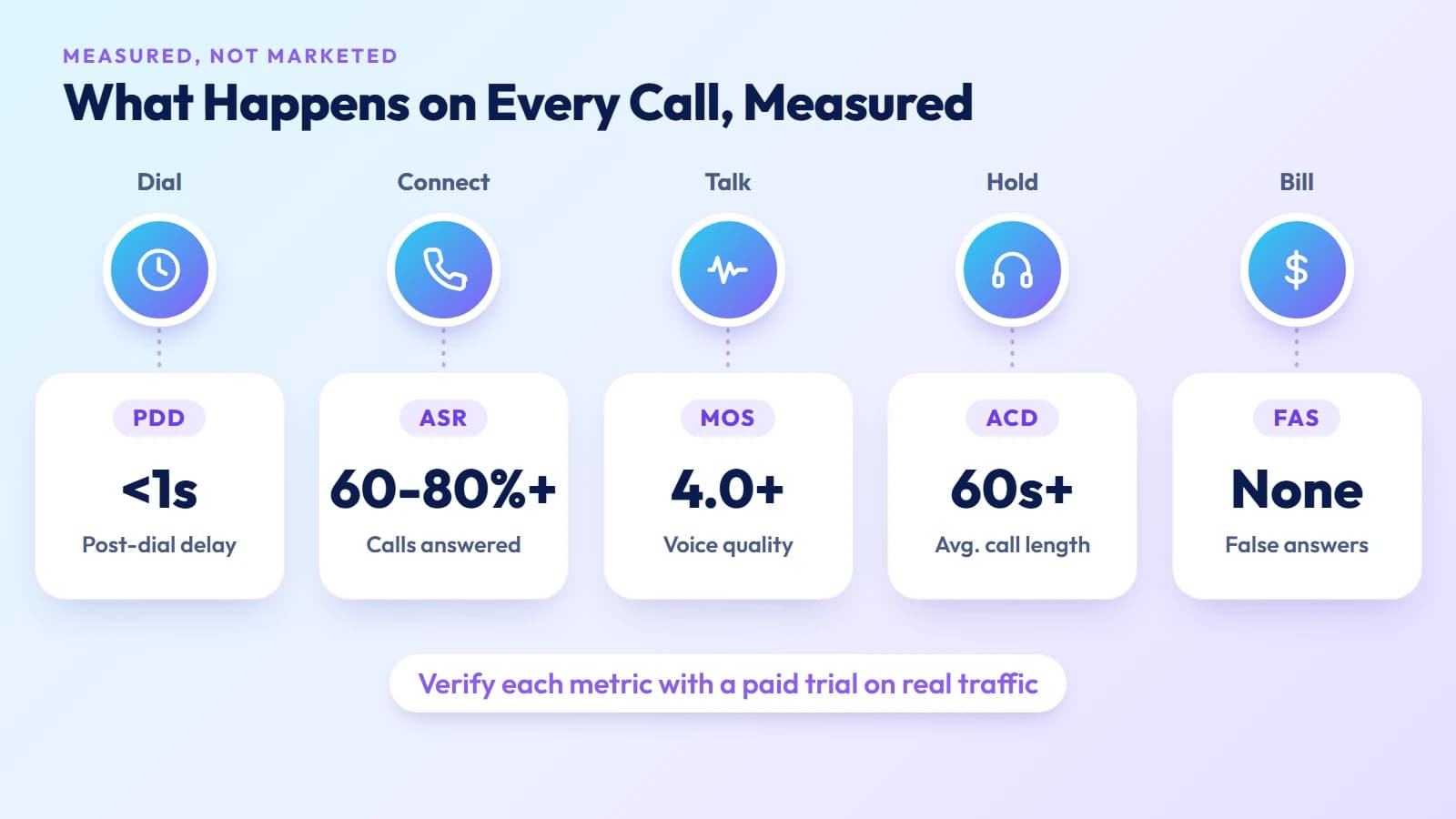
The single most important concept in comparing wholesale VoIP providers is the route. A route is the path a call takes to its destination, and its quality is measured, not marketed:
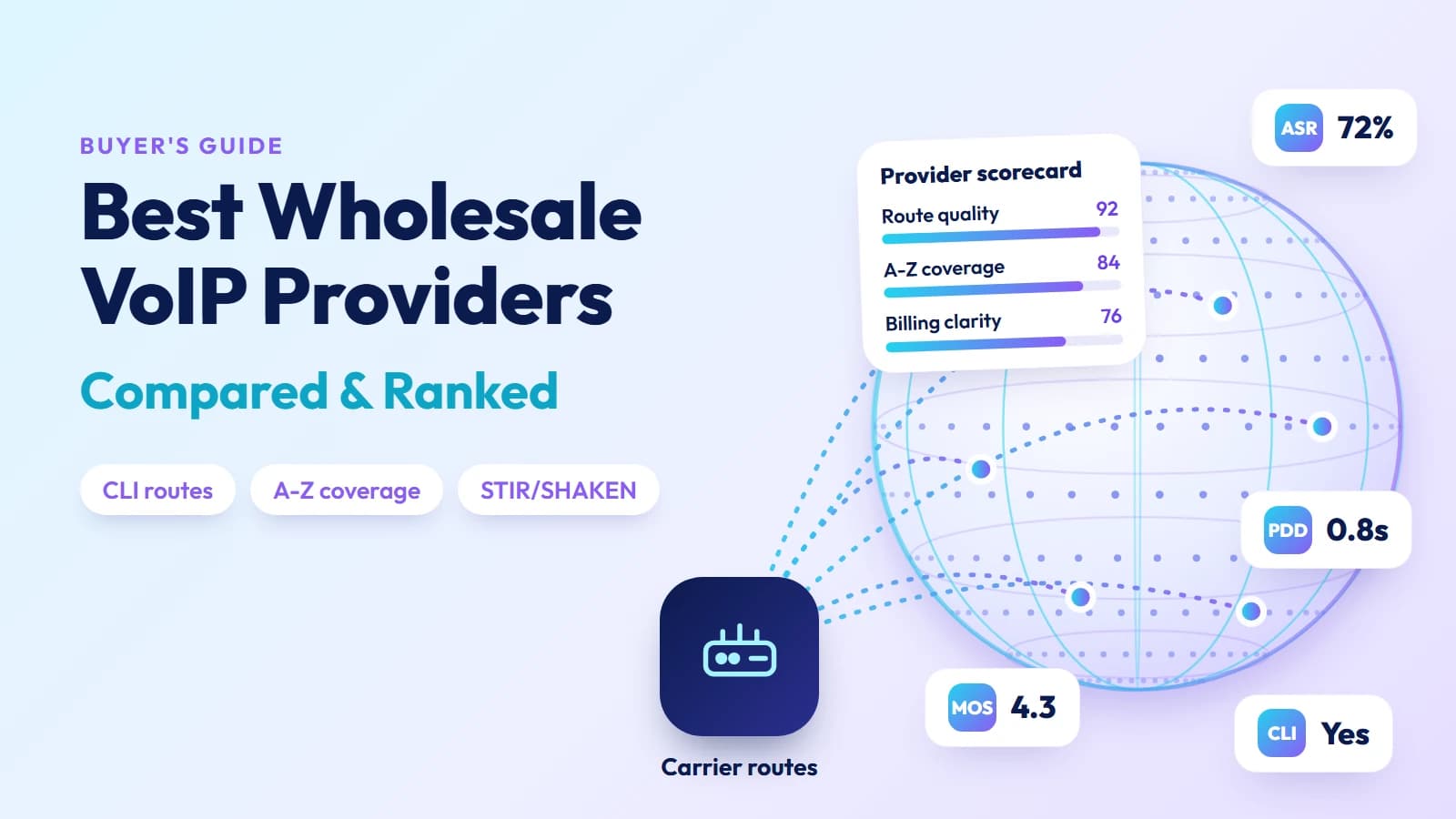
- ASR (Answer-Seizure Ratio) — the percentage of calls that actually connect. Tier-1 routes hold 60–80%+ on major destinations; gray routes can fall below 30%.
- ACD (Average Call Duration) — longer averages signal cleaner audio and real conversations. Sub-60-second ACD on long-haul routes is a warning sign.
- PDD (Post-Dial Delay) — the pause before ringing starts. Over 3 seconds kills answer rates; direct routes typically deliver under 1 second.
- MOS (Mean Opinion Score) — a 1–5 voice quality score; 4.0+ is the tier-1 benchmark.
- FAS (False Answer Supervision) — where a provider bills for calls the destination never answered. This is how per-minute savings disappear. Demand clean CDRs and FAS-free billing commitments in writing.
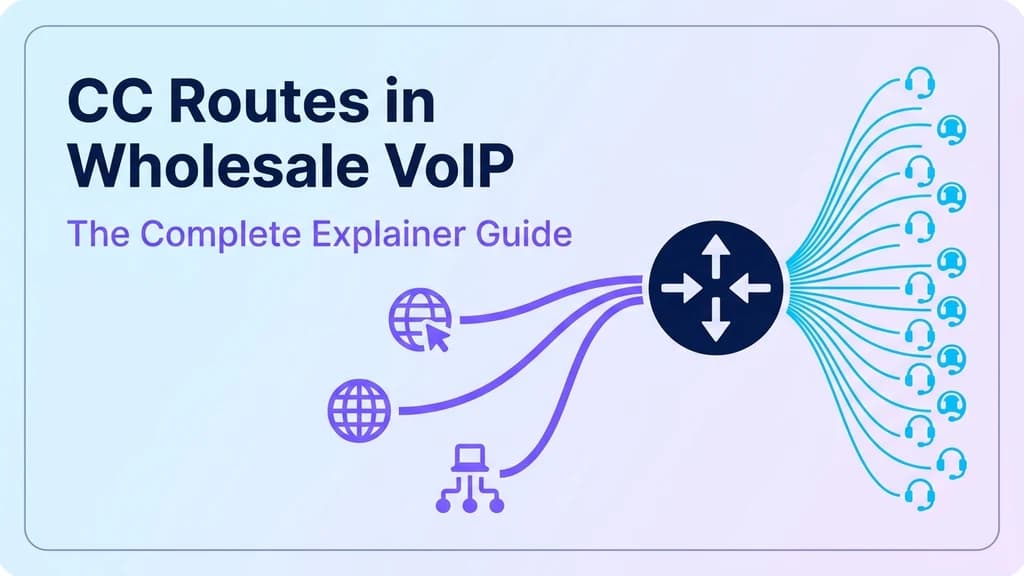
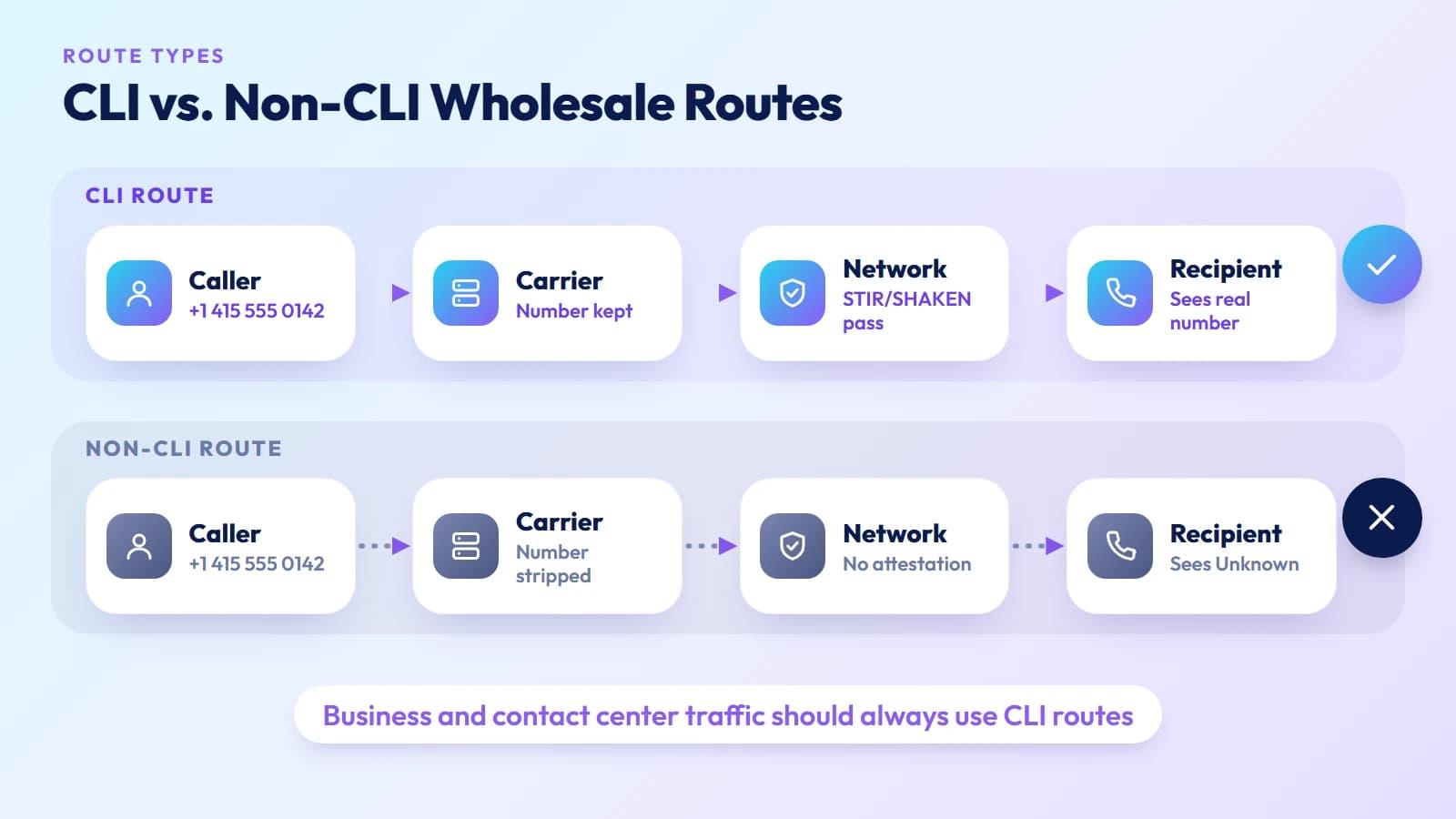
CLI vs. non-CLI routes matters just as much. CLI (Caller Line Identification) routes preserve the caller's number end-to-end — essential for business calls, callbacks, and trust. Non-CLI (often called CC routes) are cheaper but strip or mask the number, which tanks answer rates and increasingly fails carrier filtering under STIR/SHAKEN enforcement. The best wholesale VoIP providers are transparent about which routes are CLI, and at what quality tier.
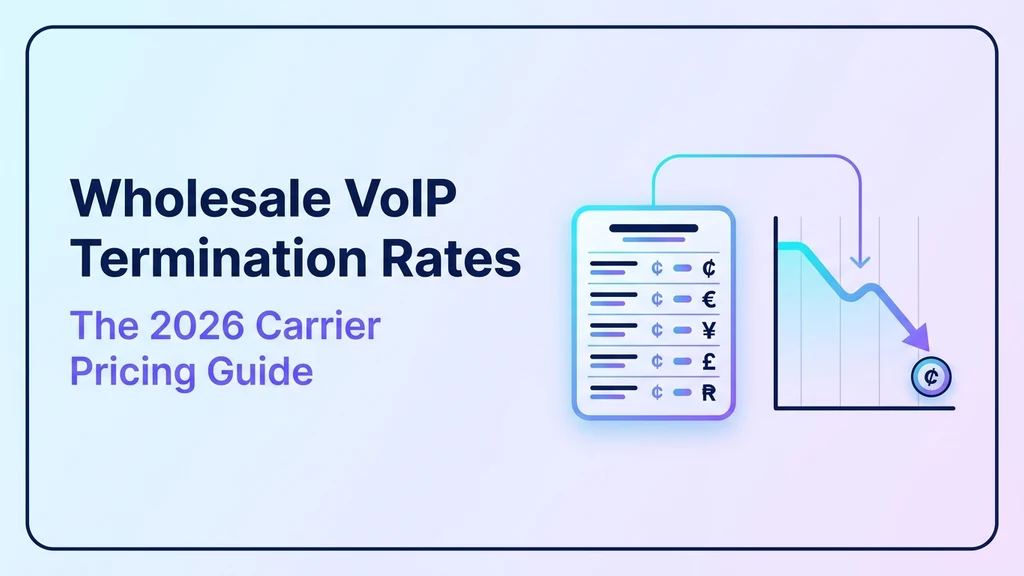
Current Rate Reference: US domestic tier-1 termination runs $0.001–$0.004/min. Western Europe is $0.005–$0.025/min. Emerging markets (parts of Africa, Pacific Islands, MENA) can exceed $0.30/min. Always compare billing increments alongside the raw rate — 1/1 (per-second) billing beats 60/60 rounding significantly at volume.
Ready when you are
Protect your business line.
MCM's local numbers ship with verified caller ID and smart call filtering — customers always know it's really you, and spam never reaches your team.
The Best Wholesale VoIP Providers
Every provider in this list is evaluated on the same criteria: route quality, A-Z coverage, CLI certification, pricing transparency, compliance posture, and operational support.
My Country Mobile — Best: Mid-Market Global Wholesale
Global A-Z termination across 190+ countries with CLI routes, transparent wholesale pricing, 99.99% uptime SLA, built-in STIR/SHAKEN, and active fraud monitoring. Trusted by 17,500+ businesses. Accessible pricing and fast provisioning make it the go-to for resellers, ITSPs, and contact centers that need global coverage without enterprise-tier commitment complexity.
Strengths:
- 190+ country A-Z with CLI routes
- Transparent wholesale rate deck
- STIR/SHAKEN + fraud controls built in
- 24/7 support, fast onboarding
- Pay-as-you-go, no large minimums
Limitations:
- Network footprint smaller than Tier-1 giants
- Limited quality tier granularity vs. IDT Express
IDT Express — Best: High-Volume A-Z International
NYSE-listed carrier with 160+ country A-Z coverage, 1,000+ CLI-certified routes across Platinum/Gold/Instant quality tiers, and 550+ direct carrier interconnects. Powers several other platforms listed here at the wholesale layer. Self-serve portal with real-time analytics. Minimum $100 top-up, $25 trial credit.
Strengths:
- 1,000+ CLI-certified routes, 3 quality tiers
- Native BYOC for Twilio, MS Teams, Genesys
- 550+ direct carrier interconnects
- A2P SMS + DID numbers under one account
Limitations:
- Best rates require volume forecast call
- Less developer-friendly than Telnyx/Twilio
- Not suited for under 1,000 min/month
Telnyx — Best: Developer-First Owned Backbone
Owns its own private global IP backbone rather than reselling, which keeps PDD low and gives engineering teams direct routing control. Excellent REST API, developer documentation, and self-serve portal. Strong STIR/SHAKEN implementation. Good US/Canada coverage; international reach growing but thinner than IDT in MENA and rural LATAM.
Strengths:
- Owned IP backbone — not a reseller
- Transparent rate sheet, no minimums
- Best-in-class API + developer docs
Limitations:
- MENA/APAC/LATAM coverage thinner
- Account approval slow for new resellers
Bandwidth — Best: US Tier-1 Domestic Reliability
An actual Tier-1 US carrier that owns the last mile for domestic traffic. Powers Twilio, Zoom Phone, and Microsoft Teams at the wholesale layer. Excellent HIPAA, STIR/SHAKEN, and E911 compliance. International coverage is via partners rather than direct. Enterprise pricing and onboarding — not self-service. Right choice for US-centric SaaS and enterprise voice; wrong choice for global A-Z.
Strengths:
- Tier-1 US carrier — owns last mile
- HIPAA + STIR/SHAKEN + E911 depth
- Powers major UCaaS platforms
Limitations:
- US-focused; international via partners only
- Enterprise commitment model, no self-serve
Twilio Elastic SIP Trunking — Best: Startups & Developer Entry Point
Best developer experience in the market — SDKs, documentation, integrations — with transparent public pricing and no minimum spend. Covers 100+ countries but resells capacity from carriers including Bandwidth and IDT Express, so you pay a retail markup. At 50,000+ minutes/month the per-minute premium becomes material; consider pairing with BYOC at scale.
Strengths:
- Best developer experience + SDK depth
- No minimums; $15 trial credit
- One API across voice, SMS, email
Limitations:
- Retail markup — resells wholesale capacity
- No quality-tier selection
- Cost penalty is significant at scale
Sinch — Best: Enterprise Voice + A2P SMS Bundle
One of the largest messaging companies globally after multiple acquisitions, with tier-1 carrier-grade voice and strong A2P SMS coverage at enterprise scale. Best evaluated when combining global messaging (A2P, RCS) with voice under one contract. Sales-led motion with long onboarding cycles and non-transparent pricing; requires procurement muscle.
Wholesale VoIP Provider Comparison
| Provider | Best For | Coverage | Pricing Model | CLI Routes | STIR/SHAKEN |
|---|---|---|---|---|---|
| My Country Mobile | Mid-market global wholesale | 190+ countries | Pay-as-you-go | Yes | Yes |
| IDT Express | High-volume A-Z international | 160+ countries | Volume rate deck | Yes, Platinum/Gold tiers | Yes |
| Telnyx | Developer-first / owned backbone | Global (owned IP) | Self-serve, transparent | Yes | Yes |
| Bandwidth | US Tier-1 enterprise | US-focused | Enterprise commit | Yes, US domestic | Yes |
| Twilio SIP | Developers / startups | 100+ countries (resold) | API metered, no minimum | Varies by destination | Yes |
| Sinch | Enterprise voice + A2P SMS | Global tier-1 | Volume commits, negotiated | Yes | Yes |
What to Look for When Comparing Wholesale VoIP Providers
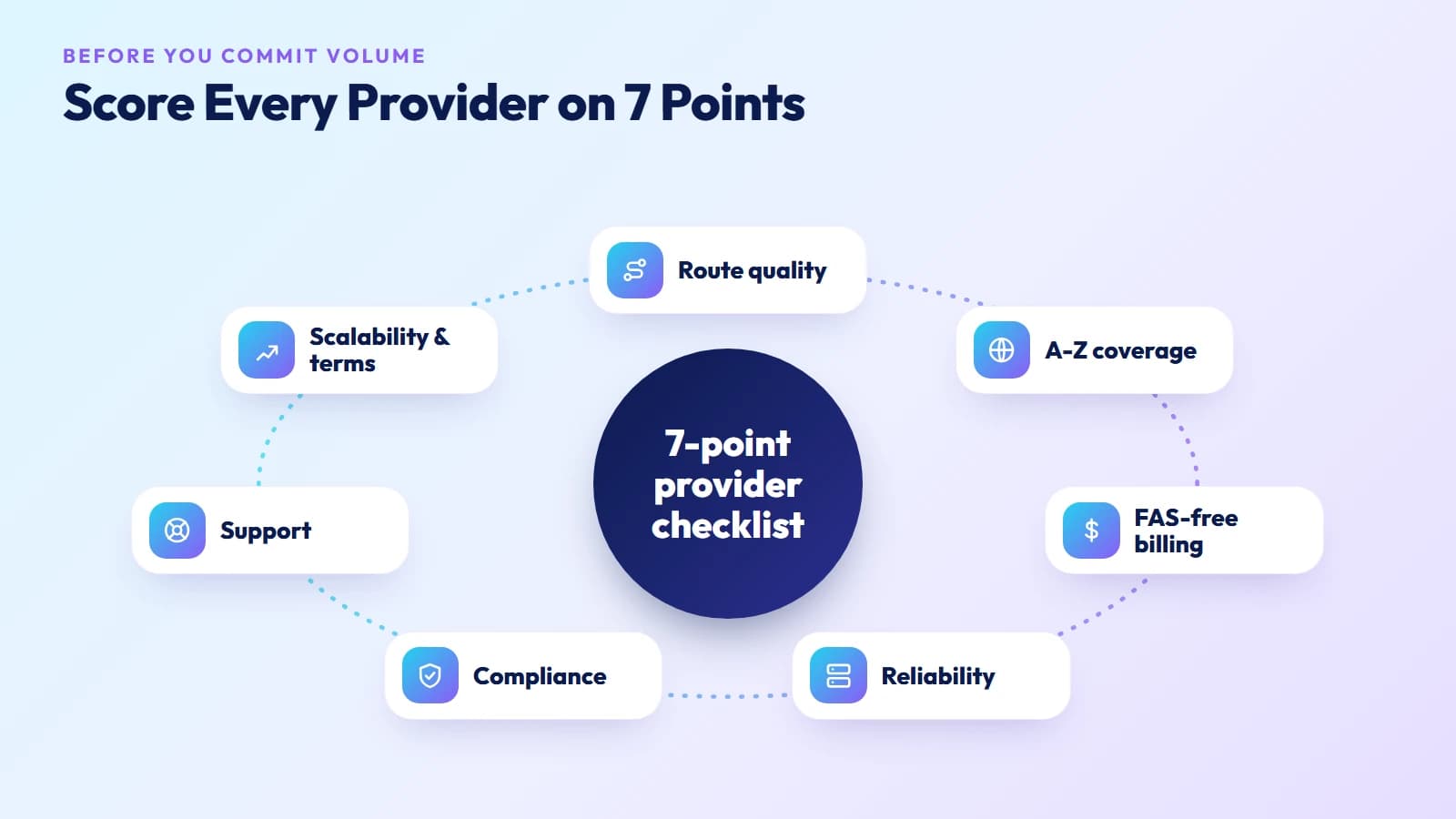
Run every provider through this evaluation before committing volume:
-
Route quality — demand live data. Ask for ASR, ACD, and PDD figures on your specific destinations, then validate them with a paid trial on real traffic. Published quality benchmarks tell you what to expect; a live test tells you what you'll get.
-
A-Z coverage for your actual lanes. Does the provider have direct routes to the countries and mobile/landline breakouts you actually call, or are they relying on third-party aggregators for APAC, MENA, and LATAM? Genuine direct interconnects mean fewer hops, lower PDD, and fewer quality degradation points.
-
FAS-free billing and transparent rate decks. False Answer Supervision — being billed for calls the destination never answered — is common on low-cost routes. Confirm FAS-free billing in writing, review CDR formats, and check billing increments (1/1 second beats 60/60 rounding significantly).
-
Reliability and redundancy. Geo-redundant infrastructure, multiple carrier interconnects, automatic failover, and a real uptime SLA — not a slogan. One bad-weather outage on a single-homed provider can cost a full day of traffic.
-
Compliance and fraud protection. STIR/SHAKEN attestation for US traffic, active fraud monitoring, clean CLI handling, and KYC procedures are now baseline requirements, not differentiators. Without them, calls increasingly fail to connect or get labeled spam.
-
Support quality — test it during the trial. Open a ticket during the evaluation period and time the response. A team that responds in minutes during sales and hours during incidents is a known pattern. Wholesale is a relationship; responsive NOC support matters more than a feature list.
-
Scalability and contract terms. Prepaid vs. postpaid options, sensible minimum commits, ability to add destinations without renegotiating the whole agreement, and burst headroom for campaign traffic all determine whether the partnership still works at 3× your current volume.
Types of Wholesale VoIP Providers
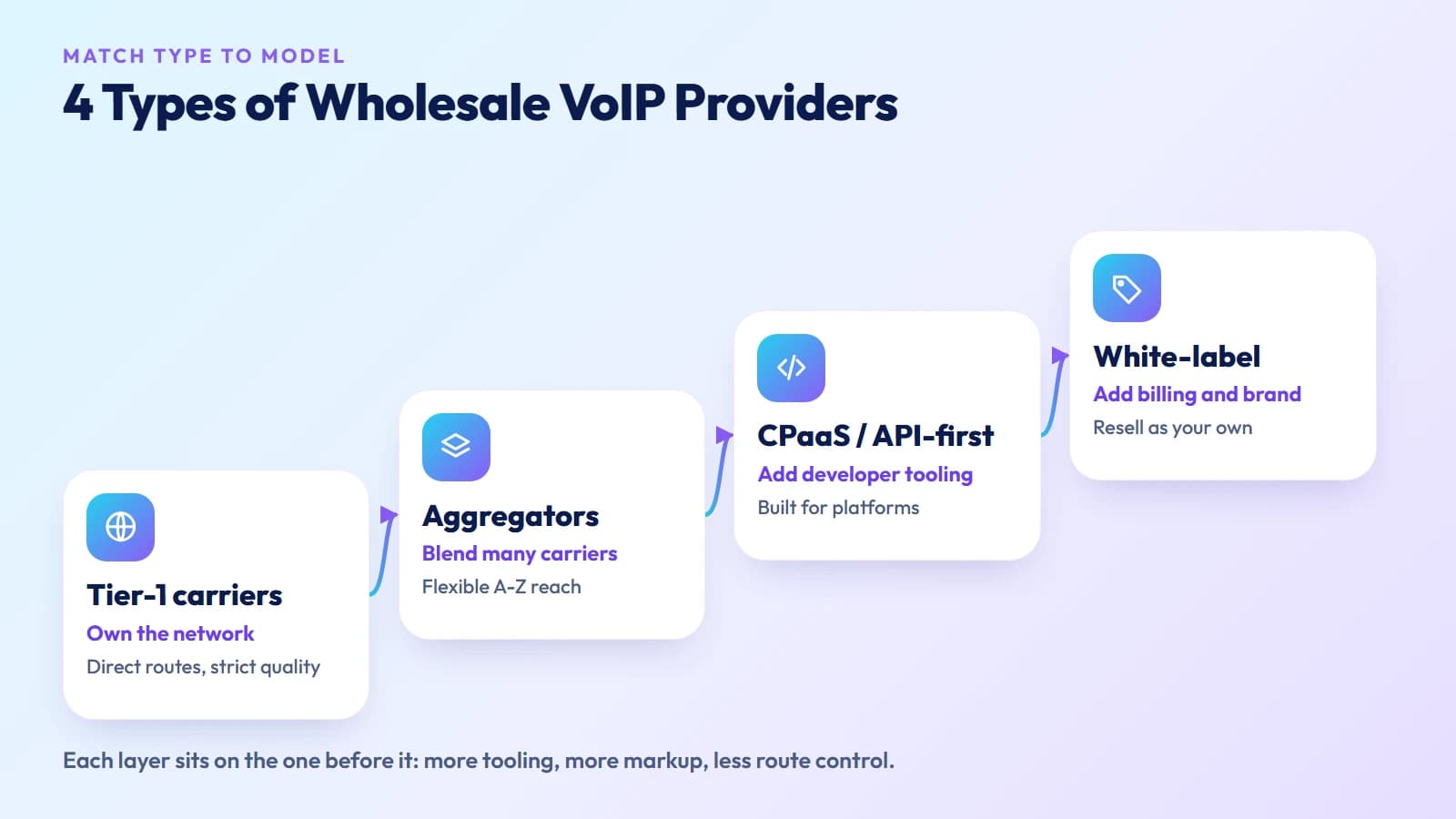
Not all wholesale VoIP providers do the same job. Matching the type to your business model matters as much as comparing rates:
- Tier-1 / facilities-based carriers own network infrastructure and originate/terminate directly — strong quality, less flexible, enterprise-oriented. Bandwidth is the archetype for US domestic.
- Aggregators / switch-based wholesalers blend many carriers' routes to optimize cost and A-Z coverage — flexible global reach, quality depends on their route management discipline and fraud controls.
- CPaaS / API-first providers wrap wholesale voice in developer tooling — great for platforms, typically priced above pure-play wholesalers due to the API layer. Twilio and Telnyx sit here.
- White-label / reseller-enablement providers add billing, provisioning, portal, and support tools so a business can resell under its own brand. SkySwitch, RingLogix, and Viirtue serve this segment.
How to Choose the Right Wholesale VoIP Partner
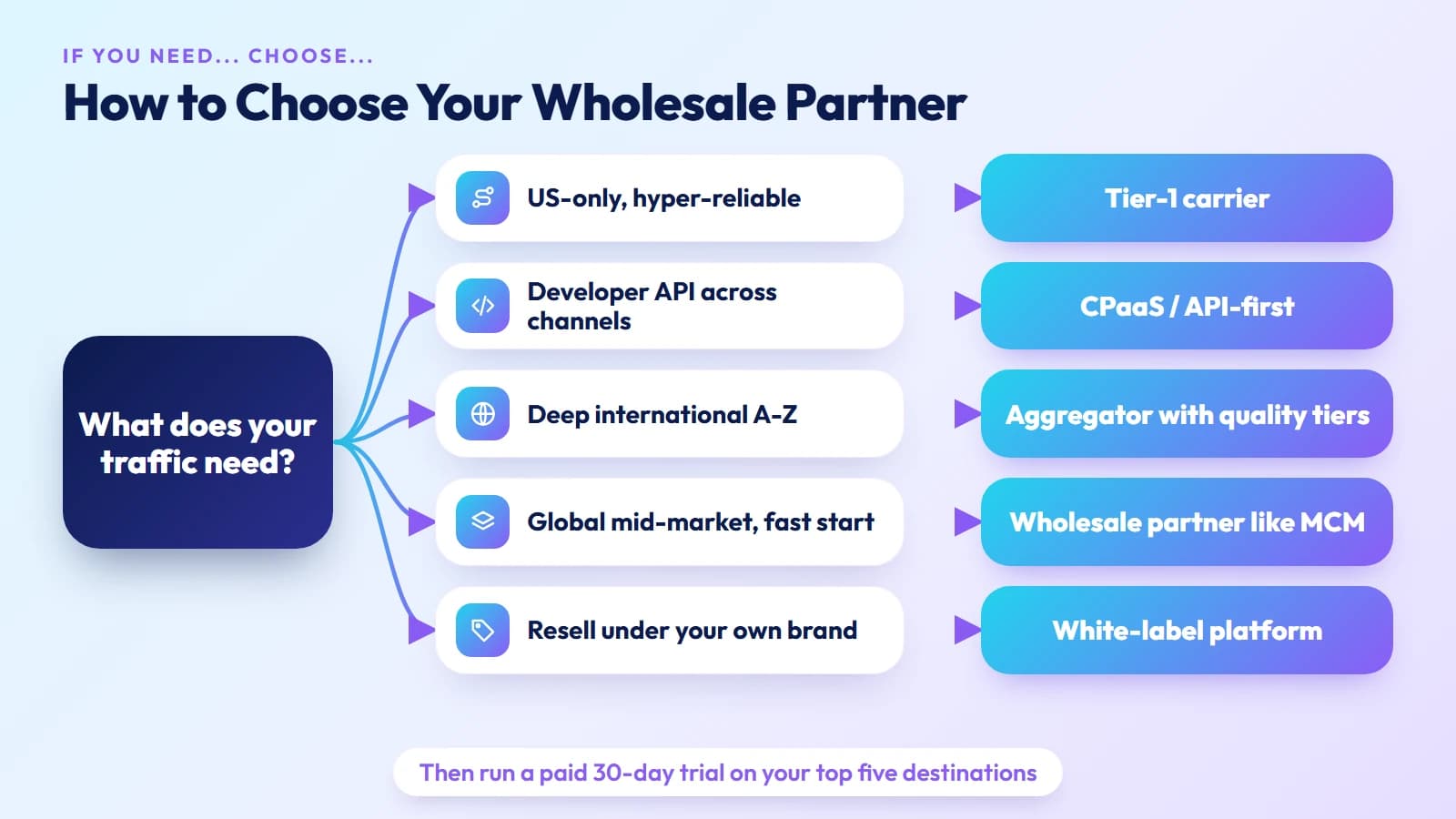
| If you need | Choose |
|---|---|
| US-only, hyper-reliable termination + E911 | Bandwidth |
| Developer API across voice, SMS & email | Twilio or Telnyx |
| Deep international A-Z with quality tiers | IDT Express |
| Global mid-market wholesale, transparent rates, fast provisioning | My Country Mobile |
| Enterprise voice + A2P SMS under one contract | Sinch |
| White-label UCaaS platform to resell under your own brand | SkySwitch / RingLogix / Viirtue |
The honest take: no provider wins every category. Run a 30-day parallel test with two shortlisted providers on your top five destinations before committing serious volume. ASR and ACD will tell you more than any sales deck.
Why Businesses Choose My Country Mobile
My Country Mobile is a wholesale VoIP provider built for carriers, resellers, and high-volume businesses that need dependable global routes without enterprise-tier complexity:
- Global A-Z termination reaching 190+ countries, with CLI routes where answer rates depend on them.
- Carrier-grade reliability backed by a 99.99% uptime target and redundant, multi-interconnect infrastructure.
- Transparent wholesale rates and clear billing — no FAS, auditable CDRs, and real-time balance visibility.
- Compliance built in — STIR/SHAKEN attestation on US traffic, active fraud monitoring, and KYC controls.
- Real support from a team that helps optimize routing for your specific traffic profile, not just closes tickets.
Trusted by 17,500+ businesses, our wholesale VoIP service gives you the routes, coverage, and quality to protect your margins on every call. See current pricing on our wholesale VoIP rates page.
Ready when you are
Ready to sound local everywhere you sell?
MCM activates business numbers in minutes, with call routing, analytics, and CRM-ready integrations. Start your trial — no card to browse inventory.
Frequently asked questions
What is a wholesale VoIP provider?
A wholesale VoIP provider sells voice termination and origination in bulk at per-minute rates, supplying the carrier capacity that resellers, call centers, and CPaaS platforms use to route large volumes of calls. They don't serve end users directly — they sell to the companies that do.
What are typical wholesale VoIP termination rates?
US domestic tier-1 termination runs $0.001–$0.004 per minute. Western European destinations average $0.005–$0.025. Harder-to-reach markets — parts of Africa, the Pacific Islands, and certain MENA routes — can exceed $0.30 per minute. Always compare billing increments (1/1 per-second billing beats 60/60 rounding) alongside the raw rate.
What's the difference between CLI and non-CLI wholesale VoIP routes?
CLI (Caller Line Identification) routes preserve the caller's number end-to-end, which is what destination networks expect and what STIR/SHAKEN attestation requires. Non-CLI routes strip or replace the originating number to reduce cost, but increasingly get blocked or labeled by destination carriers — particularly on US-bound traffic. Business calls and contact center traffic should always use CLI routes.
What is FAS, and why should I watch for it?
False Answer Supervision (FAS) is when a provider bills for calls the destination network never actually answered. It's common on low-cost gray-market routes and is how ultra-cheap per-minute rates quietly cost more than they save. Protect yourself by demanding FAS-free billing in your contract and auditing CDRs against actual answer events in your own platform.
How do I compare wholesale VoIP providers effectively?
Shortlist on route quality (ASR/ACD/PDD), A-Z coverage for your specific destinations, transparent billing (no FAS, clear CDRs, clean increments), uptime SLA, CLI handling, STIR/SHAKEN compliance, and support responsiveness. Then run a paid 30-day trial on real traffic with two providers simultaneously — live call data reveals what sales decks hide.
Does STIR/SHAKEN matter for wholesale VoIP?
Yes, for US traffic it's a hard requirement. STIR/SHAKEN attestation determines whether outbound calls connect, how they're labeled by terminating carriers, and whether your numbers stay off spam lists. Without it, US-bound calls increasingly get marked "Spam Likely" or blocked. Verify your provider's attestation level — A-level (full attestation) is the standard to require.
Can My Country Mobile provide wholesale VoIP for my business?
Yes — My Country Mobile offers global A-Z termination across 190+ countries with CLI routes, transparent rates, 99.99% uptime, and built-in STIR/SHAKEN compliance. View our wholesale VoIP rates or contact the wholesale team to get a trial route running on your destinations.