Wholesale VoIP Termination Rates Explained: Why the Cheapest Rate Isn't the Best Deal
Two providers quote you US termination. One says $0.0020 a minute, the other $0.0024. Easy call, right? Take the cheaper one.
Not so fast. The $0.0024 route might connect 90% of your calls while the $0.0020 route connects 70 — and once you do the math on connected minutes, the "expensive" route is the bargain. This guide walks through how wholesale pricing really works, so you can read a quote like an operator instead of a shopper.
WHAT "TERMINATION" ACTUALLY MEANS
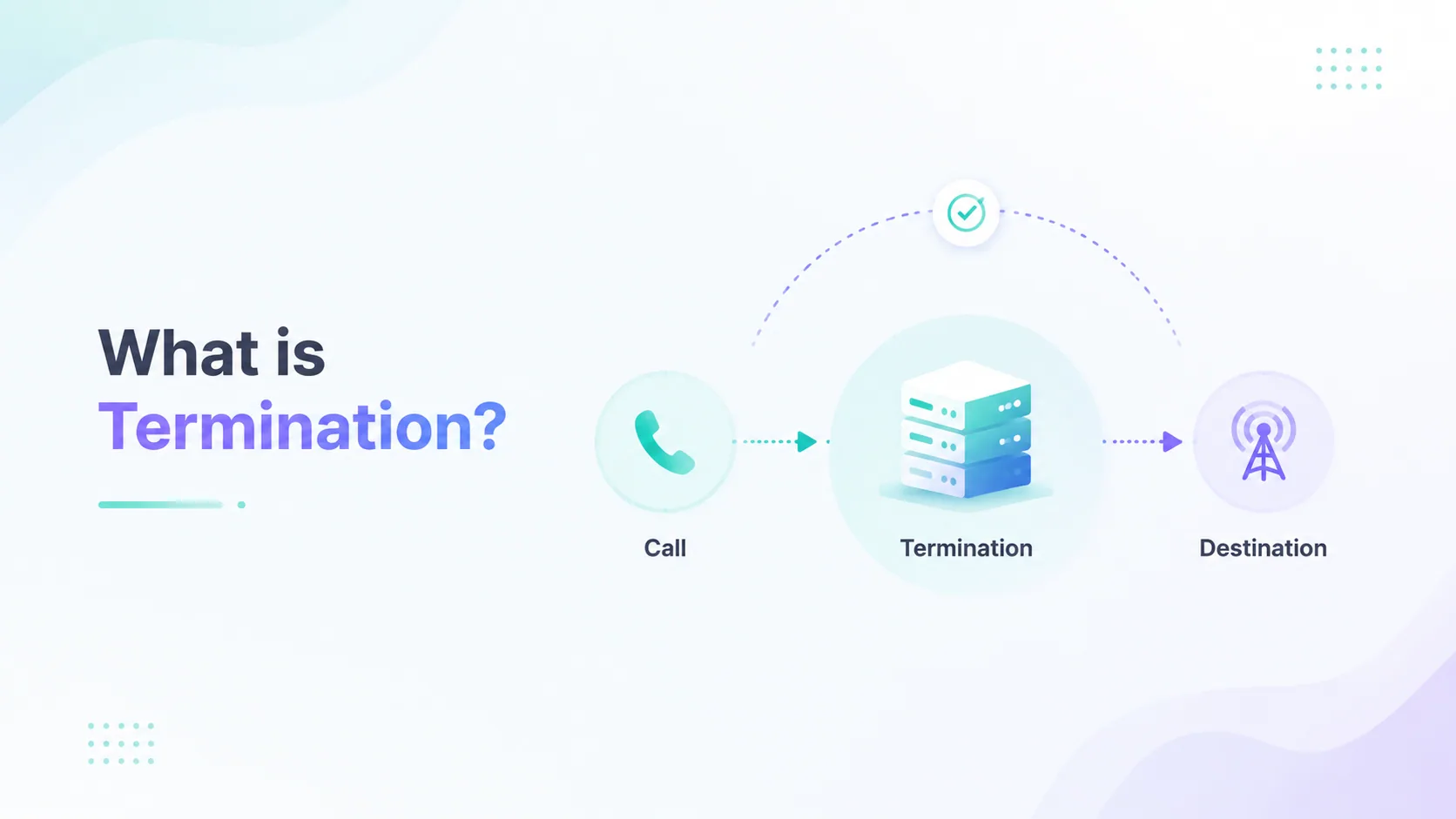
Termination is the act of handing a call off to its final destination network — landline or mobile — so it can ring the person being called.
A wholesale provider buys access to those destination networks in bulk and resells it to carriers, VoIP companies, call centers, and resellers. The per-minute price you pay for that hand-off is the termination rate.
Buy at wholesale volume and the savings are real — often 60% to 90% below retail per-minute pricing. But the rate is only half the story.
THE FACTORS THAT SET THE RATE
No two destinations cost the same to reach. A handful of variables drive every number on a rate sheet.
Destination Country and Network
This is the biggest factor. Liberalized, competitive markets like the US, UK, and Canada have low termination costs. Countries with a single state-controlled carrier are far more expensive.
Fixed vs. Mobile
Within any country, mobile numbers usually cost more to terminate than landlines. Rate sheets price the two separately for exactly this reason.
Route Quality Tier
A premium, fully compliant route costs more than a cost-optimized one. You're paying for answer rates, caller ID, and signaling integrity — more on that below.
Your Call Volume
Volume earns discounts. A typical tiered structure might be $0.009/min for the first million minutes, $0.008 for the next four, and $0.007 above five — the more you commit, the lower the unit price.
Ready when you are
Protect your business line.
MCM's local numbers ship with verified caller ID and smart call filtering — customers always know it's really you, and spam never reaches your team.
CLI VS. NON-CLI ROUTES: THE CORE TRADE-OFF
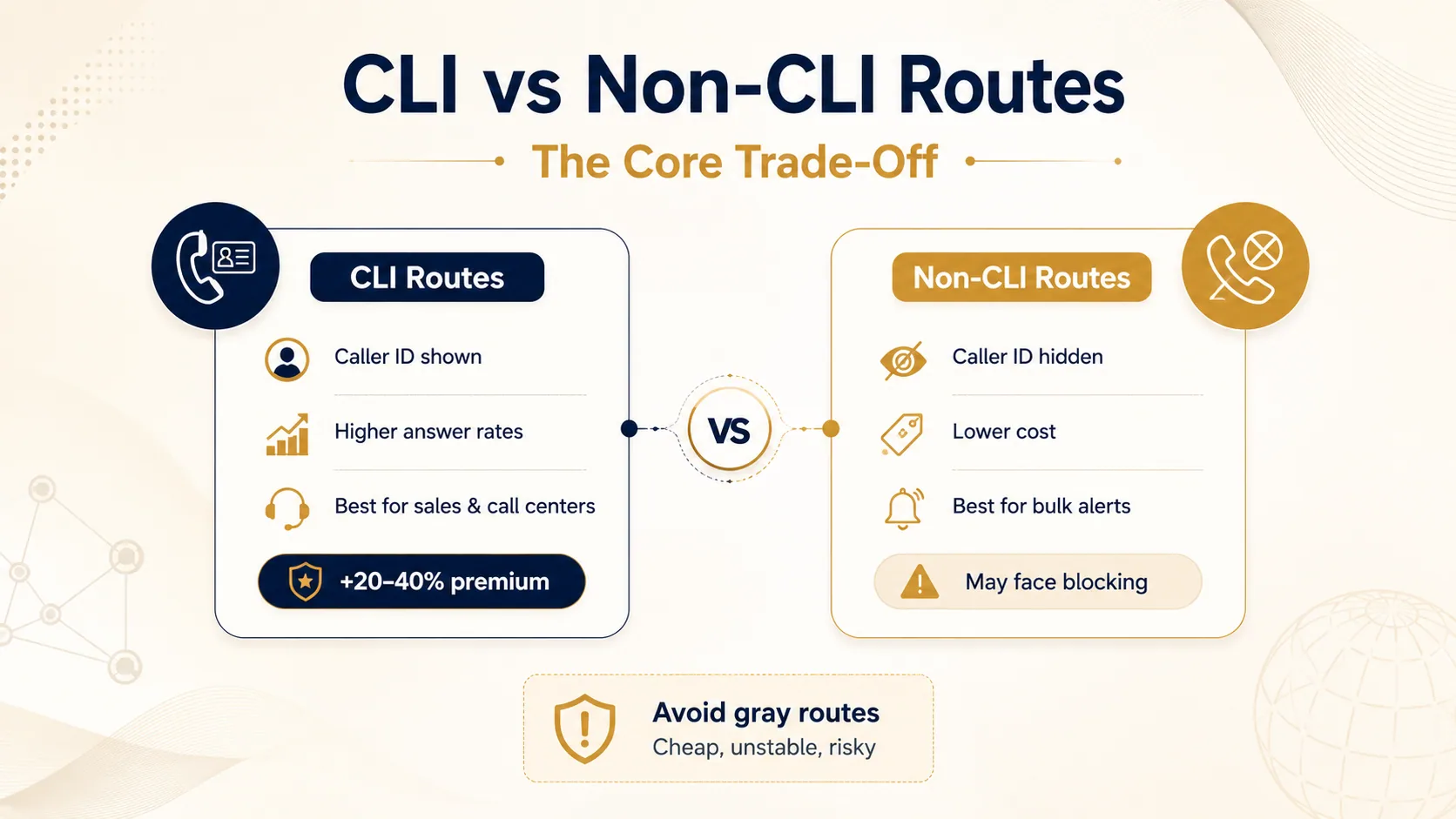
Most rate-sheet pricing splits along one line: does the route pass caller ID or not?
CLI Routes — Caller ID Preserved
CLI (Calling Line Identification) routes deliver your real caller number to the destination. The person being called sees who's calling, so answer rates climb.
These are essential for outbound sales, call centers, and any traffic where a connected conversation is the goal. They're premium routes — often 20% to 40% more per minute.
Non-CLI Routes — Caller ID Stripped
Non-CLI routes drop the caller ID. They're cheaper and fine for bulk traffic where display doesn't matter — automated alerts, high-volume notifications, low-stakes campaigns.
One caution worth naming: avoid "gray" routes that disguise international traffic to dodge legitimate termination fees. They're cheap, unstable, and a regulatory liability. A reputable provider won't sell them.
HOW A-Z ROUTES WORK
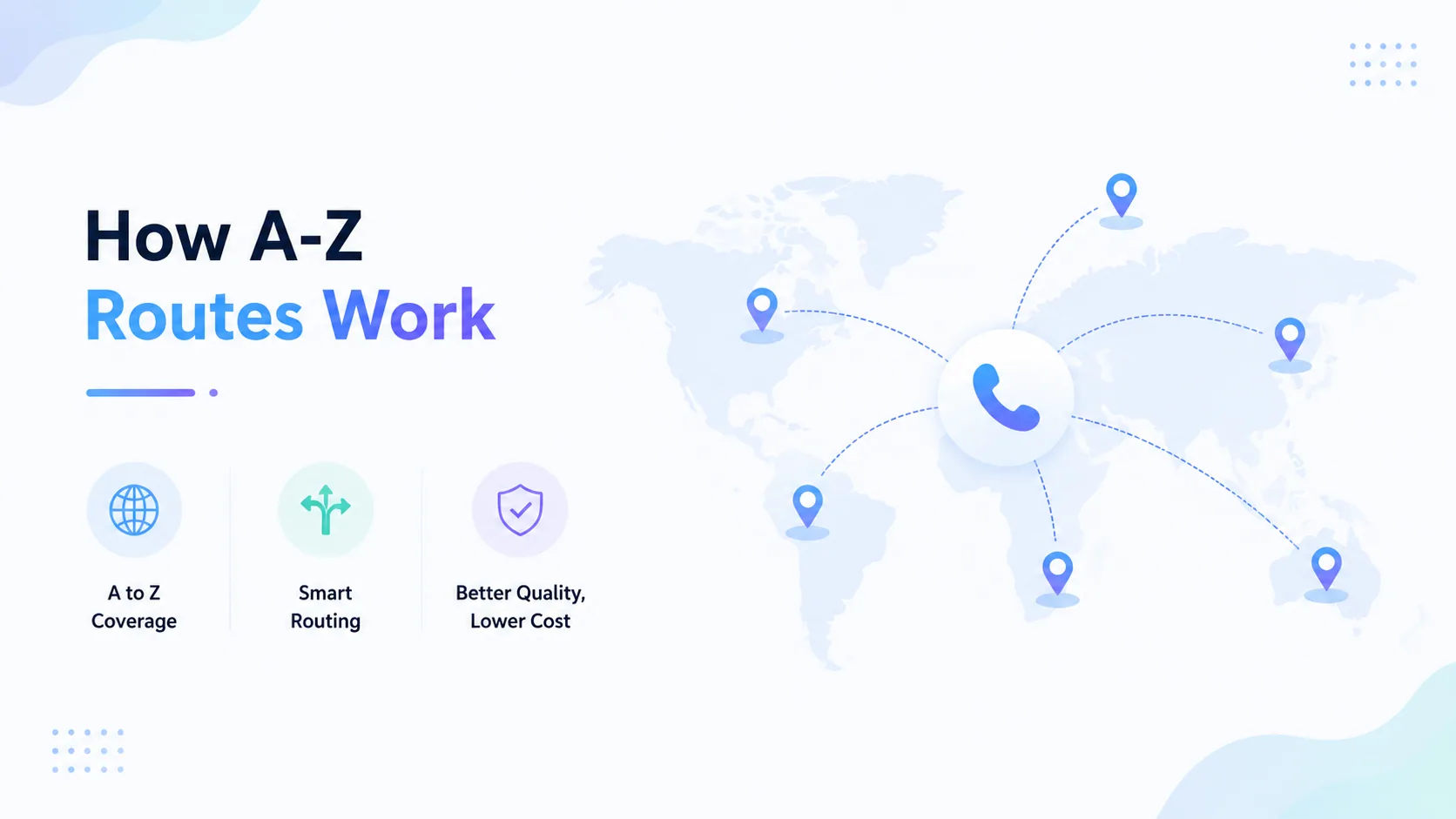
"A-Z" termination means a provider can route a call to any destination on the map — from Afghanistan to Zimbabwe. That's the "A to Z."
One Provider, Global Reach
Instead of stitching together a dozen regional carriers, you connect to one A-Z provider and reach every country through a single interconnect. Their rate sheet is your global price list.
Routing Happens Behind the Scenes
A good provider runs Least Cost Routing (LCR) — software that compares every available carrier path for each destination and picks the best one in real time, balancing price against quality.
That's why your effective cost depends on routing intelligence, not just the headline number. Carrier-grade networks like the one behind My Country Mobile (MCM) lean on LCR engines and live monitoring to keep that balance steady.
THE QUALITY METRICS THAT DECIDE REAL COST
A rate is just a price. These four metrics tell you what that price actually buys.
| Metric | What It Measures | Good Sign |
|---|---|---|
| ASR | % of attempted calls that connect | 60%+ |
| ACD | Average length of connected calls | Matches your traffic type |
| PDD | Delay between dialing and first ring | Under 1.5 seconds |
| MOS | Voice clarity score | Above 4.0 |
ASR — Your Connection Rate
Answer Seizure Ratio is the share of call attempts that actually connect. A low ASR means you're paying setup overhead on calls that go nowhere.
ACD and PDD — The Experience Check
Average Call Duration that's suspiciously short can signal route problems or false answers. High Post-Dial Delay — long dead air after dialing — frustrates callers and points to an overloaded path.
The Metric That Matters Most: Cost Per Connected Minute
Divide your spend by minutes that actually connected to a human. A pricier route with strong ASR and MOS often wins this math outright. That's the number to optimize.
HOW TO READ A RATE SHEET WITHOUT GETTING BURNED
A rate sheet is a structured file — usually CSV or Excel — listing per-minute prices by destination. Knowing the columns is half the skill.
The Columns to Check First
- Destination and code — country plus prefix
- Destination type — fixed, mobile, or special (toll-free, premium)
- Rate and currency — price per minute, and in which currency
- Effective date — when the rate starts; rates change often
The Fine Print That Bites
- Billing increments — 1/1 (per-second) billing beats 60/60 rounding
- Settlement terms — net-30 or net-60, and accepted payment methods
- Interstate vs. intrastate — US domestic rates can differ by call type
Test Before You Trust
Never migrate live traffic on a quote alone. Run test calls, check ASR and MOS on your own dashboard, and confirm the numbers match the promise.
Want to see how routing tiers map to pricing? Our overview of wholesale voice termination breaks down CC, CLI, and premium routes side by side.
PUTTING IT TOGETHER
Wholesale pricing rewards operators who think past the first number on the page. The destination, the route type, the quality metrics, and the rate-sheet fine print all combine into the cost that actually hits your books.
Start by benchmarking your current routes: pull your ASR and ACD, calculate cost per connected minute, then compare. If a provider can't show live quality data alongside their rates, that's your answer.
Ready to compare against a carrier-grade network? Request a custom rate sheet at mycountrymobile.com — no commitment, and you can run test traffic before you decide.
Ready when you are
Ready to sound local everywhere you sell?
MCM activates business numbers in minutes, with call routing, analytics, and CRM-ready integrations. Start your free trial — no card to browse inventory.
FAQs
What are typical wholesale VoIP termination rates in 2026?
Per-minute wholesale voice rates generally land between $0.003 and $0.025, depending on destination and route quality. Competitive markets like the US sit at the low end; harder destinations cost more.
What's the difference between A-Z and a single-destination route?
A-Z termination reaches any country worldwide through one provider. A single-destination route covers one country or region — useful when you have heavy, focused traffic to a specific market.
Why is the cheapest rate often a bad deal?
A low rate with poor ASR means many calls fail to connect, so your real cost per connected minute rises. A slightly higher rate with strong quality metrics usually delivers better value.
What is LCR and why does it matter?
Least Cost Routing is software that picks the best carrier path for each call in real time, weighing price against quality. It's what keeps an A-Z network both affordable and reliable.
How do CLI and non-CLI routes affect pricing?
CLI routes preserve caller ID and cost roughly 20-40% more, but lift answer rates. Non-CLI routes are cheaper and fine for bulk traffic where caller display doesn't matter.
What billing increment should I look for?
Per-second (1/1) billing is best — you pay only for time used. Rounded billing like 60/60 inflates costs on short calls, which adds up at volume.
How should I test a new provider before switching?
Run live test calls, monitor ASR, ACD, PDD, and MOS on your own dashboard, and confirm the results match the rate sheet before moving production traffic.