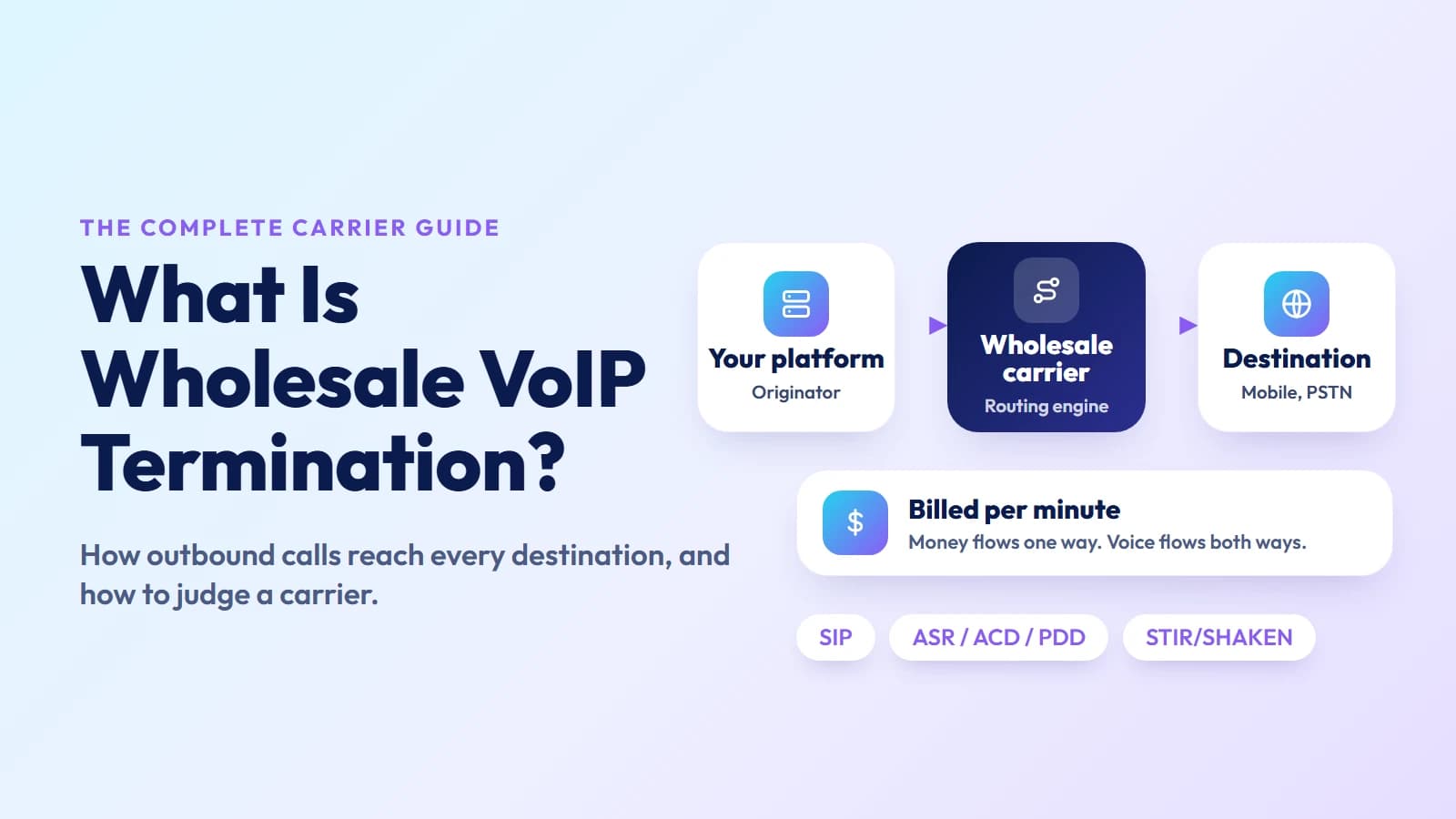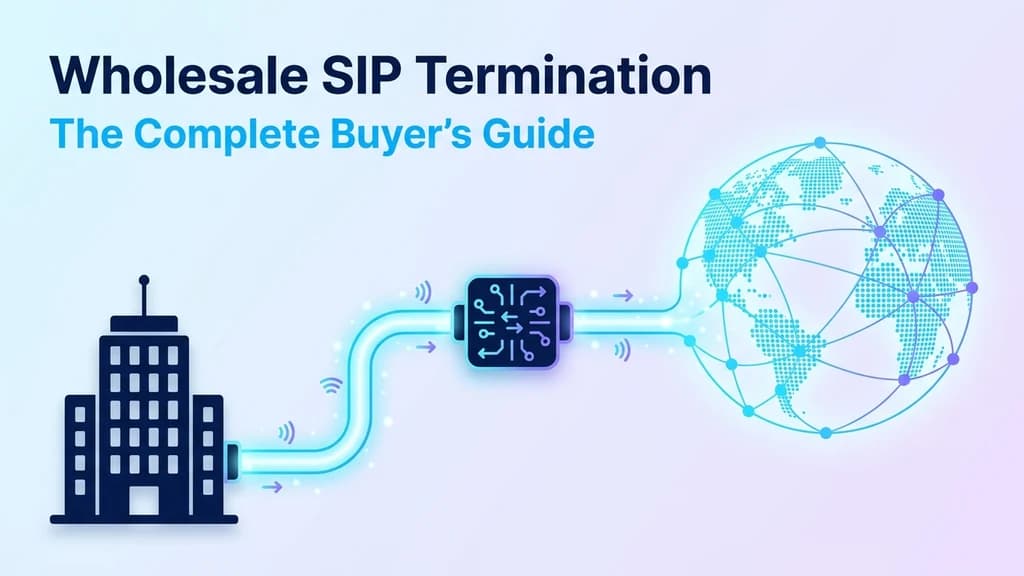
Wholesale SIP termination is the piece of infrastructure that quietly decides whether a business's outbound calls sound clean or choppy, and whether they cost three cents a minute or thirty. A wholesale carrier accepts SIP traffic from an originator — a reseller, a contact center, a UCaaS platform — over a trunk, picks the cheapest route that still clears quality thresholds, and hands the call off to the destination network. Nobody outside a NOC ever thinks about it, which is exactly why getting the carrier wrong is so easy to miss until call quality complaints start piling up.
This guide breaks down how a wholesale SIP call actually moves end to end, what separates a carrier-grade route from a cut-rate one, how pricing is actually structured, and what to check before signing with a provider. If the decision framework is what's slowing you down more than the SIP mechanics, our wholesale VoIP providers buyer's guide works the seven-point checklist end to end.
How a wholesale SIP call actually moves
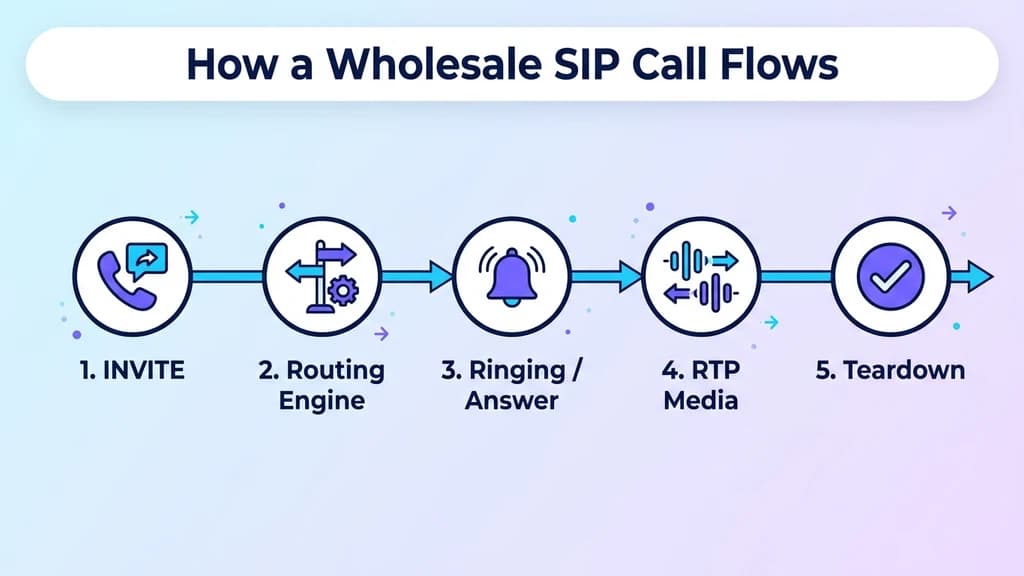
A SIP trunk is not a physical line — it's a signaling and media session negotiated over the internet using Session Initiation Protocol. When an originator's system places a call, here's what happens on the wire:
- INVITE. The originator's PBX or softswitch sends a SIP
INVITEto the wholesale carrier's session border controller, carrying the destination number, caller ID, and a list of codecs it supports. - Routing decision. The carrier's least-cost routing (LCR) engine checks its rate deck and live quality data, then picks an outbound path to the destination network — sometimes direct, sometimes through a Tier-1 partner.
- Ringing and answer. The destination network locates the subscriber and returns
180 Ringing, then200 OKwhen the call is answered. - Media exchange. RTP packets carrying the actual voice audio flow directly between the two ends, using whichever codec both sides negotiated in the SIP handshake.
- Teardown and billing. Either party hangs up with a
BYEmessage, and the carrier's billing system logs the call's duration for invoicing.
The entire signaling exchange — INVITE to ringing — typically takes one to four seconds on a healthy Tier-1 route. When that stretches past six or seven seconds, callers hang up and redial before the destination even picks up, which is usually the first sign of a routing problem rather than a network outage.
The metrics that actually separate carriers
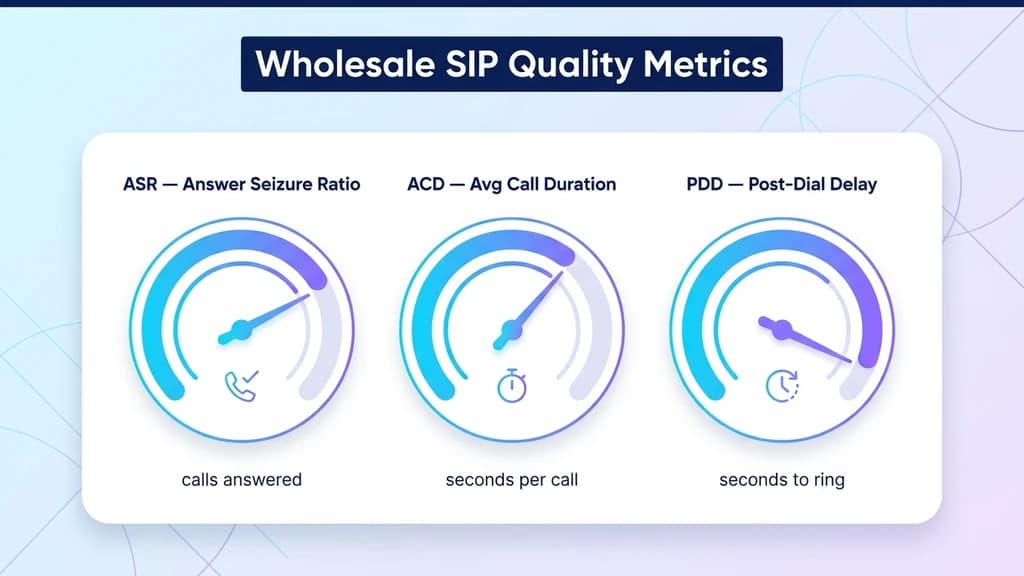
Any wholesale carrier can quote a low per-minute rate. What the rate doesn't show is whether the calls on that route actually connect and stay connected. Three numbers tell that story:
ASR (Answer Seizure Ratio) — the share of call attempts that get answered. Domestic US routes on solid underlay typically run 60–75%; mobile-heavy international destinations often land lower even on premium paths, simply because more calls go unanswered by nature.
ACD (Average Call Duration) — the average length of answered calls. A sudden drop to under 15 seconds across a route usually means false answer supervision: the carrier is marking calls as connected before the destination phone was actually picked up, which inflates their billed minutes at the buyer's expense.
PDD (Post-Dial Delay) — the seconds between dialing and the phone actually ringing. Above six seconds, real callers start hanging up, which silently tanks ASR on a route that might otherwise be fine.
A carrier that won't share these numbers per destination isn't one worth routing production traffic through — you're buying blind.
What drives the price of a route
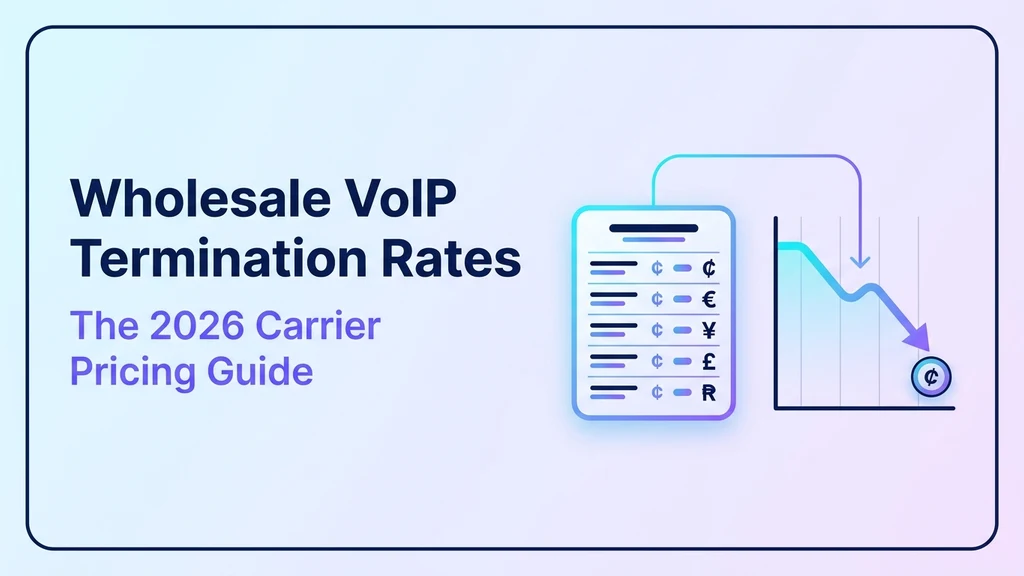
Wholesale SIP termination is priced per minute, per destination, and that price moves on a handful of real variables rather than carrier goodwill:
- CLI vs. Non-CLI. CLI routes preserve the caller's real number end to end and are required by regulators in markets like the UAE, Saudi Arabia, and Brazil — they typically cost 30–60% more than Non-CLI routes on the same destination.
- Volume commitment. Carriers price steady, predictable volume lower than sporadic or bursty traffic, since it lets them plan capacity on their upstream interconnects.
- Destination network depth. A direct interconnect with the destination's mobile or fixed-line operator is cheaper and more reliable than a route relayed through two or three transit carriers.
- Billing increment. 1-second billing costs more per minute than 60/60 or 6/6 billing, since the carrier can't round call duration in its favor.
Many businesses buying wholesale SIP capacity route it straight into a UCaaS (Unified Communications as a Service) platform — a single cloud system for calling, messaging, and video — where the trunk becomes invisible infrastructure behind a phone number that just works. Contact us if you need wholesale SIP capacity wired directly into a hosted phone system rather than managed as a separate carrier relationship.
Ready when you are
Protect your business line.
MCM's local numbers ship with verified caller ID and smart call filtering — customers always know it's really you, and spam never reaches your team.
Compliance is not optional anymore
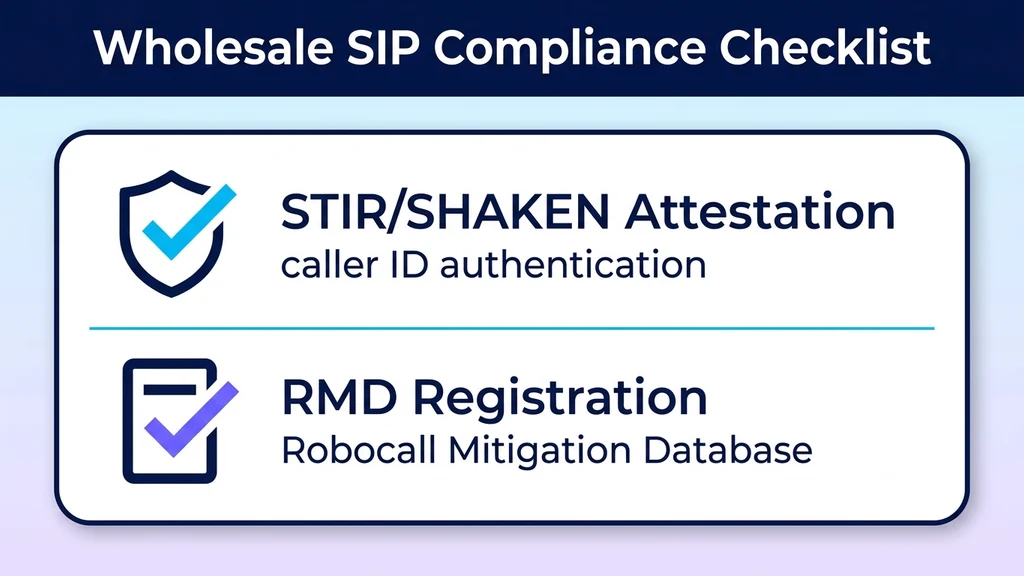
US-bound SIP traffic in particular carries regulatory weight that didn't exist a decade ago. Two requirements matter most:
STIR/SHAKEN attestation. Carriers cryptographically sign calls to prove the caller ID hasn't been spoofed. A-level attestation means the carrier can vouch for both the caller's identity and their right to use that number — anything less gets flagged more aggressively by carrier spam filters.
Robocall Mitigation Database registration. Every voice service provider terminating calls to US numbers has to file with the FCC's RMD annually. This applies even to resellers running traffic over someone else's Tier-1 network — the underlying carrier's filing does not cover a reseller's own obligation. The FCC's STIR/SHAKEN framework is the authoritative source for what attestation levels actually mean and how they're enforced.
Skipping either one doesn't just risk a fine — carriers and handset makers increasingly block or mislabel unauthenticated traffic outright, which shows up as dropped ASR long before any regulator gets involved.
Choosing a wholesale SIP termination provider
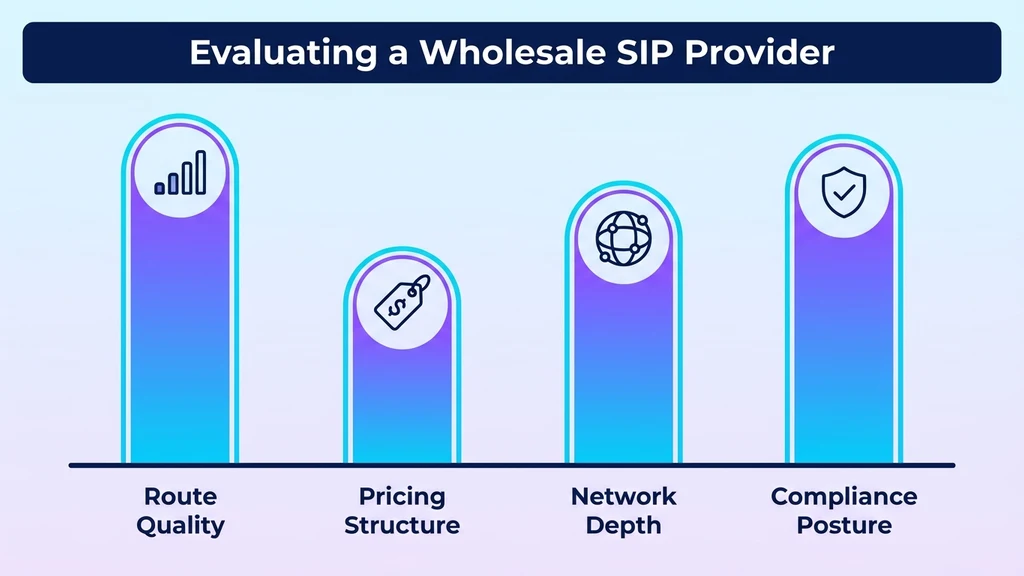
Vendor selection comes down to four checks, in order: can they show ASR/ACD/PDD by destination on request, is their pricing structured around real route classes rather than a single blended rate, do they carry direct interconnects on the destinations that matter to your traffic, and can they produce evidence of STIR/SHAKEN and RMD compliance without hesitation.
A short test period is the cheapest way to find out. Route a small, representative slice of live traffic — a few percent — for one to two weeks, and compare the ASR and PDD the carrier actually delivers against what they quoted. Carriers that perform worse under real production traffic than in a sales call are common enough that this step alone filters out most bad fits before a full migration.
Conclusion
Wholesale SIP termination is infrastructure most businesses never see and rarely think about — until a carrier's route quietly degrades and calls start failing to connect. The fix isn't picking the lowest quoted rate; it's picking a carrier that can prove its ASR, PDD, and compliance posture on the destinations that actually matter to your traffic. My Country Mobile runs wholesale SIP termination on Tier-1 underlay with per-destination quality reporting, so the numbers are visible before you commit any real volume.
Key takeaways
- A wholesale SIP call moves through INVITE → routing → ringing/answer → RTP media → teardown, typically in one to four seconds end to end on a healthy route.
- ASR, ACD, and PDD are the three metrics that actually separate a good carrier from a cheap one — a quoted rate alone tells you nothing about call quality.
- Price moves on CLI vs. Non-CLI, volume commitment, destination network depth, and billing increment — not carrier goodwill.
- STIR/SHAKEN attestation and RMD registration are mandatory for US-bound traffic, and a reseller's obligation isn't covered by their upstream carrier's filing.
- Test a carrier on a small slice of real traffic before committing full volume — quoted numbers and delivered numbers aren't always the same thing.
Ready when you are
Ready to sound local everywhere you sell?
MCM activates business numbers in minutes, with call routing, analytics, and CRM-ready integrations. Start your trial — no card to browse inventory.
FAQ
What is wholesale SIP termination?
A carrier service that accepts SIP-based voice traffic from an originator and routes it to destination phone networks worldwide, billed per minute by destination.
How is wholesale SIP termination different from retail SIP trunking?
Retail SIP trunking is what a single business buys to connect its own phone system to the PSTN. Wholesale SIP termination is the underlying carrier layer — the infrastructure that resellers, UCaaS platforms, and carriers themselves buy in bulk and route retail trunks through.
What is a good ASR for a wholesale SIP route?
It depends heavily on destination. Domestic US routes on solid underlay typically run 60–75%. International mobile-heavy destinations often run lower simply because a larger share of attempts naturally go unanswered — the number matters less than whether it's stable over time.
Do I need STIR/SHAKEN compliance if I'm a reseller, not a carrier?
Yes. Any voice service provider terminating calls to US numbers has to register with the FCC's Robocall Mitigation Database independently, even if the underlying network is operated by a wholesale partner.
How do I evaluate a wholesale SIP termination provider before committing?
Ask for ASR, ACD, and PDD broken down by destination, confirm their route classes and pricing structure, and run a small percentage of real traffic through them for one to two weeks before migrating full volume.