Introduction
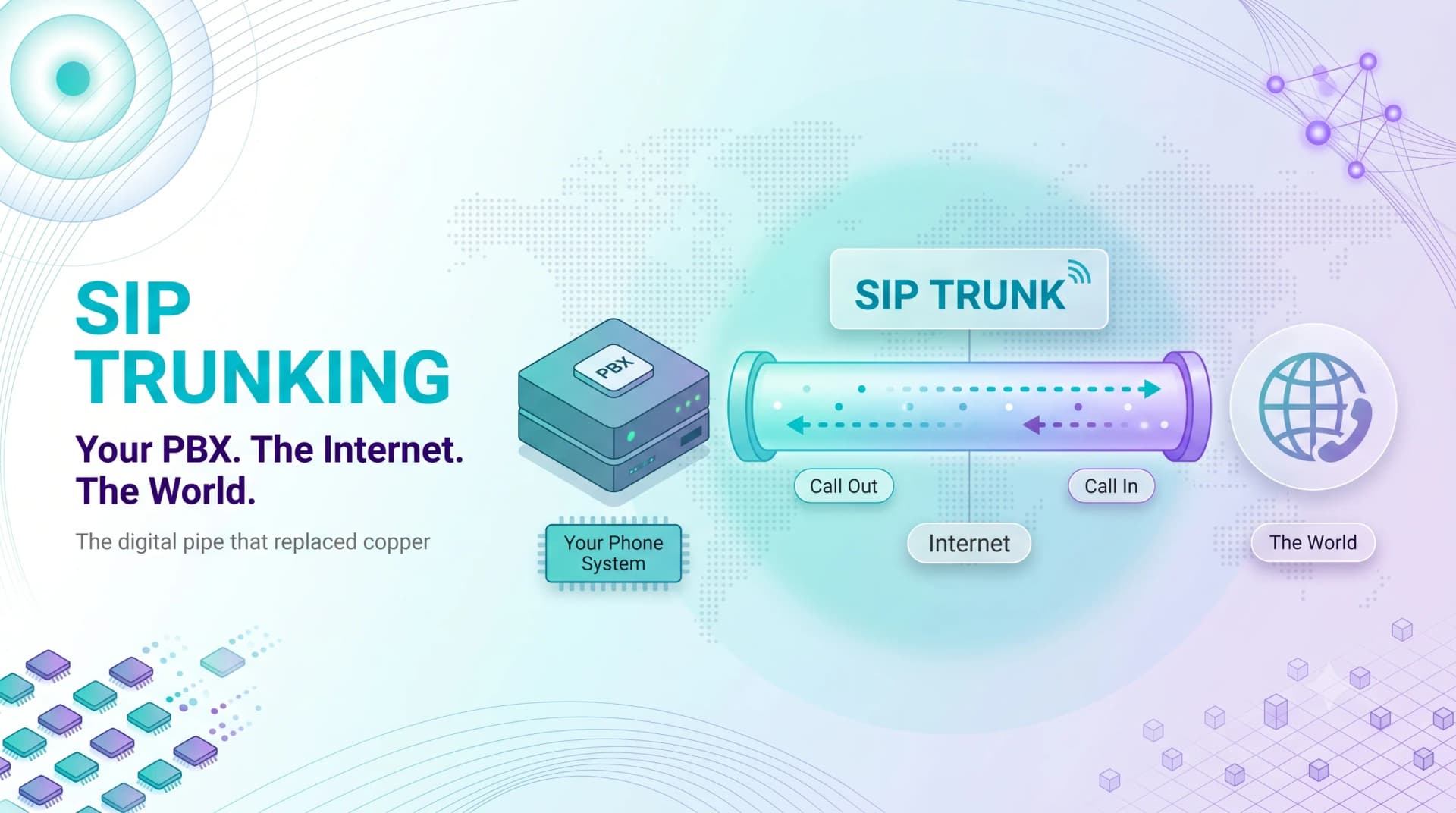
Your business has a phone system that works fine. Then someone says you should "move to SIP trunking" — and suddenly there's a wall of acronyms. PBX, PSTN, SIP, RTP. What is any of it?
Here's the good news. SIP trunking is one of the easier telecom concepts once someone explains it without the jargon. And it's why phone bills keep dropping for businesses that switch.
This guide does exactly that — plain language, a real call walkthrough, honest numbers. About 7 minutes.
THE SIMPLE DEFINITION
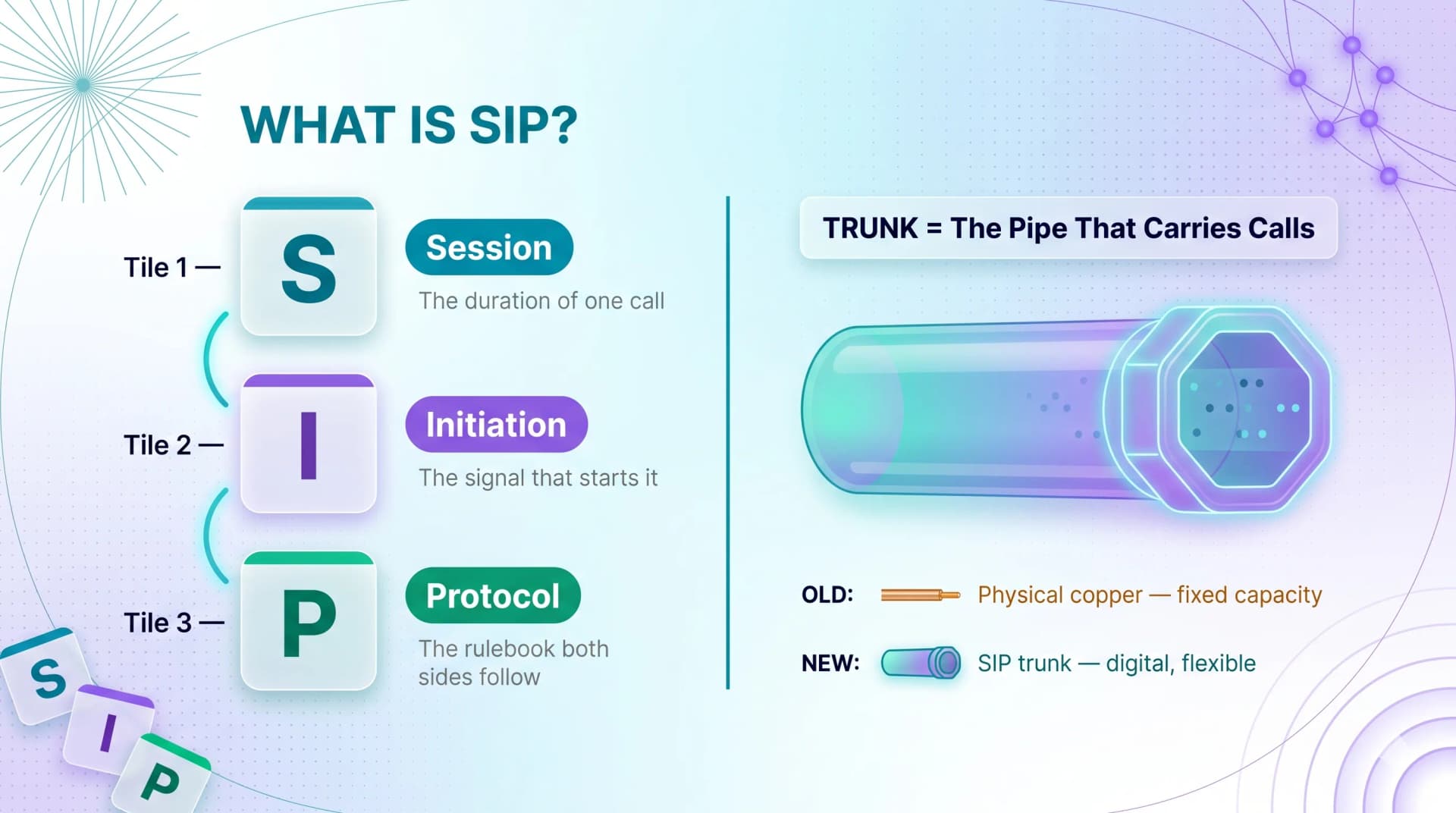
Let's answer it directly. SIP trunking in VoIP is a way to connect your business phone system to the outside phone network using the internet instead of physical phone lines.
A "trunk" is just the pipe that carries calls between your office and the wider world. SIP trunking makes that pipe digital.
Breaking Down the Word
SIP stands for Session Initiation Protocol — the standard rulebook (RFC 3261) for starting, managing, and ending a call over IP.
A trunk historically meant a bundle of physical lines. Put them together: a digital connection that carries many calls at once over your internet link.
WHAT SIP TRUNKING REPLACES
To see why this matters, look at what came before. The old way used copper lines.
Businesses used to rent physical lines — often a PRI circuit, which bundled 23 voice channels. Each line was a fixed cost whether you used it or not.
The Problem With Physical Lines
Copper-based trunks had real limits that frustrated growing businesses:
- Rigid capacity — need a 24th simultaneous call? Order another circuit and wait weeks.
- Geographic lock-in — lines were tied to one physical building.
- Higher cost — line rental plus expensive long-distance and international rates.
SIP trunking removes all three. Capacity becomes a setting, not a construction project.
Ready when you are
Protect your business line.
MCM's local numbers ship with verified caller ID and smart call filtering — customers always know it's really you, and spam never reaches your team.
HOW SIP TRUNKING WORKS, STEP BY STEP
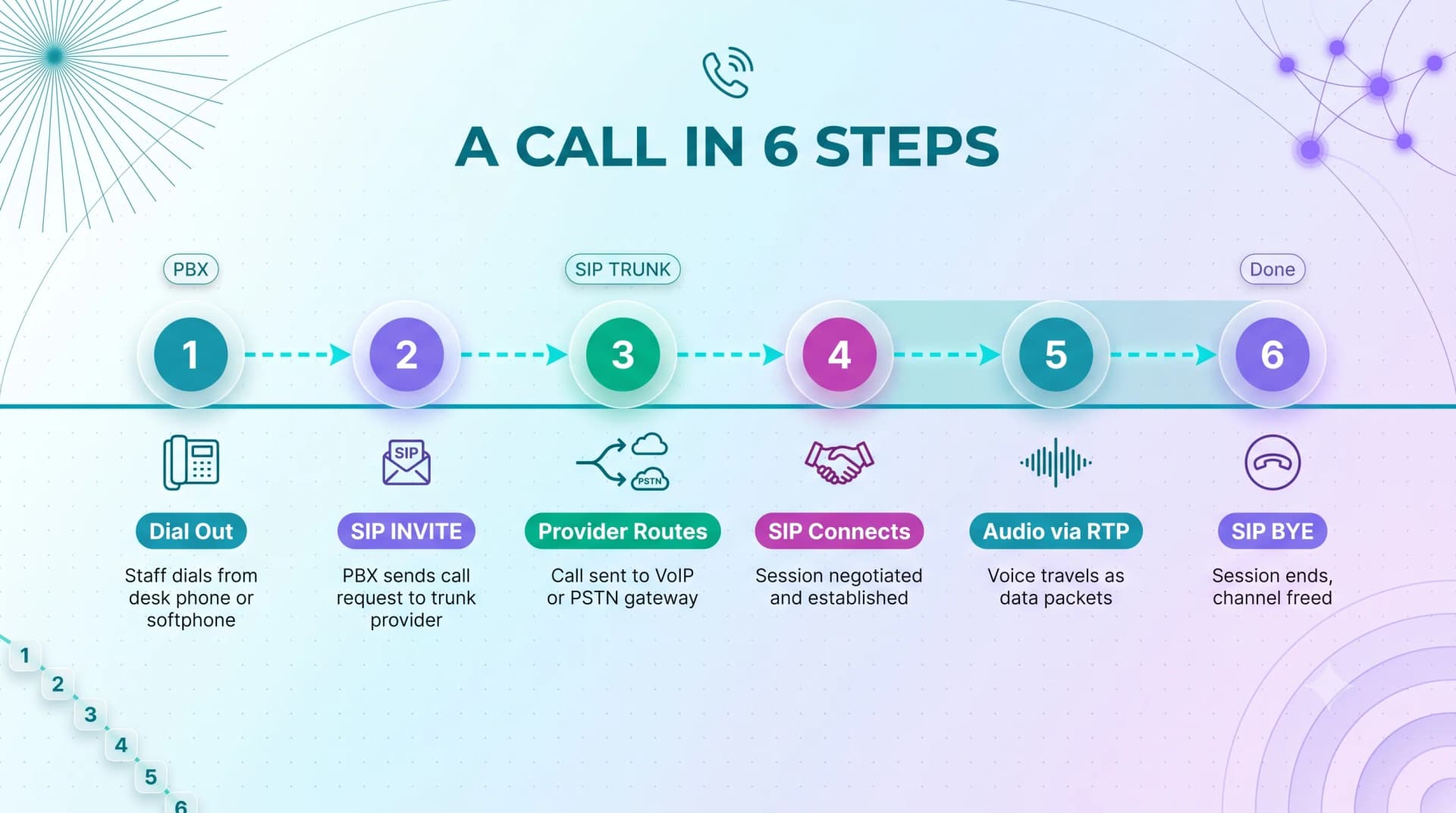
Here's where most explanations get vague. Let's actually follow a call from start to finish.
Your existing phone system (the PBX) stays right where it is. SIP trunking simply gives it a new way to reach the outside world.
The Call Flow
When someone makes a call, here's what happens behind the scenes:
- A staff member dials out from a desk phone or softphone; the PBX starts the call.
- The PBX sends a SIP INVITE to your trunk provider with the number and preferred audio codec.
- The provider routes the call onward — to another VoIP endpoint, or through a gateway to the traditional phone network (the PSTN).
- SIP messages negotiate and connect the session.
- The actual audio travels as real-time data packets using RTP, reassembled at the other end.
- When someone hangs up, a SIP BYE message ends the session and frees the channel.
The Part That Matters
Notice the PBX never changes. SIP trunking is a connection upgrade, not a system replacement.
That's the key selling point — you modernize the pipe without ripping out the phone system your team already knows.
Wondering whether your current PBX is SIP-ready? Most modern systems are. MCM's SIP trunking connects to standard platforms in minutes — free to explore, no card required.
SIP TRUNK VS PRI: A QUICK COMPARISON
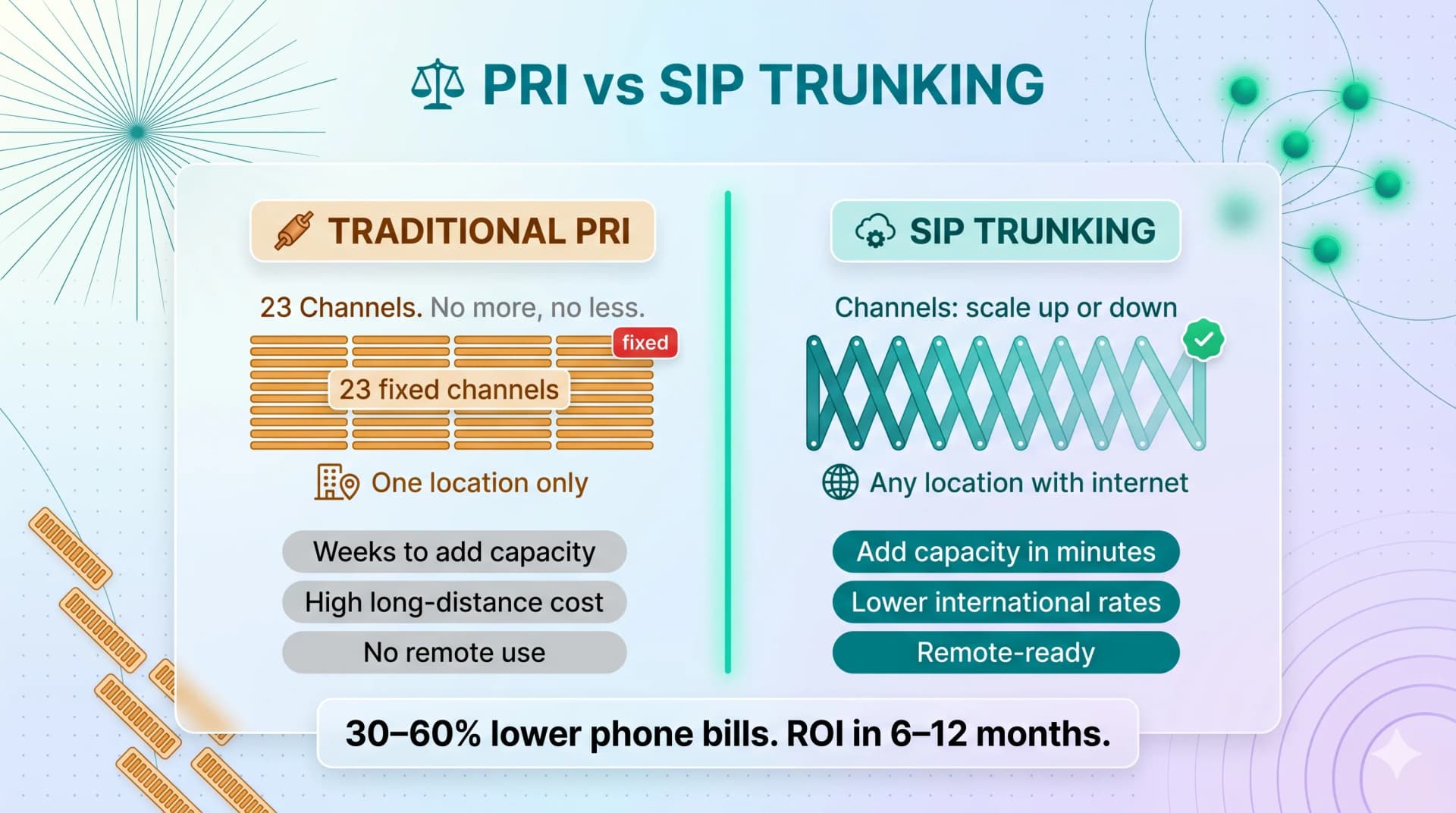
The clearest way to see SIP trunking's value is side by side with the PRI lines it replaces.
Both carry business calls. Only one bends to your needs.
| Factor | Traditional PRI | SIP trunking |
|---|---|---|
| Connection | Physical copper circuit | Internet (IP) |
| Adding capacity | Order a new circuit, wait weeks | Adjust in software, near-instant |
| Channels per unit | Fixed at 23 | Flexible — scale up or down |
| Location | Tied to one building | Works anywhere with internet |
| Long-distance cost | High | Significantly lower |
| Disaster recovery | Limited | Reroute calls instantly |
THE REAL BENEFITS IN 2026
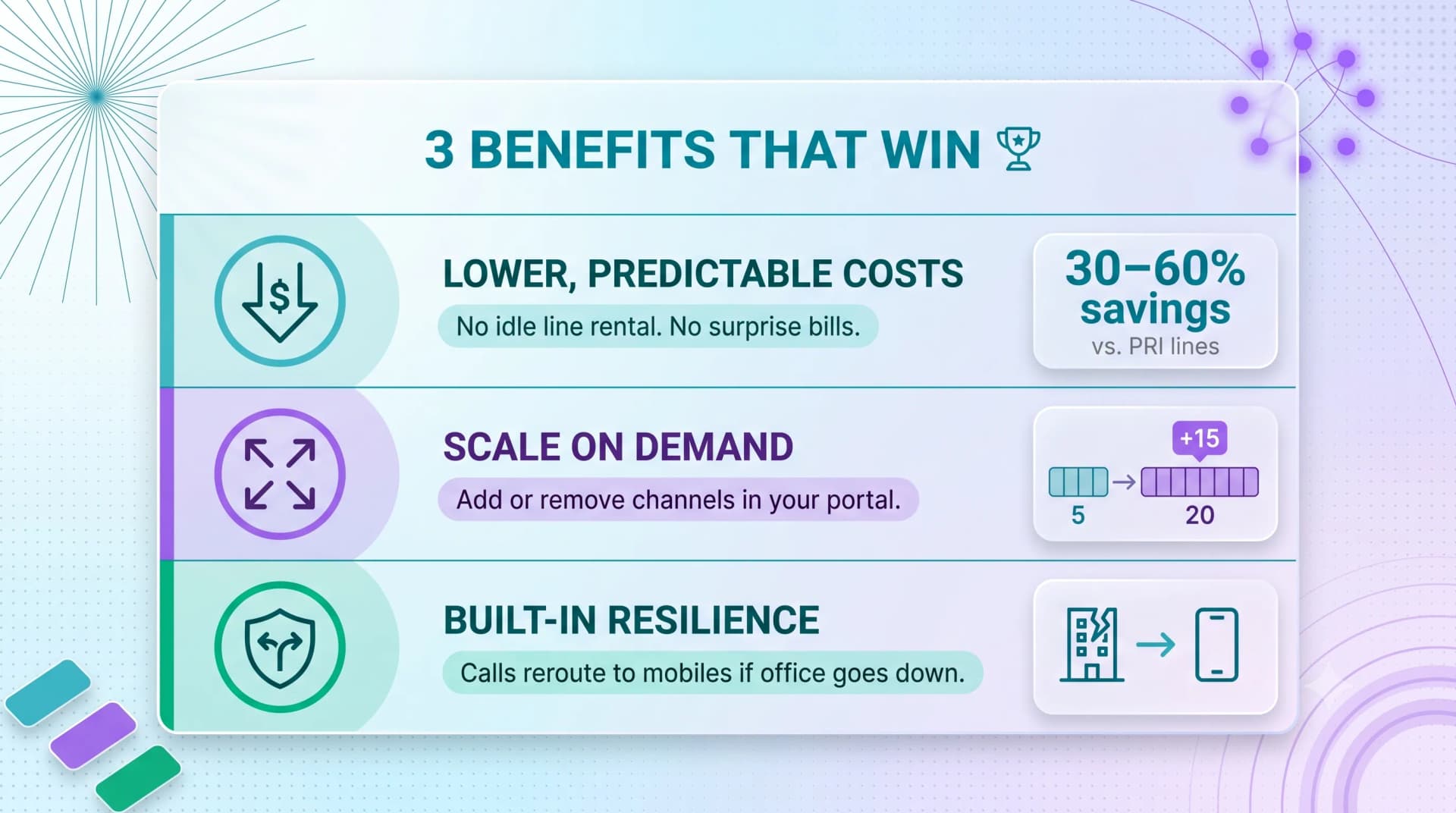
Plenty of articles list ten benefits. Honestly, three of them carry the decision.
These are the reasons businesses actually make the switch.
Lower, More Predictable Costs
Businesses moving to VoIP and SIP trunking typically cut phone bills by 30–60%, and many reach return on investment within 6 to 12 months. You also stop paying for idle physical lines.
Scale on Demand
Hiring 20 people next month? Add channels in your provider portal — no hardware, no waiting.
This also works in reverse. Seasonal business can scale down and stop paying for unused capacity.
Built-In Resilience
If your office loses power or internet, SIP trunks can instantly reroute calls to mobiles, another site, or the cloud. A physical line going down used to mean silence.
This isn't a niche technology, either — the SIP trunking market is projected to grow from roughly $85 billion in 2026 to over $180 billion by 2031.
Running the numbers for your own business? MCM's calling platform lets you test capacity and rates on a free trial — live in about 5 minutes, no contracts.
WHAT TO CHECK BEFORE SWITCHING
SIP trunking is reliable, but it's not magic. A couple of things deserve a real look first.
Get these right and the transition is smooth.
Your Internet Connection
Calls now ride your internet link, so bandwidth and stability matter. A business-grade connection with quality-of-service settings keeps audio clean.
A rough rule: budget around 85–100 kbps per simultaneous call, plus headroom for everything else online.
Provider Quality and Security
Not all trunk providers route calls the same way. Look for strong uptime, fraud protection, and modern caller-ID authentication standards like STIR/SHAKEN.
Good routing is the difference between crisp calls and dropped ones — ask providers how they handle it. Already running on an older SIP trunk? See our 5 ways to maximize a MegaPath SIP trunk for tuning tactics that carry over to any modern provider.
Ready when you are
Ready to sound local everywhere you sell?
MCM activates business numbers in minutes, with call routing, analytics, and CRM-ready integrations. Start your trial — no card to browse inventory.
FAQs
What is SIP trunking in VoIP, in one sentence?
It's a method of connecting your business phone system to the public phone network over the internet, replacing physical phone lines with a flexible digital connection that carries multiple calls at once.
Is SIP trunking the same as VoIP?
Not quite. VoIP is the broad concept of making calls over the internet. SIP trunking is one specific way to do it — the connection that links an existing PBX to the outside phone network.
Do I need to replace my PBX to use SIP trunking?
Usually no. SIP trunking connects to your existing PBX as long as it's IP-capable, which most modern systems are. It upgrades the connection, not the whole phone system.
How much can SIP trunking save my business?
Most businesses cut phone costs by 30–60% after switching, mainly from eliminating physical line rental and lowering long-distance and international rates. Many see full ROI within 6 to 12 months.
Is SIP trunking reliable enough for a business?
Yes, when paired with a stable internet connection and a quality provider. SIP trunks also add resilience — calls can reroute automatically to mobiles or another location during an outage.
How many calls can one SIP trunk handle?
A SIP trunk's capacity is measured in channels, and each channel carries one simultaneous call. Unlike a fixed 23-channel PRI, you can add or remove channels as your call volume changes.
What internet speed do I need for SIP trunking?
Plan for roughly 85–100 kbps per concurrent call, plus extra bandwidth for normal internet use. A business-grade connection with quality-of-service prioritization is strongly recommended.
THE BOTTOM LINE
SIP trunking isn't a dramatic reinvention of your phone system — it's a smarter pipe. You keep the PBX your team knows and swap rigid copper lines for an internet connection that scales, costs less, and reroutes itself when something breaks.
If your business is still renting physical lines, the math is hard to ignore. Start by checking whether your PBX is IP-ready and what your call volume actually is.
Want to see how SIP trunking would work for your setup? Try MCM free — connect a standard PBX in minutes, no contracts, no credit card.