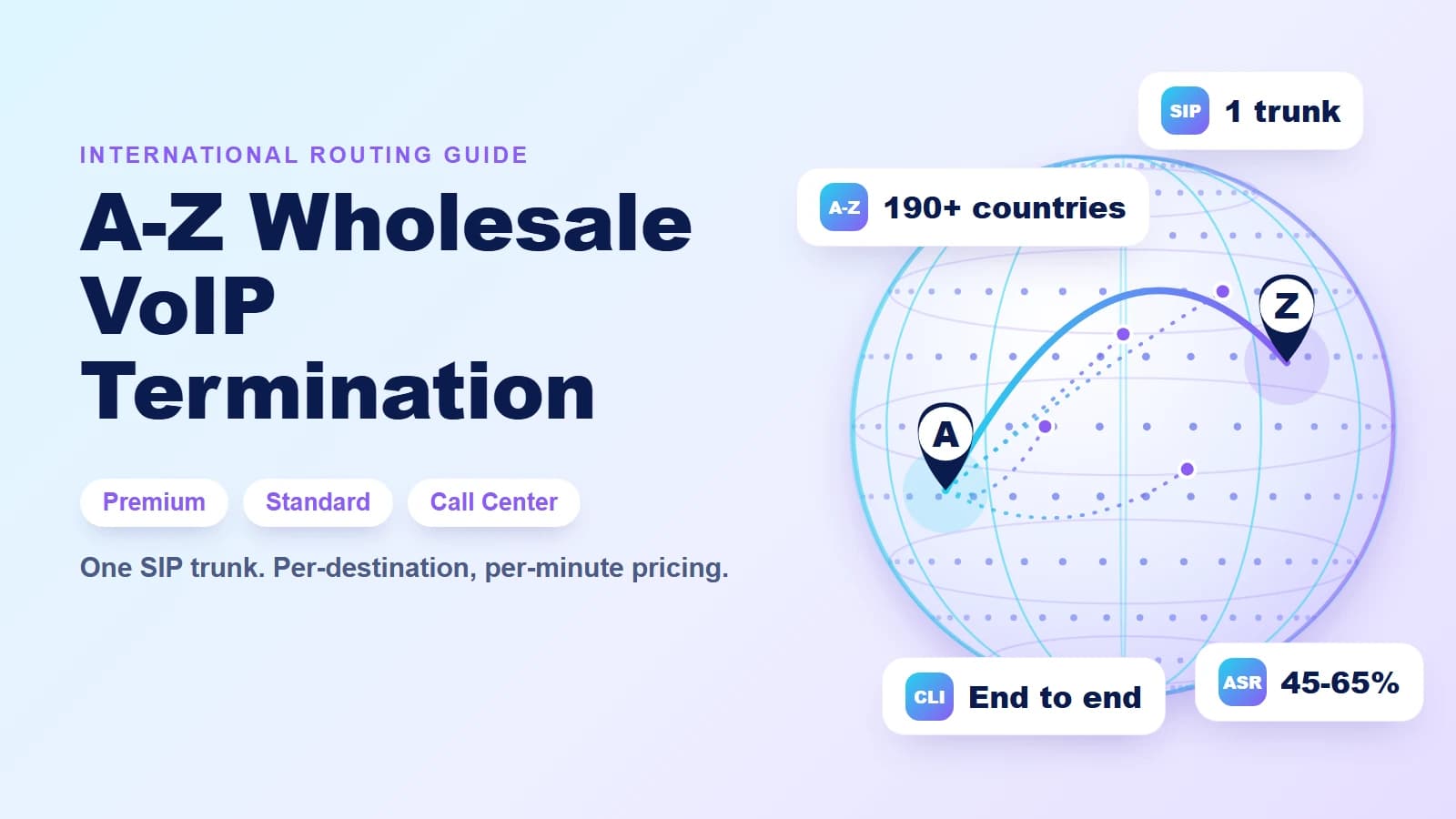
One SIP trunk. 190+ countries. Per-destination, per-minute pricing.
That is the A-Z termination promise — and it delivers, provided you understand what you are actually buying. The trunk itself is straightforward. The complexity is in what happens after your INVITE leaves your platform: which route class the carrier selects, whether CLI is preserved end-to-end, and whether the rate you are paying reflects Tier-1 quality or a grey-market shortcut that degrades after a few weeks.
This guide covers the mechanics of A-Z routing, what distinguishes CLI from Non-CLI and CC route classes, benchmark rates by region, grey route red flags, and the quality metrics you should be tracking before your next interconnect negotiation.
What "A-Z" actually means in carrier wholesale
"A-Z termination" refers to per-destination routing that covers every reachable country code in the E.164 numbering plan — from Afghanistan (+93) to Zimbabwe (+263). A single carrier relationship gives your platform an egress path to any of those destinations, priced individually from the carrier's rate deck.
This is distinct from flat-rate or bundled plans, which set a fixed monthly charge for a predefined country list. A-Z termination charges only for what you use, per minute, per destination. For businesses with variable or unpredictable international traffic, the economics favor A-Z. For businesses with heavy, predictable traffic to one or two major destinations, a dedicated corridor agreement often wins on rate.
The A-Z carrier does not necessarily own physical infrastructure to every country on the list. Most aggregators maintain Tier-1 direct routes to the top 30–40 destinations by volume, then layer transit and regional carriers beneath for the tail end of the list. Route class transparency — knowing which path your traffic actually took — is one of the sharpest differentiators between carriers.
How A-Z routing works at the carrier level
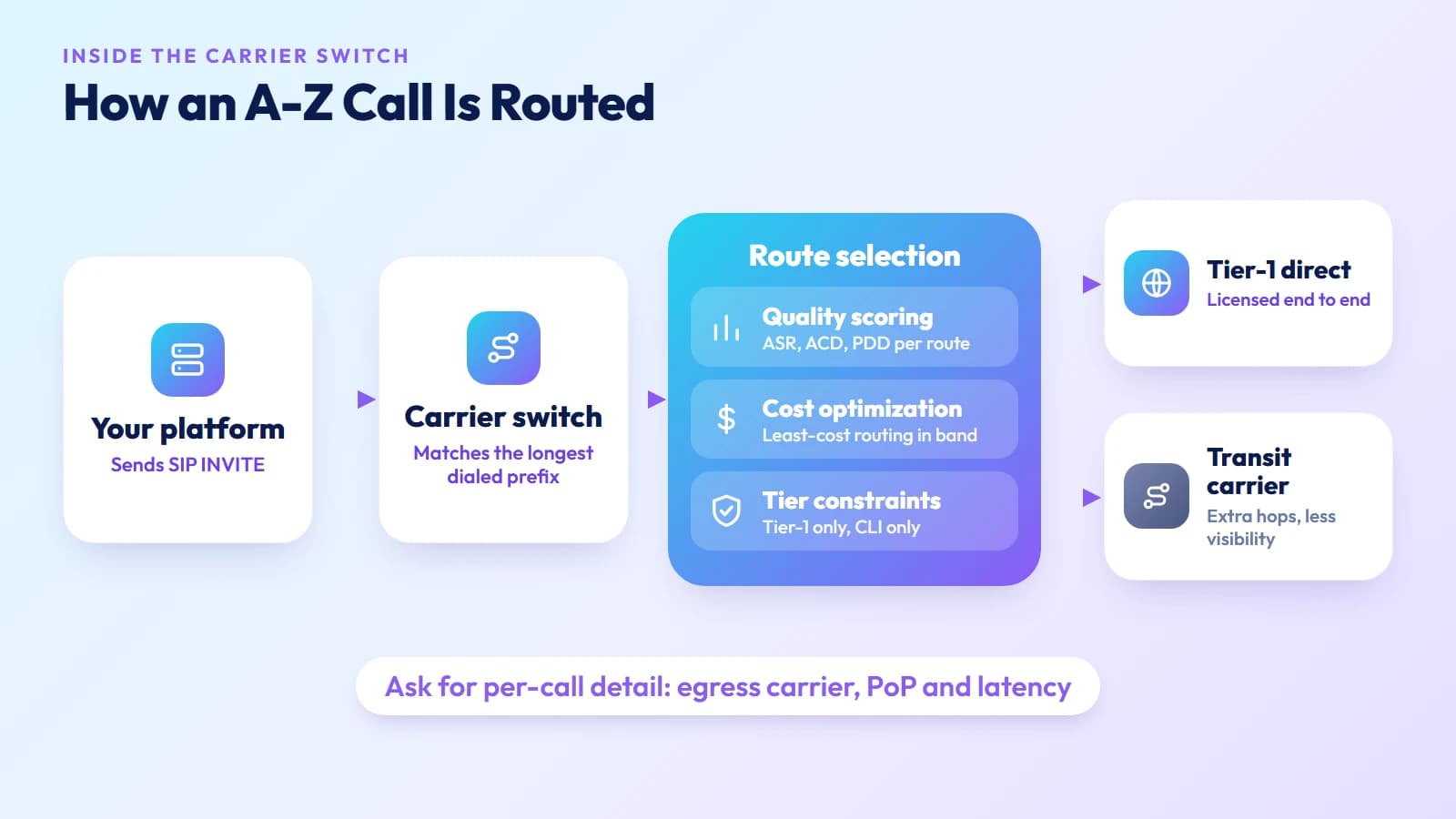
When your platform sends an INVITE, the carrier's switch performs a longest-prefix match against its routing table. A call to +971-50-xxx-xxxx (UAE mobile) matches the /971-50/ prefix, which the carrier has mapped to one or more egress routes. The switch selects a route using a combination of:
- Quality scoring — ASR, ACD, PDD data collected per route over a rolling window
- Cost optimization — least-cost routing (LCR) within the quality band
- Tier constraints — any route restrictions you have negotiated (Tier-1 only, CLI-only, etc.)
The INVITE is then forwarded to the selected egress carrier, which either terminates locally or passes it further down the chain. On grey routes and multi-hop paths, the call may traverse three or four carriers before reaching the PSTN. Each hop adds latency, creates a potential CLI-stripping point, and reduces your visibility into what actually happened.
A carrier that can show you per-call routing detail — which egress carrier handled the call, from which PoP, at what latency — is giving you signal. A carrier that cannot or will not show this is selling you opacity.
Route tiers — Premium, Standard, and Call Center
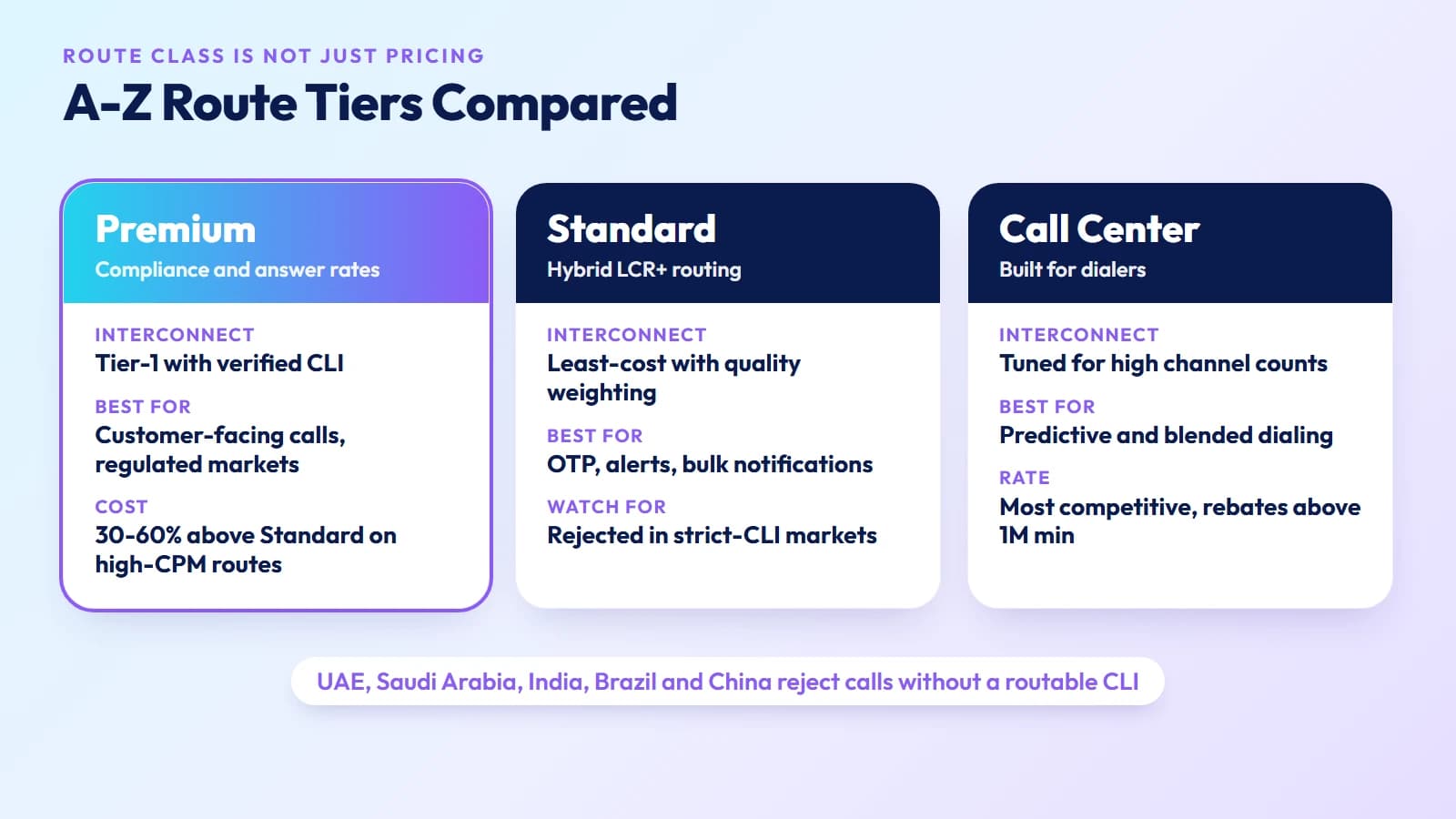
Route class is not just a pricing tier. It describes what the carrier preserves, and what the terminating PSTN requires. My Country Mobile structures its A-Z offering across three tiers:
Premium routes deliver Tier-1 interconnect with verified CLI on every prefix. The originating caller ID (A-number) is passed end-to-end, validated against the originating carrier's number range. Several markets require this at the regulatory level — UAE, Saudi Arabia, India, Brazil, and China all reject calls without a routable CLI. Beyond compliance, Premium routes show consistently higher answer rates because the called party sees a recognizable number rather than "Unknown" or "International."
Standard routes use hybrid A-Z routing with LCR+ (least-cost routing with quality weighting). These are acceptable in less-regulated markets for non-customer-facing traffic: system alerts, OTP delivery, and bulk notification. In markets with strict CLI rules, Standard calls may be rejected at the gateway before they ring.
Call Center routes carry the most competitive per-minute rate and are tuned specifically for predictive-dialer and blended inbound/outbound traffic — optimized for high simultaneous channel counts and rapid connection time. Volume rebates apply above 1M minutes per month.
Rates on MCM's A-Z service start from $0.003/min on direct interconnects, spanning 24,000+ destination prefixes across 190+ countries. The live rate explorer at mycountrymobile.com/wholesale-voip-rates updates several times a week as upstream carrier decks change — check it for current per-destination figures before committing volume.
On high-CPM destinations like the Middle East and South Asia, Premium routes cost 30–60% more than Standard. That premium buys regulatory compliance and answer-rate lift. For corridors above roughly 1M minutes per month, operator-level CLI quotes are available on request.
Ready when you are
Protect your business line.
MCM's local numbers ship with verified caller ID and smart call filtering — customers always know it's really you, and spam never reaches your team.
Tier-1 A-Z routes vs grey routes
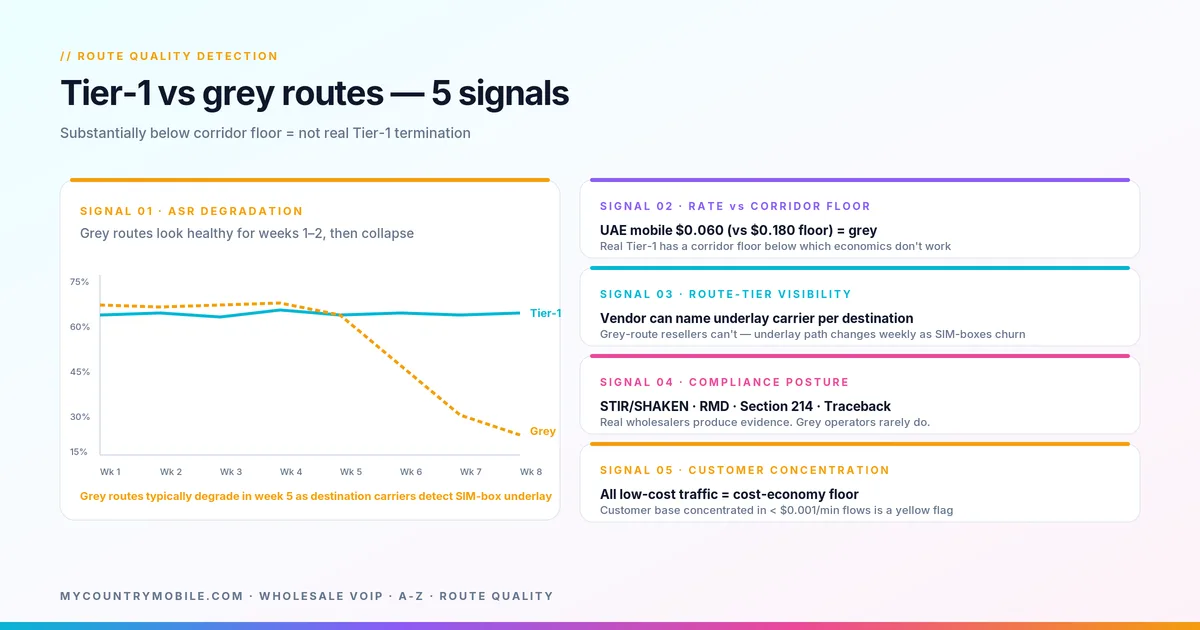
A Tier-1 route means the terminating carrier has a direct bilateral interconnect with the destination country's incumbent or a licensed operator. The call rides licensed infrastructure end-to-end. This is what you are paying CLI rates to get.
A grey route is any path that uses infrastructure in a way that circumvents the standard bilateral agreement — SIM farms, OTT bypass, unlicensed interconnect. Grey routes are cheaper because they exploit gaps in the termination fee structure. They are also unreliable, often short-lived, and in many markets expose the sender to regulatory liability.
Five signals that a rate is grey-route backed:
-
Rate is significantly below the corridor floor. Every regulated destination has a minimum termination rate set by the incumbent. Any quote that comes in 40% or more below the known floor for that market should trigger immediate due diligence — it almost always means bypass traffic.
-
ASR spikes then degrades. Grey routes often start with good ASR as the bypass method is fresh, then decline over 2–6 weeks as the operator identifies and blocks the traffic pattern. A route that went from 55% to 22% ASR in three weeks without a rate-deck change is almost certainly grey.
-
No route-tier disclosure. If your carrier cannot tell you whether a route is Tier-1, Tier-2, or bypass, they either do not know or do not want you to know. Neither is acceptable.
-
Weak compliance posture. No auditable SOC 2 or equivalent, no published STIR/SHAKEN attestation level (for US traffic), no mention of local licensing in regulated markets.
-
Traffic concentration in very-low-cost prefixes. A carrier whose top destinations by volume are almost entirely dirt-cheap corridors is often optimized for bypass, not quality. Ask for their destination mix before committing volume.
ASR, ACD, and PDD benchmarks by region
These three metrics are the language of route quality. If your carrier does not publish them or cannot pull them on demand, you are flying without instruments.
ASR (Answer-Seizure Ratio) — percentage of call attempts that result in an answered call. Low ASR means calls are being rejected, filtered, or dropped before they connect. Sustained low ASR costs you origination charges on failed calls.
ACD (Average Call Duration) — average seconds per answered call. Abnormally short ACD (under 20 seconds on customer-facing traffic) signals either a quality problem (poor audio causing immediate hangups) or FAS (False Answer Supervision — the route bills for an "answered" call that was never actually picked up).
PDD (Post-Dial Delay) — seconds between your INVITE and the first ring-back. Over 7 seconds feels broken to the calling party and drives premature hangups.
| Region | Acceptable ASR | ACD Floor | PDD Threshold |
|---|---|---|---|
| North America | 45–65% | 90 sec | < 3 sec |
| Western Europe | 40–60% | 85 sec | < 4 sec |
| Middle East | 35–55% | 75 sec | < 5 sec |
| South Asia | 30–50% | 70 sec | < 5 sec |
| Southeast Asia | 25–45% | 65 sec | < 6 sec |
| Latin America | 30–50% | 72 sec | < 5 sec |
| Sub-Saharan Africa | 20–40% | 60 sec | < 7 sec |
If your traffic to any region sustains ASR below the lower bound of its range for more than 7 consecutive days, escalate to NOC. If ACD is under 30 seconds on destinations where you expect meaningful conversations, investigate FAS immediately.
Billing increments — the hidden rate inflator
Published per-minute rates are only half the cost equation. Billing increments determine how short calls are rounded up.
A 1/1 increment (one-second minimum, one-second rounding) charges exactly what the call used. A 30/6 increment charges a minimum of 30 seconds then rounds up in 6-second blocks. On a predictive-dialer campaign where average ACD is 45 seconds, the 30/6 model charges roughly the same as 1/1. But on a campaign where many calls are answered and hung up within 15 seconds, you are paying 30 seconds per event.
60/60 increments (one-minute minimum, one-minute rounding) are the worst-case for short-call traffic. A 10-second call costs the same as a 60-second call. On heavy campaign traffic, 60/60 can inflate effective per-minute costs by 40–80% versus the published rate.
Always negotiate 1/1 or 6/6 increments for campaign and dialer traffic. For inbound customer calls with normal ACD, 6/6 is acceptable.
Choosing an A-Z termination wholesaler: five criteria
1. Destination depth on your top corridors The A-Z label says 190+ countries, but what matters is route quality on the 10–15 destinations that drive 80% of your volume. Ask for route transparency — Tier-1 direct vs. transit — on each of those prefixes before signing.
2. Route-tier visibility per call Real-time CDRs that show egress carrier, route class, and PDD per call let you catch degradation before it affects your customers. Carriers who offer only summary reports are harder to hold accountable.
3. Billing increment As covered above: 1/1 or 6/6 for variable-duration traffic. Non-negotiable for dialer use cases.
4. NOC responsiveness A-Z traffic degrades unpredictably. The difference between a 20-minute outage and a 4-hour outage is often whether your carrier has 24/7 NOC with real-time rerouting authority. Ask for an escalation SLA in the contract, not just a support ticket queue.
5. Compliance evidence For US traffic: STIR/SHAKEN attestation level (A is required for direct calls from your own numbers). For regulated international markets: copies of local operator licenses or interconnect agreements. A carrier with a published compliance page and auditable evidence is a carrier that has thought about what happens when a regulator calls.
What to ask before your next interconnect
A short checklist for evaluating any A-Z termination proposal:
- Route class available per destination (Tier-1 direct / transit / bypass)
- CLI preservation confirmed end-to-end, not just to the first hop
- Live ASR/ACD/PDD data accessible via API or portal (not just monthly reports)
- Billing increment — 1/1 or 6/6 confirmed in writing
- Rate update notice period — 24–72 hours minimum before effective date
- 24/7 NOC with rerouting authority, escalation SLA in the contract
- STIR/SHAKEN attestation level for US traffic
- Regulatory compliance documentation for UAE, India, Brazil, Saudi Arabia if you terminate there
- FAS protection — contractual prohibition and monitoring commitment
Comparing carriers side by side? Our guide to the best wholesale VoIP providers ranks the main options, and the wholesale SIP termination guide covers the trunk side.
Ready when you are
Ready to sound local everywhere you sell?
MCM activates business numbers in minutes, with call routing, analytics, and CRM-ready integrations. Start your free trial — no card to browse inventory.
Frequently asked questions
What is A-Z VoIP termination?
A-Z VoIP termination is a wholesale service that routes outbound calls to any international destination — every country code in the ITU E.164 numbering plan — over a single SIP trunk. Instead of managing separate carrier relationships per country, a reseller or enterprise buys one interconnect and pays per-destination, per-minute rates from a published rate deck.
How is A-Z termination different from flat-rate or bundled termination?
Flat-rate or bundled plans charge a fixed monthly fee for calls to a predefined country list. A-Z termination prices every destination individually, charges purely per-minute, and has no monthly minimums in most wholesale agreements — making it better suited for businesses with unpredictable international call patterns.
Do all destinations require CLI delivery on A-Z routes?
No, but many high-value markets do. UAE, Saudi Arabia, India, Brazil, and China mandate CLI delivery at the regulatory level. Calls presented without CLI are rejected before they ring. In less-regulated markets CLI still improves answer rates, so most enterprise customers request CLI routes by default even where it is not legally required.
How often do A-Z wholesale rates change?
Most carriers refresh rate decks weekly. High-volatility corridors — Middle East mobile, West African destinations, Latin American mobile — can move 5–15% week-over-week during regulatory or interconnect changes. Stable corridors like US, UK, and Western Europe mobile rates are relatively fixed for months at a time. Any A-Z wholesaler worth using gives 24–72 hours notice before a rate change takes effect.
What ASR should I expect on A-Z routes?
ASR benchmarks vary by region. North America CLI routes should sustain 45–65% ASR. Western Europe runs 40–60%. Middle East and South Asia CLI routes typically land between 30–55%. Sub-Saharan Africa is lowest at 20–40%. Sustained ASR below the regional baseline for more than 7 consecutive days warrants escalation to your carrier's NOC.
Can I get A-Z termination without a long-term contract?
Yes. Most wholesale A-Z carriers offer prepaid or month-to-month arrangements for smaller volumes. Volume-based contracts (typically 50K+ minutes per month) unlock better rates and dedicated route management. Self-service portals let you top up, pull rate decks, and configure trunks without a sales cycle.