Most wholesale VoIP migrations fail for the same reason: a single-event cutover with no parallel testing, no rollback path, and a live customer environment as the proving ground.
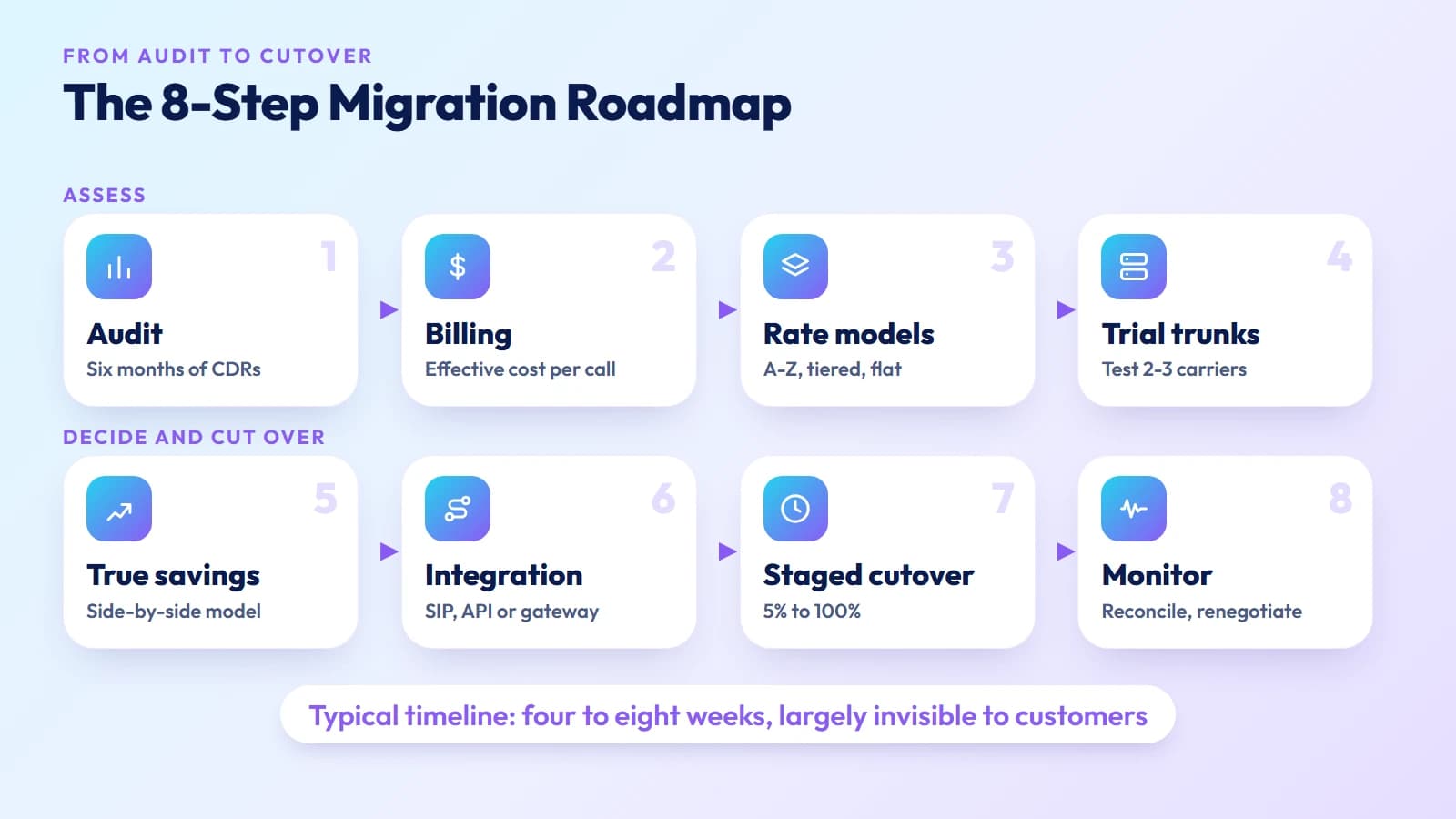
Done right, a wholesale VoIP migration takes four to eight weeks and is largely invisible to your customers. Done wrong, it shows up as a spike in call failures, a complaint queue, and an emergency escalation to a NOC you have never spoken to before.
This guide walks through the full sequence — from traffic audit to post-cutover renegotiation — with the decision points that determine whether your migration lands cleanly or not.
Step 1 — Audit your current call patterns and costs
Before you evaluate a single new vendor, you need to understand exactly what you are moving. Pull six months of CDR (Call Detail Record) data and examine:
- Destination mix — which country codes and prefixes make up your top 80% of volume. This tells you which corridors matter most in any rate deck comparison.
- Call duration distribution — average call duration per destination. Short-ACD destinations are sensitive to billing increment differences; long-ACD destinations are not.
- Time-of-day patterns — peak traffic windows affect how much concurrent channel capacity you need to negotiate.
- Baseline quality per destination — your current ASR, ACD, and PDD by region. These become the benchmarks you hold your new carrier to.
Six months of data is the minimum. Seasonal patterns — campaign periods, holidays, regional events — only become visible over that window.
Step 2 — Evaluate your current billing mechanics
Your current per-minute rate is not your actual cost. Before you can compare a new carrier fairly, you need to know what your legacy billing is actually charging per completed call.
Reconcile 90 days of invoices against CDRs and look for:
- Billing increment effects — a 30/6 or 60/60 increment inflates effective costs significantly on short-duration traffic. Calculate your effective per-minute cost across your real call duration distribution, not the published rate.
- FAS (False Answer Supervision) — check whether answered call counts in your invoices match ring events in your CDRs. A consistent 3–8% gap is a FAS signal.
- Per-attempt fees — some carriers charge a small fee on every call attempt regardless of whether it answers. At high call volumes this is material.
- DID rental charges — often bundled into wholesale agreements without clear line-item visibility.
This reconciliation exercise usually reveals that your effective cost is 10–25% higher than the headline rate you negotiated.
Step 3 — Understand the wholesale rate structure
Wholesale VoIP pricing comes in three main models, and your evaluation criteria differ depending on which model a candidate carrier uses.
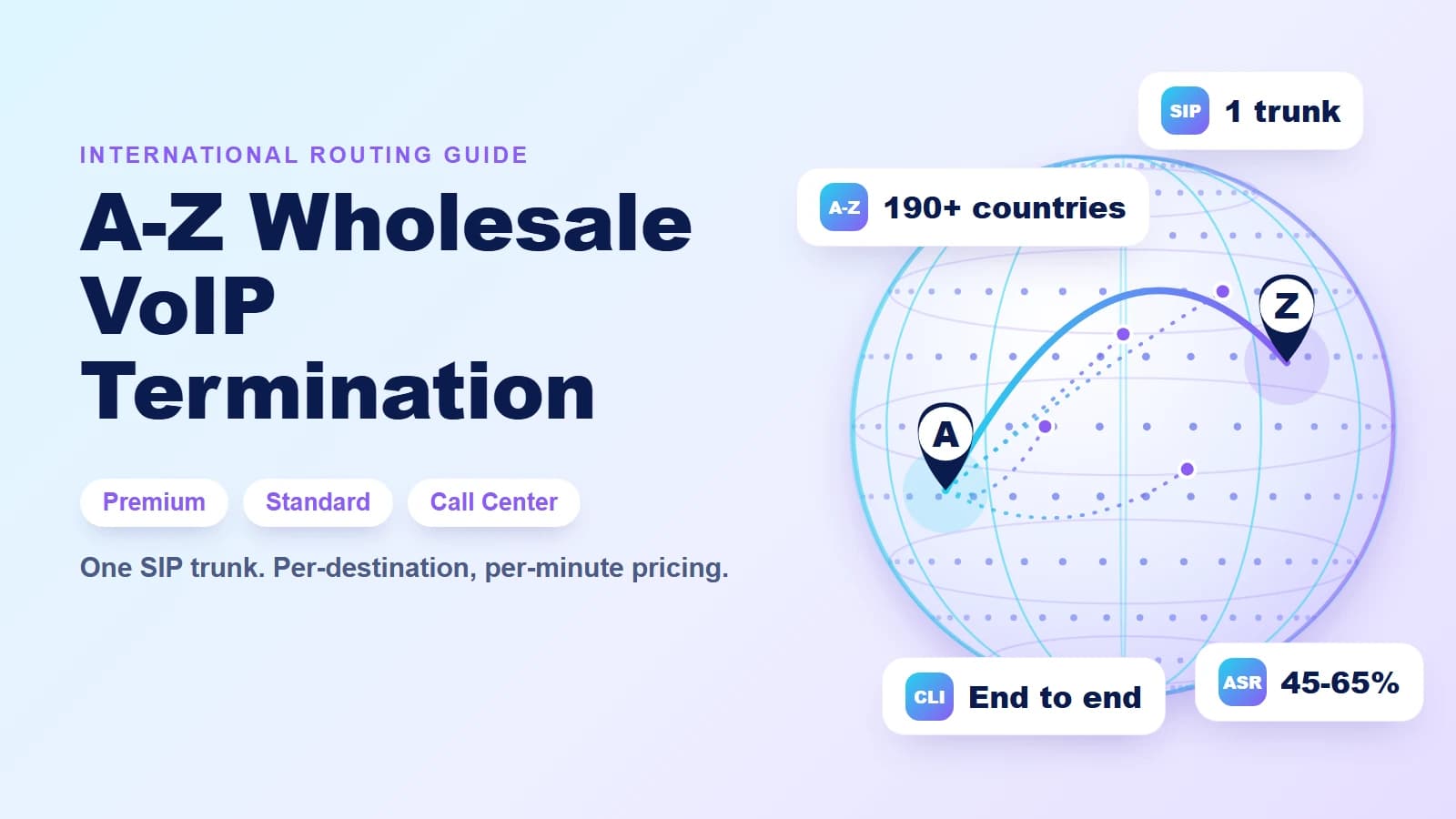
A-Z rate decks price every destination individually per minute. Flexible, transparent, and easy to compare across carriers. The risk is rate volatility on high-CPM corridors. My Country Mobile's wholesale service uses this model, with the live rate explorer at mycountrymobile.com/wholesale-voip-rates updating several times a week as upstream decks change.
Tiered routing (Premium / Standard / Call Center, or equivalent) bundles route class with pricing. Premium routes carry Tier-1 CLI; Standard uses hybrid LCR; Call Center targets dialer traffic with volume rebates. This is how MCM structures its offering — starting from $0.003/min on direct interconnects across 24,000+ destination prefixes.
Flat-rate or blended pricing sets a single per-minute rate for a defined destination bundle. Simpler to budget, but usually priced conservatively to protect the carrier's margin across all traffic types.
Most enterprises with an international destination mix get the best value from A-Z or tiered pricing. Flat-rate plans favor businesses with heavy, predictable traffic to a small number of destinations.
Ready when you are
Protect your business line.
MCM's local numbers ship with verified caller ID and smart call filtering — customers always know it's really you, and spam never reaches your team.
Step 4 — Request trial SIP trunks from two or three wholesalers
Never evaluate a wholesale carrier on rate deck alone. Live traffic quality on your specific destination mix is the only reliable signal.
Request trial trunks from two to three candidate carriers and run them in parallel for at least two weeks. What to test:
- ASR by destination against the regional benchmarks from your Step 1 baseline
- PDD — anything over 7 seconds on high-value corridors is a red flag
- CLI preservation — validate end-to-end delivery on the markets you care about
- NOC responsiveness — deliberately escalate a test quality issue and measure response time and resolution quality
- Portal and CDR access — can you pull per-call routing detail, or only summary reports?
Two weeks is the minimum test window. Grey routes and suboptimal paths often show acceptable quality in week one, then degrade as the carrier identifies and blocks traffic patterns.
Step 5 — Calculate true savings
Build a side-by-side cost model using your actual CDR data, not theoretical traffic assumptions. The comparison needs to account for:
| Cost factor | Legacy approach | Wholesale (MCM) |
|---|---|---|
| Billing increment | Often 30/6 or 60/60 | 1/1 or 6/6 available |
| FAS protection | Rarely audited | Contractual prohibition |
| Route transparency | Summary reports only | Per-call CDR with egress carrier detail |
| NOC access | Ticket queue | 24/7 with rerouting authority |
| CLI handling | Varies by corridor | Verified end-to-end on Premium tier |
| Rate deck frequency | Monthly or quarterly | Several times weekly |
| Compliance evidence | Ad hoc | SOC 2, STIR/SHAKEN, ISO 27001 |
Successful evaluations typically show a 15–40% reduction in total wholesale spend once billing increment normalization and FAS elimination are included alongside the headline rate difference. The per-minute rate change alone usually understates the full saving.
Step 6 — Choose your integration method

There are three ways to connect a wholesale SIP trunk to your existing infrastructure:
Direct SIP trunk with LCR — your softswitch or SBC routes outbound calls to the wholesale carrier's SIP proxy, with your existing LCR logic selecting between carriers based on destination and quality. Recommended for most migrations. Minimal infrastructure change, keeps your existing dialplan intact, and is straightforward to roll back.
API-driven provisioning — carriers like MCM offer REST APIs for real-time trunk management, rate deck pulls, and CDR retrieval. Relevant if you are building a programmatic routing layer or need automated rate deck ingestion for a reseller platform.
SIP-to-SIP gateway — a media gateway translates between your existing infrastructure's SIP variant and the wholesale carrier's. Useful for legacy systems that cannot handle direct SIP registration but adds a latency hop and a hardware dependency you would rather not have in a production path.
For most resellers and enterprises, the direct SIP trunk is the right choice. The API layer becomes relevant at scale.
Step 7 — Implement gradually with parallel routing
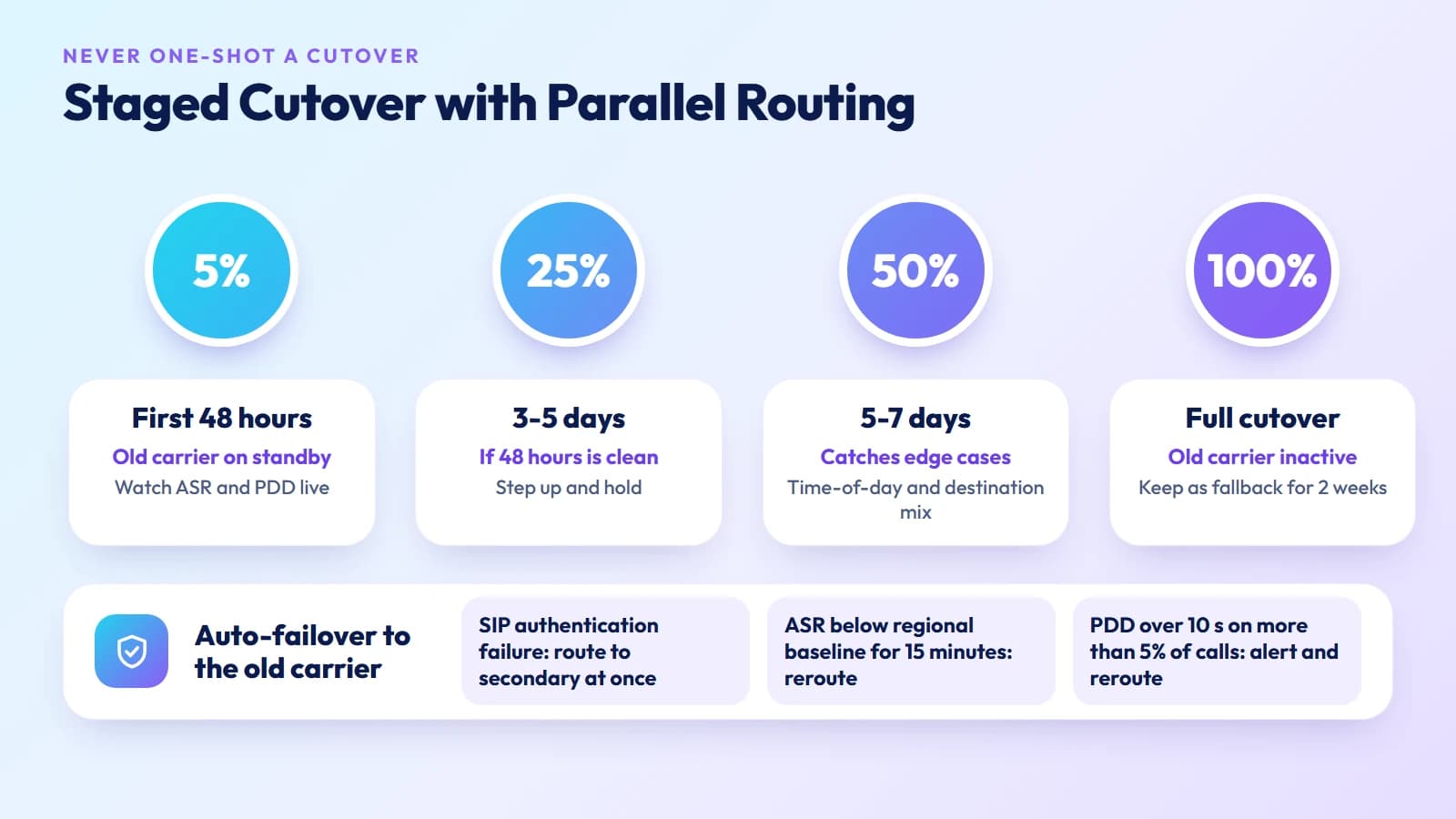
This is the step that determines whether your migration is invisible to customers or not. Do not do a single-event cutover.
The standard phased approach:
- 5% of traffic — first 48 hours on the new trunk, old carrier on standby. Watch ASR and PDD in real time.
- 25% of traffic — if 48 hours is clean, step up. Hold for three to five days.
- 50% of traffic — hold for five to seven days. This is where you catch time-of-day and destination-mix edge cases.
- 100% of traffic — full cutover. Keep the old carrier configured but inactive for two weeks as a fallback.
Configure automatic failover triggers in your SBC before go-live:
- SIP authentication failure → immediate route to secondary
- ASR drops below regional baseline for 15 consecutive minutes → reroute
- PDD exceeds 10 seconds on more than 5% of calls → alert and reroute
Do not decommission your legacy trunk until you have completed at least two full billing cycles on the new carrier and reconciled the invoices.
Step 8 — Monitor quality and renegotiate
A migration is not finished at cutover. The post-go-live period is when you establish the operational rhythms that protect quality and reduce costs over time.
Monthly — reconcile CDRs against invoices. Verify billing increments are applied correctly. Check FAS rates. Confirm route class matches what you contracted.
Quarterly — pull ASR/ACD/PDD by region and compare against your baseline. If any corridor has degraded, escalate before the next contract review cycle, not during it.
Annually — run a competitive benchmark. Request rate decks from two other carriers and compare against your current agreement. Wholesale markets move, and a carrier that was competitive at contract time may not be a year later. Use the benchmark as leverage in renegotiation, not as a precursor to another migration.
Common pitfalls to avoid
Optimizing on deck rate alone. The carrier with the lowest published per-minute rate on a destination is not always the cheapest option once billing increments and FAS are calculated in.
Omitting billing increments from contracts. If the contract does not specify the increment, the carrier defaults to their standard — often 60/60. Get 1/1 or 6/6 in writing before you sign.
Skipping the FAS audit. FAS is hard to detect without CDR-level reconciliation. If your carrier invoices 8% more answered minutes than your platform logs, that is FAS revenue going to the carrier.
Not renegotiating volume tiers. Most wholesale agreements have volume break points. If your traffic grows 40% in a year and you have not renegotiated, you are probably sitting in a tier below what your volume qualifies for.
Treating compliance as a checkbox. STIR/SHAKEN attestation, GDPR handling for call recordings, and local licensing in regulated markets (UAE, India, Saudi Arabia) are ongoing obligations, not items to verify once at contract signing.
Ready when you are
Ready to sound local everywhere you sell?
MCM activates business numbers in minutes, with call routing, analytics, and CRM-ready integrations. Start your free trial — no card to browse inventory.
Frequently asked questions
How long does a wholesale VoIP migration take end-to-end?
A well-run migration takes four to eight weeks from first traffic audit to full cutover. The core phases are: two weeks for CDR analysis and vendor evaluation, two weeks of parallel testing at low traffic volume, one to two weeks ramping from 25% to 100%, and one week of post-cutover monitoring before decommissioning the legacy trunk. Rushing the parallel-test phase is the most common cause of quality incidents at cutover.
Can I keep my existing softswitch when switching wholesalers?
Yes. Switching wholesale providers is a SIP trunk reconfiguration, not a platform replacement. You update the outbound route in your softswitch or SBC to point to the new carrier's SIP proxy, configure authentication credentials, and test. Your existing dialplan, IVR, and call routing logic stay intact.
What's the financial breakeven for switching wholesalers?
Most wholesale migrations break even within the first billing cycle. Engineering effort is typically 20–40 hours of internal time, and the savings on effective per-minute cost are immediate. Successful evaluations typically show a 15–40% reduction in total wholesale spend once billing increments, FAS elimination, and route-quality improvements are factored in.
Do I need to renegotiate my customer contracts when changing wholesale termination?
In most cases, no. Your customer contracts are for the service you deliver, not the specific wholesale carrier underneath it. If your customer contracts include SLA terms referencing quality benchmarks, confirm that the new carrier's SLA meets or exceeds those before cutting over.
What happens to my existing DID numbers when I switch wholesalers?
DIDs are managed separately from outbound termination. Your inbound number inventory stays with whichever provider hosts it unless you also want to port those numbers. A termination-only migration leaves your DID portfolio unchanged. Porting can run in parallel but should not be bundled into the outbound cutover.
Should I run multi-wholesaler permanently or consolidate to one?
Under 500K minutes per month, a single Tier-1 carrier is usually the simpler, more reliable choice. Above 500K minutes per month, a primary-plus-overflow model makes sense: one carrier for 80–90% of traffic with a secondary for failover and rate arbitrage on specific corridors.