How to Choose Wholesale Voice Termination Providers: A 2026 Buyer's Guide
Two providers quote you the same destination. One is at $0.009 a minute, the other at $0.004. The cheap one looks like a win — until your answer rates crater and customers start complaining.
In wholesale voice, the rate on the sheet tells you almost nothing on its own. What matters is the route behind it, the quality metrics that route delivers, and what happens when something breaks at 3 a.m.
This guide is a practical framework for evaluating wholesale voice termination providers in 2026 — what to test, what to ask, and where the traps are. We run a global voice network at My Country Mobile (MCM), so this comes from the operations side.
START WITH WHAT YOU'RE ACTUALLY BUYING
Voice termination is the service of handing your outbound calls to a carrier that delivers them to the destination network.
A wholesale provider sits between you and the final-mile carriers, aggregating routes across countries. Your costs, your call quality, and your fraud exposure all flow from that relationship.
So the choice isn't about finding the lowest number. It's about finding the provider whose routes match your traffic type.
KNOW YOUR ROUTE TYPES
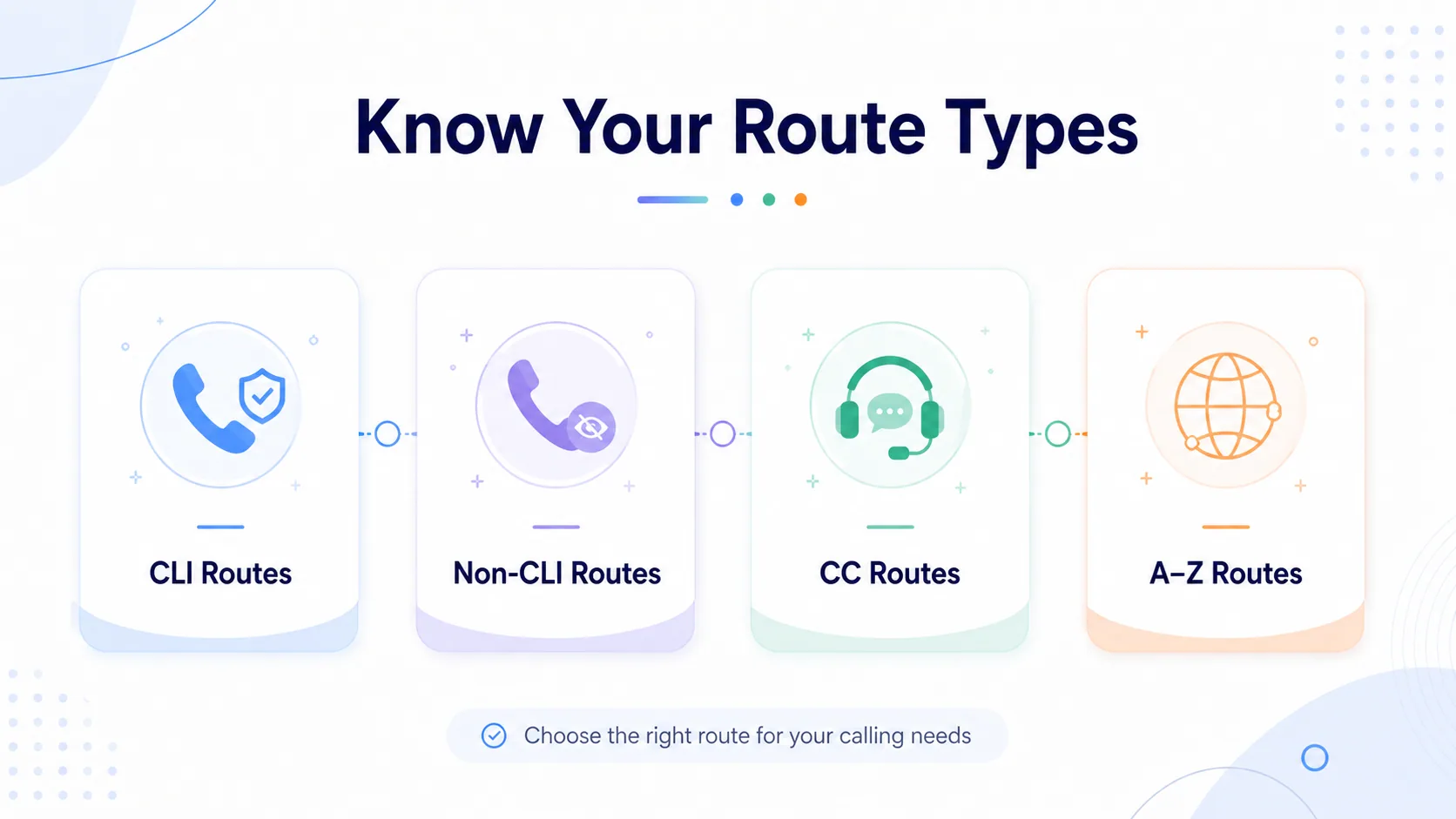
Every provider sells different route grades. Mixing them up is the most common — and costly — mistake.
CLI Routes
CLI (Caller Line Identification) routes pass the caller's number through to the destination. Answer rates are higher because the call looks legitimate.
These are the routes for call centers, enterprises, and any traffic where the recipient needs to see who's calling.
Non-CLI Routes
Non-CLI routes don't pass caller ID. They cost less and suit high-volume bulk traffic where caller display doesn't matter.
The trade-off is lower answer rates and, in some markets, blocking. Cheap blended Non-CLI is often what's hiding behind a suspiciously low rate.
CC and A-Z Routes
Call center (CC) routes are tuned for the dialing patterns of contact centers. A-Z termination means global coverage across all destinations from one provider.
Match the route grade to your use case before you compare a single price.
Ready when you are
Protect your business line.
MCM's local numbers ship with verified caller ID and smart call filtering — customers always know it's really you, and spam never reaches your team.
THE QUALITY METRICS THAT ACTUALLY MATTER
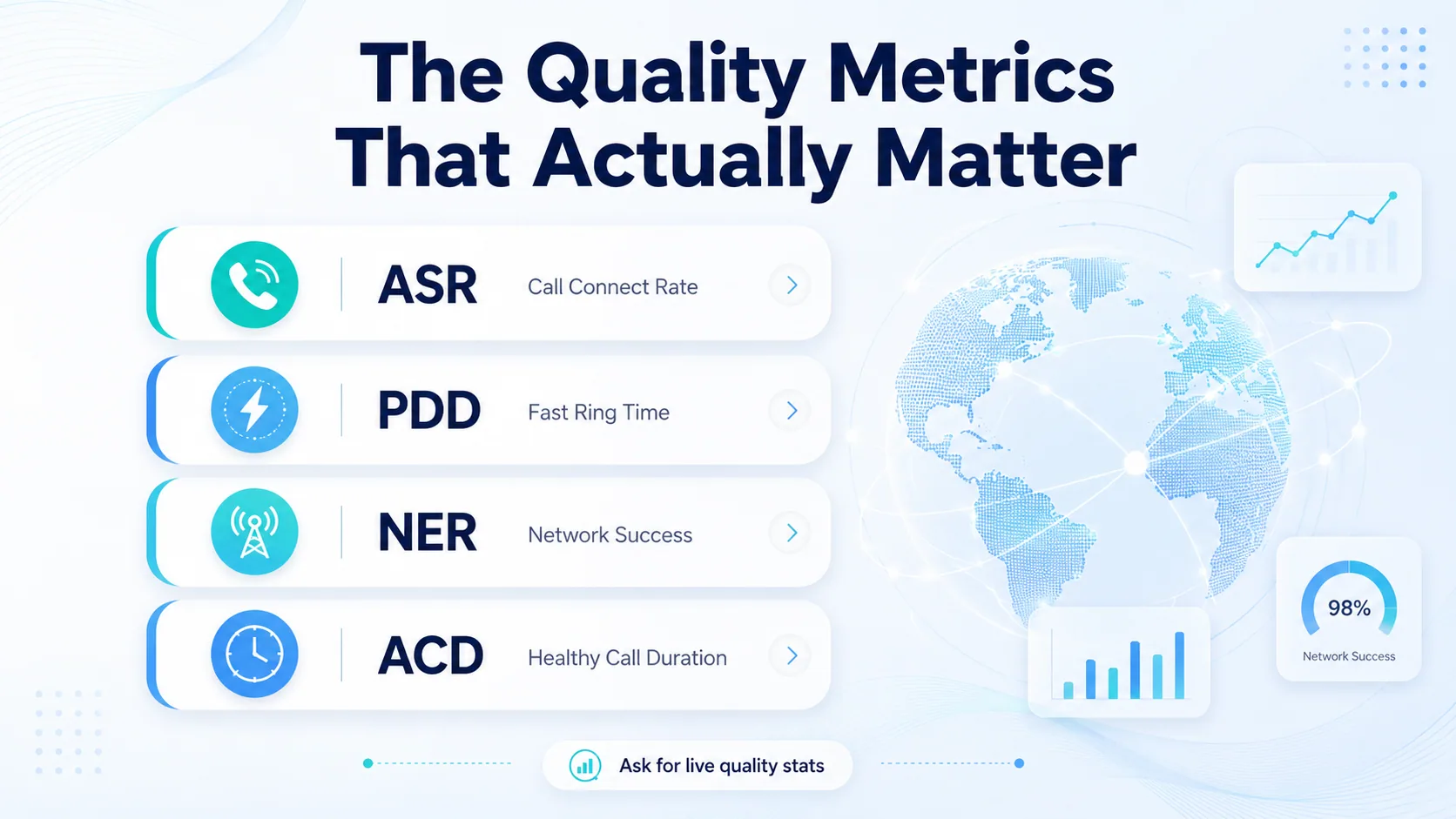
A rate sheet is meaningless without quality data behind it. These are the numbers to demand.
| Metric | What It Measures | What Good Looks Like |
|---|---|---|
| ASR | Answer Seizure Ratio — calls that connect | 60%+ on most routes |
| PDD | Post-Dial Delay — wait before ringback | Low; long delays cause hang-ups |
| NER | Network Effectiveness Ratio — technical success | High; excludes busy/no-answer |
| ACD | Average Call Duration — call length | Healthy length, not abnormally short |
A provider serious about quality will share live or recent stats. One that dodges the question is telling you something.
A reputable provider publishes route performance openly. MCM's wholesale voice routing is built around QoS monitoring across CLI, Non-CLI, and CC routes — ask any shortlisted provider for the same transparency.
HOW TO READ A RATE STRUCTURE
Pricing in wholesale voice is where good providers and bad ones separate fastest.
Watch for the Single Suspicious Rate
A trustworthy provider quotes tiered pricing — Premium, Standard, Economy — per destination. One flat, very low rate for everything usually means low-quality blended routes.
If a price looks too good for that country, it almost always is.
Understand Billing Increments
Per-second billing is fairer than per-minute rounding. A "1/1" increment bills exact seconds; a "60/60" rounds every call up to a full minute.
On high call volumes, that rounding adds up to real money. Always confirm the increment.
Factor In Volume Commitments
Higher committed traffic should unlock better rates. Ask how pricing scales — and whether you're locked into minimums you can't realistically hit.
NETWORK INFRASTRUCTURE AND COVERAGE
Behind the rates sits the network. Its design decides your reliability.
Look for direct interconnects with in-country mobile and landline operators — the more direct routes, the better the quality and the fewer middlemen. Ask how many destinations are served directly versus through other aggregators.
Geographically distributed Points of Presence (PoPs) reduce latency and provide failover. A provider with redundant routing keeps calls flowing when one path goes down.
COMPLIANCE AND FRAUD PROTECTION IN 2026
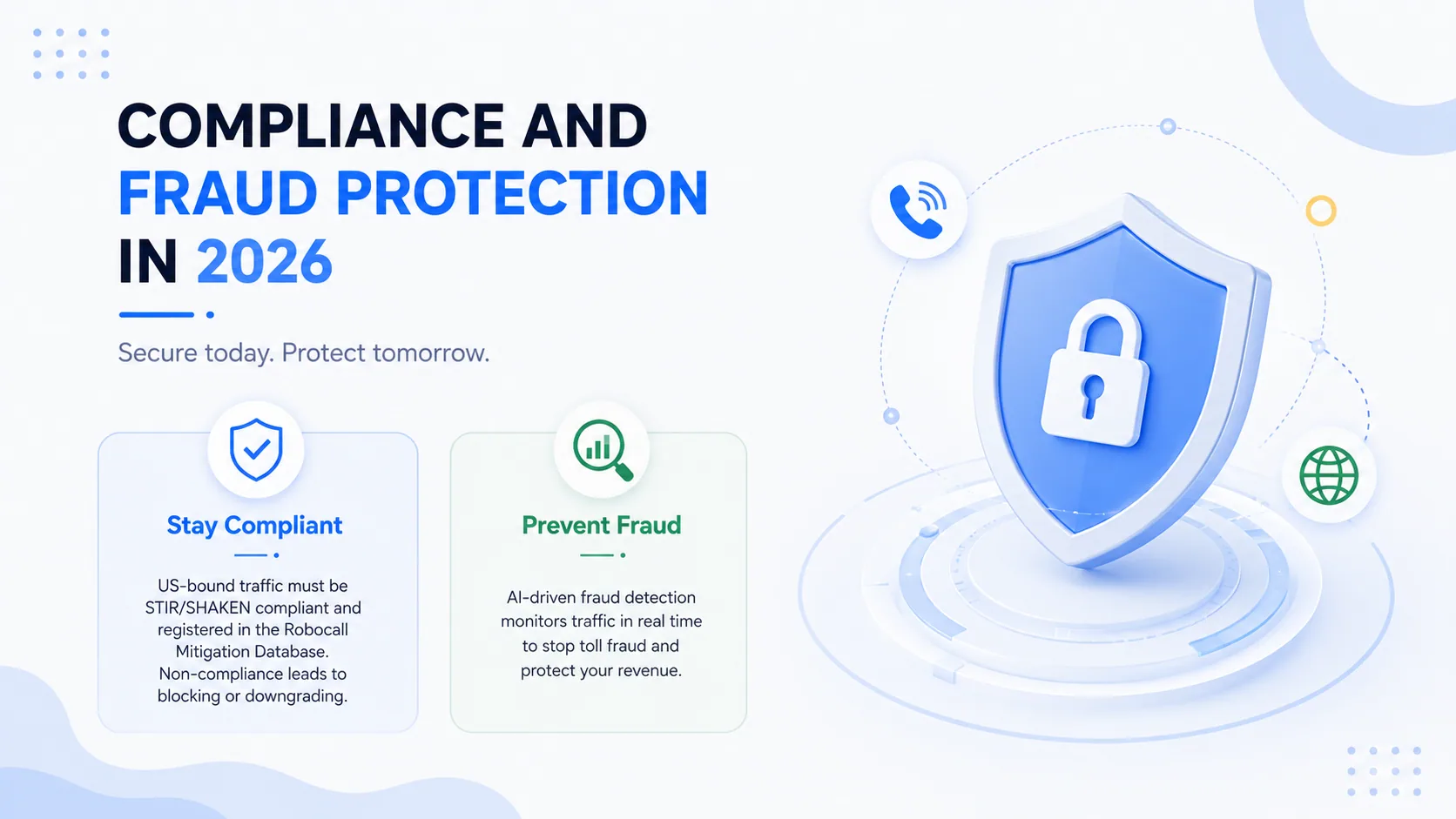
This is no longer optional, especially for US-bound traffic.
Any provider terminating to the US must be STIR/SHAKEN compliant and registered in the Robocall Mitigation Database. Without it, your traffic gets blocked or downgraded.
Equally important: ask about AI-driven fraud detection. Toll fraud can drain thousands in hours, and a provider that monitors traffic anomalies in real time protects your revenue, not just theirs.
SUPPORT — THE TEST EVERYONE SKIPS
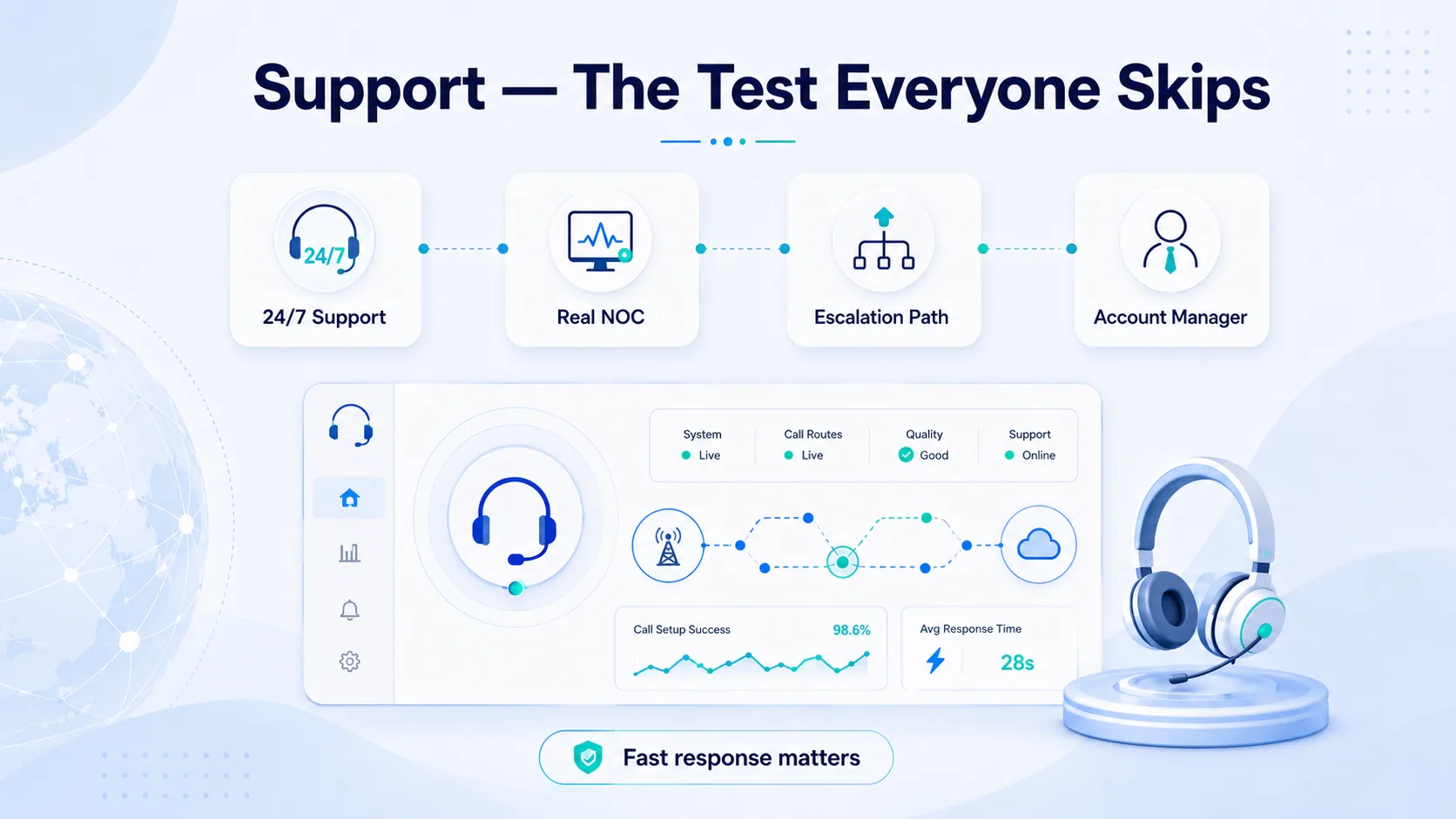
Routes degrade. Destinations go down. The question is how fast your provider responds.
Find out whether support is 24/7, and whether there's a real NOC (Network Operations Center) actively monitoring traffic — or just a ticket queue. Ask for the escalation path before you sign.
A dedicated account manager for meaningful volume is a strong signal. So is a provider willing to put response times in writing.
HOW TO RUN YOUR EVALUATION
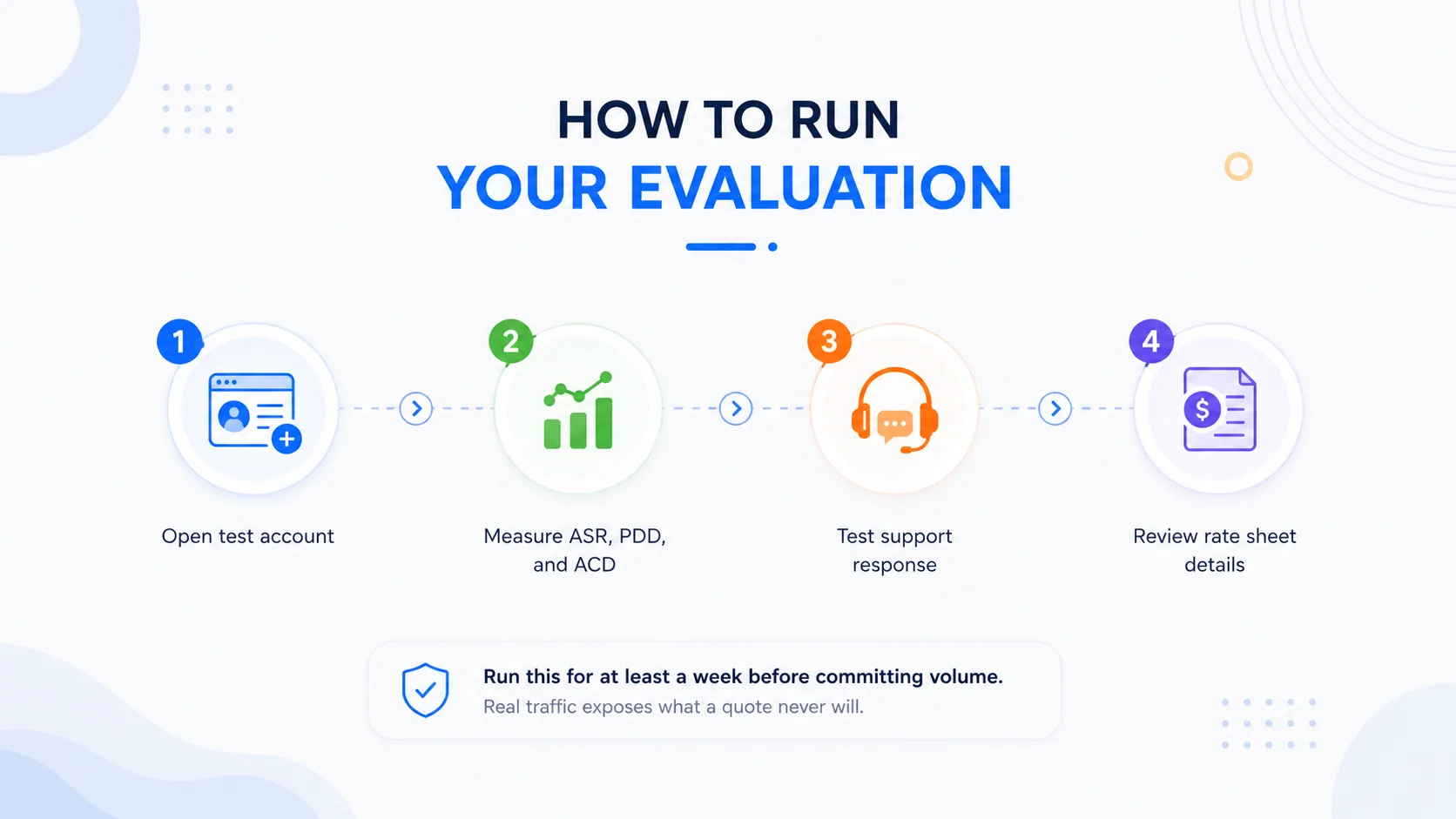
Don't decide on a sales call. Decide on a test.
- Open a test account and send live traffic to your real destinations.
- Measure ASR, PDD, and ACD against the provider's claims.
- Test support by raising a ticket and timing the response.
- Review the rate sheet for tiering, increments, and hidden minimums.
Run this for at least a week before committing volume. Real traffic exposes what a quote never will.
WHAT TO DO NEXT
The best wholesale voice termination providers win on the same things every time: route quality you can verify, transparent tiered pricing, compliance you can confirm, and support that actually answers.
Build a shortlist, then test each one with live traffic. The provider that survives a week of your real calls — not the one with the lowest sheet — is the one to choose.
Want to benchmark a network built around route transparency and 24/7 monitoring? Start a free trial with MCM and test the routes yourself.
Ready when you are
Ready to sound local everywhere you sell?
MCM activates business numbers in minutes, with call routing, analytics, and CRM-ready integrations. Start your free trial — no card to browse inventory.
FAQs
What is wholesale voice termination?
It's the service of routing outbound calls through a provider that delivers them to destination networks worldwide. Carriers, VoIP providers, and call centers buy it to connect calls at scale.
What's the difference between CLI and Non-CLI routes?
CLI routes pass the caller's number to the destination, giving higher answer rates — best for call centers and enterprises. Non-CLI routes don't pass caller ID, cost less, and suit bulk traffic.
Which quality metrics should I check before choosing a provider?
Focus on ASR (calls that connect, ideally 60%+), PDD (delay before ringback, kept low), NER (technical success rate), and ACD (call duration). A good provider shares this data openly.
Why is the cheapest wholesale rate often a bad deal?
A single very low rate usually means low-quality blended Non-CLI routes. The result is poor answer rates and dropped calls — costing more in lost business than the rate saves.
Do wholesale voice providers need to be STIR/SHAKEN compliant?
For traffic terminating in the US, yes. Providers must support STIR/SHAKEN and be registered in the Robocall Mitigation Database, or the traffic risks being blocked or downgraded.
How do I test a wholesale voice provider before committing?
Open a test account, send live traffic to your real destinations for at least a week, measure ASR/PDD/ACD against their claims, and raise a support ticket to time the response.
How does call volume affect wholesale voice pricing?
Higher committed traffic typically unlocks better per-minute rates. Ask how pricing tiers scale with volume — and confirm any minimums are realistic for your traffic.