Brazil is the largest voice market in Latin America and one of the ten largest in the world by call volume. Its population exceeds 215 million, its mobile penetration is near universal, and its contact center industry is a global BPO destination for English, Spanish, and Portuguese-language operations. For carriers, CPaaS providers, and resellers building voice products for this market, wholesale voice is the commercial and technical layer that makes it possible — carrier-to-carrier agreements that allow traffic to flow at per-minute rates well below what a consumer would pay.
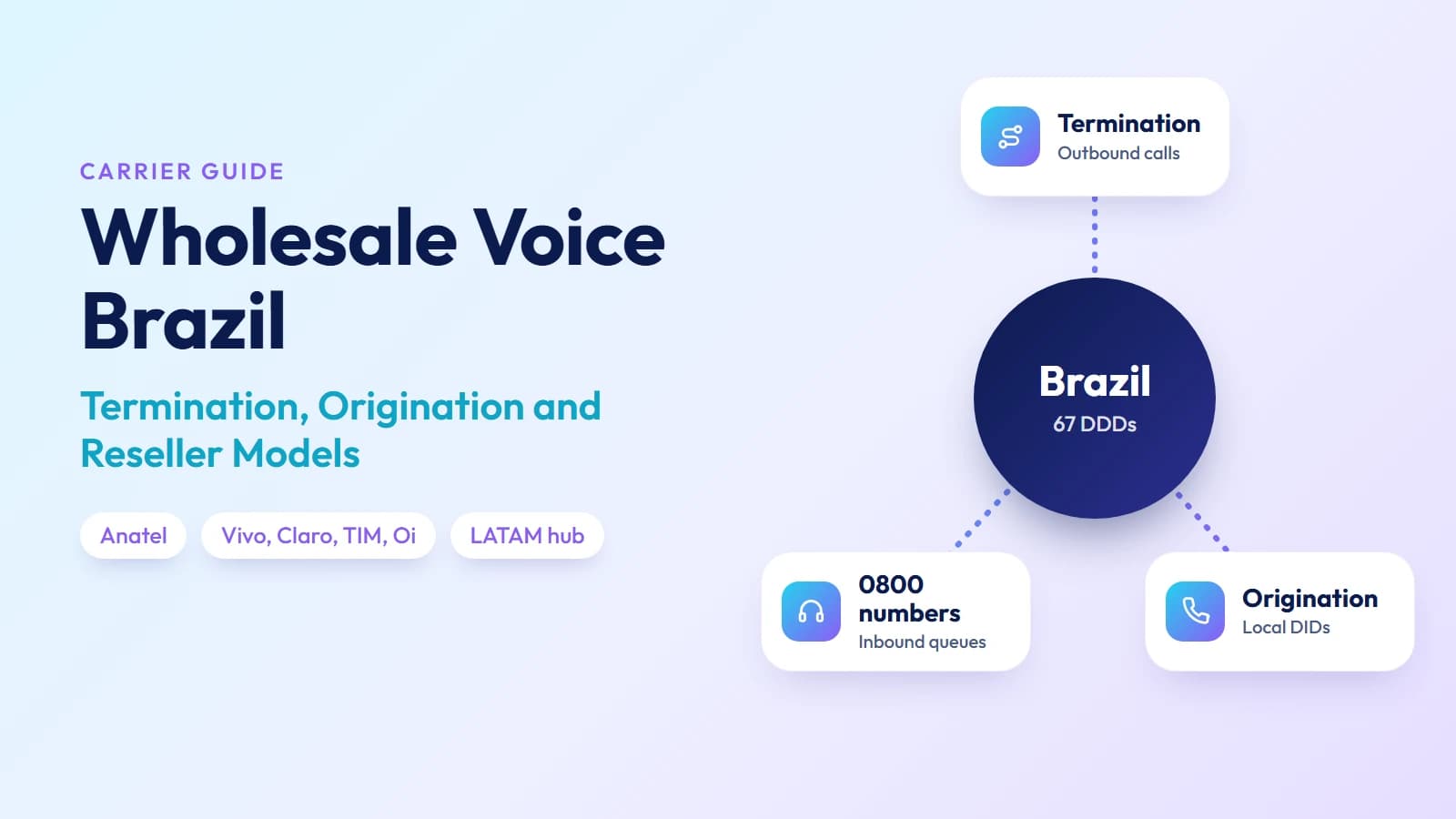
What sets Brazil apart from other large voice markets is the complexity of its carrier ecosystem, the wide cost gap between fixed and mobile voice, a specific regulatory environment under Anatel, and a set of commercial models (termination, origination, DID, 0800 toll-free) that together define a full wholesale voice strategy for the Brazilian market.
The Brazilian carrier ecosystem
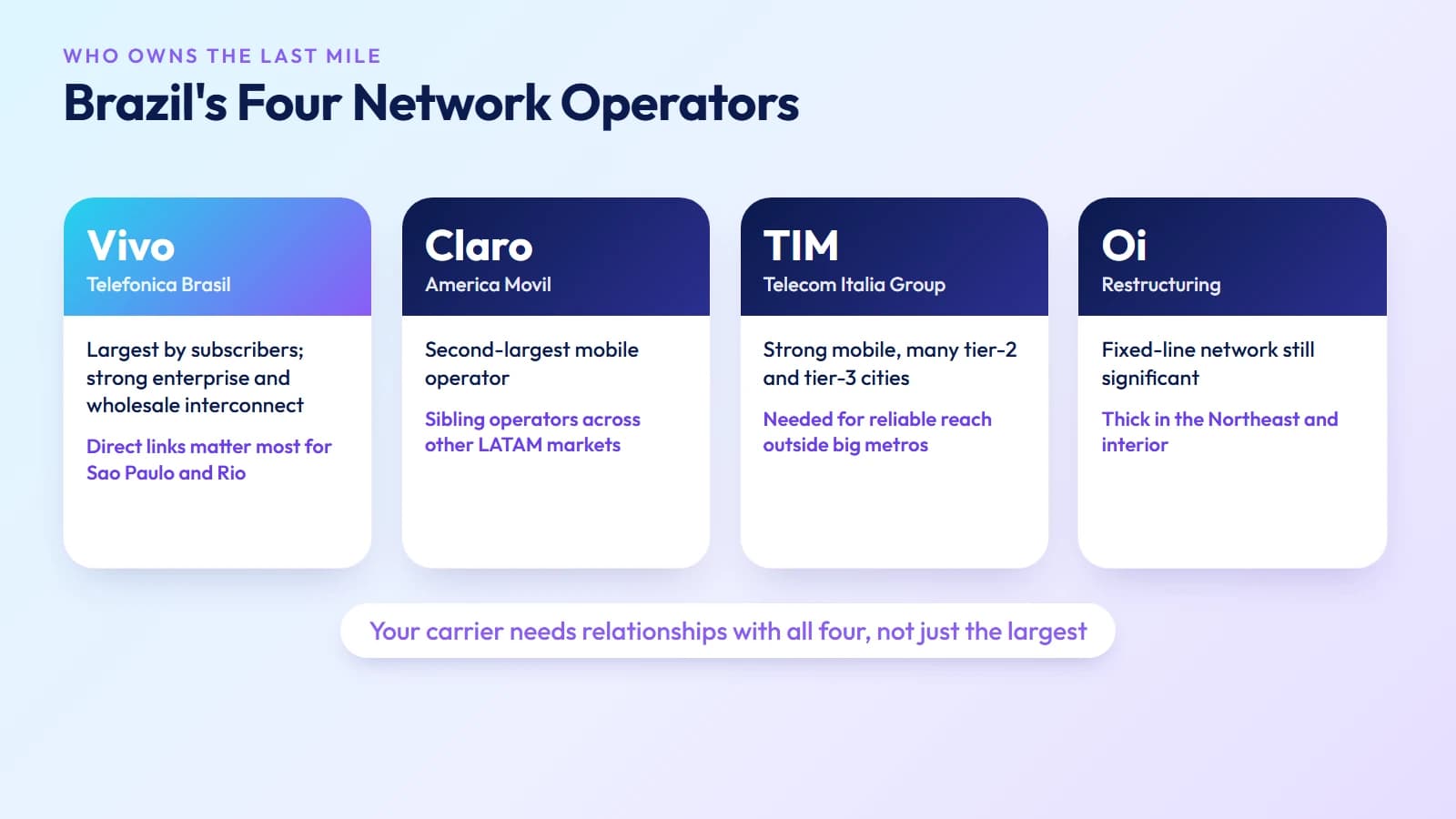
Four network operators own the infrastructure that wholesale voice ultimately terminates to:
Vivo (Telefónica Brasil) — The largest operator in Brazil by subscriber base, covering both fixed and mobile. Telefónica's presence gives Vivo strong enterprise and wholesale interconnect relationships. International carriers frequently seek direct Vivo interconnects to optimize quality on São Paulo and Rio de Janeiro traffic.
Claro Brasil (América Móvil) — The second-largest mobile operator. Claro's ownership by América Móvil creates natural interconnect synergies with other LATAM markets in the same group, making Claro a natural interconnect partner for carriers routing traffic across multiple South American countries.
TIM Brasil (Telecom Italia Group) — Strong mobile coverage with a particular concentration in tier-2 and tier-3 cities. TIM interconnects are often necessary for reliable termination to markets outside the major metropolitan areas.
Oi — The fourth national operator, currently in a restructuring process following financial difficulties. Oi's fixed-line network remains significant, particularly in the Northeast and interior markets where Vivo, Claro, and TIM coverage is thinner. Wholesale carriers with Oi interconnects can reach subscribers that would otherwise require additional transit.
For an international carrier or reseller, this means your wholesale voice Brazil provider needs relationships with all four operators — not just the largest. A carrier reaching only Vivo and Claro will show degraded quality or higher PDD on Oi-connected subscribers in the northeast, and on TIM subscribers in smaller cities.
Termination vs. origination — building a two-way voice strategy
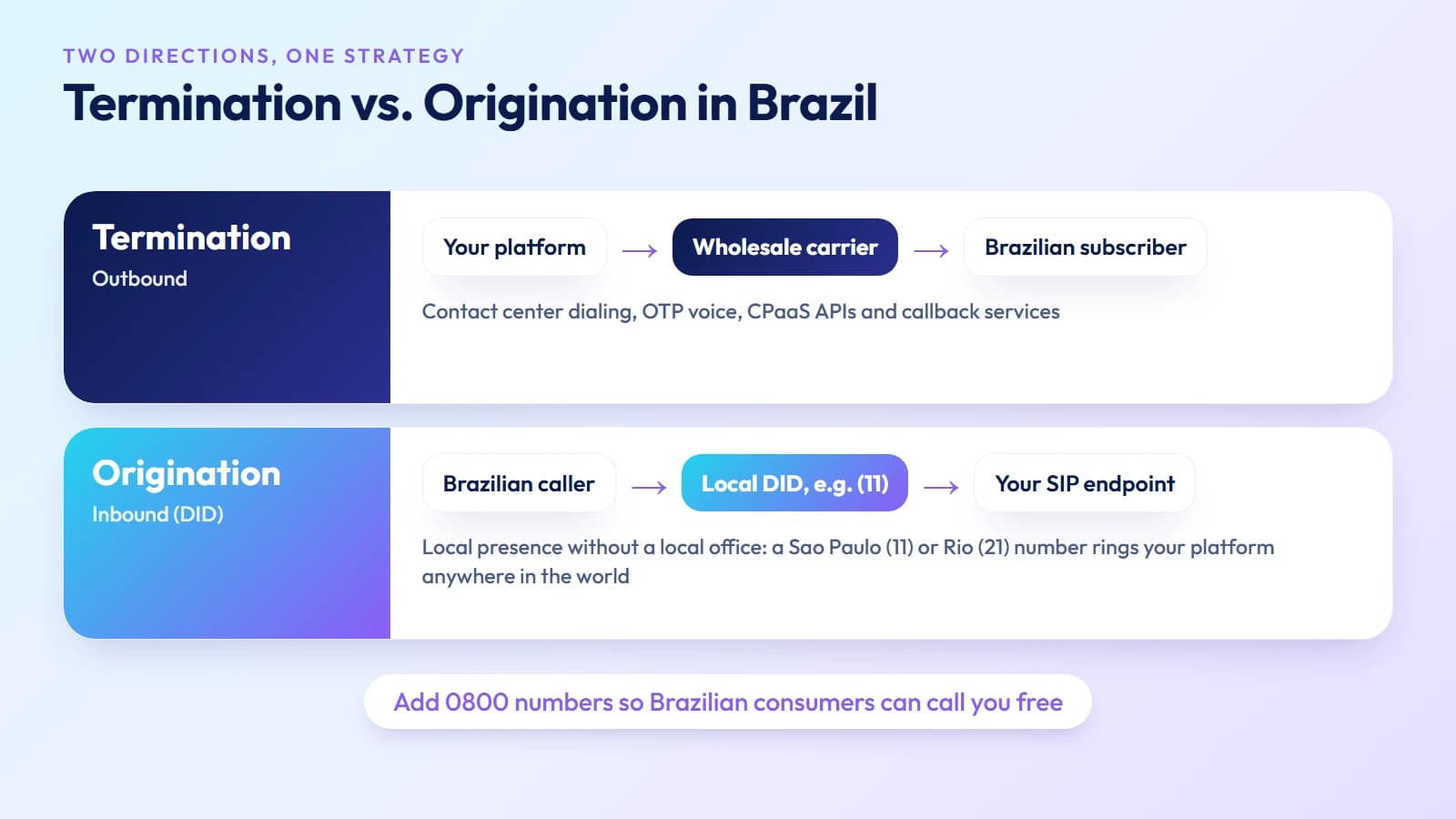
Wholesale voice in Brazil is not just outbound (termination). A complete strategy covers both directions:
Voice termination (outbound)
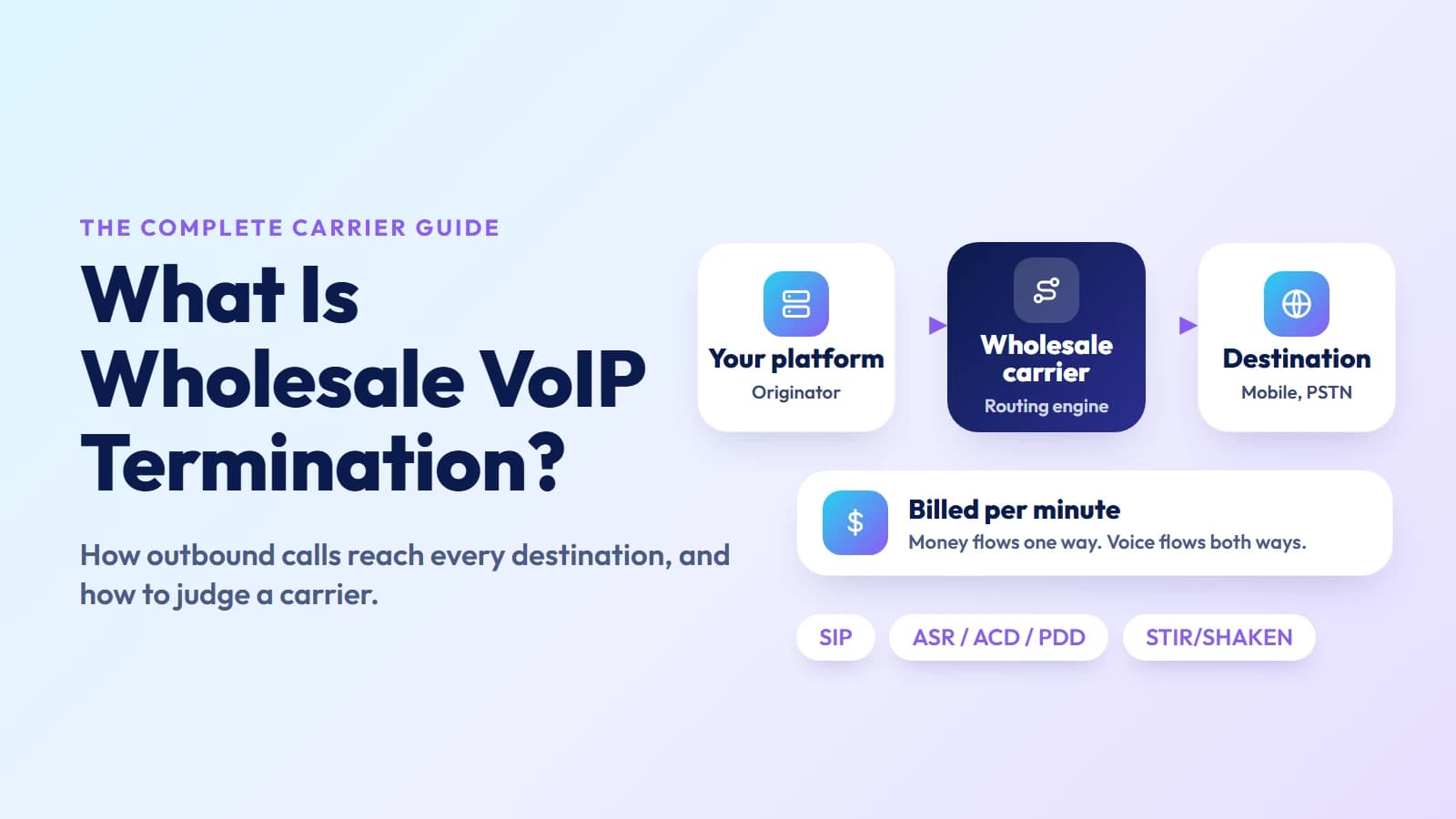
Termination is the service most buyers source first: your platform originates calls, the wholesale carrier routes them to Brazilian fixed-line and mobile subscribers, and you pay per minute. The commercial and technical details — fixed vs. mobile cost gap, DDD coverage, CLI delivery, billing increment — determine your effective cost and call quality on outbound campaigns.
Brazilian outbound use cases driving the most volume:
- Contact center outbound dialing (collections, sales, appointment reminders)
- Two-factor authentication and OTP delivery over voice
- CPaaS platform outbound APIs for business communications
- International callback services for Brazilian diaspora
Voice origination (inbound)
Origination, or DID (Direct Inward Dialing) service, is the reverse: your carrier provisions a Brazilian local number in a specific DDD, calls to that number route inbound to your SIP endpoint anywhere in the world. Your customer in São Paulo dials a local São Paulo number; the call arrives at your cloud PBX or contact center platform.
Origination enables local presence without a physical office. A foreign company serving Brazilian customers presents a local number by DDD — São Paulo businesses get a (11) number, Rio customers get a (21) number — which improves answer rates on inbound calls and reduces customer friction compared to international numbers.
DID inventory availability by DDD is not uniform. Major DDDs (11, 21, 31, 41, 51, 61, 71) have deep inventory with most carriers. Regional DDDs in smaller states have limited supply and sometimes require local carrier arrangements. Confirm inventory depth and porting capability in your specific target DDDs before selecting a carrier.
0800 toll-free
Brazilian 0800 numbers are the domestic equivalent of toll-free: the caller pays nothing, and the call charge accrues to the number owner. 0800 numbers are heavily used in Brazil for customer service, inbound contact center queues, and collections operations. They require provisioning through an Anatel-licensed carrier. Including 0800 in your Brazilian voice portfolio removes the cost barrier for Brazilian consumers calling inbound — relevant for contact centers where inbound call rate affects campaign performance.
How the wholesale voice reseller model works in Brazil
Most buyers of wholesale voice Brazil services are not building on top of their own network infrastructure. They are resellers: CPaaS platforms, hosted PBX providers, contact center operators, and telecom resellers who buy wholesale capacity from a carrier like MCM and sell it — packaged as minutes, SIP trunks, or embedded in a platform — to their own end customers.
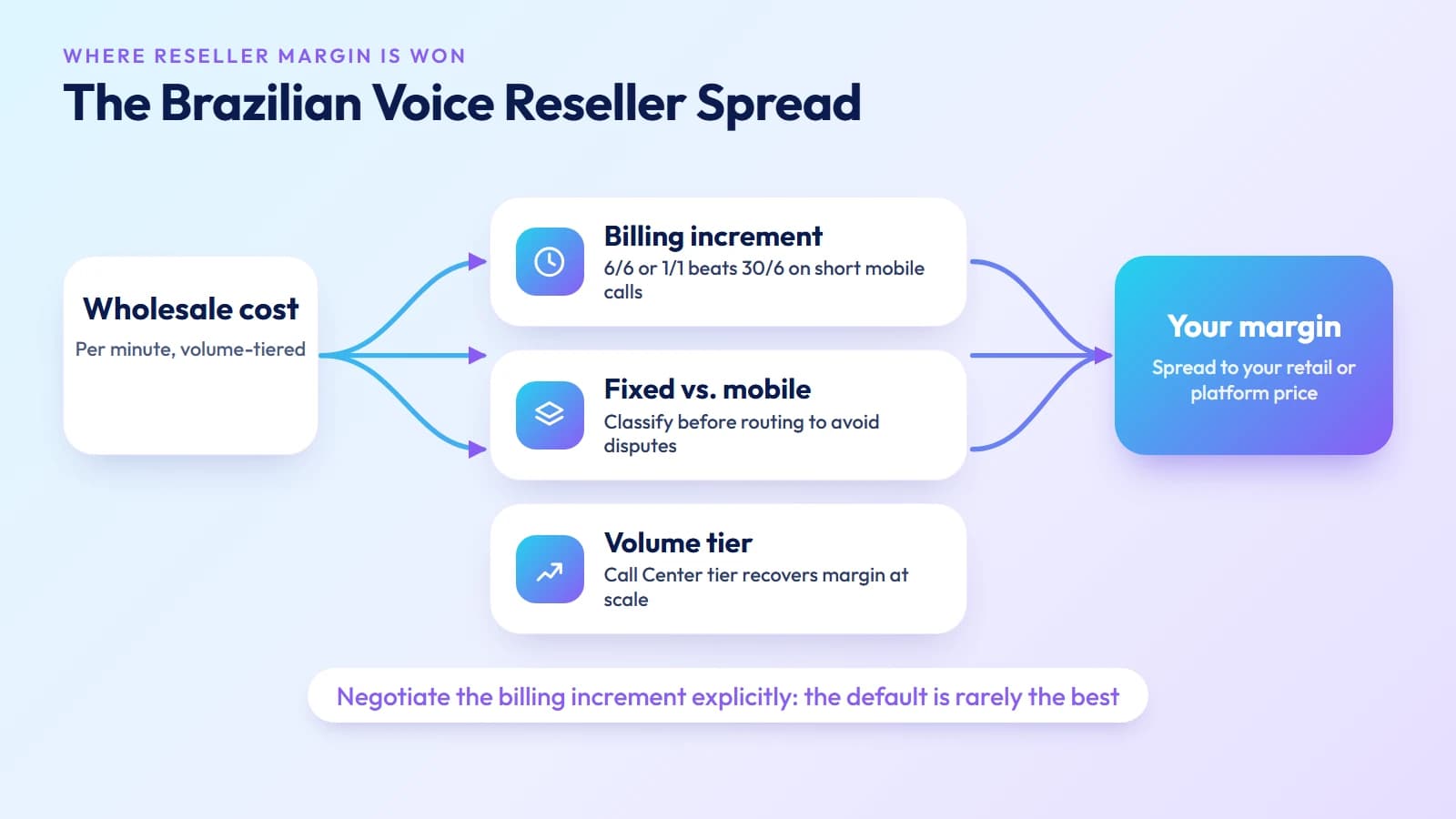
The margin in a Brazilian voice reseller model is the spread between your wholesale cost (per-minute, volume-tiered) and your retail or platform price. Three factors compress or widen that spread:
Billing increment — Mobile termination in Brazil carries a meaningful per-minute floor. A 30/6 billing increment (30-second minimum, 6-second increments thereafter) inflates your cost on short-ACD mobile calls versus a 6/6 or 1/1 increment. Negotiate your billing increment explicitly; the default offered is usually not the most favourable for mixed-duration traffic.
Mobile vs. fixed classification — Brazil's mobile termination rates are substantially higher than fixed-line rates for the same DDD. Correct number classification (fixed vs. mobile) before routing is a margin-protection measure, not a technical nicety. Misrouting mobile calls into the fixed rate deck or vice versa generates billing disputes and unexpected costs.
Volume tier — MCM's Call Center tier applies above defined monthly volume thresholds and delivers meaningfully lower per-minute rates than Standard, with dedicated capacity on high-volume DDDs. If your Brazilian traffic or your customers' aggregate traffic exceeds the tier threshold, the Call Center tier recovers significant margin versus staying on Standard pricing.
Current wholesale voice rates for Brazil across Premium, Standard, and Call Center tiers — covering all fixed and mobile DDDs — are available at mycountrymobile.com/wholesale-voip-rates/.
Ready when you are
Protect your business line.
MCM's local numbers ship with verified caller ID and smart call filtering — customers always know it's really you, and spam never reaches your team.
Brazil as a LATAM hub
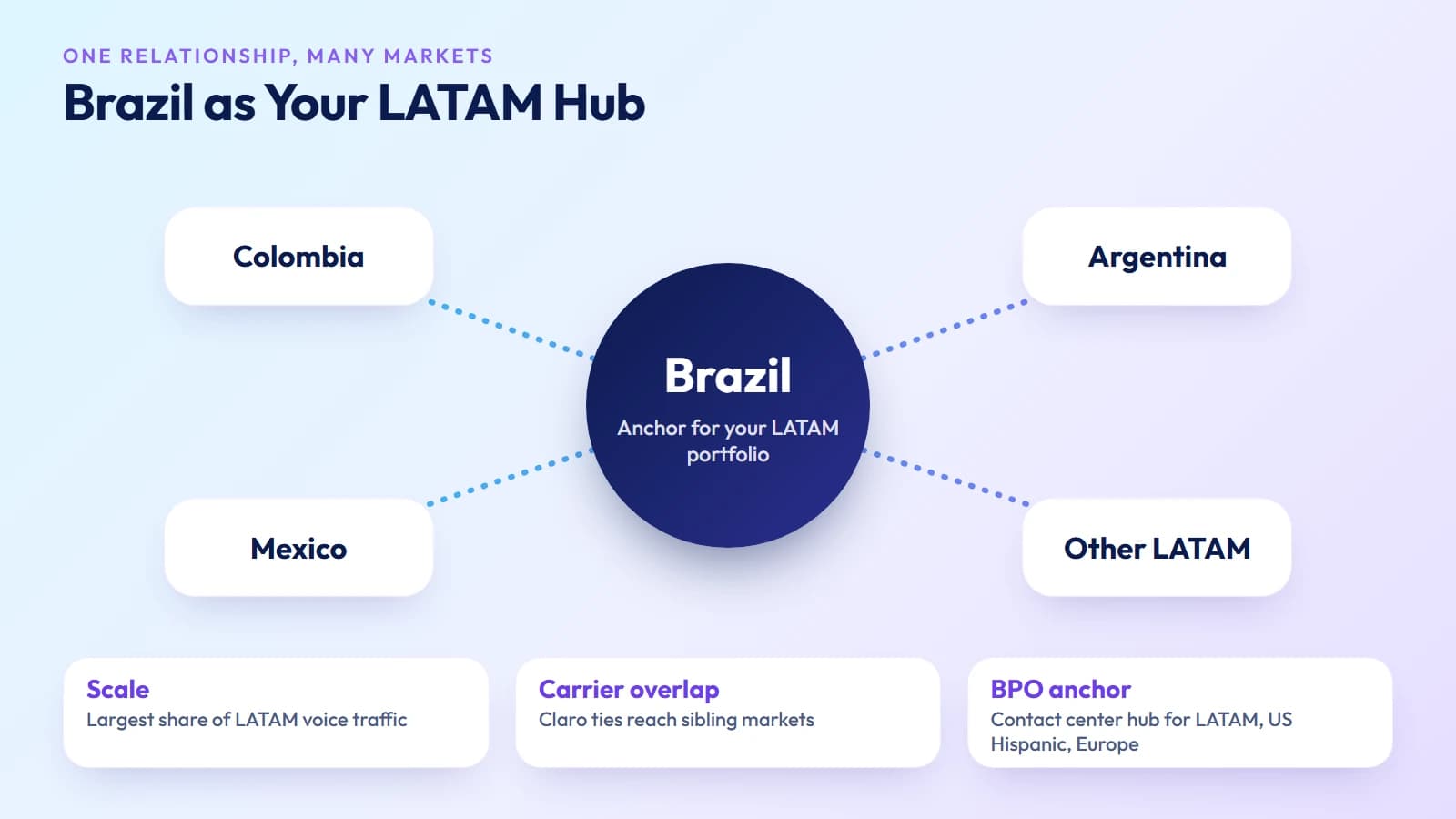
Brazil is the natural anchor for a broader LATAM wholesale voice strategy, for three reasons.
Scale — Brazil alone accounts for a larger share of LATAM voice traffic than any other single country. Establishing efficient Brazilian termination reduces the effective cost across the entire LATAM portfolio.
Geographic and carrier overlap — Carriers with strong Brazilian interconnects (Claro Brasil, for example) often have sibling relationships with Claro operators in Colombia, Mexico, Argentina, and other América Móvil markets. A wholesale voice provider with direct Claro Brazil interconnects frequently delivers better quality on other LATAM Claro markets through the same carrier relationship.
BPO and contact center anchor — Brazil's contact center industry serves customers across all of LATAM, the US Hispanic market, and Europe. Carriers building capacity for Brazilian outbound automatically serve the region's largest contact center hub.
When evaluating a wholesale voice Brazil provider, ask whether the same carrier relationship covers your other LATAM destinations. A fragmented LATAM strategy — separate providers for Brazil, Colombia, Mexico, Argentina — creates billing reconciliation complexity and eliminates the volume leverage that drives the best per-minute rates.
Traffic profiles and carrier evaluation
Wholesale carriers evaluate Brazilian voice buyers by traffic profile before quoting. The profile shapes the rate deck, billing structure, and route assignment. The main categories:
Retail / end-user — Relatively low volume, mixed destinations, unpredictable peaks. Typically placed on Standard routes with 6/6 billing.
Wholesale / carrier — High volume, destination-specific traffic, predictable patterns. Carrier-grade agreements with rate decks covering the full A-Z DDD matrix.
Contact center — High CPS (calls per second) peaks during dialing campaigns, concentration in specific DDDs, mobile-heavy traffic. Requires burst capacity commitments and mobile termination assurances. Best served by Call Center tier agreements with dedicated capacity.
AI voice dialer — Growing segment. AI-driven outbound dialing platforms often generate higher CPS bursts than human-operated contact centers, with shorter ACD on unanswered calls. Some carriers apply specific handling for AI dialer traffic given fraud signal patterns. Clarify how your carrier classifies and routes AI dialer traffic before deployment.
When submitting a traffic profile for Brazilian wholesale voice, provide: peak CPS, monthly minute estimate broken down by fixed vs. mobile, primary DDDs, CLI requirements, and billing increment preference. A carrier that quotes without asking these questions is quoting on assumptions that may not match your actual cost.
What to demand from a Brazilian wholesale voice carrier
All four major operator interconnects — Verify direct interconnect or first-hop coverage for Vivo, Claro, TIM, and Oi. Ask for prefix-level confirmation of which interconnect handles which DDD ranges.
Anatel-licensed termination partner — The carrier's Brazilian last-mile partner must hold the appropriate Anatel license (SCM or STFC). Request the partner name and license details.
Separate fixed and mobile rate decks — A single blended "Brazil" rate is hiding either the mobile surcharge or poor mobile coverage. Insist on per-DDD breakdowns split by fixed and mobile.
FAS protection in contract — False Answer Supervision is a documented issue on Brazilian routes. Require explicit FAS prohibition with CDR reconciliation remedies.
DID inventory and porting confirmation — If origination is part of your requirement, confirm DID inventory depth in your target DDDs and whether Brazilian number porting (from another carrier) is supported.
0800 provisioning capability — For inbound contact center use cases, confirm whether the carrier can provision and manage Brazilian 0800 toll-free numbers, and what the provisioning lead time is.
24/7 NOC with Brazil-specific escalation — Brazilian traffic peaks follow Brazilian business hours (BRT, UTC−3). Support that only covers US or European office hours cannot respond quickly to a Brazilian dialing campaign outage at 10:00 AM São Paulo time.
My Country Mobile covers the full Brazilian wholesale voice stack — termination to all 67 DDDs across fixed and mobile, DID origination in major markets, 0800 provisioning, and three-tier pricing (Premium, Standard, Call Center) with Anatel-licensed in-country interconnects. Start with the rate explorer at mycountrymobile.com/wholesale-voip-rates/.
For the technical detail on numbering, CLI and FAS protection, read our wholesale VoIP Brazil termination guide.
Ready when you are
Ready to sound local everywhere you sell?
MCM activates business numbers in minutes, with call routing, analytics, and CRM-ready integrations. Start your trial — no card to browse inventory.
Frequently asked questions
What is wholesale voice in Brazil?
Carrier-grade voice routing and termination at volume across Brazil's fixed and mobile networks, sold at per-minute wholesale rates to carriers, platforms, contact centers, and resellers building their own voice products.
Who are the major carriers in the Brazilian wholesale voice market?
Vivo (Telefónica), Claro (América Móvil), TIM (Telecom Italia Group), and Oi. All four own network infrastructure that wholesale voice ultimately terminates to. Your carrier needs interconnects with all four for reliable nationwide coverage.
What is the difference between voice termination and origination in Brazil?
Termination is outbound — your platform calls Brazilian subscribers. Origination is inbound — Brazilian callers dial a local DID that routes to your SIP endpoint anywhere in the world. A full strategy uses both.
What Brazilian DDD area codes are available for DID origination?
Major DDDs (11 São Paulo, 21 Rio, 31 Belo Horizonte, 41 Curitiba, 51 Porto Alegre, 61 Brasília, 71 Salvador) have deep inventory. Regional DDDs have limited supply — confirm before committing.
Can I offer a Brazilian 0800 toll-free number to my customers?
Yes. Brazilian 0800 numbers are provisioned through Anatel-licensed carriers and are standard in wholesale voice portfolios. They are widely used for contact center inbound and customer service lines.
What traffic volumes qualify for wholesale voice pricing in Brazil?
Most carriers begin volume-based pricing at 10,000–50,000 minutes per month. Call Center tier pricing typically activates above 500,000–1,000,000 minutes per month.