Wholesale VoIP termination is the infrastructure layer that connects your outbound calls to the rest of the world. When a contact center dials a customer in Lagos, when a CPaaS platform bridges a conference call to a mobile subscriber in São Paulo, or when a carrier reseller originates a DID call toward a landline in Tokyo — all of that traffic has to terminate somewhere. Wholesale termination is the service that carries it there, billed at a per-minute wholesale rate rather than the retail rate a consumer would pay.
Understanding how it works — at the protocol level, the routing level, and the quality-metrics level — is the difference between a procurement decision and a guess.
What wholesale VoIP termination is, in operational terms
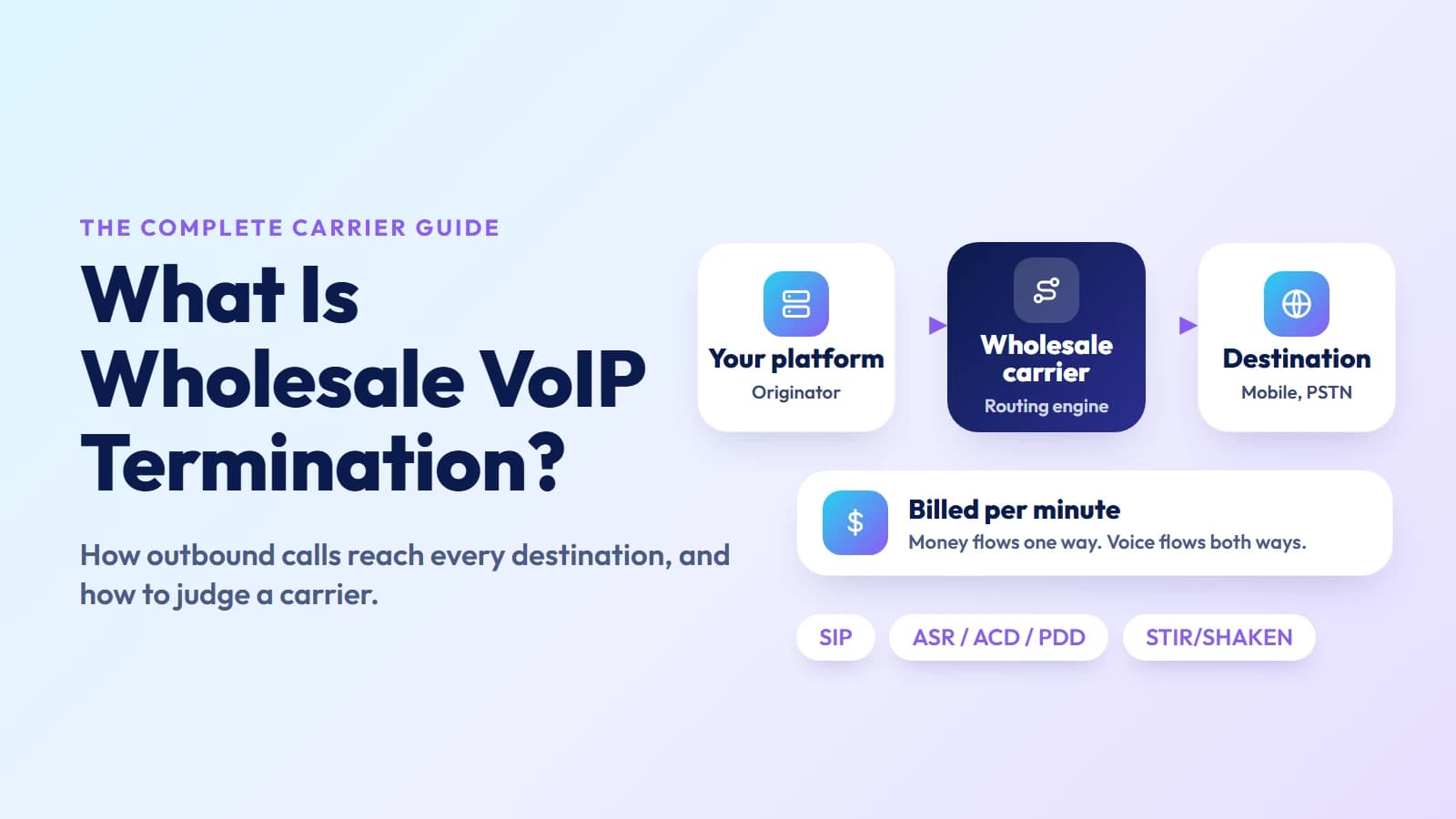
Three parties are always involved. The originator — your platform, your switch, your contact center — sends a SIP INVITE toward the wholesale carrier. The carrier's routing engine selects a path to the destination network (a mobile operator, a PSTN gateway, another carrier's switch) and extends the call. The originator pays the wholesale carrier per minute; the carrier pays interconnect fees to the destination network and keeps the margin.
Money flows in one direction. Voice flows both ways. Your CDRs should reflect exactly what the destination network confirmed, billed in the increment your contract specifies — not what your switch thinks it sent.
The critical phrase is "routing engine." Wholesale carriers don't maintain a single fixed path to every destination. They maintain a matrix of routes — direct interconnects, transit agreements, and LCR (least-cost routing) fallbacks — and the routing engine traverses that matrix on each call, selecting the best available path within your quality floor.
How a wholesale VoIP call actually works
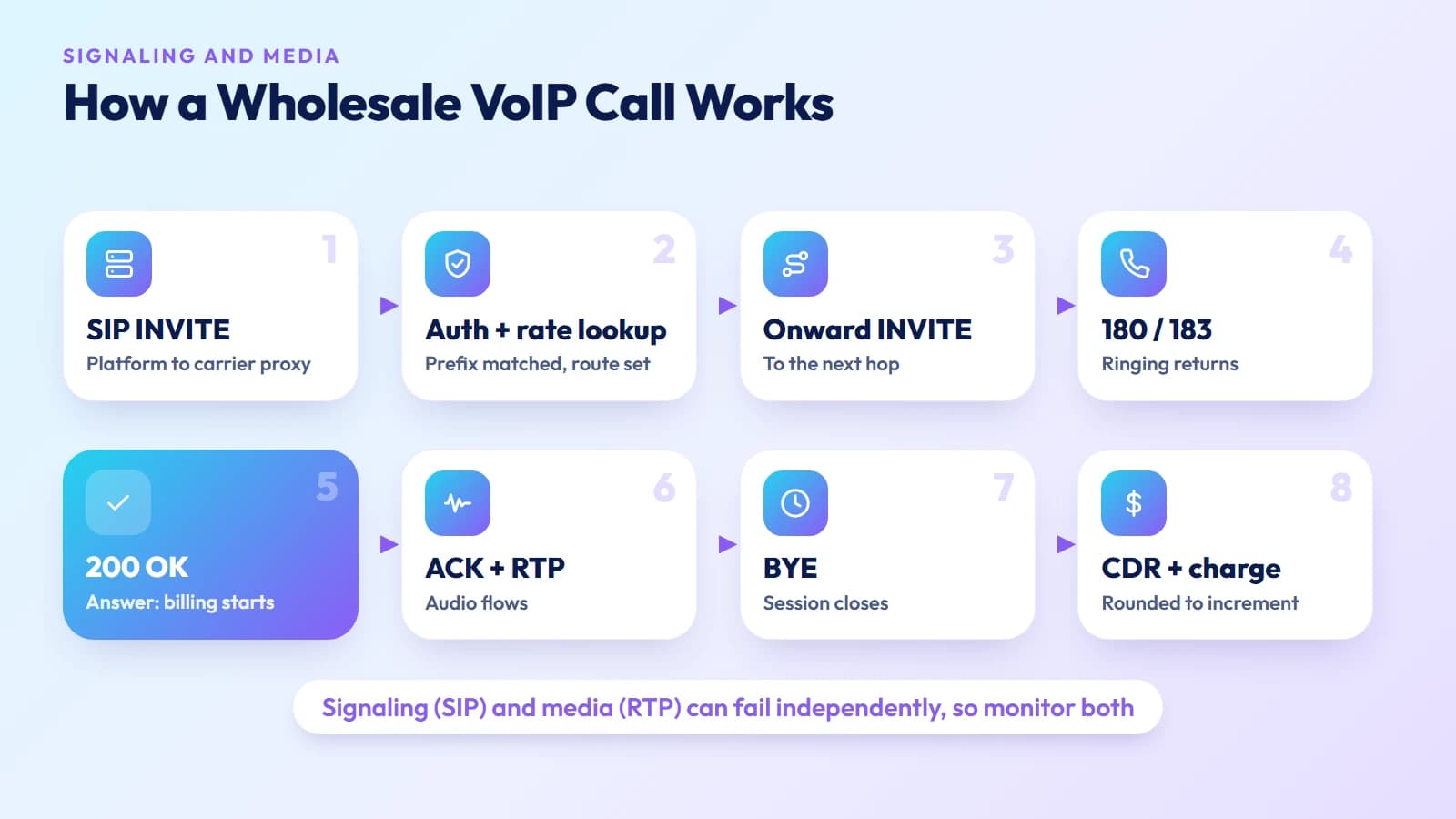
A sample call from a US contact center to a Nigerian mobile subscriber illustrates each stage:
- SIP INVITE — Your switch sends an INVITE to the carrier's SIP proxy, including the called number (E.164 format), the calling number (CLI), and codec preferences in the SDP body.
- Authentication and rate lookup — The carrier's proxy authenticates your IP or SIP credentials, looks up the destination prefix (234 for Nigeria), and selects a route based on your routing plan.
- Onward INVITE — The carrier sends a new INVITE toward the next hop — a transit carrier, a direct interconnect, or a local exchange carrier in Nigeria.
- 180 Ringing / 183 Session Progress — Ringing tones propagate back through the chain.
- 200 OK — When the called party answers, a 200 OK travels back. This is the billing trigger. The carrier's CDR system starts the clock.
- ACK + RTP media — Both sides confirm the session with ACK. RTP audio packets begin flowing — usually directly between your switch and the far-end gateway to minimize latency, bypassing the signaling proxies.
- BYE — When the call ends, a BYE request closes the session. The carrier's CDR records the duration, rounds to the billing increment, and generates a charge.
The signaling path (SIP) and the media path (RTP) can — and often do — fail independently. A carrier showing 100% signaling uptime can still have degraded voice quality if its media relays are congested. Monitoring both layers separately is not optional.
Quality metrics that decide route health
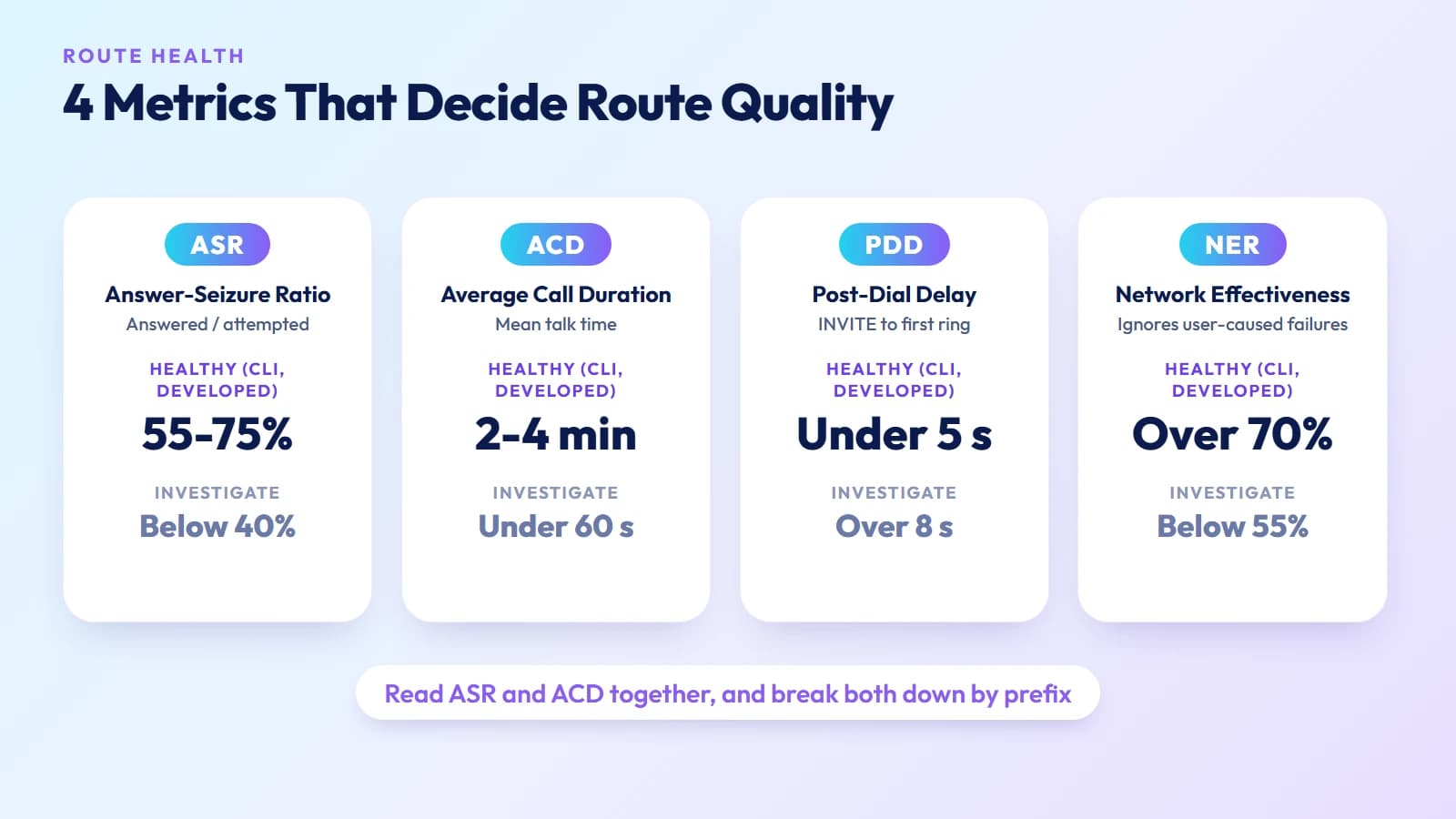
Four metrics govern whether a route is performing or quietly draining margin:
ASR (Answer-Seizure Ratio) — The percentage of call attempts that result in an answered call. A healthy Tier-1 CLI route to Western Europe typically runs 60–75% ASR. Sub-40% ASR over a sustained window points to number unreachable errors, network congestion, or grey route instability.
ACD (Average Call Duration) — The mean talk time across answered calls. A healthy ACD for a business route is 2–4 minutes. ACD well below 60 seconds is a red flag even if ASR looks acceptable — it can indicate billing loops, codec incompatibilities causing immediate hangups, or interconnect issues that disconnect calls after connection is registered but before audio arrives.
ASR + ACD read together is the critical pairing. High ASR with very low ACD often signals fraud or billing manipulation rather than genuine call completions. Always break ACD down by destination prefix, not just by country — aggregate figures can hide anomalies on specific ranges that look fine at the country level.
PDD (Post-Dial Delay) — The seconds between the SIP INVITE and the first ring tone. PDD under 5 seconds is standard for direct interconnects; PDD creeping above 8 seconds suggests excessive hops or distant routing. High PDD in contact center environments inflates agent handle time.
NER (Network Effectiveness Ratio) — Similar to ASR but excludes user-caused failures (busy, no answer, rejected). NER isolates network-layer problems from user behavior, making it more useful for diagnosing infrastructure issues.
| Metric | Healthy range (CLI, developed markets) | Investigate below |
|---|---|---|
| ASR | 55–75% | 40% |
| ACD | 2–4 min | 60 seconds |
| PDD | < 5 seconds | 8 seconds |
| NER | > 70% | 55% |
Ready when you are
Protect your business line.
MCM's local numbers ship with verified caller ID and smart call filtering — customers always know it's really you, and spam never reaches your team.
The codec stack — what each one does
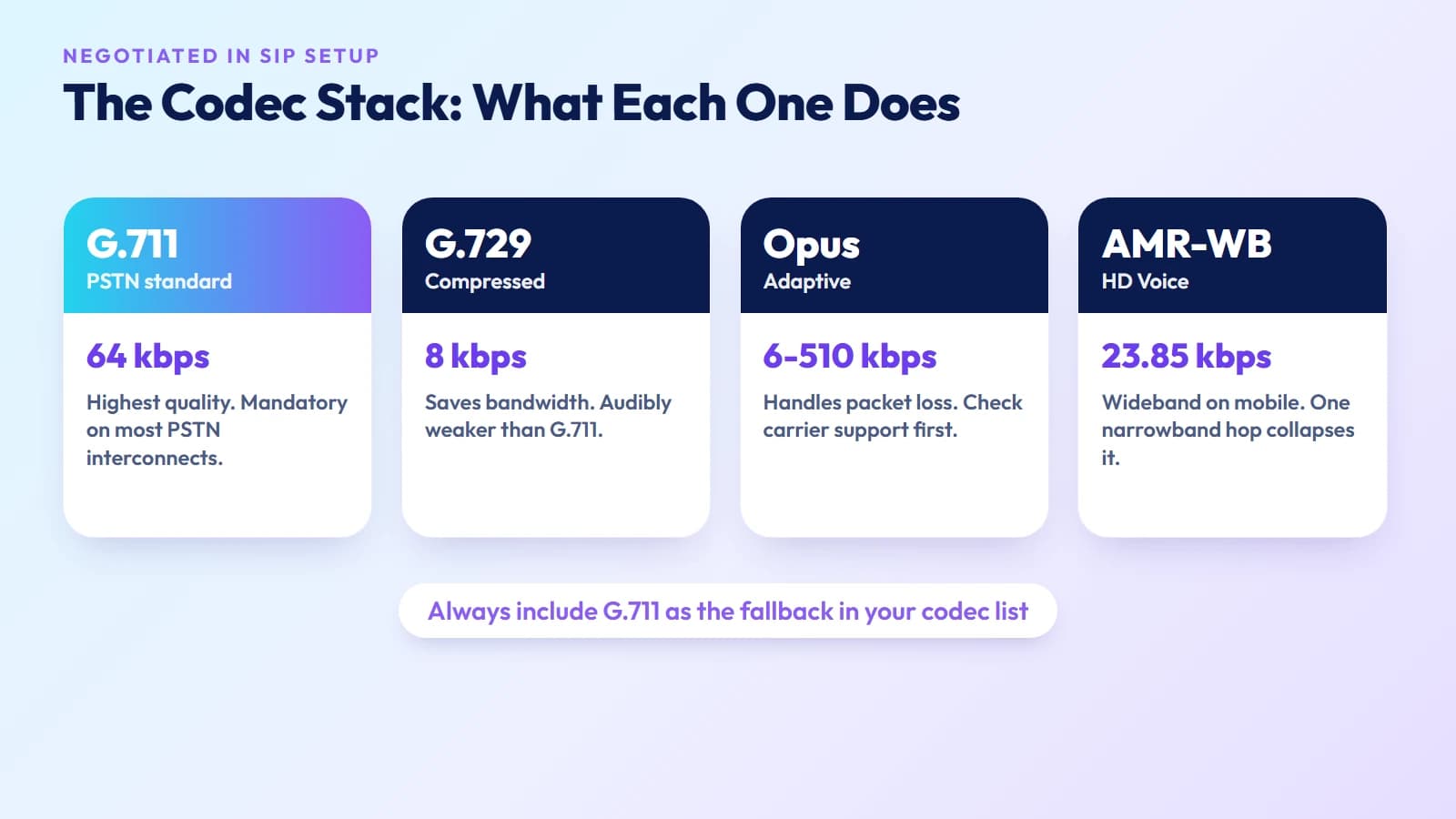
The codec negotiated during SIP setup determines audio quality, bandwidth consumption, and compatibility with destination networks.
G.711 (a-law / μ-law) — The standard PSTN codec. 64 kbps per call, uncompressed, highest quality for voice. Mandatory for most PSTN interconnects. If a destination network only speaks G.711 and your call arrives in G.729, a transcoding step is required — which adds latency and can degrade quality.
G.729 — 8 kbps compressed audio. Widely deployed on legacy enterprise equipment. Adequate for voice but audibly inferior to G.711. Saves bandwidth at scale but introduces artifacts if the network has additional compression upstream.
Opus — Adaptive 6–510 kbps. The modern standard for WebRTC and internet-native calling. Handles packet loss gracefully. Not universally supported on older carrier equipment, so confirm compatibility before specifying it as a preferred codec toward PSTN destinations.
AMR-WB (G.722.2) — Wideband audio at 23.85 kbps, used on HD Voice-capable mobile networks. When both ends and the path support it, call quality is noticeably better than G.711 narrowband. Requires HD Voice interconnects end-to-end — any narrowband hop in the chain collapses it to G.711.
Specify codec preference in your SDP, confirm what your carrier's gateway supports, and always include G.711 as a fallback in your codec list.
Route tiers — Premium, Standard, and Call Center
Not all routes to a destination are equivalent, and wholesale carriers price them accordingly. My Country Mobile offers three tiers:
Premium routes use direct Tier-1 interconnects. CLI is delivered intact, ASR and ACD targets are highest, and PDD is minimized. The right choice for customer-facing calls where answer rates and audio quality directly affect revenue — outbound sales, customer service, appointment reminders.
Standard routes blend direct interconnects with LCR fallbacks, trading some quality headroom for lower cost per minute. CLI delivery is still supported on most destinations. Suitable for high-volume internal communications, verification calls, or destinations where the cost-quality tradeoff favors volume over maximum quality.
Call Center routes are structured for operations running above one million minutes per month. Volume rebates, dedicated capacity, and priority routing during peak hours are part of the commercial package. If your monthly volume qualifies, the effective per-minute cost drops significantly versus Standard rates.
For current route pricing across 24,000+ prefixes and 190+ countries, use MCM's live rate explorer at mycountrymobile.com/wholesale-voip-rates/.
Fraud, security, and the regulatory layer
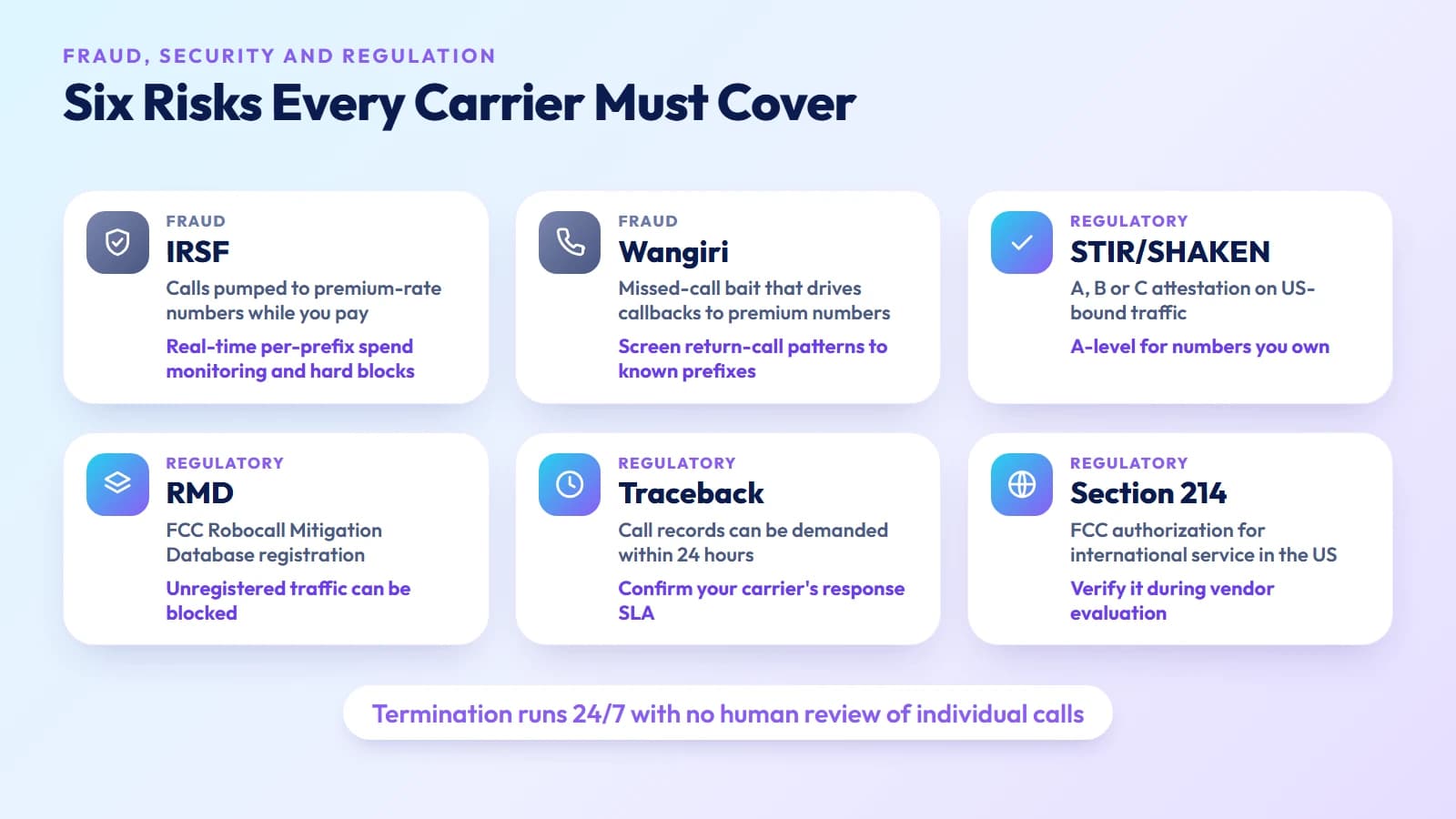
Wholesale termination infrastructure runs 24/7 without human review of individual calls. That automation is also the attack surface.
IRSF (International Revenue Share Fraud) — Fraudsters generate high volumes of calls to premium-rate numbers in high-cost destinations, collecting revenue share while your account is billed. IRSF can accumulate thousands of dollars in exposure before a daily limit triggers. Real-time per-prefix spend monitoring and hard blocks on destinations you don't legitimately call are the first line of defense.
Wangiri fraud — Automated missed-call baiting that tricks people into calling back premium-rate numbers. Carriers are liable for the traffic they carry, so screening return-call patterns to known Wangiri prefixes is now a standard carrier responsibility.
STIR/SHAKEN — For US-bound traffic, STIR/SHAKEN attestation is mandatory. Full (A) attestation means the carrier vouches that the calling number is assigned to the originating customer. Partial (B) or Gateway (C) attestation reduces deliverability to mobile subscribers and may trigger spam labeling by analytics engines. Choose a carrier that can deliver A-level attestation for numbers you legitimately own.
RMD registration — The FCC's Robocall Mitigation Database requires carriers to file a mitigation plan and intermediate carriers to verify that upstream partners are registered. Unregistered traffic can be blocked by downstream carriers.
Traceback cooperation — The FCC and USTelecom's Industry Traceback Group can demand call records within 24 hours for robocall investigations. Carrier agreements should confirm your provider's traceback obligations and response SLAs.
Section 214 licensing — Carriers providing international service in the US must hold an FCC Section 214 authorization. Verify this during vendor evaluation; unlicensed providers create regulatory exposure for their customers.
Failover and SLA expectations
A carrier's headline SLA means little if failover is manual. Evaluate these specifically:
Automatic failover time — When a primary route degrades, how quickly does the routing engine shift traffic? Sub-second failover to a secondary route is achievable on modern SBC platforms; anything requiring manual intervention creates outage windows that accumulate across a month.
Geographic redundancy — Does the carrier operate PoPs in multiple regions, or does all your traffic transit a single data center? Multi-PoP architecture limits blast radius if a region goes down.
NOC availability — 24/7 staffed Network Operations Center is not universal in the wholesale market. Confirm response time SLAs for P1 (complete outage) and P2 (quality degradation) tickets before signing a contract.
SIP 5xx error monitoring — Zero SIP 5xx errors over any 30-minute window is a reasonable quality floor during normal operations. Persistent 503 (Service Unavailable) or 504 (Gateway Timeout) responses indicate a routing problem that requires escalation, not a retry loop on your side.
How to choose a wholesale provider
Evaluate candidates across four dimensions:
Route quality — Request 30-day ASR, ACD, and PDD statistics for your top-10 destination countries before signing. Aggregate numbers are a starting point; prefix-level breakdowns for your specific traffic mix are more useful. A carrier confident in their routes will provide both.
Commercial terms — Billing increment matters more than the headline rate. A $0.010/min rate billed in 60/60 increments costs more on sub-minute calls than a $0.012/min rate billed in 6/6. Confirm FAS (False Answer Supervision) protections — billing that starts before the called party answers inflates your CDRs and should be contractually prohibited.
Compliance posture — For US traffic, confirm STIR/SHAKEN capability and attestation levels. For international traffic, ask about local interconnect licenses in your top destination markets. A carrier that can't answer these questions directly is unlikely to handle a regulatory inquiry quickly.
Trial period — Run a four-week parallel test before full cutover. Route 10–15% of live traffic through the new carrier, compare CDRs against your current provider, and check ASR and ACD by destination. This is the only way to validate quality claims with your actual traffic profile.
Ready when you are
Ready to sound local everywhere you sell?
MCM activates business numbers in minutes, with call routing, analytics, and CRM-ready integrations. Start your trial — no card to browse inventory.
Frequently asked questions
What is wholesale VoIP termination in one sentence?
A per-minute, SIP-based service in which a carrier routes your outbound calls to destination networks on your behalf, charging you a wholesale rate rather than a retail one.
How does wholesale voice termination differ from wholesale VoIP termination?
Operationally, they are the same service. "Voice termination" is older telecom language; "VoIP termination" specifies that the transport layer is SIP over IP rather than TDM circuits.
Who buys wholesale VoIP termination?
Carriers, CPaaS platforms, contact centers, virtual number resellers, and any business that originates enough outbound call volume to qualify for wholesale pricing.
What is a Tier-1 wholesale carrier?
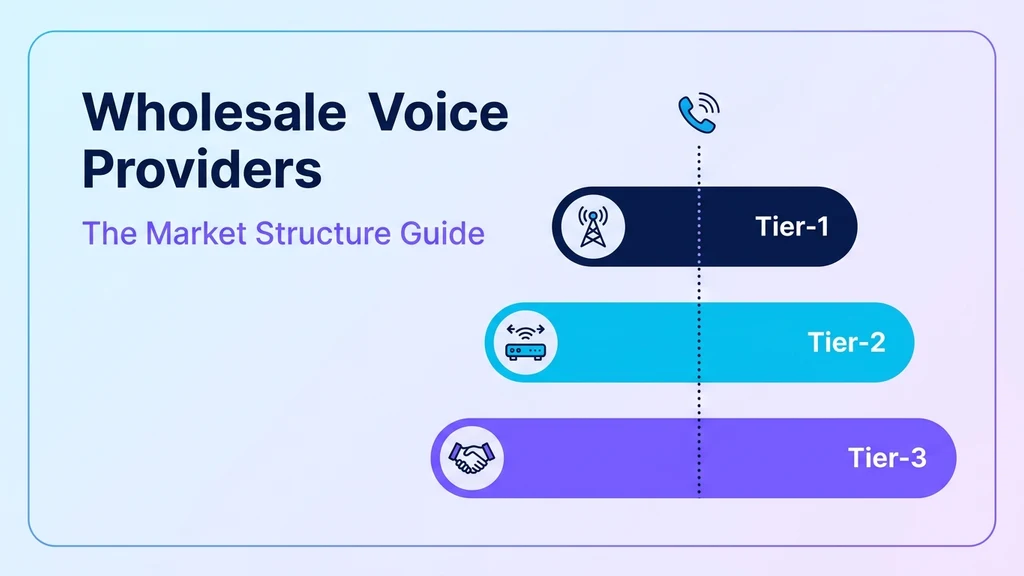
A carrier with direct interconnects to most destination networks, eliminating transit hops that add latency and degrade quality.
What ASR and ACD numbers should I expect from a healthy route?
For developed markets, a healthy CLI route typically shows ASR above 55–65%, ACD above 2–3 minutes, and PDD below 5 seconds. High ASR paired with very low ACD can signal billing loops or codec problems rather than genuine completions.
What compliance is required for US-bound wholesale VoIP traffic?
STIR/SHAKEN attestation, RMD registration, traceback cooperation, and — if applicable — a Section 214 international services license.