What Is UCaaS? A Plain-English Guide for 2026
Your team uses a desk phone for calls, one app for chat, another for video, and a fourth for file sharing. Four tools, four logins, four bills — and a sign-in screen every time someone switches.
That fragmentation is exactly the problem UCaaS was built to solve. The category is now worth roughly $70 billion and growing past 25% a year, so it's worth understanding properly.
This guide explains what the technology actually does, how it works under the hood, what it costs, and how it differs from CCaaS — in language a non-engineer can follow.
WHAT IS UCAAS, REALLY?
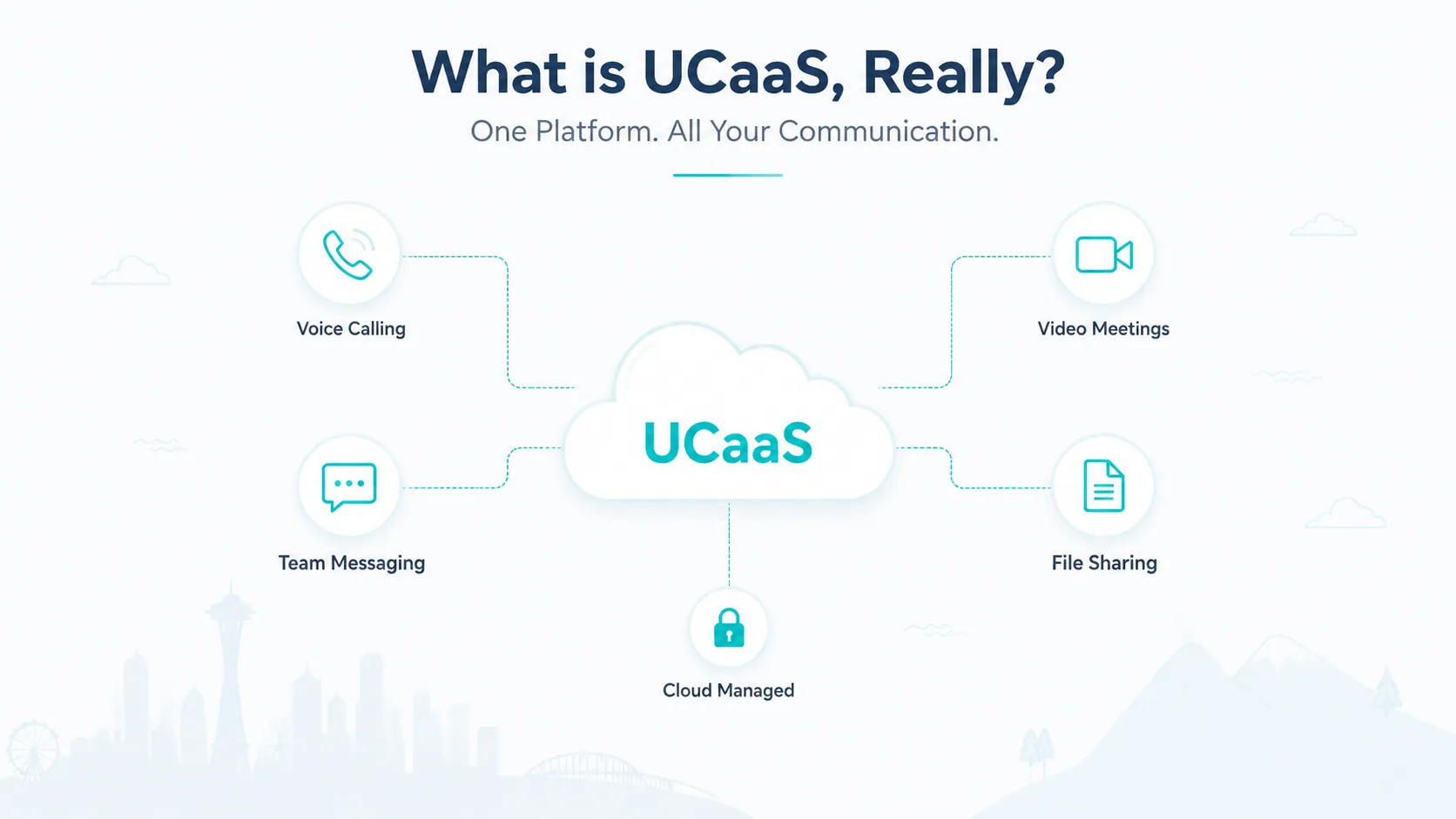
UCaaS stands for Unified Communications as a Service. It's a cloud platform that combines voice calling, video meetings, team messaging, and file sharing into one application.
Instead of buying phone hardware and running it yourself, you subscribe to the whole communication stack and a provider runs it for you.
The "Unified" Part Matters Most
The value isn't any single feature — every vendor has video and chat. It's that they live in one place, share one contact list, and one set of login details.
A call can become a video meeting in a click. A chat thread keeps the file you shared last week. Nothing gets lost between apps.
The "as a Service" Part
You pay a monthly per-user fee, usually $15 to $40, and the provider handles servers, updates, and uptime. There's no PBX in a closet to maintain.
That shift — from owning equipment to renting a service — is the same move that took email and storage to the cloud years ago.
HOW DOES UCAAS ACTUALLY WORK?
At its core sits a cloud phone system powered by VoIP — Voice over Internet Protocol — which carries calls as data packets over the internet instead of copper phone lines.
Around that voice engine, the provider layers messaging, video, and presence tools, all delivered through one app on desktop and mobile.
Where the Heavy Lifting Happens
The provider operates the data centers, call routing, and security infrastructure. Your business just needs a stable internet connection and devices.
When someone calls your number, the platform routes it to whichever device that person is signed into — desk, laptop, or phone. The call follows the person, not the wire.
Why the Underlying Network Counts
A unified communications platform is only as reliable as the voice network beneath it. Call quality, uptime, and global reach all depend on that carrier layer.
This is where infrastructure providers like My Country Mobile (MCM) come in — supplying the carrier-grade VoIP routing and SIP trunking that keep cloud communication clear across 190+ countries.
Mapping out a move to the cloud? Start with the network. MCM delivers wholesale voice and global numbers with a 99.99% uptime SLA — the foundation any cloud phone system relies on. See how MCM's voice network works → No commitment — just a clear look at the infrastructure side.
Ready when you are
Protect your business line.
MCM's local numbers ship with verified caller ID and smart call filtering — customers always know it's really you, and spam never reaches your team.
THE CORE FEATURES YOU GET
Most platforms bundle the same essential tools. Knowing what each one does helps you compare providers without getting lost in feature lists.
Voice and Cloud Calling
A full business phone system: extensions, call forwarding, voicemail-to-email, auto-attendant menus, and call recording — no physical handset required.
Video Meetings and Screen Sharing
Built-in video conferencing for one-to-one or group calls, with screen sharing and, increasingly, AI-generated meeting notes.
Team Messaging and Presence
Instant chat with channels and direct messages, plus presence indicators that show who's available, busy, or away before you call.
Mobile and Desktop Apps
The same number and tools on every device. Staff working from home or on the road look and sound exactly like they're at the office.
CRM and App Integrations
Connections to tools like Salesforce, HubSpot, and Microsoft Teams so call logs and customer data flow automatically — no copy-pasting between systems.
WHY BUSINESSES SWITCH: THE REAL BENEFITS
The pitch is rarely "more features." It's usually cost, flexibility, and removing IT headaches. Here's what holds up in practice.
Lower, More Predictable Costs
Companies that move to cloud communications see an average 50% drop in total communication spend, mostly from removing hardware, maintenance, and separate phone lines.
A flat per-user fee also makes budgeting far easier than a tangle of carrier and equipment invoices.
Effortless Scaling
Adding 20 staff means adding 20 licences — done in minutes, not a hardware order. Seasonal businesses scale down just as fast.
Built for Hybrid Work
Because everything runs in the cloud, location stops mattering. Remote and office staff use identical tools, which is why adoption accelerated so sharply.
Less IT Burden
No on-site servers to patch, no failed phone cards to replace. Updates and security arrive automatically from the provider.
UCAAS VS CCAAS: WHAT'S THE DIFFERENCE?
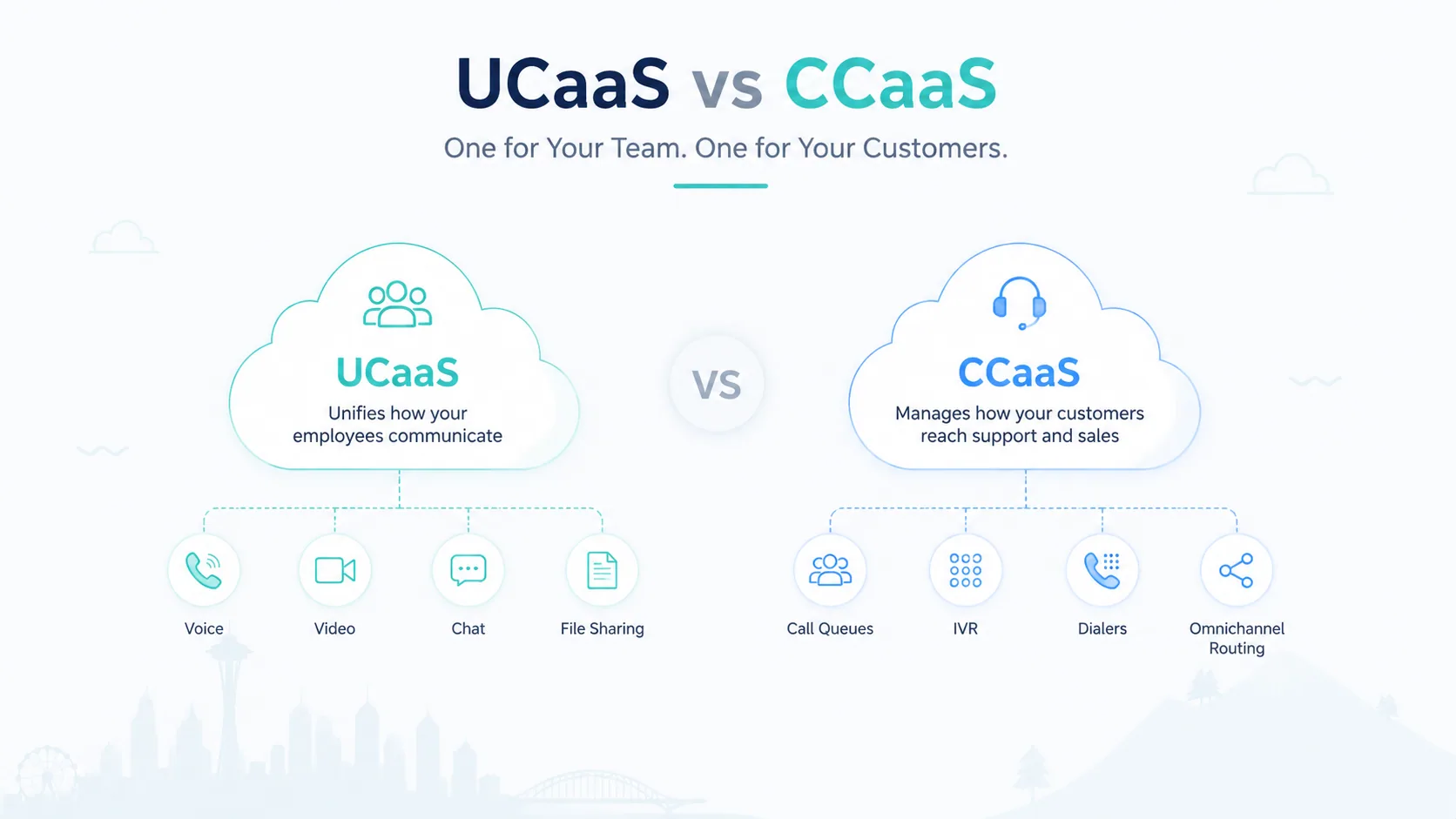
These two get confused constantly. The simplest distinction: one faces inward, the other faces outward.
UCaaS unifies how your employees communicate. CCaaS — Contact Center as a Service — manages how your customers reach support and sales teams.
| Factor | UCaaS | CCaaS |
|---|---|---|
| Primary users | Internal employees | Customer service & sales agents |
| Main purpose | Team collaboration | Customer interaction handling |
| Core tools | Voice, video, chat, file sharing | Call queues, IVR, dialers, omnichannel routing |
| Typical buyer | IT / operations leader | Contact center manager |
| Best fit | Whole-company communication | High-volume support or sales teams |
Do You Need Both?
Many businesses run both — and in 2026 the two are converging fast. Shared analytics and one infrastructure let internal experts jump into customer calls instantly.
If you only support customers occasionally, a UCaaS platform with call queues may be enough. High call volumes usually justify a dedicated CCaaS setup.
Comparing providers and feeling buried in jargon? Get a straight answer on whether a unified platform, a contact center solution, or both fits your team — from people who run the network underneath. Talk to MCM's communications team → A practical conversation, not a sales pitch.
IS UCAAS SECURE?
Moving phones to the cloud raises a fair question: is it safe? With a reputable provider, it's generally more secure than aging on-site equipment.
What to Expect From a Serious Provider
Encrypted calls and messages, multi-factor login, and compliance with standards relevant to your industry — HIPAA for healthcare, PCI for payments.
On the voice side, look for STIR/SHAKEN caller authentication and active fraud monitoring to block spoofed calls and toll fraud.
The Questions to Ask
Where is data stored? What's the uptime guarantee? How is call traffic protected against fraud? Vague answers are a warning sign.
A provider running its own monitored, carrier-grade network — with redundancy and 24/7 oversight — gives you far more to verify than a thin reseller.
WHERE UCAAS IS HEADING IN 2026
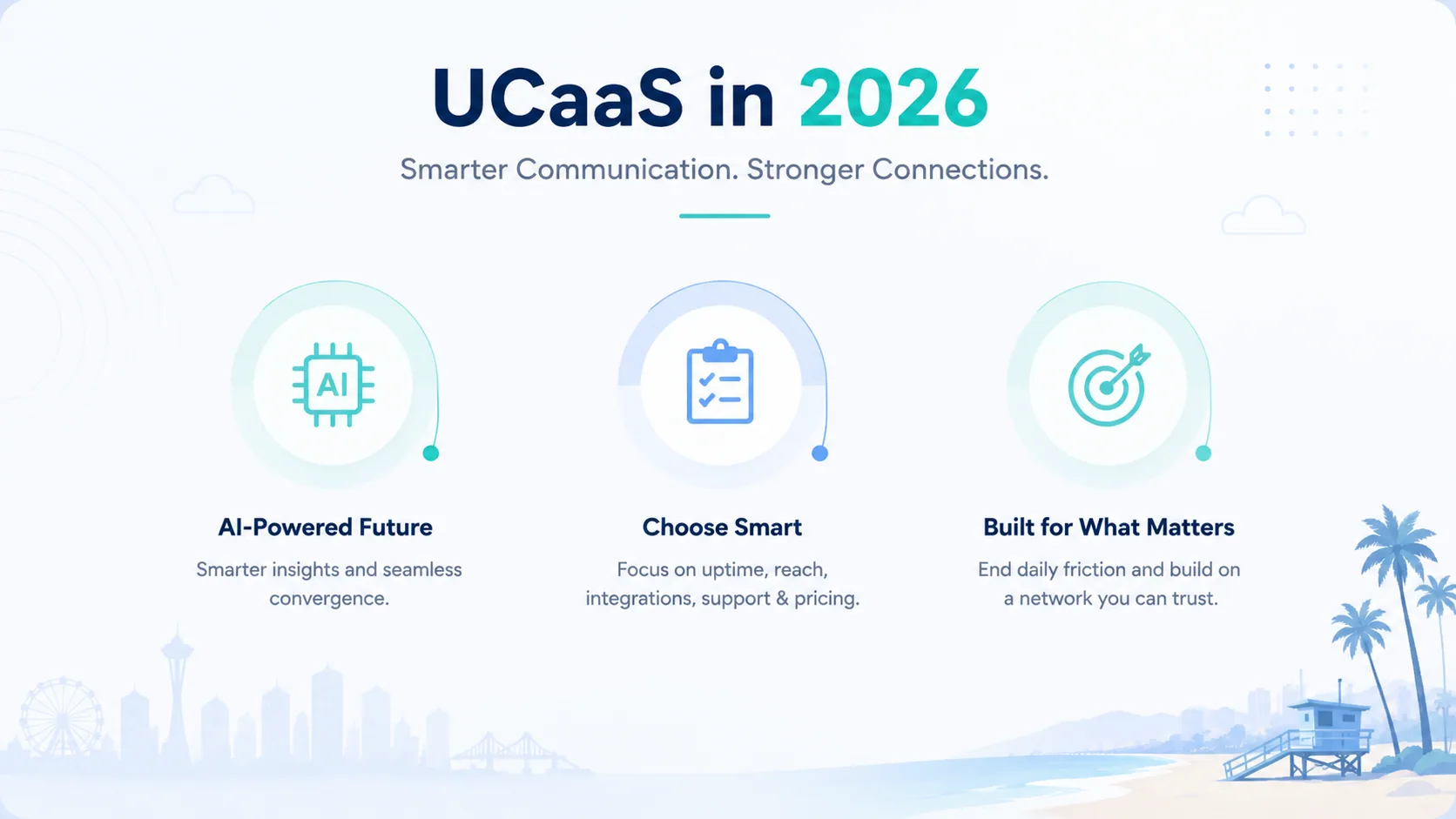
The category is no longer just "phones in the cloud." It's becoming a business intelligence layer, and AI is the engine.
Real-time transcription, live translation, sentiment analysis, and AI copilots that summarize meetings and draft follow-ups are now standard on leading platforms.
The other big shift is convergence — internal and customer-facing communication merging into one connected ecosystem rather than two separate purchases.
CHOOSING A PROVIDER: A QUICK CHECKLIST
Feature lists look identical across vendors, so judge on the fundamentals that actually affect daily use.
- Uptime SLA — 99.99% should be the minimum, not a stretch goal.
- Network reach — Global coverage matters if you call internationally.
- Integrations — Confirm it connects to the CRM and tools you already use.
- Support — Real humans, fast response, ideally a named account contact.
- Transparent pricing — Per-user costs with no surprise add-ons.
The right choice depends on your size, call volume, and growth plans — not on whoever has the longest feature page.
THE BOTTOM LINE
Unified communications isn't about chasing the newest tool. It's about ending the daily friction of four disconnected apps and one unreliable phone system.
Start by auditing what your team uses now and what it costs — licences, hardware, lines, IT time. Most businesses are surprised by the total.
If the numbers and the hybrid-work reality point to consolidation, the next step is picking a provider built on a network you can trust. Explore MCM's voice infrastructure to see what that foundation should look like.
Ready when you are
Ready to sound local everywhere you sell?
MCM activates business numbers in minutes, with call routing, analytics, and CRM-ready integrations. Start your free trial — no card to browse inventory.
FAQs
What does UCaaS stand for?
It stands for Unified Communications as a Service — a cloud platform delivering voice, video, messaging, and file sharing in one subscription, managed entirely by the provider.
How much does a UCaaS platform cost?
Most providers charge $15 to $40 per user per month, depending on features. Businesses typically cut total communication costs by around 50% versus traditional phone systems.
What's the difference between UCaaS and VoIP?
VoIP is the technology that carries calls over the internet. A unified communications platform is a complete service built around VoIP, adding video, chat, file sharing, and apps into one tool.
Is UCaaS the same as CCaaS?
No. UCaaS handles internal employee communication and collaboration. CCaaS is built for customer-facing contact centers, with call queues, IVR, dialers, and omnichannel routing.
Do I need fast internet to use it?
Yes. Calls travel over your internet connection, so a stable broadband or fiber link is essential. Most providers publish minimum bandwidth requirements per user.
Can a small business use UCaaS?
Absolutely. With no hardware to buy and per-user pricing, cloud communication often suits small businesses better than legacy systems — and it scales as the team grows.