Businesses that still run separate systems for phone calls, video meetings, team messaging, and file sharing are paying more than they should, and doing more work to manage it. UCaaS benefits go far beyond convenience: unified cloud communications cut costs, support remote teams natively, and replace a pile of hardware with one platform that works from any device, anywhere.
This guide breaks down the 10 key UCaaS benefits, compares them against traditional phone systems, and shows which businesses see the biggest impact when they switch.
What Is UCaaS? (Quick Recap)
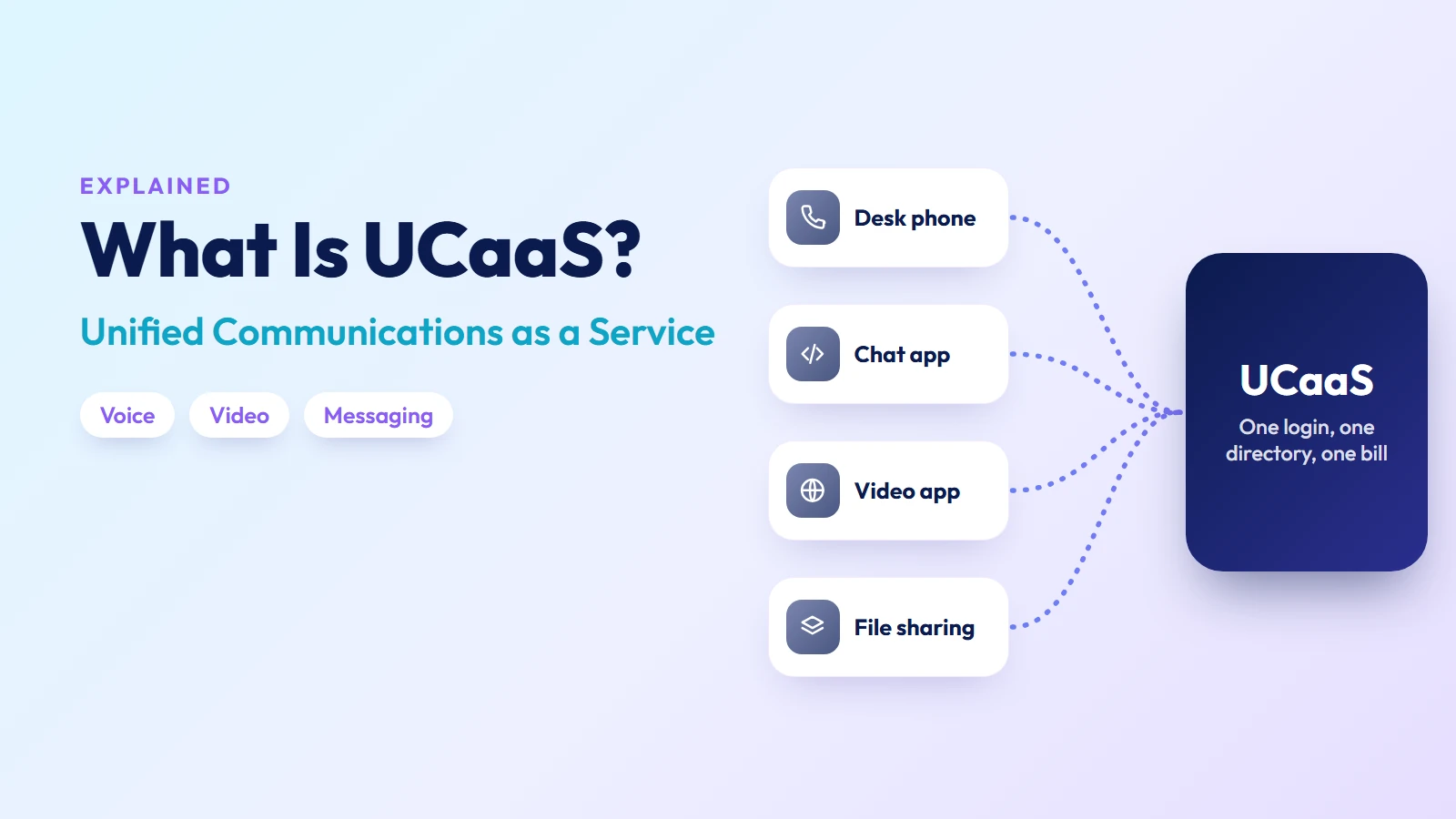
UCaaS (Unified Communications as a Service) is a cloud platform that combines your business phone system, video conferencing, team messaging, file sharing, and collaboration tools into a single monthly subscription. No PBX hardware. No on-site maintenance. No IT team required to manage it.
For a full explainer, see our guide on what UCaaS is and how it works. Here, we focus on what you actually gain by switching.
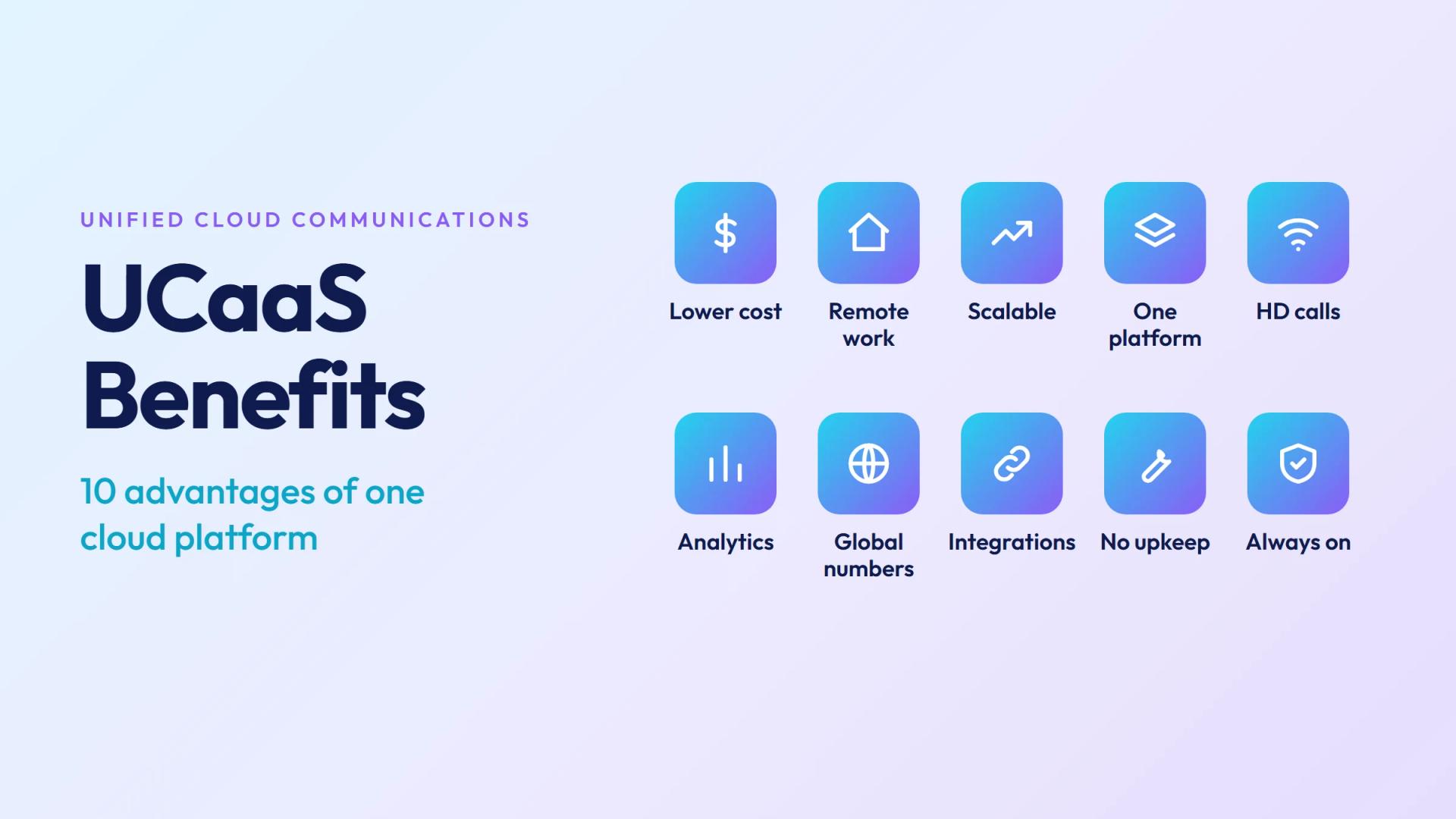
The 10 Core UCaaS Benefits
| # | Benefit | In one line |
|---|---|---|
| 1 | Significant cost reduction | No upfront hardware, no PBX maintenance contracts, and one bill that replaces 3–4 separate subscriptions. |
| 2 | Remote and hybrid work ready | Every employee works with a full business phone system from any device, any location. |
| 3 | Instant scalability | Add a user in minutes from an admin dashboard. No hardware orders, no technician visits. |
| 4 | All channels unified | Voice, video, messaging, and file sharing in one platform, so your team stops switching between apps. |
| 5 | Better call quality | Carrier-grade VoIP networks deliver HD audio that beats most traditional phone lines. |
| 6 | Real-time analytics | See call volumes, missed calls, hold times, and agent performance without a separate tool. |
| 7 | Global number coverage | Get local numbers in dozens of countries. Customers call a local number; your team answers from anywhere. |
| 8 | CRM and app integrations | Connect to Salesforce, HubSpot, Zoho, and other business tools. Calls log automatically. |
| 9 | Zero maintenance burden | Your provider manages uptime, security patches, and infrastructure. |
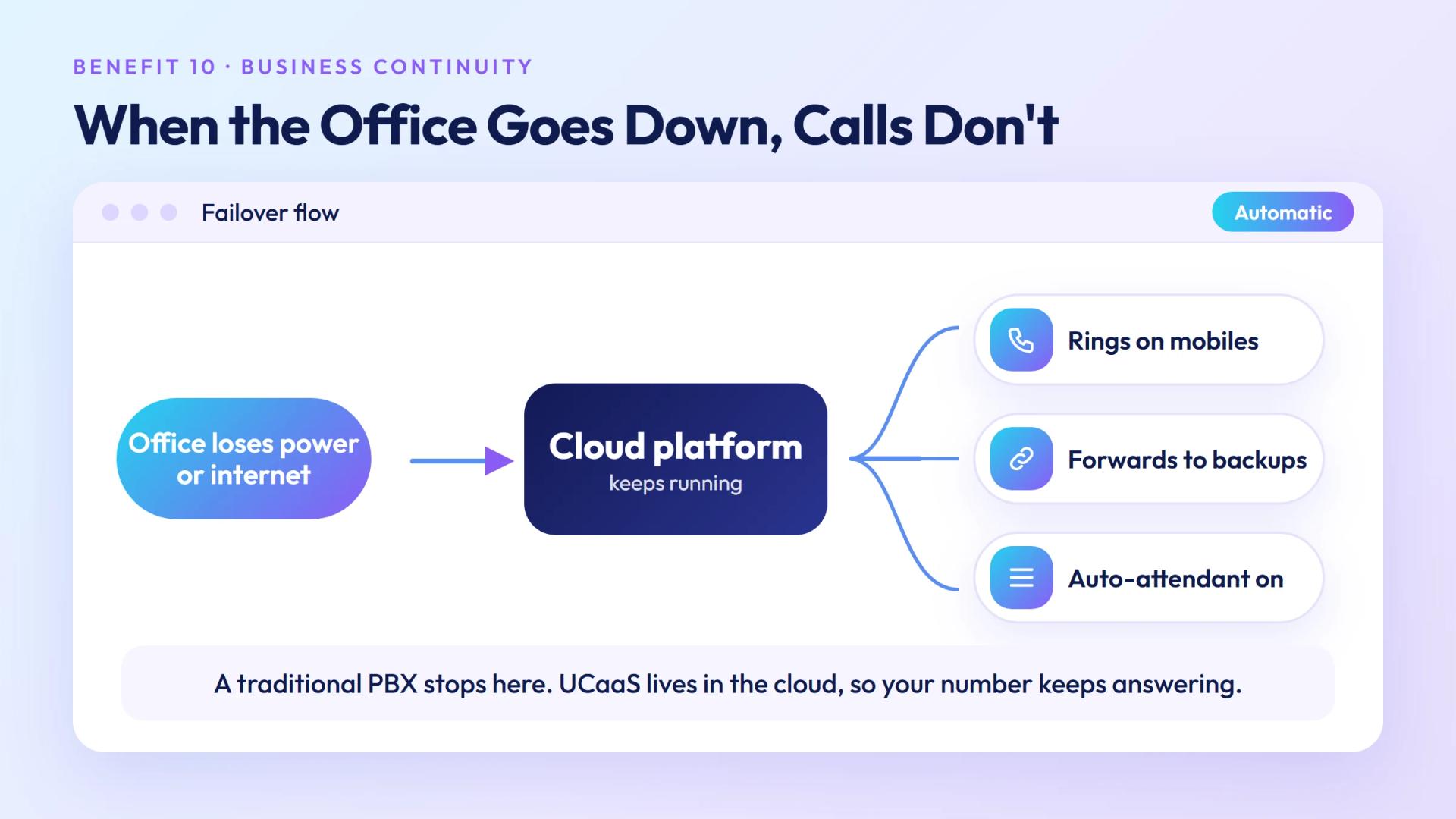
| 10 | Business continuity built in | Calls route to mobile devices during outages, so one office problem does not take down communications. |
Let's go deeper on the ones that matter most.
1. Significant Cost Reduction
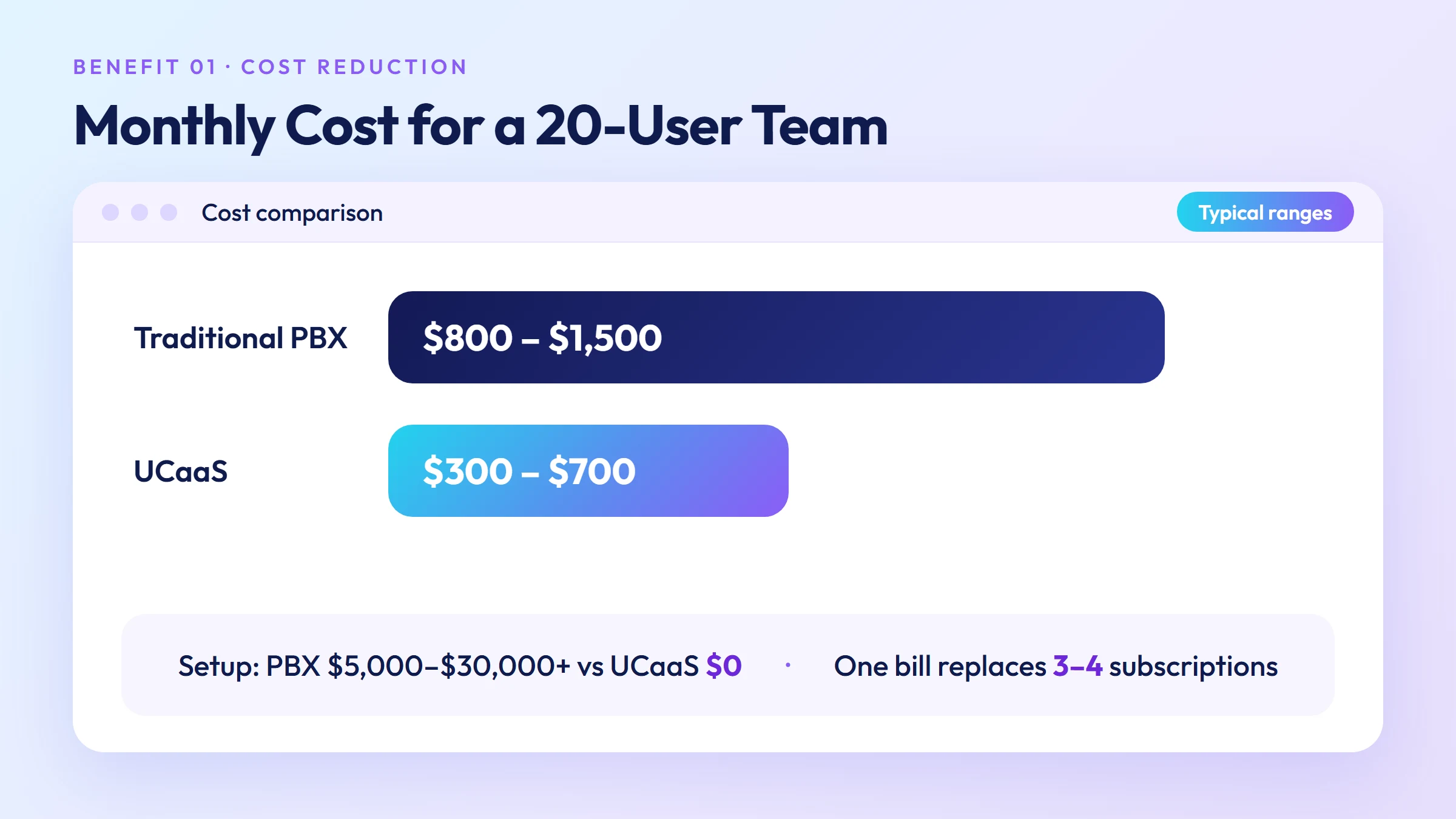
Traditional PBX hardware typically costs $5,000–$30,000+ upfront, plus ongoing maintenance contracts, landline fees, and separate subscriptions for video and messaging. UCaaS replaces all of that with a predictable per-user monthly fee, typically $15–$35 per user at standard tiers.
A 20-person business paying $25/user/month ($500/month total) is likely spending less than their current combined bills for a business phone system, Zoom, Slack, and IT support for the PBX. The savings compound as the team grows.
2. Native Remote and Hybrid Work Support
This is one of the most underappreciated UCaaS benefits. With a traditional phone system, remote work requires a VPN, call forwarding workarounds, or expensive hardware shipped to home offices. With UCaaS, every employee has a full business phone on their laptop or mobile phone from day one: same extension, same business number, same call quality.
The company always presents a consistent, professional face to customers regardless of where the team is physically located.
3. Instant Scalability in Both Directions
Traditional PBX scales in hardware: you need more ports, more cards, more physical installation work. UCaaS scales in software. Hiring 5 new sales reps? Add 5 seats in the admin panel. Done in under 10 minutes. Downsizing after a contract ends? Remove seats just as quickly, with no hardware you're stuck with.
This elasticity makes UCaaS particularly powerful for businesses with seasonal volume, rapid growth phases, or project-based hiring.
4. All Business Channels in One Platform
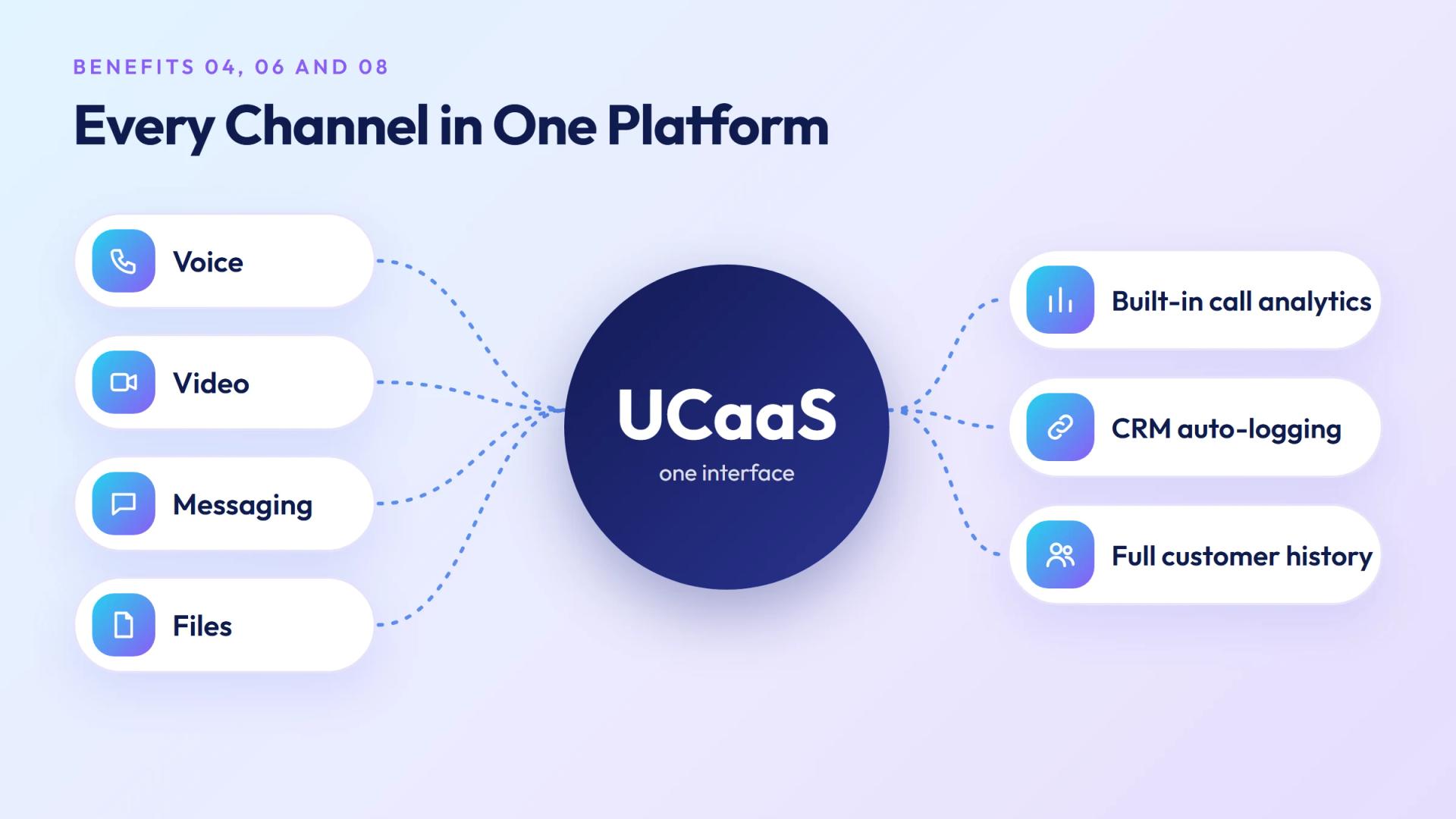
The word "unified" in UCaaS isn't marketing language. It's the core proposition. Voice, video conferencing, team messaging, presence indicators ("on a call," "available," "in a meeting"), and file sharing all live in the same interface. Your team stops toggling between a desk phone, Zoom, Slack, and email to reach each other.
For customer-facing teams, this also means your agents can see a customer's full interaction history (calls, chats, emails) in one view, which directly improves service quality.
5. Superior Call Quality
Modern UCaaS platforms run on carrier-grade VoIP infrastructure, the same backbone used by telecom operators globally. This delivers HD audio (G.722 codec) that is noticeably clearer than most traditional landlines, with features like echo cancellation and adaptive bitrate that adjust to network conditions automatically.
The underlying technology is SIP trunking, the industry standard for routing business calls over the internet at carrier-grade quality.
6. Actionable Analytics Without Extra Tools
UCaaS platforms include built-in call analytics: total inbound and outbound call volumes, missed call rates, average hold times, calls by department, peak call hours, and individual agent performance. This level of visibility used to require expensive call recording hardware or separate analytics subscriptions. With UCaaS, it's included.
Even a 5-person team benefits from knowing how many calls they're missing and during which hours.
7. Local Presence in Any Market
Get a local phone number in virtually any city or country. Your team in Mumbai can present a New York number to US customers, or vice versa. For businesses selling internationally, this is a significant trust and answer-rate improvement, because people are far more likely to pick up a local number than an international one.
DID (Direct Inward Dialing) numbers are provisioned quickly, without you having to register with local carriers in each country.
8. CRM and Business App Integrations
UCaaS platforms integrate natively with CRM systems like Salesforce, HubSpot, Zoho CRM, and Pipedrive. When a call comes in, the customer's record opens automatically. After the call ends, it logs with duration, notes, and recording. No manual data entry. No missed follow-ups because someone forgot to log a call.
9. Zero Infrastructure Maintenance
Your UCaaS provider manages the infrastructure: servers, software updates, security patches, uptime monitoring, and failover. Your IT team (if you have one) has nothing to maintain on the communications side. For companies without a dedicated IT team, this is especially valuable. Communications simply work, without anyone needing to understand how.
10. Automatic Business Continuity
When a traditional PBX fails, calls stop. When an office loses power or internet, your phone system goes dark. UCaaS handles this automatically: calls route to employee mobile phones, calls forward to backup numbers, and your auto-attendant keeps working from cloud infrastructure unaffected by local outages.
For businesses where missed calls mean missed revenue, this automatic resilience is not optional. It's essential.
UCaaS Benefits vs Traditional Phone Systems
| Factor | Traditional PBX | UCaaS | Winner |
|---|---|---|---|
| Setup cost | $5,000 – $30,000+ | $0 | UCaaS |
| Monthly cost (20 users) | $800–$1,500 | $300–$700 | UCaaS |
| Remote work | Requires VPN/hardware | Native, any device | UCaaS |
| Add a new user | Hardware + technician | Admin panel, 5 min | UCaaS |
| Video & messaging | Not included | Built in | UCaaS |
| Call analytics | Separate tool required | Built in | UCaaS |
| International numbers | Requires local carrier | Fast, any country | UCaaS |
| Maintenance | IT team or vendor | None, provider handles it | UCaaS |
| Business continuity | Office-dependent | Automatic failover | UCaaS |
| On-prem data control | Full control | Cloud-hosted | Tie / depends |
The only scenario where a traditional PBX retains an edge is on-premises data sovereignty: specific government or regulated industries where all communications data must remain on internal servers. For the vast majority of businesses, UCaaS wins on nearly every dimension.
Ready when you are
Protect your business line.
MCM's local numbers ship with verified caller ID and smart call filtering — customers always know it's really you, and spam never reaches your team.
Benefits of UCaaS by Business Size
Small Businesses (2–50 employees)
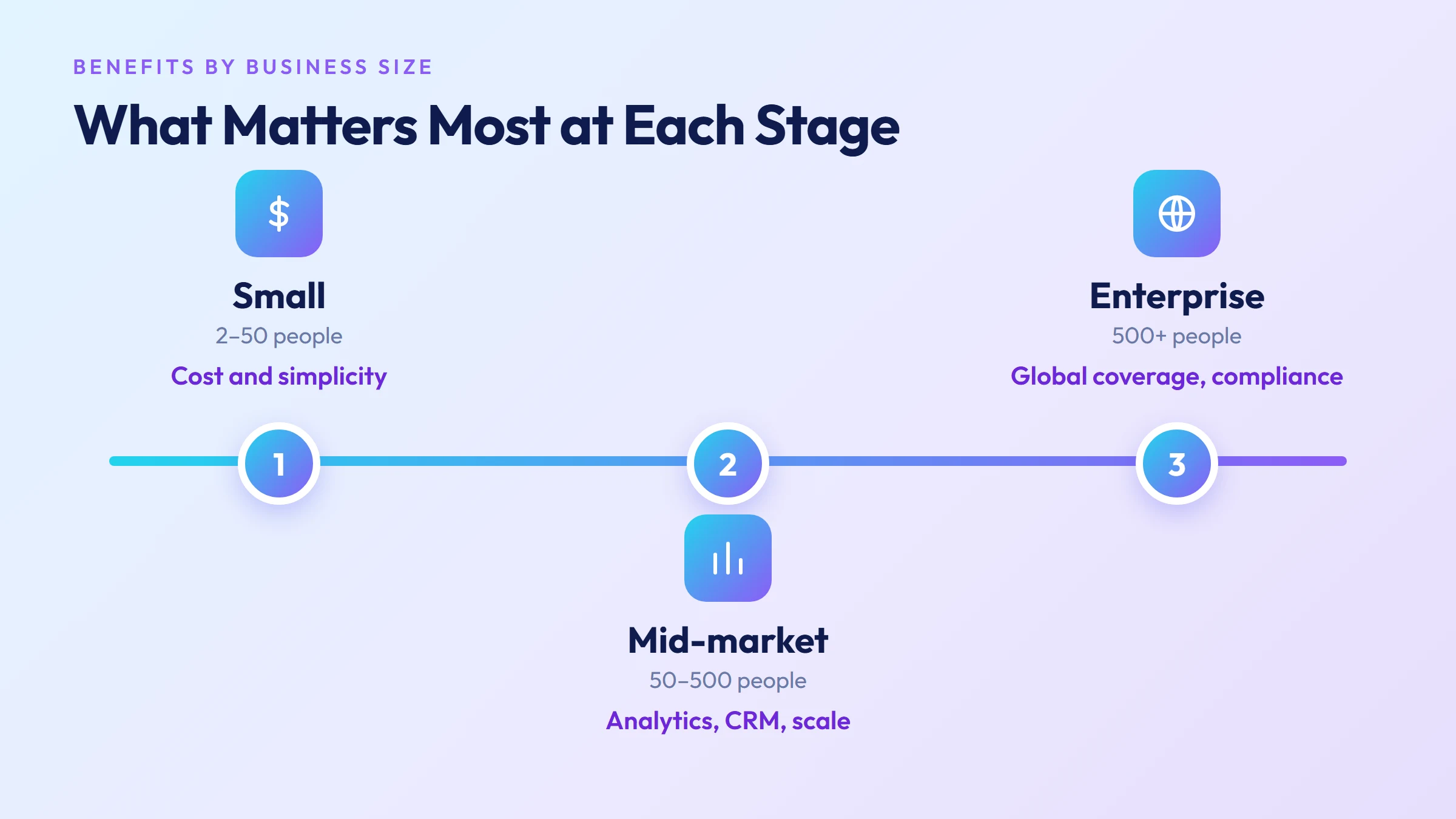
The cost and simplicity benefits of UCaaS hit hardest here. A 10-person business gets a professional phone system with extensions, auto-attendant, voicemail-to-email, and video meetings for $150–$350/month total, with no upfront investment and no IT person required. See our full breakdown: UCaaS for Small Business.
Mid-Market Businesses (50–500 employees)
At this scale, the analytics, CRM integration, and scalability benefits become central. Sales teams get full call visibility. HR teams can onboard new hires with a phone number and extension on their first day. Multi-office companies unify communications across locations without site-to-site ISDN lines.
Enterprise (500+ employees)
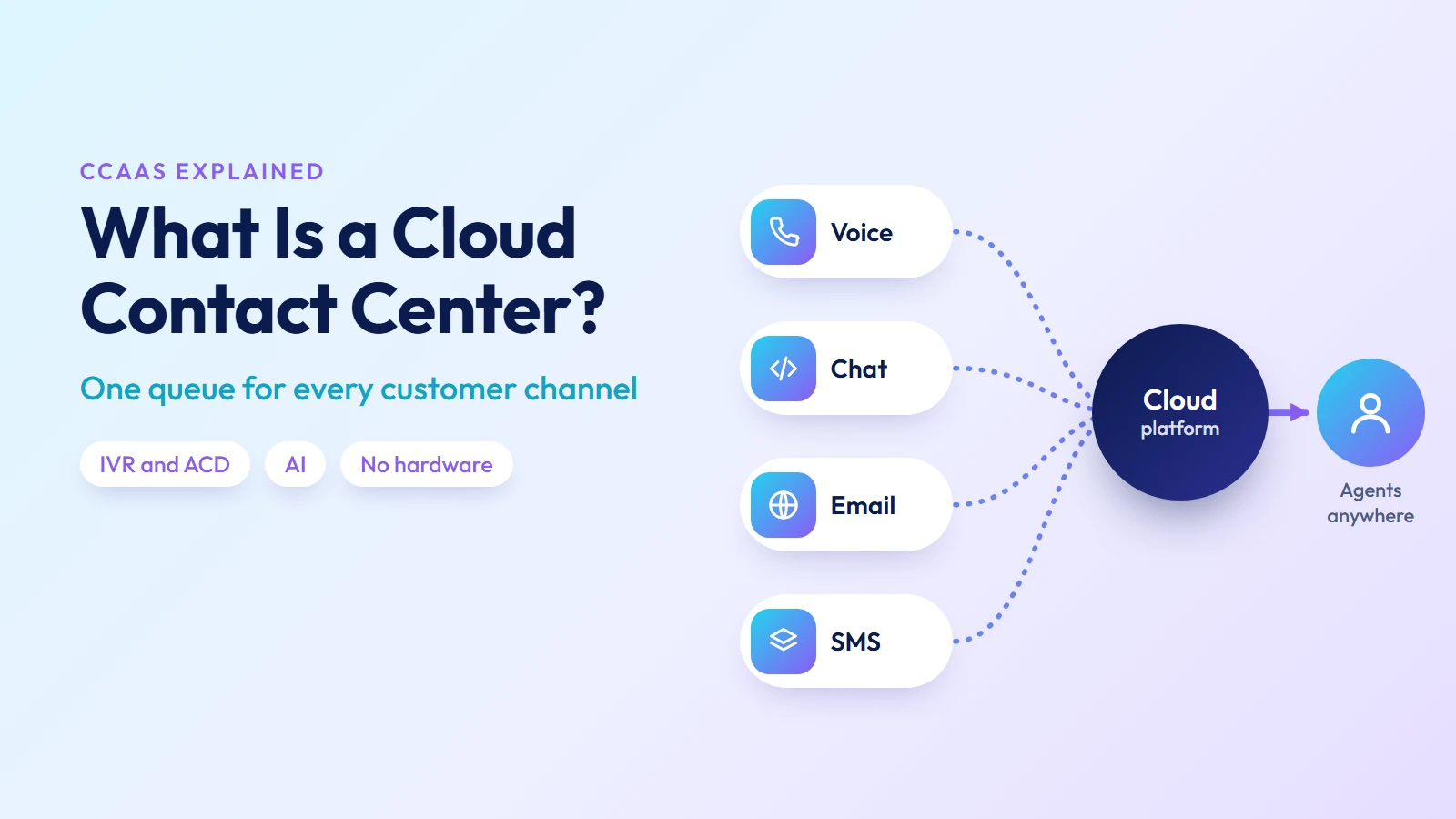
Large enterprises benefit most from global number coverage, compliance recording features, and deep integrations with enterprise systems. UCaaS also solves the challenge of standardizing communications across offices in different countries: one platform, one bill, consistent features globally. For contact-center-heavy enterprises, see how UCaaS compares to CCaaS.
Which Industries Benefit Most from UCaaS?
| Industry | Primary UCaaS Benefit |
|---|---|
| Professional services (law, accounting, consulting) | Professional client-facing phone presence, call recording for compliance |
| Healthcare | Secure communications and patient callback routing (HIPAA requirements depend on the provider's compliance program) |
| E-commerce and retail | Customer support at scale, seasonal team scaling, omnichannel integration |
| BPO and outsourcing | Large distributed agent teams, call analytics, international number coverage |
| Technology companies | Remote-first work, developer-friendly APIs, global presence |
| Financial services | Call recording for compliance, secure communications, audit trails |
| Real estate | Mobile agents, call tracking, local number presence in multiple markets |
How My Country Mobile Delivers These Benefits
My Country Mobile is a carrier-grade UCaaS and wholesale VoIP provider built on direct peering agreements with global networks, which means call quality and reliability that consumer-grade platforms can't match.
Key advantages with MCM specifically:
- Global DID coverage: local numbers in many countries, with no local carrier registration for you to manage
- Carrier-grade SIP trunking: the same infrastructure that powers enterprise telephony, available to businesses of any size
- Transparent pricing: no hidden per-minute fees buried in contracts, so you know exactly what you pay
- Live support: real technical support, not just a ticketing system, when call quality issues arise
- Wholesale rates for high-volume callers: businesses with large call volumes can access wholesale termination pricing directly, which most UCaaS providers don't offer
Get all 10 UCaaS benefits, without the enterprise price tag
Carrier-grade voice quality, global DID numbers, built-in video and messaging, and analytics in one platform. No hardware, no long-term contracts. Talk to sales →
Ready when you are
Ready to sound local everywhere you sell?
MCM activates business numbers in minutes, with call routing, analytics, and CRM-ready integrations. Start your trial — no card to browse inventory.
Frequently Asked Questions
What are the main benefits of UCaaS?
The core UCaaS benefits are: significant cost savings over traditional phone systems, native support for remote and hybrid teams, instant scalability, all channels unified in one platform (voice, video, messaging), better call quality, real-time analytics, global number coverage, CRM integrations, zero infrastructure maintenance, and automatic business continuity during outages.
How does UCaaS save money compared to a traditional phone system?
UCaaS eliminates upfront PBX hardware costs ($5,000–$30,000+), ongoing maintenance contracts, and separate subscriptions for video conferencing and team messaging. A typical business replaces 3–4 monthly bills with one UCaaS subscription at $15–$35 per user per month, often resulting in meaningfully lower total communications costs.
Is UCaaS good for remote work?
Yes. UCaaS is purpose-built for remote and hybrid teams. Every employee gets a business number and extension on their laptop or mobile device. Internal calls are free. The company presents one main business number to customers regardless of where employees are. Video, chat, and file sharing are built in, so no additional tools are needed.
What is the biggest advantage of UCaaS over basic VoIP?
Basic VoIP replaces your desk phone calls with internet-based calls. UCaaS goes much further: it's a complete platform that adds video conferencing, team messaging, presence, analytics, CRM integration, and auto-attendant features. UCaaS unifies all business communications in one platform; VoIP only handles the voice channel.
Can UCaaS scale with business growth?
Yes. Scalability is one of UCaaS's defining benefits. Adding a user takes minutes in an admin dashboard (no hardware, no technician). You can add phone numbers in new countries, open new offices, and onboard teams without changing your underlying infrastructure. You pay only for what you actually use.
What industries benefit most from UCaaS?
Every industry benefits, but the highest-impact sectors are professional services (reliable client communications), healthcare (secure patient communications), e-commerce and retail (scalable customer support), BPO and outsourcing (distributed teams, call analytics), and technology companies with remote-first workforces.