Introduction
You've got a number for a supplier in Shenzhen. It starts with a 0, has way too many digits, and your phone won't connect the call. Sound familiar?
The Chinese phone number format isn't complicated — but it follows rules that look nothing like North American or European numbering. One of them, the leading-zero rule, breaks more international calls than any other.
This guide walks through the whole system: how mobile and landline numbers are built, what +86 does, when to drop that leading 0, and exactly how to dial China from anywhere.
6-minute read. Verified against current ITU and Chinese carrier numbering plans.
THE TWO NUMBER TYPES IN CHINA
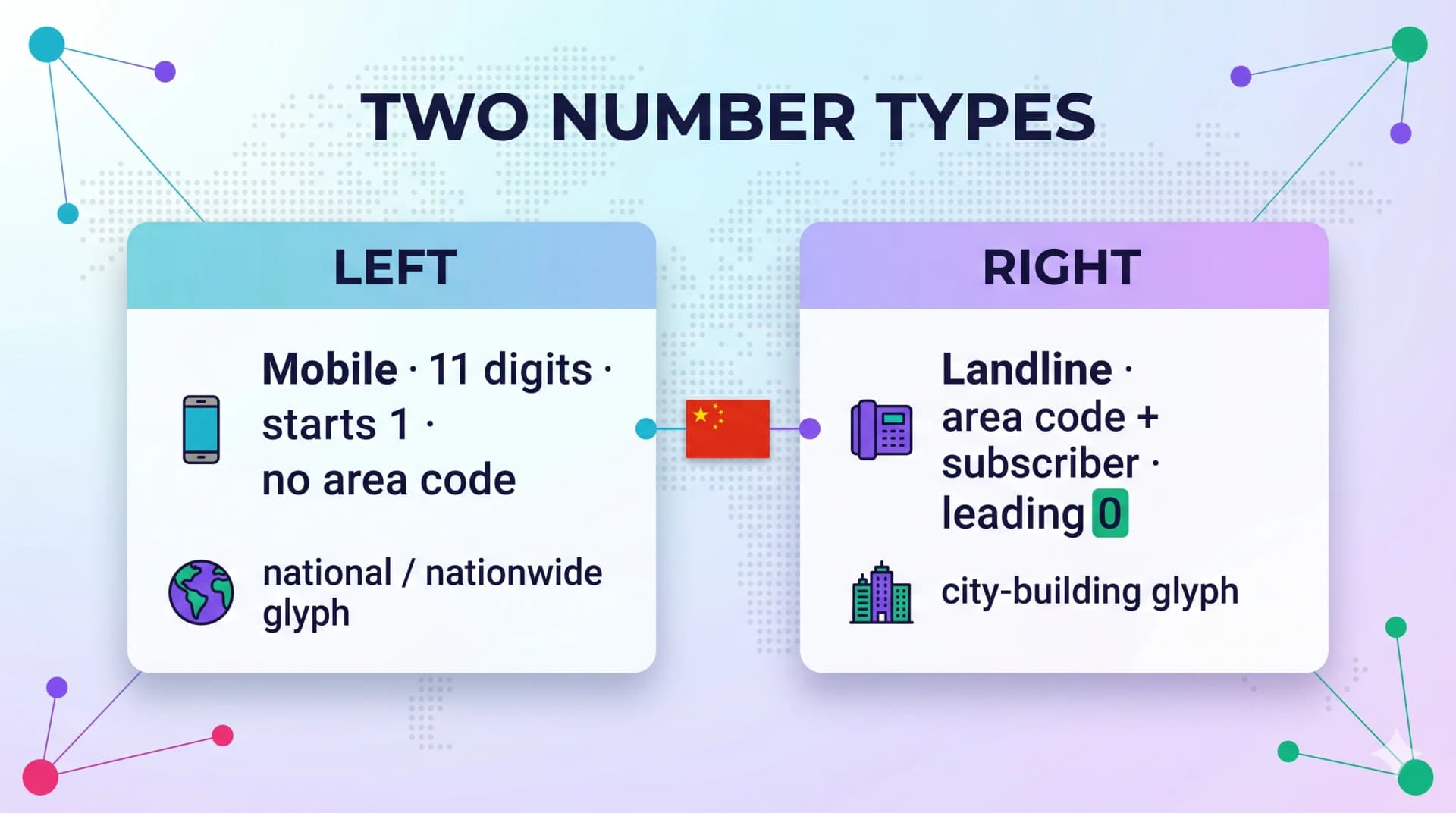
Before any dialing, you need to know which kind of number you're holding. China has two, and they follow different rules.
Mobile Numbers
Mobile numbers are always 11 digits and always start with the digit 1. They contain no area code — a Chinese mobile number works the same nationwide.
This is the number type you'll see most often for business contacts.
Landline Numbers
Landlines combine a city area code with a local subscriber number. They're shorter than mobiles and tied to a specific city.
When written for local use, landlines carry a leading 0 on the area code — and that 0 is the source of most dialing mistakes.
HOW CHINESE MOBILE NUMBERS ARE BUILT
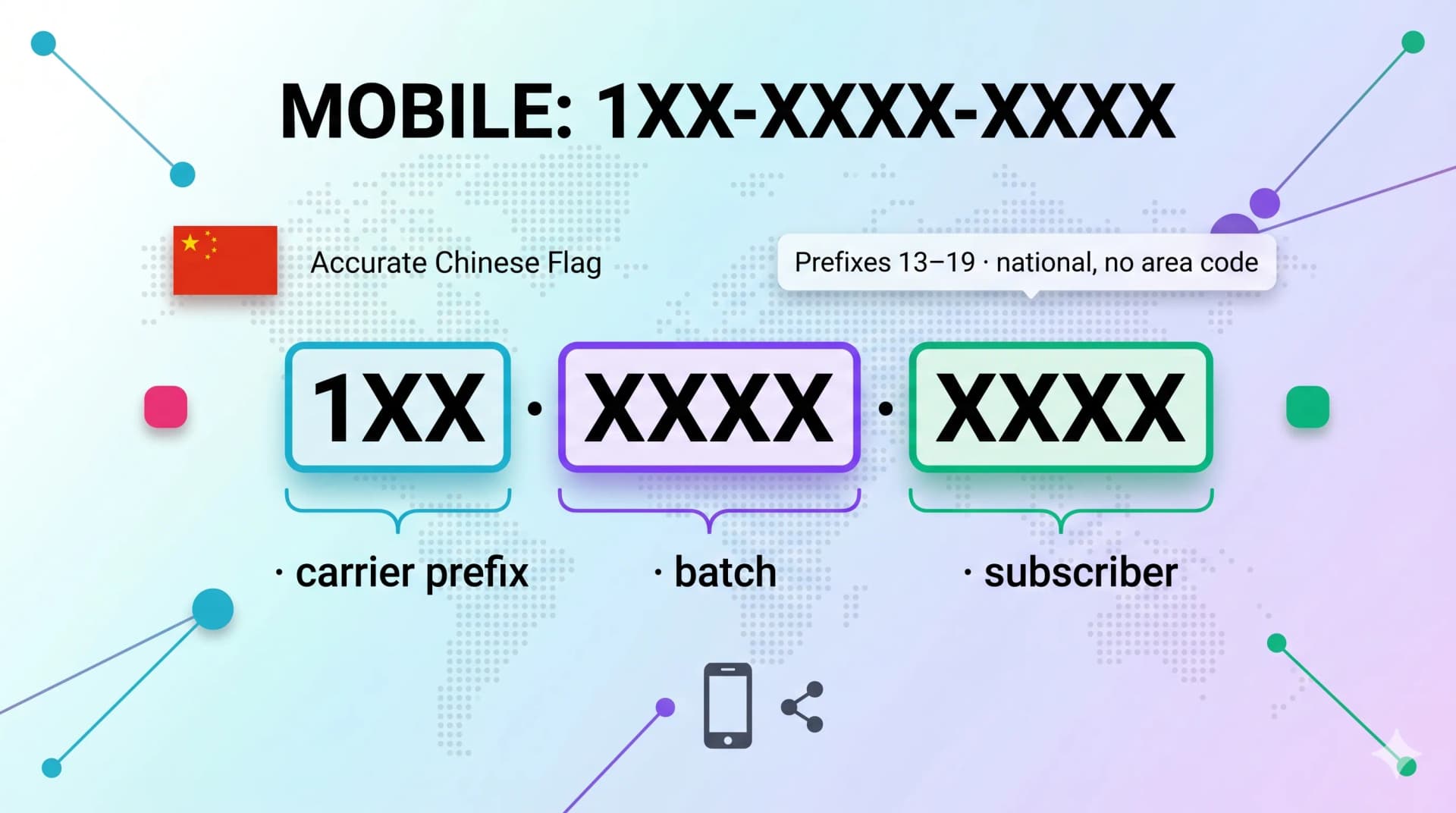
A Chinese mobile number breaks into three readable chunks. Once you see the pattern, the digit wall stops looking random.
The Three-Block Structure
The standard layout is 1XX-XXXX-XXXX — a three-digit prefix, then a four-digit block, then a final four-digit block.
- Block 1 (3 digits): the carrier prefix, always starting with 1
- Block 2 (4 digits): an area or batch identifier
- Block 3 (4 digits): the unique subscriber digits
What the Prefix Tells You
The opening prefix signals the carrier — China Mobile, China Unicom, or China Telecom. Valid mobile prefixes begin 13, 14, 15, 16, 17, 18, or 19.
So a number starting 138 or 159 is a mobile line. A number starting with anything else almost certainly isn't.
Why Mobiles Need No Area Code
Chinese mobile numbers are national. Whether the phone is in Beijing or Chengdu, you dial the same 11 digits — no city code attached.
Ready when you are
Protect your business line.
MCM's local numbers ship with verified caller ID and smart call filtering — customers always know it's really you, and spam never reaches your team.
HOW CHINESE LANDLINE NUMBERS ARE BUILT
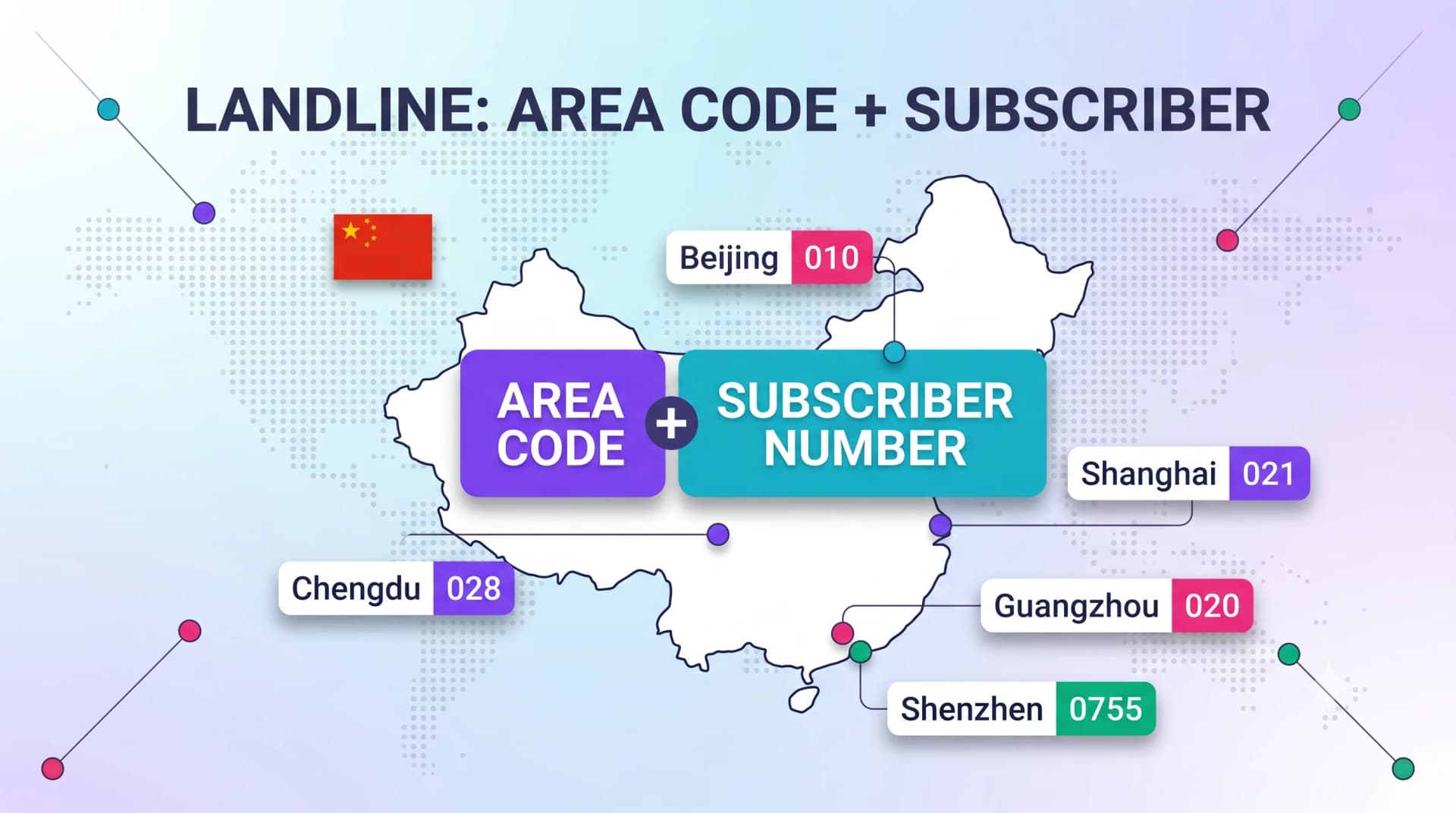
Landlines work the opposite way: location is baked right into the number.
Area Code Plus Subscriber Number
A landline is an area code (2 or 3 digits) plus a subscriber number (7 or 8 digits). The biggest cities get the shortest codes.
| City | Area code (local form) |
|---|---|
| Beijing | 010 |
| Shanghai | 021 |
| Guangzhou | 020 |
| Shenzhen | 0755 |
| Chengdu | 028 |
The Leading Zero
Notice every area code above starts with 0. That 0 is a domestic trunk prefix — it tells China's network "this is a long-distance call inside China."
Keep that 0 for calls within China. Drop it for calls from outside China. That single rule prevents most failed international calls.
If your team places regular calls into China, a provider like My Country Mobile (MCM) handles +86 routing and the leading-zero logic automatically — no manual digit-juggling.
WHAT THE +86 COUNTRY CODE DOES
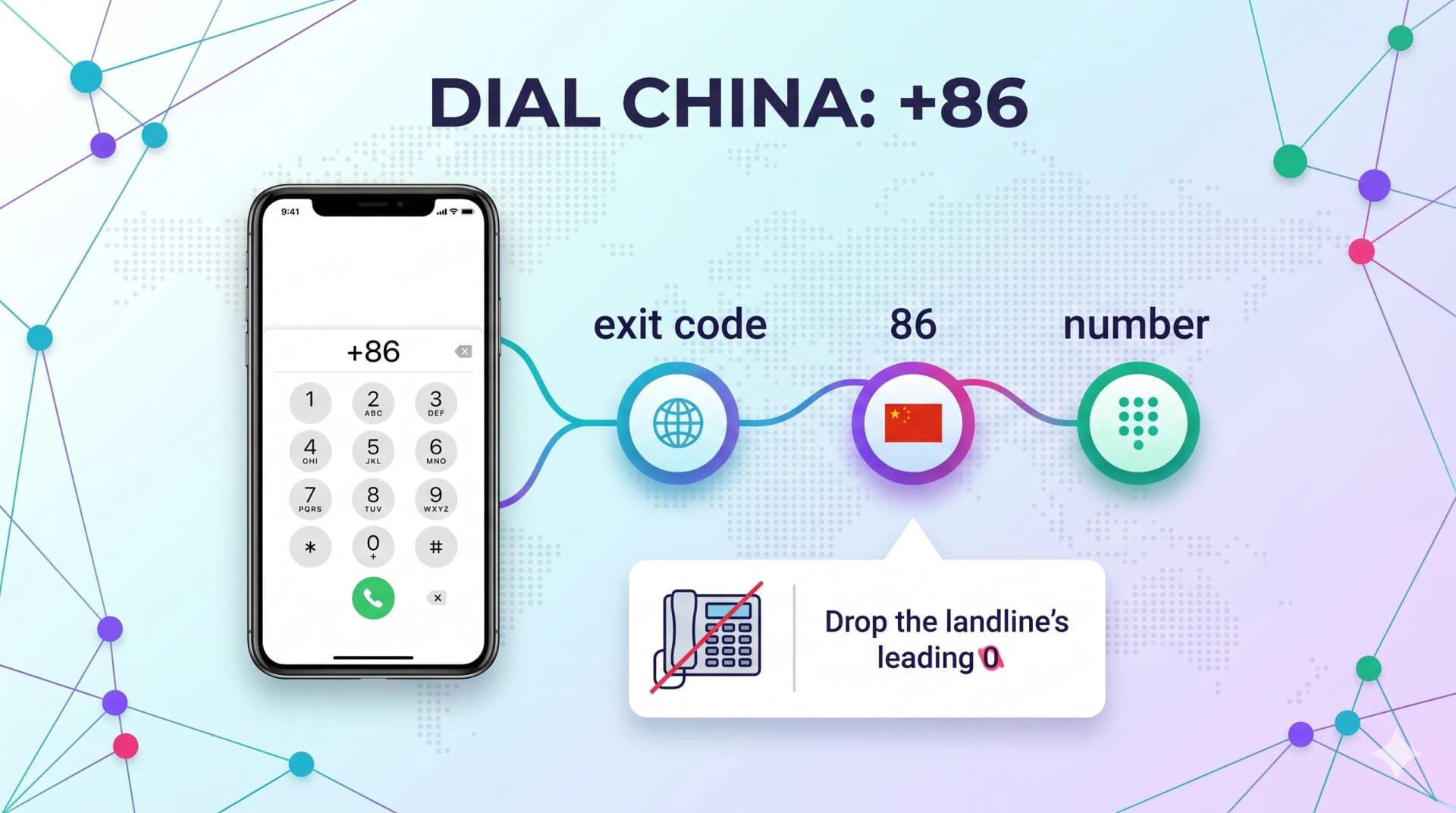
Every country has a dialing code. China's is 86, and you'll see it written as +86 or 0086.
When You Need It
You add 86 only when calling China from another country. The + (or your local exit code) tells the network the call is leaving your country; 86 tells it the destination is China.
Calling within China? You never use 86 — it's purely for international calls coming in.
The Plus Sign
The + is shorthand for "the exit code for wherever I'm calling from." On a mobile, typing + works globally. On a landline, you replace + with your country's actual exit code — 011 from the US, 00 from most of Europe.
HOW TO DIAL A CHINESE NUMBER — STEP BY STEP
Here's the full sequence, split by the two number types. This is where the leading-zero rule earns its keep.
Calling a Chinese Mobile From Abroad
Dial: exit code + 86 + the 11-digit mobile number. Mobiles have no leading 0 to remove, so nothing gets dropped.
Example from the US: 011 86 138 XXXX XXXX.
Calling a Chinese Landline From Abroad
Dial: exit code + 86 + area code without the 0 + subscriber number.
To reach a Beijing landline written locally as 010-8765-4321, you dial: exit code, then 86, then 10 (not 010), then 8765 4321.
Quick Dialing Reference
| Scenario | Format |
|---|---|
| Mobile, from abroad | Exit code + 86 + 11-digit number |
| Landline, from abroad | Exit code + 86 + area code (no 0) + number |
| Landline, within China (other city) | 0 + area code + number |
| Mobile, within China | Just the 11-digit number |
COMMON MISTAKES TO AVOID
A few errors come up again and again. Knowing them saves a lot of "call failed" frustration.
Keeping the Leading 0 on International Calls
The most frequent mistake. The domestic 0 must come off when you dial from outside China — leaving it in misroutes the call.
Adding an Area Code to a Mobile
Mobile numbers are national. Tacking a city code onto an 11-digit mobile breaks it. Mobiles travel as-is.
Forgetting the Exit Code
The +86 alone isn't enough from a landline — you still need your own country's exit code in front of it. On mobiles, the + handles this for you.
Mistaking Number Length
If a number is 11 digits and starts with 1, it's a mobile. If it's shorter and city-bound, it's a landline. Treat them by the right rules.
WHAT TO DO NEXT
The Chinese phone number format comes down to one habit: identify mobile vs. landline first, then apply the leading-zero rule. Get those two right and the rest follows.
If your business calls or texts China regularly, manual dialing logic gets old fast — and one wrong digit means a lost connection. A virtual number and proper international routing remove the guesswork entirely.
Start a trial with My Country Mobile at mycountrymobile.com — set up China-ready calling in minutes, with no contracts and no credit card. For the bigger picture, see our guide to international VoIP calling.
Ready when you are
Ready to sound local everywhere you sell?
MCM activates business numbers in minutes, with call routing, analytics, and CRM-ready integrations. Start your trial — no card to browse inventory.
FAQs
What is the format of a Chinese mobile number?
It's 11 digits, always starting with 1, usually written as 1XX-XXXX-XXXX. The first three digits identify the carrier.
What is China's country code?
It's 86, written as +86. You add it only when calling China from another country, never for calls inside China.
Do I keep the 0 in a Chinese landline area code?
Keep it for calls within China. Drop it when calling from abroad — for example, Beijing's 010 becomes 10 in an international call.
How many digits is a Chinese landline number?
A landline is a 2- or 3-digit area code plus a 7- or 8-digit subscriber number, so the local form runs 9 to 12 digits including the 0.
Why won't my call to China connect?
The usual cause is the leading 0. Calling from abroad, remove the 0 from a landline area code; mobiles never have one to remove.
Do Chinese mobile numbers have area codes?
No. Mobile numbers are national — the same 11 digits work anywhere in China, with no city code attached.
How do I call a Chinese mobile from the United States?
Dial 011, then 86, then the full 11-digit mobile number. Nothing is dropped, since mobiles carry no leading 0.