
Why "free temporary number for OTP" is such a common search
A free temporary number for OTP sounds like the obvious fix any time a sign-up form demands a phone number you'd rather not hand over — plug in a free number, grab the code, move on. It sometimes works exactly that way. Just as often, the code never arrives, and the reason has nothing to do with a slow network.
This guide covers how free OTP-receiving numbers actually work, why verification codes to them fail so much more often than codes to a real phone, which kinds of platforms block them outright, and when it's worth using a private number instead.
How free OTP-receiving numbers actually work
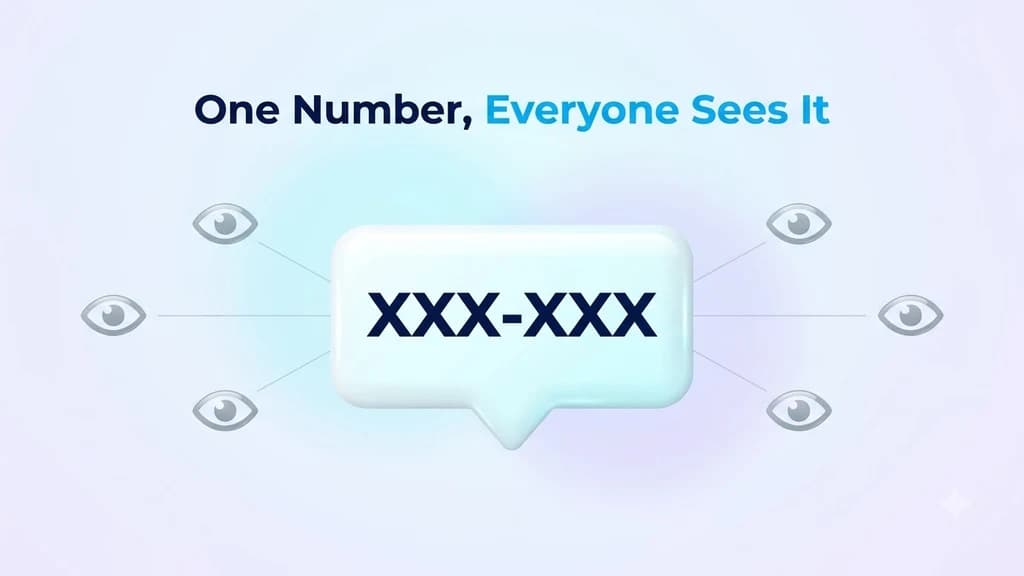
Most "free number for OTP" sites work the same way: they publish a list of real VoIP numbers, and any incoming text to those numbers shows up live on the site for anyone to read — no login required. You pick a listed number, enter it wherever a form asks for one, and refresh the page until your code appears.
Nothing about this is private. Every message sent to that number is visible to every other visitor at the same moment, which is the trade-off for it costing nothing and requiring no signup.
Why OTP codes to free numbers often don't arrive
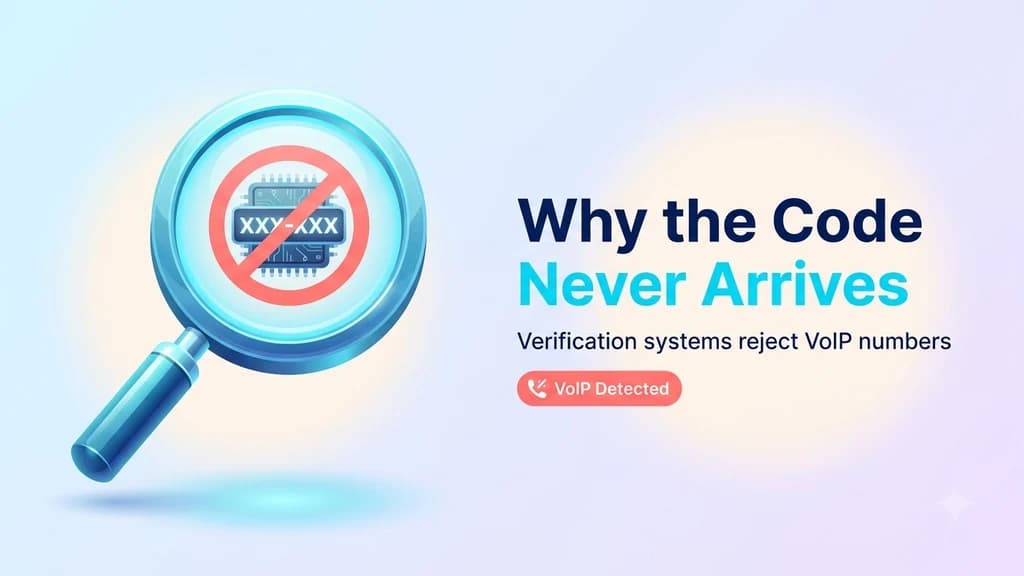
The single biggest reason a free number fails for OTP isn't the number being "used up" — it's that serious verification systems are specifically designed to reject it. NIST SP 800-63B, the U.S. government's digital identity guidelines, directly addresses this: it states that methods which don't prove possession of a specific device, including VoIP numbers, shall not be used for out-of-band authentication, and requires verifiers using phone-based verification to check that a number isn't registered as VoIP before trusting it. NIST's official guidance is what many platforms' verification systems are built around.
On top of that baseline rule, three more practical problems stack up:
- Known number lists. Free numbers are public, so their digits circulate widely — platforms maintain blocklists of numbers already flagged for abuse.
- Reuse collisions. Thousands of people share the same handful of numbers, so a platform may reject a number it already used for someone else's account.
- Rate limits and timing. A shared number can receive dozens of codes an hour from unrelated sign-ups, and yours can get lost, delayed, or overwritten in that noise.
Ready when you are
Protect your business line.
MCM's local numbers ship with verified caller ID and smart call filtering — customers always know it's really you, and spam never reaches your team.
Which platforms block free numbers — a quick reality check
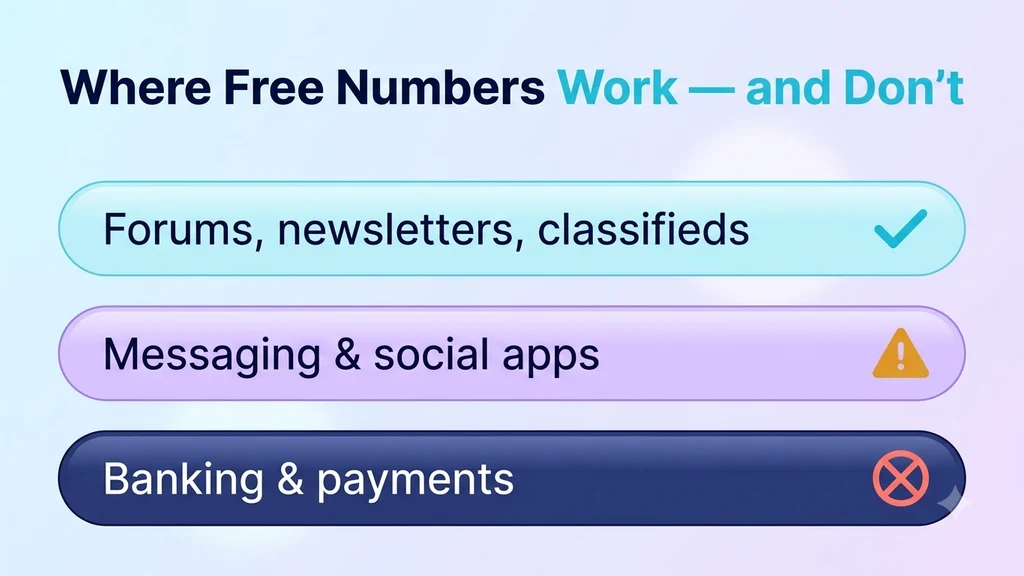
Not every service checks equally hard, so results vary a lot by what you're signing up for:
| Platform type | Typical result with a free number |
|---|---|
| Low-stakes forums, newsletters, one-off promo codes | Usually works |
| Marketplace listings, classifieds | Usually works |
| Major messaging apps (WhatsApp, Telegram, etc.) | Frequently blocked or requires retries |
| Social platforms with anti-abuse systems | Often blocked |
| Banking, payments, and anything security-sensitive | Blocked by design — this is exactly what NIST's guidance targets |
The pattern holds across most platforms: the more a service has to lose from a fraudulent account, the more aggressively it screens out VoIP and shared numbers at verification time.
When a private virtual number is the better choice
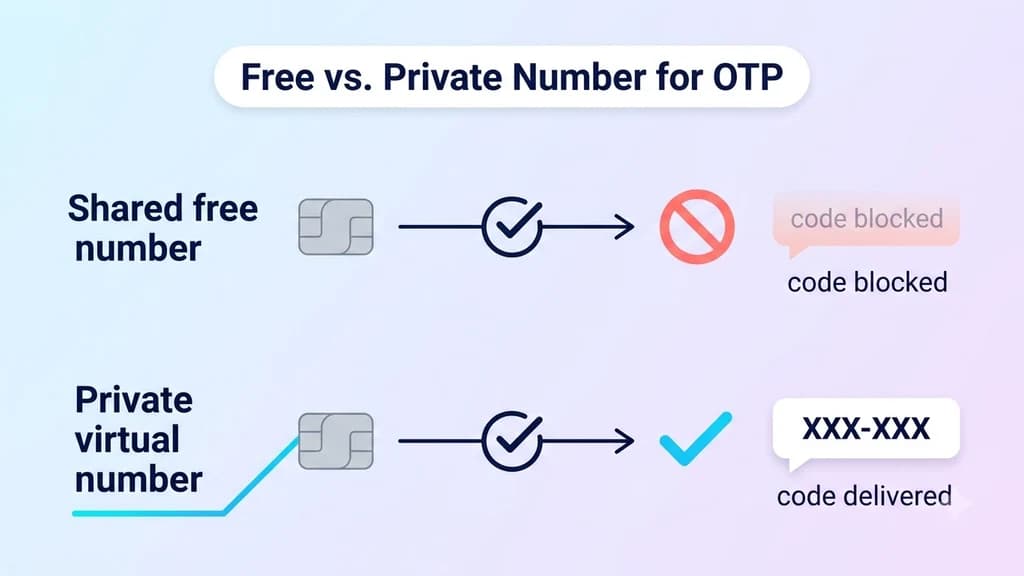
If a free number keeps failing, or you need OTP delivery to actually be reliable rather than a coin flip, the fix isn't finding a "better" free site — it's using a private number a verification system can't distinguish from any other real line. A dedicated virtual number from a cloud provider isn't shared, isn't sitting on a public blocklist, and receives codes the same way a personal number would.
This matters beyond one-off sign-ups too: any business running its own verification flows over UCaaS (Unified Communications as a Service) needs the same reliability on the sending side, for the same reason NIST flags on the receiving side — codes have to actually arrive. For the broader picture of temporary numbers beyond just OTP — classifieds, dating, travel — see our full temporary phone number guide. Contact us to set up a private number built for reliable verification from the start.
Conclusion
A free temporary number can absolutely receive an OTP — right up until the platform on the other end is built to stop it. That's not bad luck; it's NIST-aligned verification systems doing exactly what they're designed to do with VoIP and shared numbers. For anything low-stakes, a free number is fine. For anything that actually matters, a private number removes the guesswork entirely.
Key takeaways
- Free OTP-receiving numbers are public and shared — anyone can read the codes sent to them.
- NIST SP 800-63B explicitly says VoIP numbers shouldn't be used for out-of-band verification, and many platforms build their checks around that standard.
- Free numbers also fail from reuse, blocklisting, and rate limits, on top of the VoIP check itself.
- Low-stakes signups usually work fine; banking, payments, and major apps frequently block them outright.
- A private virtual number solves the problem because it isn't shared, isn't blocklisted, and isn't detectable as a throwaway line.
Ready when you are
Ready to sound local everywhere you sell?
MCM activates business numbers in minutes, with call routing, analytics, and CRM-ready integrations. Start your free trial — no card to browse inventory.
FAQ
Can I use a free temporary number to receive an OTP?
Sometimes. It works for low-stakes signups but is frequently blocked or delayed by platforms that specifically screen out VoIP and shared numbers.
Why didn't my verification code arrive on a free number?
Most likely the platform detected it as a VoIP or shared number and blocked delivery, per guidance like NIST SP 800-63B — or the number was already flagged, reused, or overloaded with other people's codes at the same time.
Is it against the rules to use a free number for OTP?
It depends on the platform's terms of service — some explicitly prohibit VoIP numbers for account verification, which is a separate issue from whether the code technically arrives.
Which platforms are most likely to block free OTP numbers?
Banking, payments, and major messaging or social apps with strong anti-abuse systems block them most often. Low-stakes forms and one-off signups usually don't check as strictly.
Are free OTP number websites safe to use?
For a low-stakes, one-time signup, yes. Every message sent to a free number is public, so never use one for anything sensitive like banking or your primary email.
What's the difference between this and a regular temporary phone number?
They're related, but a general temporary number covers many uses — dating, classifieds, travel — while OTP delivery specifically runs into the VoIP-detection issue covered here, which doesn't apply the same way to those other uses.
What's the reliable alternative if free numbers keep failing?
A private virtual number from a cloud provider. It isn't shared or blocklisted, so verification systems treat it like any other real line.


