"Calling Restrictions" Explained: What the Message Means and How to Fix It
You dial a number, and instead of ringing you get a robotic voice: "the number you have dialed has calling restrictions." The call's dead before it started.
It's a confusing message because it never says whose restriction or why. That vagueness is the real problem.
This guide decodes what that announcement actually means, sorts the causes into the two places they come from, and gives you a step-by-step fix. By the end you'll know whether the issue is yours to solve — or theirs.
5-minute read.
WHAT THE "CALLING RESTRICTIONS" MESSAGE ACTUALLY MEANS
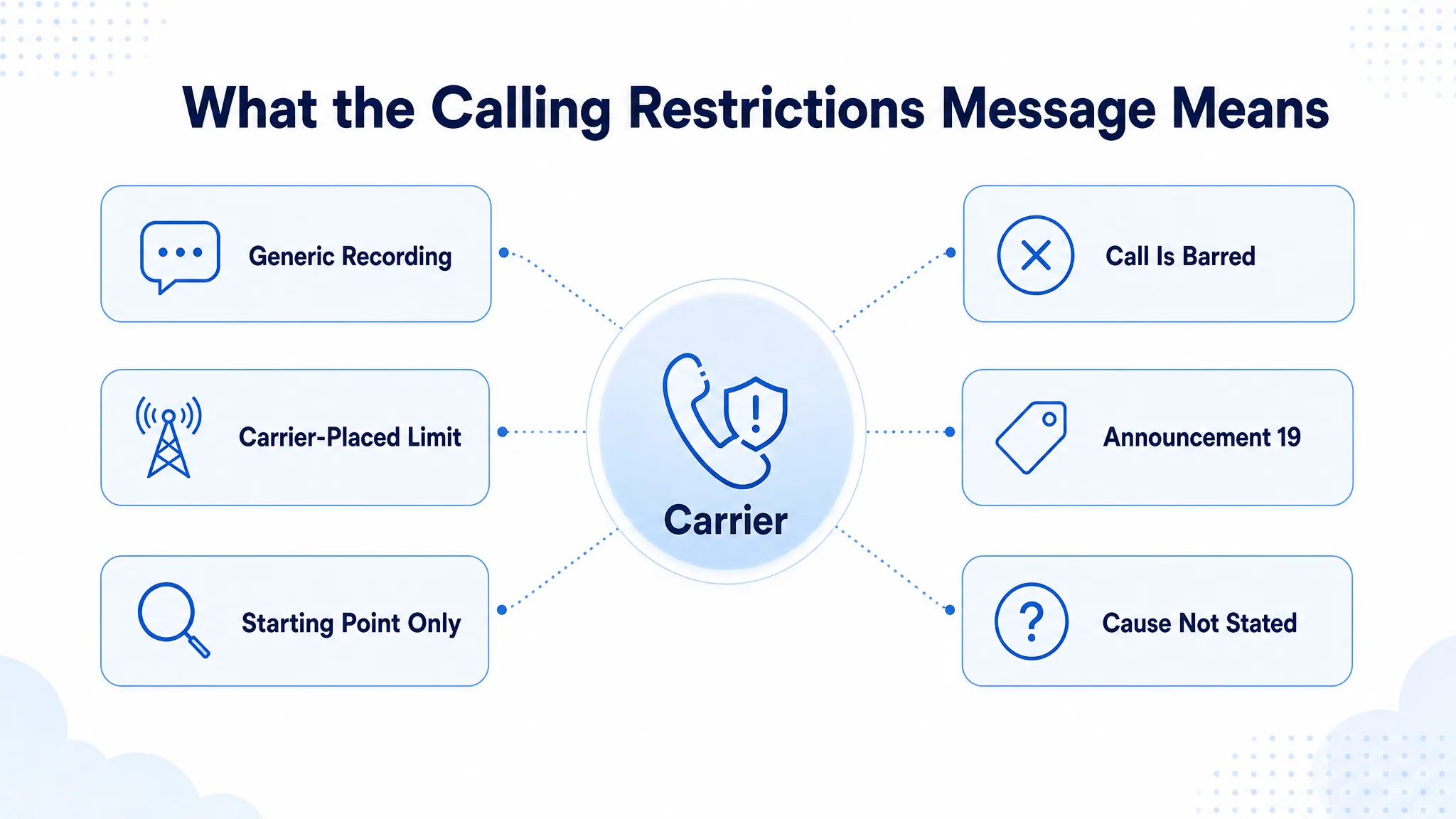
The message means a carrier — yours or the recipient's — has placed a limit that's blocking the call from completing normally.
It's a generic, pre-recorded announcement. The phone network plays it whenever a call is barred, no matter the underlying reason.
Why It's So Vague
Carriers use one catch-all recording instead of dozens of specific ones. It's simpler for them, frustrating for you.
So the message itself is not a diagnosis. It's a starting point — the real cause sits behind it.
The Announcement 19 Version
You may hear a longer variant ending with "...announcement 19." That number is just an internal carrier code identifying the recording.
It carries no special meaning for you. Treat "announcement 19" exactly like the standard restriction message.
COMMON CAUSES: WHY CALLS GET BLOCKED
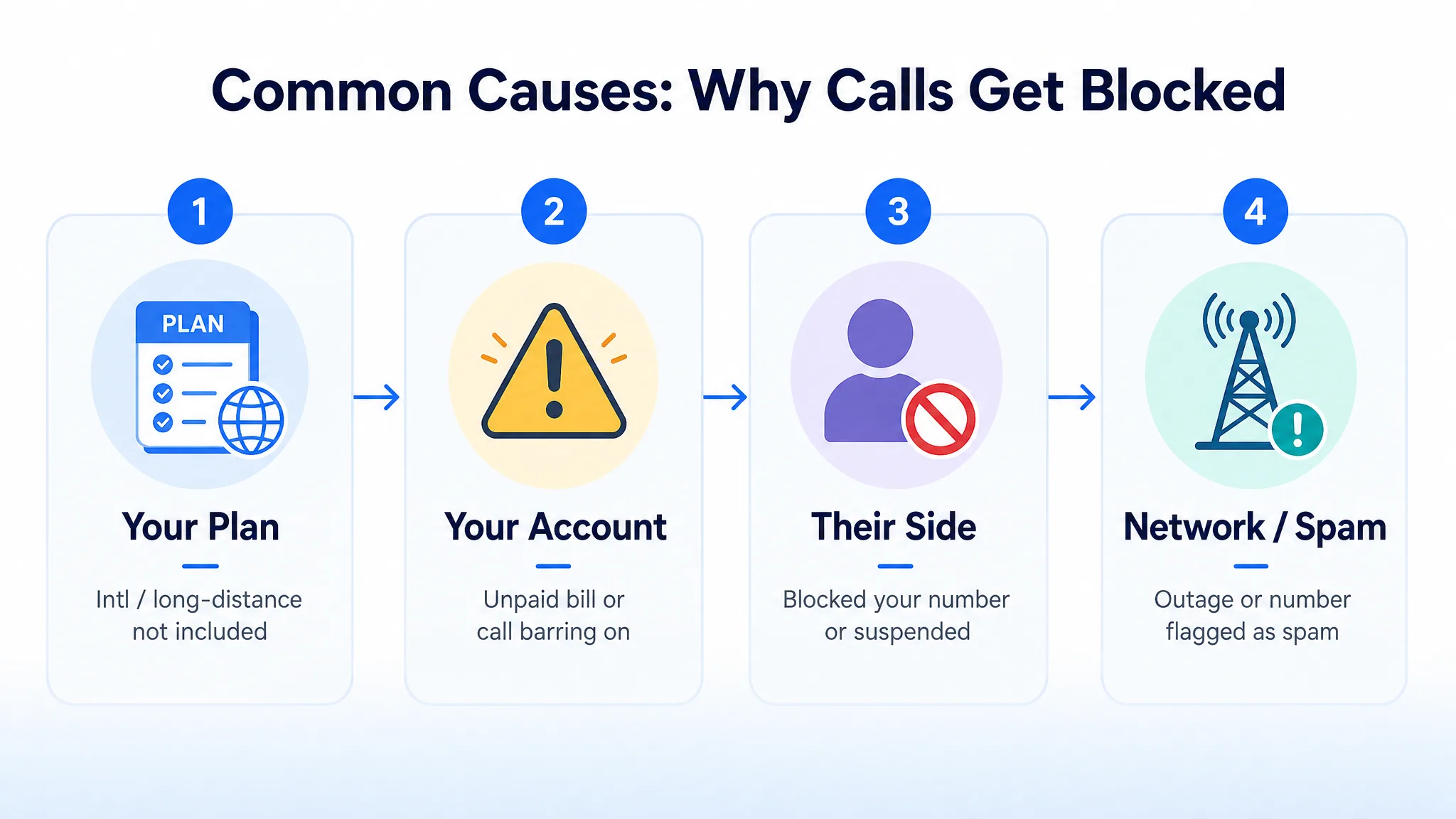
The block can originate on either end of the call. That's the key insight — and the reason this message confuses so many people.
Sorting causes by side is the fastest path to a fix.
Causes on Your End
Your plan may not include the call type — long-distance, international, or premium-rate numbers are common gaps.
An unpaid bill, a weak signal, an active "call barring" setting, or your number being flagged as spam can all trigger it too.
Causes on the Recipient's End
The person you're calling may have blocked your number directly, or have "Do Not Disturb" switched on.
Their account could be suspended for non-payment, or their carrier may be having a network outage. None of that is yours to fix.
A Simple Cause: A Wrong Digit
Before assuming anything, consider the obvious one. A mistyped area or country code can route you to a barred path.
Re-dial carefully before troubleshooting further — it solves the problem more often than people expect.
Ready when you are
Protect your business line.
MCM's local numbers ship with verified caller ID and smart call filtering — customers always know it's really you, and spam never reaches your team.
STEP-BY-STEP: HOW TO FIX CALLING RESTRICTIONS

Work through these checks in order. They move from quick wins to deeper fixes, so you'll often resolve it before reaching the end.
Start with the fast stuff.
Step 1: Run the Quick Checks
Re-dial the full number including area and country codes. Toggle Airplane mode on and off to refresh your network connection.
Move to a spot with stronger signal. A weak connection alone can fail a call and produce this message.
Step 2: Check Your Phone Settings
Open your call or phone settings and look for Call Barring or Call Restriction. If it's on, switch it off.
Confirm you haven't accidentally blocked the number, and that Do Not Disturb isn't suppressing the call.
Step 3: Review Your Account and Plan
Check your balance and confirm your latest bill is paid — service suspension is a frequent, quiet cause.
Then verify your plan covers the call type. Many plans exclude international or long-distance calls unless you add them.
Running a business line and tired of opaque carrier limits? MCM's free trial lets you test a cloud number's calling reach in about five minutes — no credit card needed.
Step 4: Test Whether It's the Recipient
Call a different number. If that call connects fine, the restriction is almost certainly on the recipient's side.
In that case, reach them another way — text or email — and let them know their line is blocking calls.
Step 5: Escalate to Your Carrier
If everything checks out and the call still fails, contact your provider's support.
Ask them directly whether there's a restriction on your line, a spam flag on your number, or a known network issue. They can see what you can't.
COMMON SCENARIOS AND WHAT THEY MEAN
Different situations point to different causes. Match yours to this table for a faster diagnosis.
| What You're Seeing | Most Likely Cause | First Move |
|---|---|---|
| Only one number is blocked | They blocked you, or their line is suspended | Call someone else to confirm |
| Every call fails | Your plan, balance, or call-barring setting | Check account and phone settings |
| Only international calls fail | Your plan doesn't cover them | Add an international package |
| Started after non-payment | Service suspension | Pay the outstanding balance |
If Your Number Was Flagged as Spam
High call volume — common for sales teams — can get a number wrongly labeled as spam, which carriers may then restrict.
You can request a review through your carrier or a number-reputation service to clear the flag.
HOW TO AVOID CALLING RESTRICTIONS ON A BUSINESS LINE
For a personal phone, the fixes above are usually enough. For a business, repeated restrictions cost real revenue.
A few habits keep your lines clear.
Keep Accounts and Compliance Clean
Pay invoices on time and confirm your plan covers every destination your team calls.
Modern cloud providers also support STIR/SHAKEN caller authentication, which helps your calls display as verified rather than suspect.
Use a Reliable Voice Provider
A carrier-grade network with proper routing and number reputation management reduces the false spam flags that trigger restrictions.
This is where a dedicated provider beats a basic consumer plan — the routing is built for volume.
Want business lines that connect without the guesswork? Start a free trial at mycountrymobile.com — set up in minutes, no contracts, with calling reach across 190+ countries.
Ready when you are
Ready to sound local everywhere you sell?
MCM activates business numbers in minutes, with call routing, analytics, and CRM-ready integrations. Start your free trial — no card to browse inventory.
FAQs
Why does my phone say "calling restrictions" for only one number?
When a single number is affected, the cause is almost always on their side — they may have blocked you, or their account is suspended. Test by calling a different number; if that works, the restriction isn't yours to fix.
Can an unpaid bill cause calling restrictions?
Yes, on either end. If your bill is unpaid, your carrier may suspend service. If the recipient hasn't paid, their line can be suspended too — and your call to them will fail.
How long do calling restrictions last?
It depends on the cause. A wrong setting clears the instant you fix it. A non-payment suspension lasts until the balance is paid, and a spam flag stays until reviewed and cleared.
Does Airplane mode cause calling restrictions?
Airplane mode itself blocks all calls, but it doesn't trigger this specific message. Still, toggling it off and on refreshes your network connection and can resolve a restriction caused by a weak signal.
What does "announcement 19" mean in the message?
"Announcement 19" is just an internal carrier code for the recording. It adds no special meaning — troubleshoot it the same way you would the standard calling restrictions message.
Can I fix a restriction caused by a spam flag on my number?
Yes. If your number was wrongly flagged, contact your carrier or a number-reputation service to request a review. Cloud providers with STIR/SHAKEN authentication also help keep your number trusted.
Is the restriction always something I did wrong?
No. The cause is split roughly evenly between your end and the recipient's. The message is deliberately generic, so always test with a second call before assuming the fault is yours.