The 20 best free video calling apps, and what each one is actually for
Every app on this list claims to be the best way to video call for free. None of them are the best at everything — Zoom handles large meetings well, WhatsApp is built for close contacts, Discord is built for communities. Picking the right one depends entirely on who's on the other end of the call.
This guide covers all 20, what each genuinely does well, the free-tier limits that catch people off guard, and when a consumer app stops being enough for a growing business.
How these were chosen
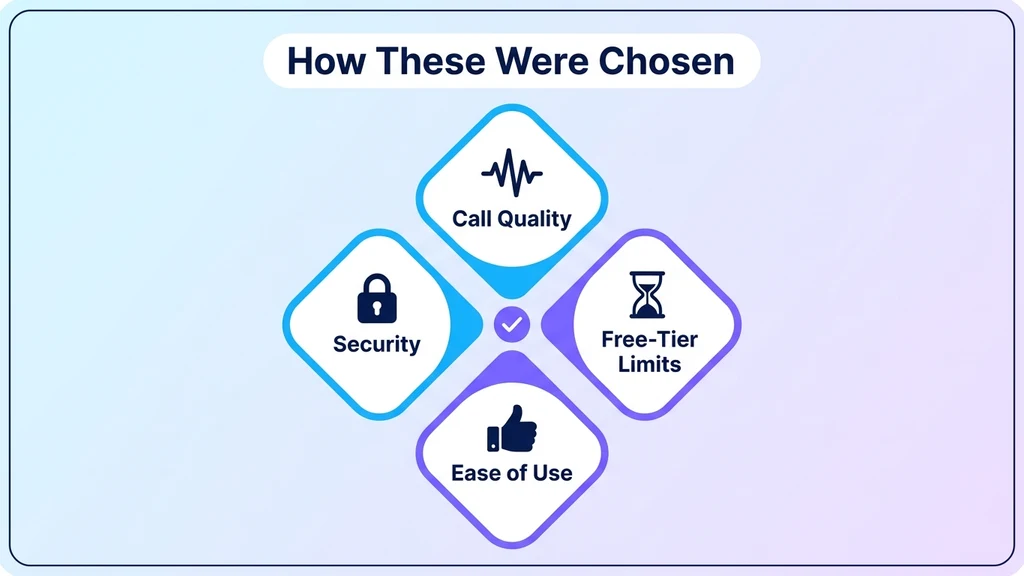
Every app here was judged against the same four factors: call quality at typical home internet speeds, free-tier limits (time caps, participant caps, feature gates), ease of use for the least tech-savvy person on the call, and security (encryption and privacy practices). Apps that failed badly on any one of these didn't make the list, regardless of how popular they are.
The 20 apps
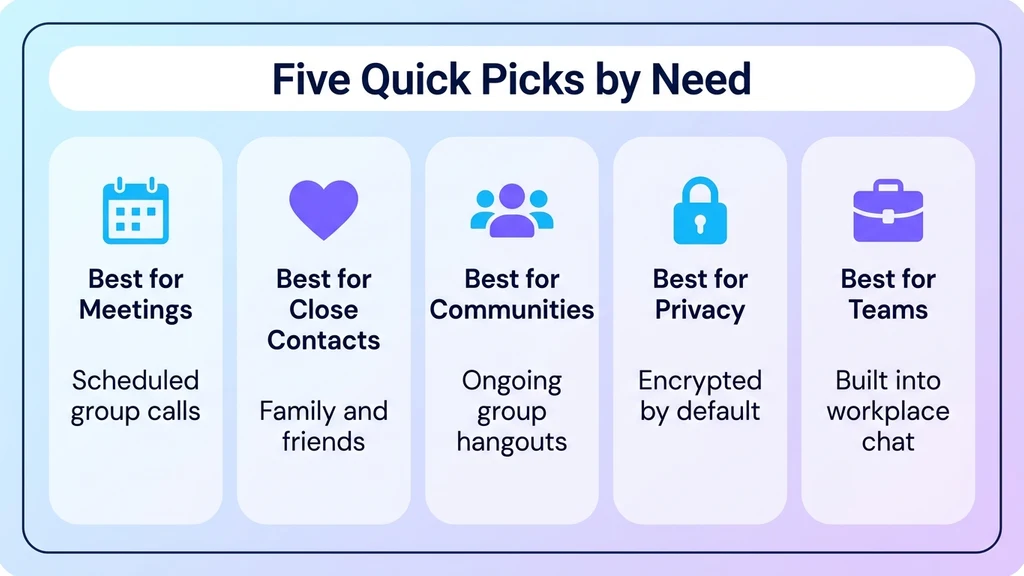
1. Zoom. The default choice for scheduled meetings and webinars. The free tier supports up to 100 participants but caps group calls at 40 minutes — the single most common complaint about the free plan.
2. Google Meet. Built into Google Workspace and free with any Google account. Runs entirely in a browser with no download required, which makes it the easiest option for calling someone who doesn't want to install anything.
3. Microsoft Teams (free tier). Strong for anyone already in the Microsoft ecosystem — Outlook and Office integration is seamless. The free version caps meetings at 60 minutes with up to 100 people.
4. Skype. One of the oldest video calling apps still actively maintained, with no time limit on free calls. Call quality varies more than newer alternatives, but it remains a reliable fallback almost everyone already has installed.
5. WhatsApp. The default for calling close contacts internationally, since it works over Wi-Fi or data with no per-minute charge. Group video calls are capped at a modest number of participants compared to meeting-focused apps.
6. FaceTime. Apple's built-in option, seamless between iPhones, iPads, and Macs, including a link-sharing feature that lets Android and Windows users join via browser. Best suited to Apple-heavy contact lists.
7. Facebook Messenger. Easy for calling anyone already in a Facebook friends list, with solid group call support built directly into an app most people already have.
8. Discord. Originally built for gaming communities, now widely used for group video hangouts and community calls. Voice and video channels can host ongoing group calls that anyone in a server can drop into.
9. Signal. The strongest privacy option on this list, with end-to-end encryption applied by default to every call, not as an opt-in feature. Best for anyone who prioritizes privacy over meeting-scale features.
10. Telegram. Fast, lightweight, and increasingly used for both one-on-one and group video calls, with large file-sharing built into the same app.
11. Viber. Popular internationally, particularly in Eastern Europe and parts of Asia, with free calling and messaging that doesn't require both parties to share a phone number publicly.
12. WeChat. The dominant messaging and video calling app in China, widely used by anyone communicating regularly with contacts there.
13. Line. Especially popular in Japan, Thailand, and Taiwan, combining messaging, video calls, and a broader app ecosystem in one platform.
14. Cisco Webex. A business-grade option with a genuinely usable free tier, including a 40-minute group meeting cap similar to Zoom's, aimed at professional rather than casual use.
15. GoTo Meeting. Positioned for business meetings, though its free tier is more limited than most others on this list — worth checking current terms before relying on it for regular use.
16. Jitsi Meet. A free, open-source option that requires no account or app install — anyone with the meeting link can join directly from a browser. A strong pick for privacy-conscious users who don't want to hand over an account to a large company.
17. Whereby. Browser-based with no downloads, aimed at small team meetings with a clean, simple interface. Free tier limits the number of participants more than meeting-focused competitors.
18. Slack (huddles). Built into Slack's free tier for teams already using it for messaging, ideal for quick ad-hoc video check-ins rather than scheduled meetings.
19. Instagram. Video calling built directly into direct messages, convenient for anyone already communicating with a contact through Instagram rather than a separate app.
20. Snapchat. Video calling built into an app already installed by a large share of younger users, convenient for that audience specifically rather than general business use.
Ready when you are
Protect your business line.
MCM's local numbers ship with verified caller ID and smart call filtering — customers always know it's really you, and spam never reaches your team.
The free-tier limits that catch people off guard
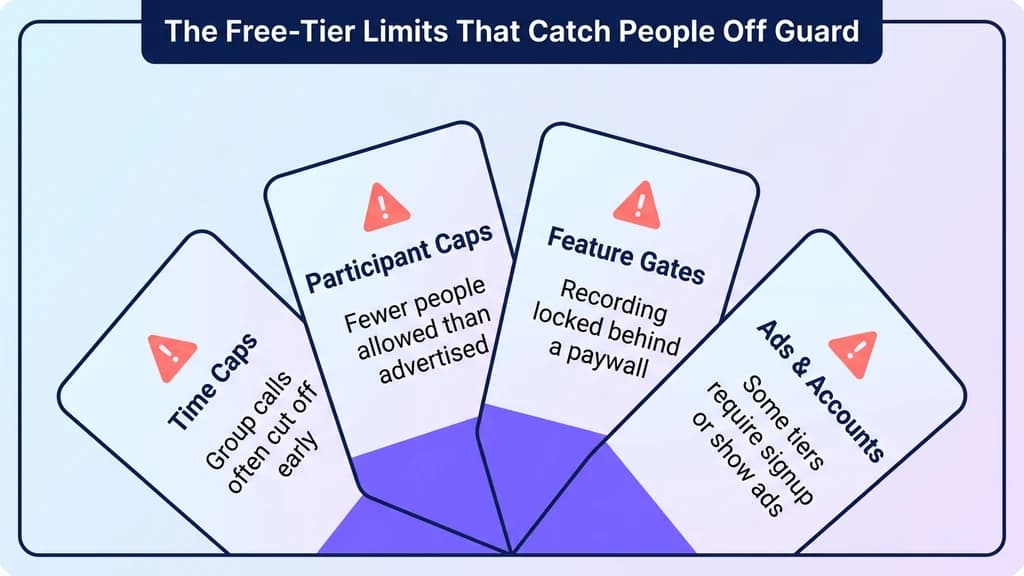
Time caps on group calls. Zoom, Teams, and Webex all cap free group meetings somewhere between 40 and 60 minutes — the single most common surprise for anyone running a longer call.
Participant caps. Apps built for close contacts (WhatsApp, FaceTime, Messenger) cap group calls at a modest number of people, while meeting-focused apps (Zoom, Meet, Teams) support far larger groups.
Feature gates. Recording, virtual backgrounds, and breakout rooms are frequently locked behind a paid tier even when the video calling itself is free.
Ads and account requirements. A handful of apps on this list require a full account signup or show ads on the free tier — worth checking before committing a team to one. Check what each platform covers before discussing anything sensitive over video, and know that the FTC's fraud reporting site is where scams on any of them get reported.
When a consumer app isn't enough for a business
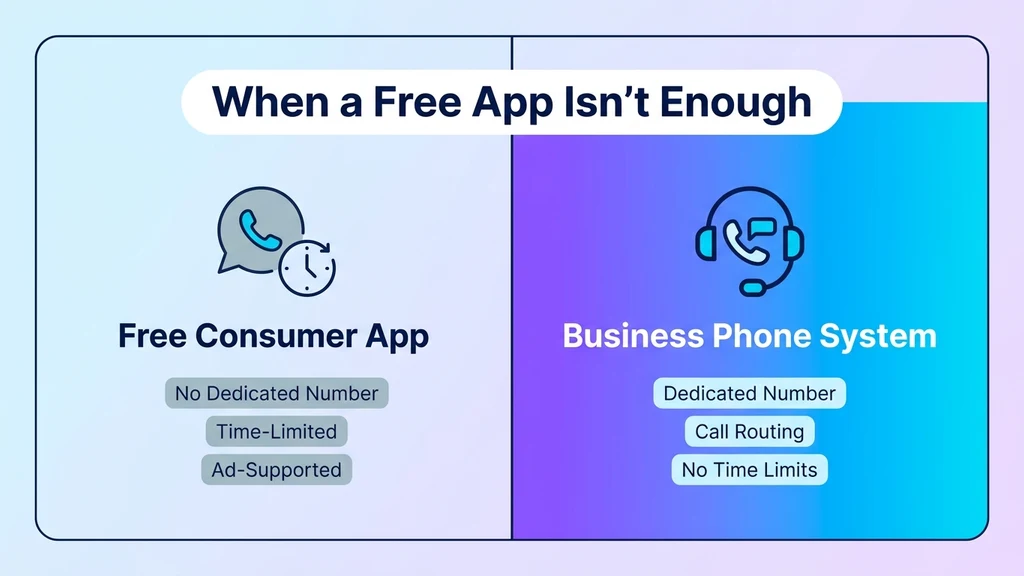
Every app above works fine for personal calls and small, informal team check-ins. Where they start to fall short is anything customer-facing at scale: no dedicated business phone number, no call routing to the right person or department, and often that same 40-minute time cap showing up right in the middle of a client call.
That's the gap a UCaaS (Unified Communications as a Service) platform is built to close — one system combining video calling, voice, and messaging with a real business phone number attached, instead of stitching together whichever free app a customer happens to already have installed, the same evaluation framework covered in our wholesale VoIP providers guide for voice specifically. My Country Mobile builds this kind of unified system for teams that have outgrown ad-hoc consumer apps. Contact us to see what a dedicated business communication setup looks like versus juggling several free apps.
Conclusion
There's no single best free video calling app — the right pick depends on who's calling and why. Zoom and Meet fit scheduled meetings, WhatsApp and FaceTime fit close contacts, Discord fits communities, and Signal fits anyone who wants privacy above all else. What all 20 share is a ceiling: once video calling needs to scale to real customer volume with a dedicated number and routing behind it, a proper business communication system does the job a free app was never built for.
Key takeaways
- No single app wins on every factor — call quality, free-tier limits, ease of use, and security trade off differently across all 20.
- Time caps on group calls (Zoom, Teams, Webex) are the most common free-tier surprise, typically 40–60 minutes.
- Privacy-first options like Signal and Jitsi Meet trade some convenience for stronger default encryption and no required account.
- Participant caps vary widely — apps built for close contacts support far fewer people than meeting-focused platforms.
- Once video calling needs a dedicated business number and call routing, a UCaaS platform replaces the free-app patchwork entirely.
Ready when you are
Ready to sound local everywhere you sell?
MCM activates business numbers in minutes, with call routing, analytics, and CRM-ready integrations. Start your trial — no card to browse inventory.
FAQs
What is the best free video calling app overall?
There isn't a single best option — Zoom and Google Meet suit scheduled meetings, WhatsApp and FaceTime suit close contacts, and Signal suits anyone prioritizing privacy. The right choice depends on who you're calling.
Which free video calling app has no time limit on group calls?
Skype has no time limit on free calls. Zoom, Microsoft Teams, and Cisco Webex all cap free group meetings somewhere between 40 and 60 minutes.
Which video calling app is the most private?
Signal applies end-to-end encryption by default to every call. Jitsi Meet is also a strong privacy option since it requires no account to join a call.
Can I use a free video calling app for my business?
For small, informal calls, yes. For customer-facing calls at volume, most free apps lack a dedicated business number and call routing — a UCaaS platform is built to cover that gap.
Do any of these apps work without downloading anything?
Google Meet, Jitsi Meet, and Whereby all run directly in a browser with no app download required, which makes them the easiest to use with someone unfamiliar with the platform.
What's the difference between these consumer apps and a business phone system?
Consumer apps are built for personal or small-team calls with free-tier limits on time and participants. A business phone system adds a dedicated number, call routing, and no arbitrary time caps on customer calls.