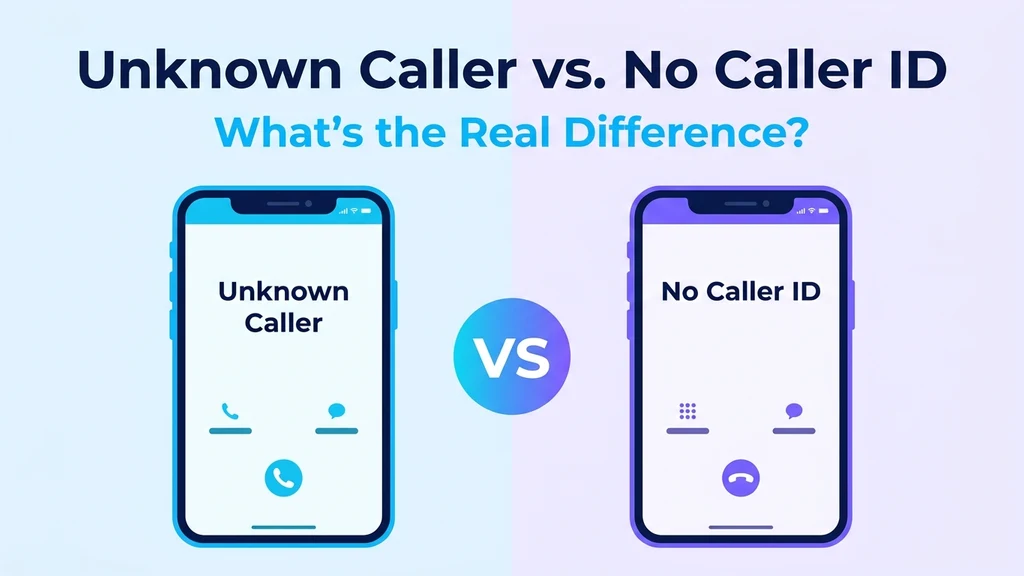
Quick answer: "No Caller ID" means the caller deliberately withheld their number before dialing. "Unknown Caller" is broader — it can mean a withheld number, but it can also mean an international call, a spoofed number, or a number your carrier simply couldn't match to any information. They look the same on screen but don't always mean the same thing.
Two calls come in. One says "No Caller ID." The other says "Unknown Caller." Most people treat them as interchangeable — and most of the time, that's a safe enough assumption. But the labels come from different points in the call chain, and knowing which is which changes how much you should actually worry about either one.
This guide breaks down what each label really means, why they get triggered differently, and what to actually do the next time one lights up your screen.
The direct answer
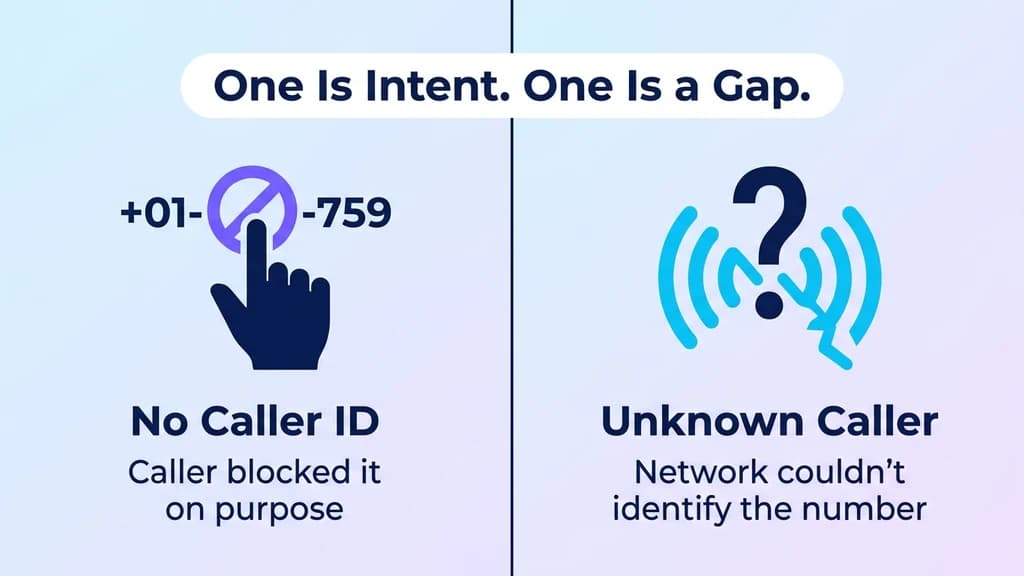
"No Caller ID" is specific. It means the caller took a deliberate action — dialing *67 first, or having "Caller ID Blocking" turned on permanently — so their number is never transmitted to your phone at all.
"Unknown Caller" is a catch-all. Your phone shows it whenever it has no usable caller information to display, which can happen for several different reasons — only one of which is a deliberately blocked number.
The distinction matters because "No Caller ID" always means intent. "Unknown Caller" sometimes means intent, and sometimes just means a technical gap somewhere in the call chain.
Why "Unknown Caller" shows up for reasons besides blocking
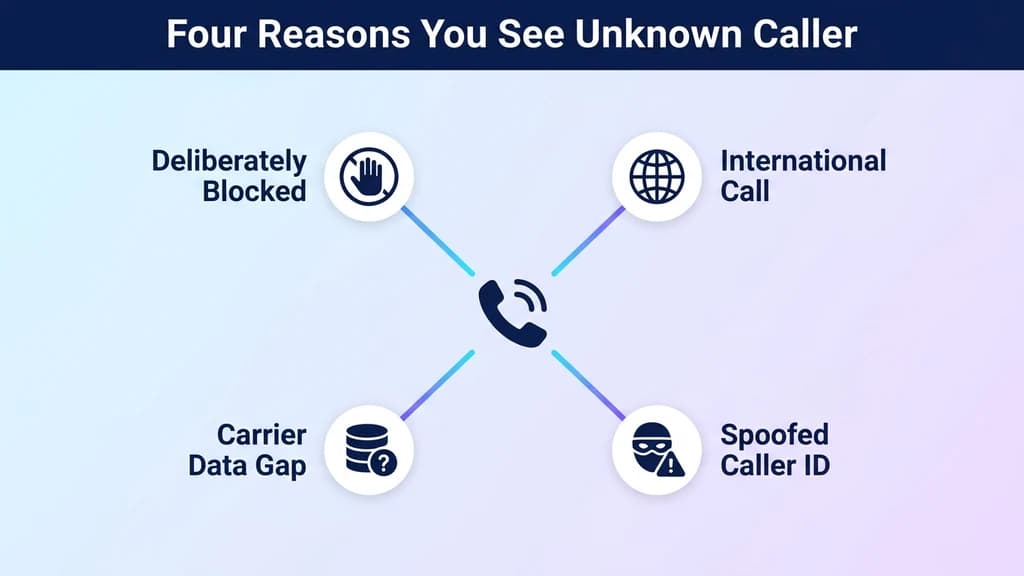
A deliberately blocked number. Same root cause as "No Caller ID" — some phones and carriers simply label this case "Unknown" instead.
An international or out-of-network call. Caller ID data doesn't always pass cleanly between carriers in different countries, or even between different domestic carriers on older infrastructure. The number technically arrived, but nothing usable came with it.
A spoofed or manipulated caller ID. Some robocall systems send caller ID data that's malformed or intentionally stripped, which phones can't parse into a real number or name.
A carrier-side data gap. Similar to how "Wireless Caller" appears when a carrier can't match a name to a number — see our guide to what "Wireless Caller" means — "Unknown Caller" can appear when the underlying number itself never made it through cleanly, not just the name.
How to tell which one you're actually dealing with
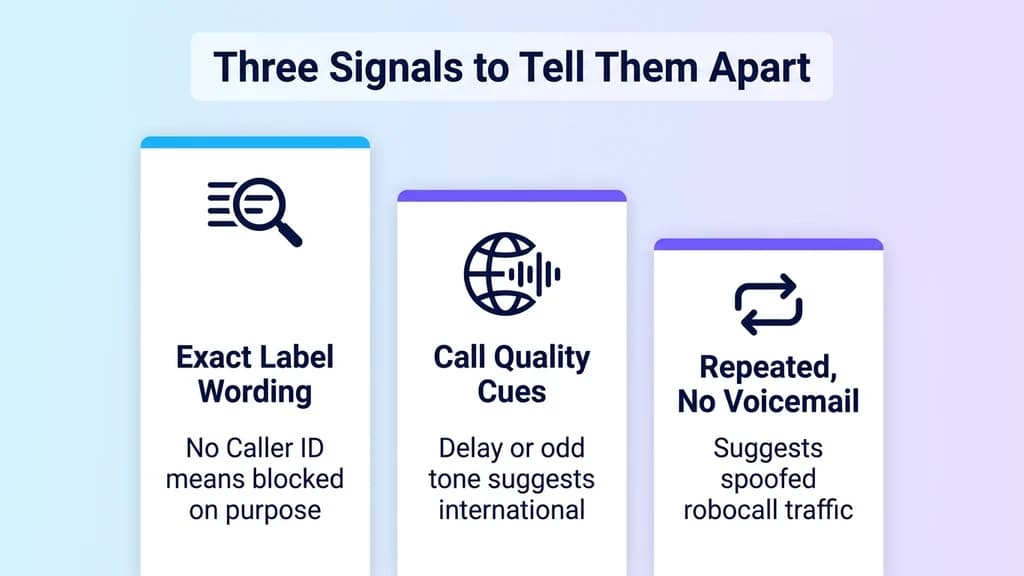
There's no perfect way to tell from the label alone, but a few signals narrow it down:
- If your phone shows "No Caller ID" specifically (rather than "Unknown"), it's almost always a deliberate block — the phone had enough information to distinguish "blocked on purpose" from "couldn't be read."
- If the call connects and audio quality feels international (slight delay, an unfamiliar dial tone pattern before you answer), it's more likely a cross-border call that lost its caller ID data in transit than a deliberate block.
- If you get a burst of "Unknown Caller" calls in a short window, especially with no voicemail left, that pattern points toward spoofed robocall traffic rather than one person blocking their number to reach you specifically.
Ready when you are
Protect your business line.
MCM's local numbers ship with verified caller ID and smart call filtering — customers always know it's really you, and spam never reaches your team.
What to actually do about each one
Neither label tells you whether to answer — that decision comes down to context, not the label itself.
If you're expecting a callback from a business, doctor's office, or delivery service that legitimately blocks outbound numbers, answering is reasonable. If the call is unexpected and repeats without a voicemail, let it go — a real caller with something important to say will leave a message either way.
Reporting persistent "Unknown Caller" spam to your carrier's blocking tools or the FCC helps flag spoofed traffic patterns, even though the individual call itself can't be traced back with certainty.
If your own outbound calls show as "Unknown Caller"
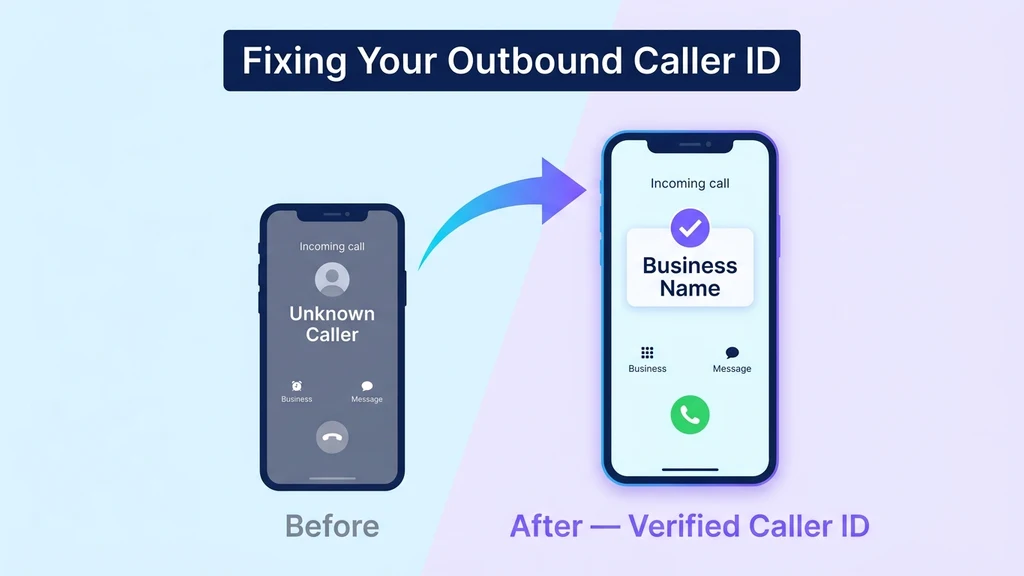
Businesses running calls through a UCaaS (Unified Communications as a Service) platform — a single cloud system for calling, messaging, and video — sometimes see their own outbound numbers display as "Unknown Caller" to recipients, usually because the outbound caller ID was never registered with the carrier. That's a fixable configuration issue, not a limitation of the phone system itself. My Country Mobile lets businesses register a verified outbound caller name on their virtual numbers, so customers see a real business name instead of a blank label. Contact us to get outbound caller ID set up correctly on a new or existing number.
Conclusion
"No Caller ID" and "Unknown Caller" look identical at a glance, but only one of them is guaranteed to mean a deliberate block. The other is a broader label covering everything from international calls to spoofed robocall traffic to a simple carrier data gap. Neither one is automatically dangerous, and neither is automatically safe to ignore — the pattern of calls tells you more than the label ever will.
Key takeaways
- "No Caller ID" almost always means the caller deliberately withheld their number.
- "Unknown Caller" is broader — it can mean a block, an international call, a spoofed number, or a carrier data gap.
- A burst of "Unknown Caller" calls with no voicemail points toward spoofed or robocall traffic, not a single person deliberately reaching you.
- If your own business calls show as "Unknown Caller," the fix is registering your outbound caller ID with your provider.
- Neither label alone tells you whether to answer — behavior and pattern matter more than the label itself.
Ready when you are
Ready to sound local everywhere you sell?
MCM activates business numbers in minutes, with call routing, analytics, and CRM-ready integrations. Start your free trial — no card to browse inventory.
FAQs
Is "Unknown Caller" the same as "No Caller ID"?
Not exactly. "No Caller ID" specifically means the caller blocked their number on purpose. "Unknown Caller" is a broader label that can include blocked numbers, but also international calls, spoofed numbers, and carrier data gaps.
Should I answer an "Unknown Caller" call?
It depends on context. If you're expecting a call from a business that blocks its outbound number, answering is reasonable. If it's unexpected and repeats without a voicemail, let it go to voicemail instead.
Can I find out who called from an "Unknown Caller" number?
Rarely, and only indirectly — since no number was transmitted, there's nothing to look up. If a legitimate caller wants to reach you, they'll usually leave a voicemail identifying themselves.
Why do my own business calls show as "Unknown Caller" to customers?
This usually means your outbound caller ID was never registered with your carrier or VoIP provider. Registering a verified caller name fixes it, and it's a standard setup step for a business phone system.
Does "Unknown Caller" mean the call is spam?
Not automatically. Plenty of legitimate calls — from doctor's offices to businesses that block outbound numbers by policy — show this label. Repeated calls with no voicemail are the real warning sign, not the label alone.
Is blocking "Unknown Caller" numbers a good idea?
It stops the annoyance but can also block legitimate calls that happen to lack caller ID data. A safer approach is letting unknown calls go to voicemail and screening from there.