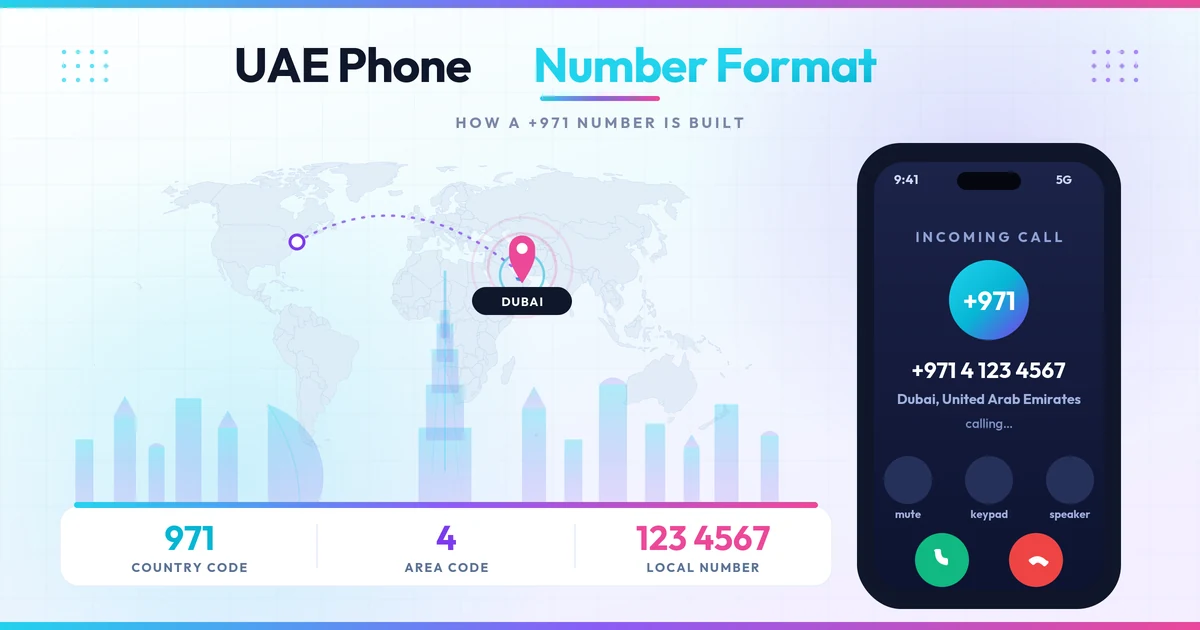
Quick answer: A UAE number in international format looks like +971 50 123 4567 (mobile) or +971 4 123 4567 (Dubai landline) — always +971, then a prefix, then a 7-digit local number. Inside the UAE, numbers carry a leading 0; drop that 0 the moment you add +971.
A UAE phone number has thrown off more international callers than almost any other format — usually because of one tiny digit. Drop the wrong zero and your call fails before it rings. This guide shows you the exact layout of a UAE phone number, side by side, so you can dial Dubai or Abu Dhabi correctly on the first try.
We pull a lot of UAE numbers across our network at My Country Mobile (MCM), and the same formatting slip-ups come up again and again. Below, you'll see a worked example for both mobile and landline numbers, plus the operator prefixes and the leading-zero rule that trips everyone up.
The Anatomy of a UAE Number
Every UAE number is built from the same four parts. Once you can spot them, the format stops being confusing.
The Four Building Blocks
A complete international number reads as: country code + area or mobile prefix + local number. The UAE country code is +971, and the local subscriber number is always 7 digits.
The piece in the middle changes depending on whether you're calling a mobile or a landline. That single difference explains most failed calls.
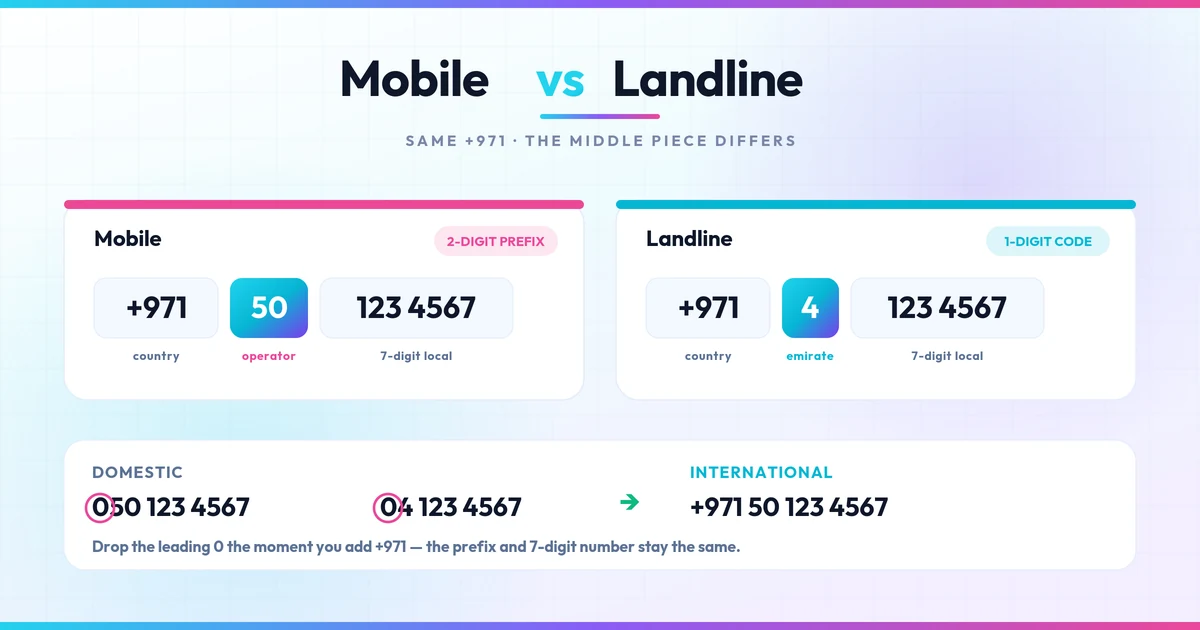
Mobile vs Landline at a Glance
Mobiles use a 2-digit operator prefix (like 50 or 55). Landlines use a 1-digit emirate area code (like 4 for Dubai).
| Type | Domestic format | International format |
|---|---|---|
| Mobile | 050 123 4567 | +971 50 123 4567 |
| Landline (Dubai) | 04 123 4567 | +971 4 123 4567 |
| Landline (Abu Dhabi) | 02 123 4567 | +971 2 123 4567 |
Notice the leading zero in the domestic version disappears in the international one. That's the rule that matters most.
A Mobile Number Example, Broken Down
Let's take a real-style mobile number and walk through it digit by digit.
Inside +971 50 123 4567
Domestically, an Emirati sees this as 050 123 4567. The "0" is a national trunk prefix used only when dialing inside the UAE.
When you call from abroad, you swap that "0" for +971. The "50" stays, the 7-digit number stays — so it becomes +971 50 123 4567.
Why the Zero Disappears
The leading "0" tells the local network "this is a domestic call." Once you add +971, the network already knows the country, so the zero becomes redundant.
Dial +971 050 123 4567 and the extra zero usually breaks the call. Keep it simple: international means no zero after +971.
If you regularly call or text UAE contacts, understanding the 971 country code dialing sequence saves you from misrouted calls.
A Landline Number Example, Broken Down
Landlines follow the same logic, but the middle piece is shorter.
Inside +971 4 123 4567
A Dubai landline shown locally as 04 123 4567 uses "04" as the emirate area code. The "0" is again just the domestic trunk prefix.
Internationally, you drop the zero and keep the "4": +971 4 123 4567. Abu Dhabi works the same way with "2", Sharjah with "6".
UAE Emirate Area Codes
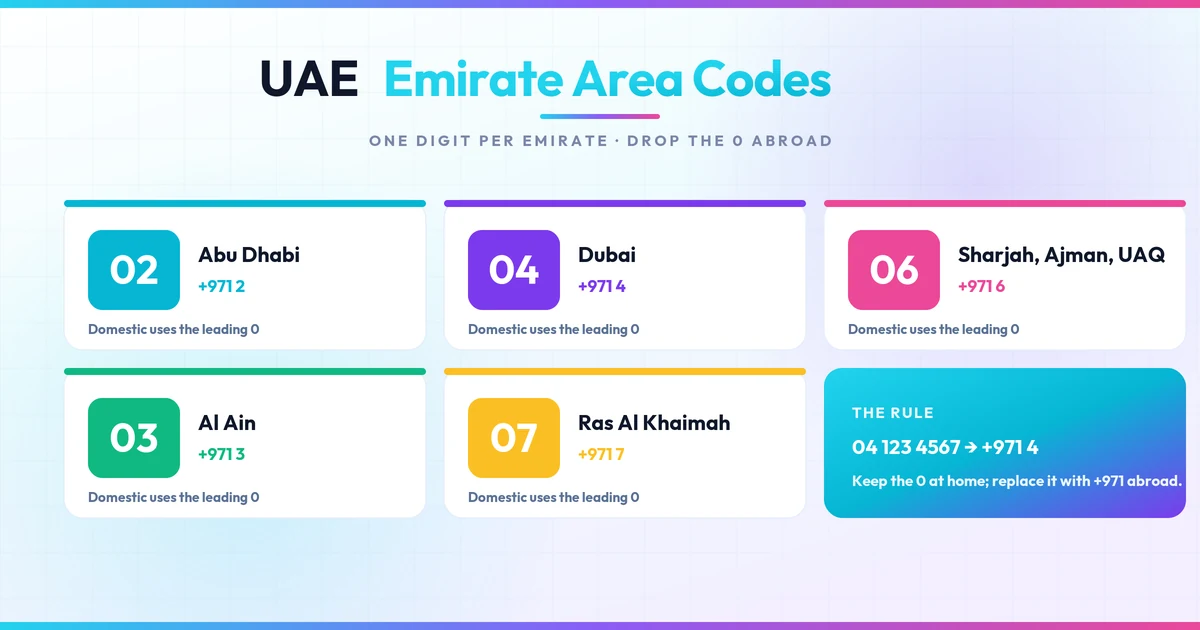
Each emirate has its own single-digit landline code. Here are the ones you'll use most.
| Emirate | Area code | International prefix |
|---|---|---|
| Abu Dhabi | 02 | +971 2 |
| Dubai | 04 | +971 4 |
| Sharjah, Ajman, Umm Al Quwain | 06 | +971 6 |
| Al Ain | 03 | +971 3 |
| Ras Al Khaimah | 07 | +971 7 |
Ready when you are
Protect your business line.
MCM's local numbers ship with verified caller ID and smart call filtering — customers always know it's really you, and spam never reaches your team.
Operator Prefixes — And Why They No Longer Tell You the Carrier
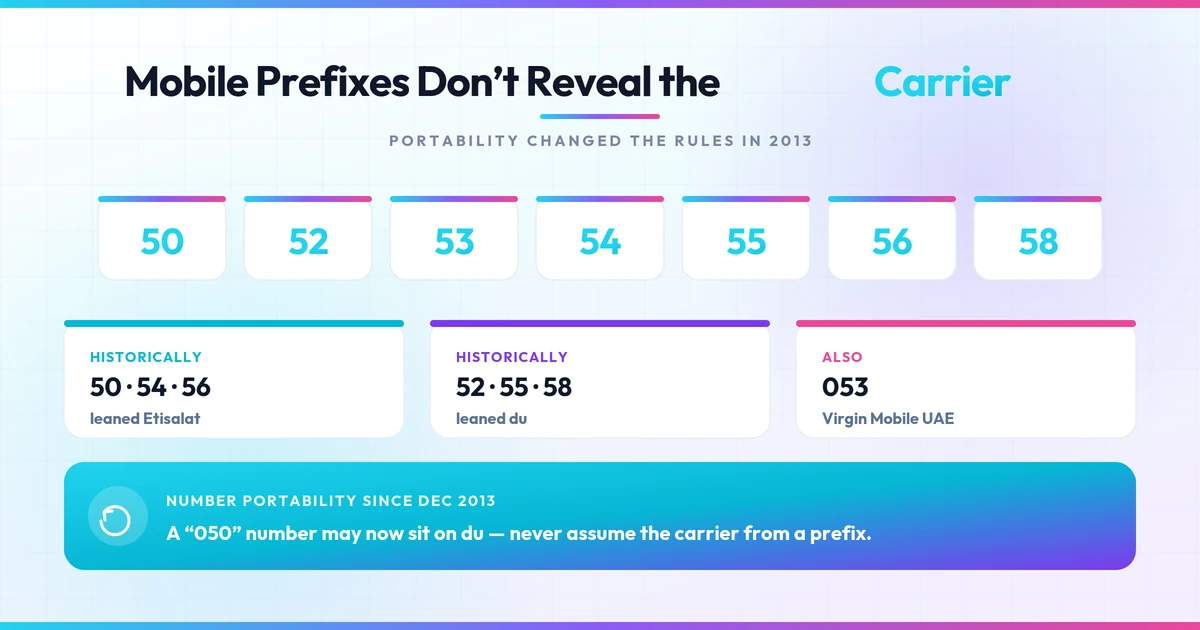
UAE mobile numbers start with recognizable 2-digit prefixes. People often assume the prefix reveals the carrier — but that stopped being reliable years ago.
The Common Mobile Prefixes
You'll see prefixes such as 50, 52, 53, 54, 55, 56, and 58. Historically, 50/54/56 leaned Etisalat and 52/55/58 leaned du.
Virgin Mobile UAE also uses 053 and shares some ranges. So a prefix points to an original operator, not necessarily the current one.
Mobile Number Portability Changed the Rules
Since the UAE launched Mobile Number Portability in December 2013, subscribers can switch carriers and keep their number. That means a "050" number could now sit on du, or a "055" number on Etisalat.
The takeaway: never assume billing or routing details from a prefix alone. Verify the live number if it matters.
Common Mistakes Callers Make
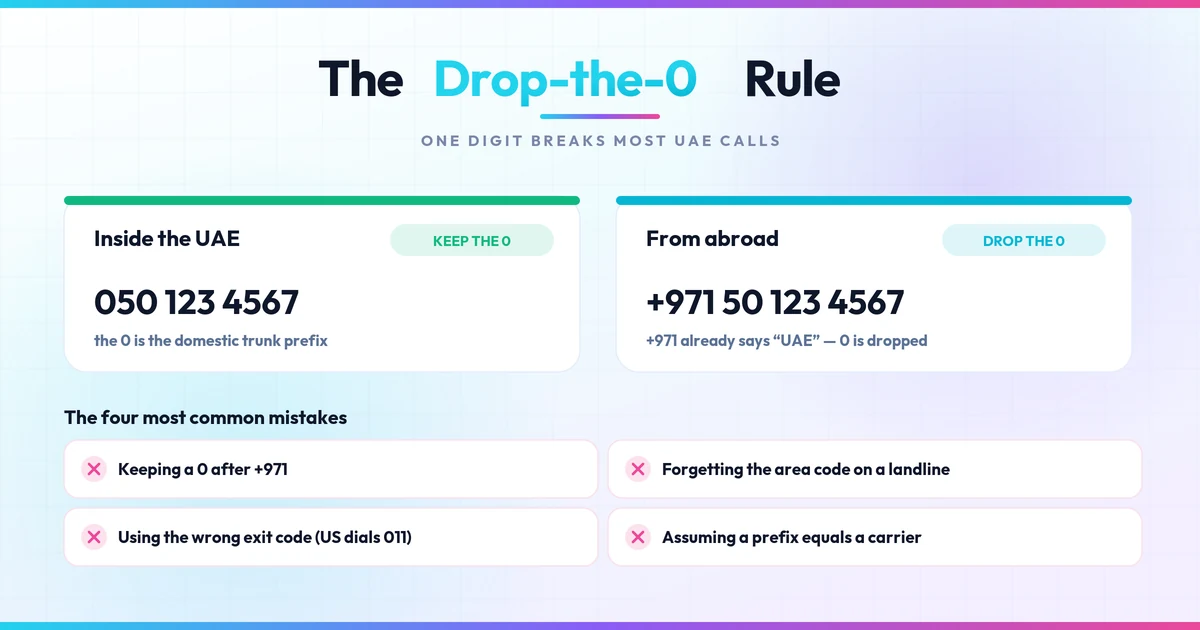
Most failed UAE calls come down to a short list of repeat offenders.
The Top Four Errors
Keeping a leading zero after +971 is the number-one mistake. Forgetting the area code on a landline is a close second.
Using your own country's exit code wrong (US callers dial 011 before +971) and assuming a mobile prefix equals a carrier round out the list.
A Quick Self-Check
Before you dial internationally, ask: exit code, then 971, then prefix with no zero, then 7 digits. If your number has more than 9 digits after +971, something's off.
Why Businesses Get a UAE Virtual Number
Plenty of companies outside the UAE want a local +971 presence without opening an office there.
The Practical Use Case
A virtual UAE number rings through to wherever your team already is — a mobile, a softphone, or a call center. Customers in Dubai see a familiar local number, so they're far more likely to pick up.
For context, MCM provisions local numbers across 190+ countries, and UAE numbers are among the most requested for sales and support teams.
Getting Started
Ready to put a local UAE number to work? Spin one up with MCM's UAE virtual numbers — no contracts, no hardware, and you can route calls in minutes. Test it with a small volume first to see how it fits your workflow.
Ready when you are
Ready to sound local everywhere you sell?
MCM activates business numbers in minutes, with call routing, analytics, and CRM-ready integrations. Start your trial — no card to browse inventory.
FAQs
What does a UAE phone number look like?
In international format it looks like +971 50 123 4567 for mobiles or +971 4 123 4567 for a Dubai landline. It's always +971, then a prefix, then a 7-digit local number — nine digits total after the country code.
Why do I drop the zero when calling the UAE?
The leading "0" is a domestic trunk prefix. Once you add the +971 country code, the network already knows it's a UAE call, so the zero is removed to avoid a misrouted or failed connection.
How do I call a UAE mobile from the United States?
Dial 011 (the US exit code), then 971, then the 2-digit mobile prefix without its zero, then the 7-digit number. For example: 011 971 50 123 4567.
How many digits is a UAE phone number?
After the +971 country code, a UAE number has 9 digits — a 1- or 2-digit area/mobile prefix followed by a 7-digit subscriber number.
Can I tell which carrier a UAE number belongs to from its prefix?
Not reliably. Number portability has been active since 2013, so a number that starts with "050" or "055" may have moved to a different carrier. The prefix only shows the original operator.
What is the area code for Dubai landlines?
Dubai landlines use area code 04 domestically, which becomes +971 4 when dialing from abroad. Abu Dhabi uses 02 (+971 2) and Sharjah uses 06 (+971 6).
Do mobile and landline numbers use the same format?
They share the +971 country code and a 7-digit local number, but mobiles use a 2-digit operator prefix while landlines use a 1-digit emirate code. That middle section is the key difference.