Introduction
Quick answer: yes, it still works. Dial *67 before a phone number and your caller ID shows up as "Private," "Blocked," or "Unknown" on the other person's screen.
But "it works" hides a few catches most articles skip. *67 won't help you on every call, it does nothing for texts, and it doesn't make you invisible to your carrier. This guide covers exactly when the code works, when it quietly fails, and what to use instead when you need real privacy.
WHAT *67 ACTUALLY DOES
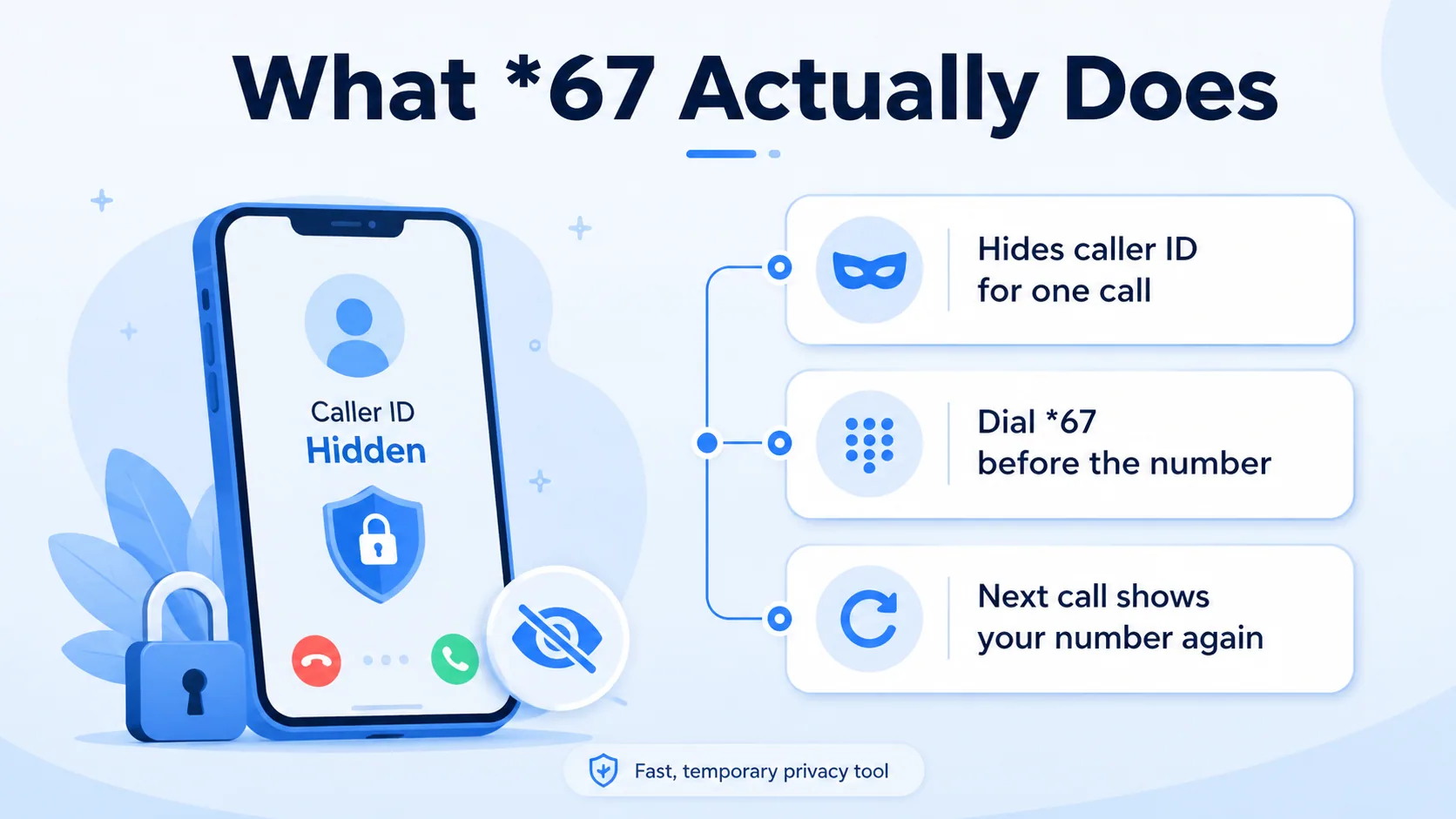
*67 is a per-call caller ID block. You dial the three characters first, then the full number — and that single call goes out anonymous.
It's a temporary toggle, not a setting. The next call you place shows your number again unless you dial *67 once more.
Why People Still Use It
It's free, built into every phone, and needs zero setup. For a one-off call to a stranger — a marketplace seller, a contractor, a number you don't fully trust — it's the fastest privacy tool available.
DOES *67 STILL WORK ON IPHONE AND ANDROID?
Yes. *67 is a network-level feature, not an app feature, so it behaves the same on iPhone, Android, and most landlines.
The phone hardware doesn't matter — your carrier processes the block. That's why a 30-year-old code still functions on a brand-new device.
How to Use *67 on a Mobile Phone
- Open your phone's dialer.
- Type *67 with no space.
- Enter the full number, including area code.
- Press call. The recipient sees "Private" or "Blocked."
How to Use It on a Landline
Pick up the handset, dial *67, then the number. Some older landline systems use 1167 on rotary phones — but on any touch-tone line, *67 is standard.
Ready when you are
Protect your business line.
MCM's local numbers ship with verified caller ID and smart call filtering — customers always know it's really you, and spam never reaches your team.
WHERE *67 QUIETLY FAILS
This is the part most guides leave out. *67 has real blind spots, and assuming it always works can backfire.
It Doesn't Work on These Numbers
- Toll-free numbers (800, 888, 877, etc.): The business pays for the call, so it receives your number regardless of *67.
- 911 and emergency services: Caller ID blocking is disabled by law — dispatchers must see your number and location.
- Some verification lines: Banks and secure systems that require caller ID may reject blocked calls.
It Does Nothing for Texts
*67 only affects voice calls. Send an SMS or MMS and your number goes through in full. For text privacy, you need a separate number, not a star code.
If you're juggling personal and business contacts, a dedicated second line is the cleaner fix. A virtual number from My Country Mobile (MCM) gives you a separate number for calls and texts in a few minutes — no second SIM, no new phone. It's a more reliable answer than dialing a code every time.
*67 VS *82: THE OPPOSITE CODES
These two codes confuse a lot of people, so here's the clean distinction.
| Code | What it does | When to use it |
|---|---|---|
| *67 | Hides your caller ID for one call | Your number normally shows, and you want this call private |
| *82 | Reveals your caller ID for one call | You have permanent blocking on, but this call needs to show your number |
If you've set permanent caller ID blocking through your carrier, *82 is how you "unblock" a single important call — like one that would otherwise hit a verification line.
THE PRIVACY LIMIT NOBODY MENTIONS
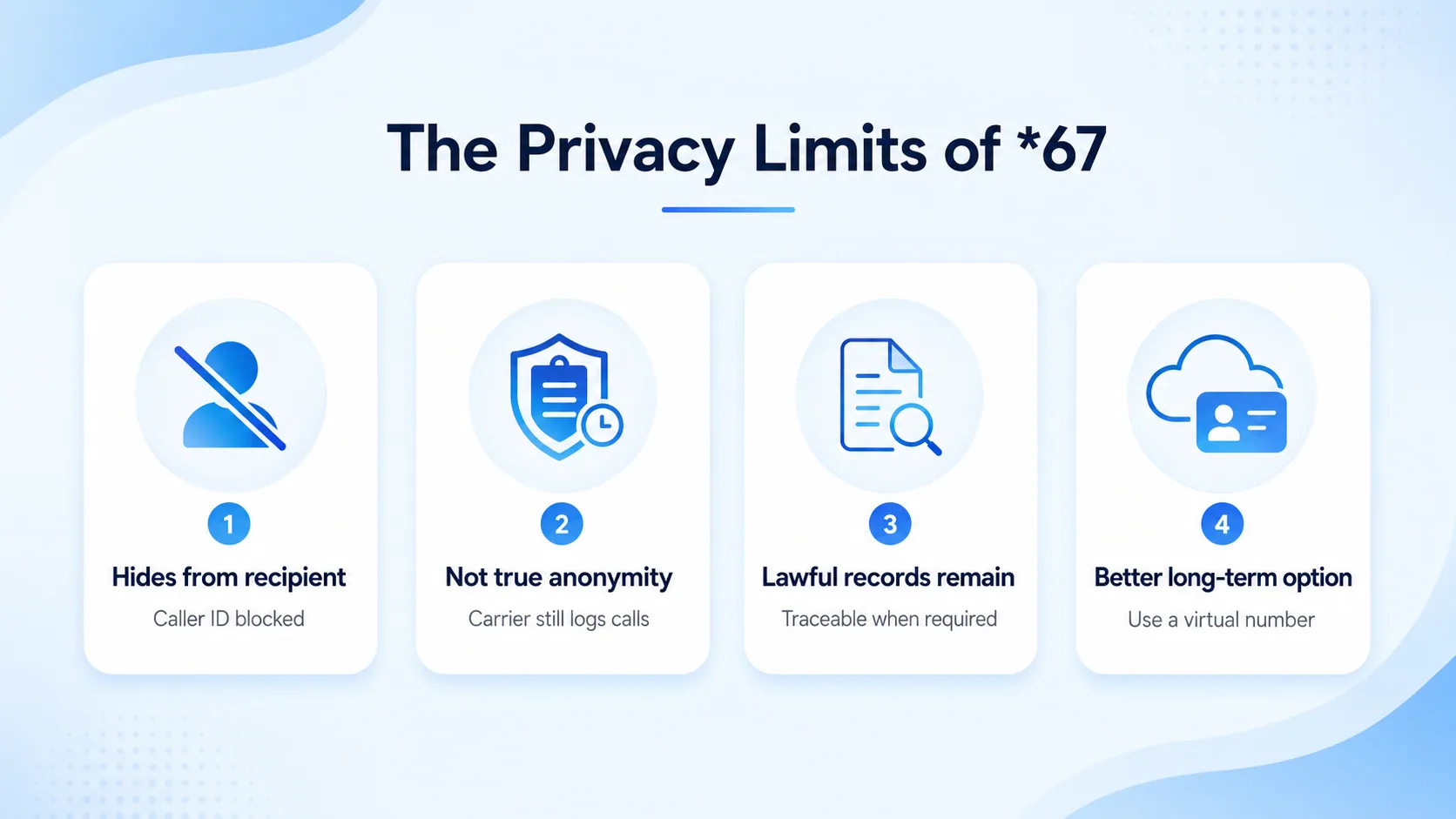
*67 hides your number from the person you're calling. It does not hide you from your carrier, and it doesn't hide you from the law.
Phone companies log every call — including the originating number — even when *67 is used. Law enforcement can request those records. So *67 is privacy from the recipient, not anonymity.
When *67 Isn't Enough
If you need lasting privacy — for a side business, online listings, or dating — a star code is the wrong tool. You'd be dialing it on every single call and hoping you never forget.
A virtual phone number solves it permanently: one number you hand out publicly, your real number stays private. You can route calls, set business hours, and shut it off whenever you want. See our guide to choosing a virtual phone number for business for the full breakdown.
COMMON MISTAKES TO AVOID
A few small errors stop *67 from working — and people blame the code instead of the slip.
Dialing It in the Wrong Order
*67 must come before the number, with no space and no pause. Dial the number first and the block won't apply.
Expecting It to Stick
It resets after every call. If you want every call blocked, set permanent caller ID blocking through your carrier instead of dialing *67 each time.
Trusting It for Sensitive Calls
Never assume *67 made you untraceable. For anything where being identified matters, use a separate number — not a temporary code.
WHAT TO DO NEXT
If you just need to hide your number on the occasional call, *67 still does the job in 2026 — dial it before the number and you're set. Test it once by calling a friend so you know it works on your carrier.
But if you're reaching for *67 on most of your calls, that's a sign you need a real second line. A virtual number keeps your personal number private full-time, works for calls and texts, and takes about five minutes to set up.
Want a private number that doesn't depend on remembering a code? Explore MCM's virtual phone numbers — local and toll-free options, no contract, live in minutes.
Ready when you are
Ready to sound local everywhere you sell?
MCM activates business numbers in minutes, with call routing, analytics, and CRM-ready integrations. Start your trial — no card to browse inventory.
FAQs
*Does 67 still work in 2026?
Yes. *67 still blocks your caller ID on most voice calls across major US and Canadian carriers. It works on iPhone, Android, and landlines because the block happens at the network level.
*Does 67 hide my number when texting?
No. *67 only affects voice calls. Text messages always send your number. To keep texts private, use a separate phone number instead.
*Can the person I call still find my number after 67?
Not through caller ID — they'll see "Private" or "Blocked." However, your carrier still logs the call, so the number is not hidden from the phone company or, with a legal request, from law enforcement.
*Why didn't 67 work on the number I called?
You likely called a toll-free, 911, or verification line — *67 is ignored on those. Also check that you dialed *67 before the number with no space.
**What's the difference between 67 and 82?
*67 hides your caller ID for one call. *82 does the opposite — it reveals your number for one call, useful if you have permanent caller ID blocking switched on.
*Is 67 free to use?
Yes. *67 is a standard network feature included with virtually all phone plans at no extra charge.
*Should I use 67 or get a second number?
Use *67 for occasional one-off calls. If you need ongoing privacy — for a business, listings, or texts — a dedicated virtual number is more reliable and works without dialing a code every time.