Quick answer: The 573 area code covers central and southeastern Missouri, including Columbia, Cape Girardeau, Jefferson City, and Rolla. Created in 1996 when it was split from the original 314 code, 573 is a standalone area code — not an overlay — serving one of Missouri's most geographically and culturally diverse regions. You can get a local 573 number through a virtual provider without relocating to Missouri.
Introduction
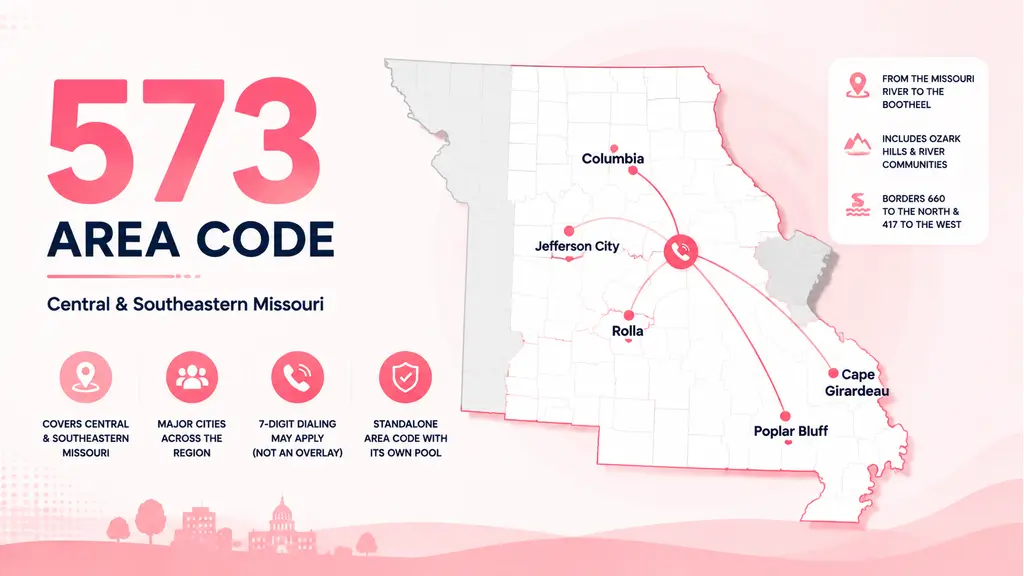
The 573 area code spans Missouri's middle and lower sections from the banks of the Missouri River in the north to the Mississippi lowlands of the Bootheel in the south, and from the Ozark Plateau in the west to the river bluffs of Cape Girardeau in the east.
Within that arc sits an unusually varied landscape: Columbia, a Big Ten university city with a thriving healthcare and media economy; Jefferson City, the seat of Missouri state government; Rolla, home to one of the nation's top engineering universities; and Cape Girardeau, a Mississippi River city that has emerged as the commercial and cultural hub of southeastern Missouri.
These cities share more than a prefix. They share the Missouri River and the Mississippi as economic lifelines, the Ozarks as a natural backdrop, and the particular Midwestern identity of communities that are neither the big city nor purely rural. The 573 area code is the phone number that knits them together.
This guide covers where 573 reaches, the communities it serves, how the code was carved out of Missouri's original numbering structure, how to dial it correctly, and how to stay safe from scams that exploit local-looking Show-Me State numbers.
Where the 573 area code reaches

The 573 area code covers central and southeastern Missouri — a large, irregularly shaped region that wraps around the eastern and southern portions of the state, from the Missouri River corridor in the north down through the Ozark hills to the Missouri Bootheel in the south.
Major counties in the 573 footprint include Boone County (Columbia), Cape Girardeau County, Cole County (Jefferson City), Phelps County (Rolla), Butler County (Poplar Bluff), Marion County (Hannibal), Scott County (Sikeston), and Pemiscot County in the Bootheel. The western boundary of 573 borders the 660 area code in north-central Missouri and the 417 code in the southwest. To the east, 573 runs to the Mississippi River, beyond which lie Illinois codes. The St. Louis metro — served by 314 and 636 — lies in the northeast corner of Missouri, just outside the 573 footprint.
Unlike many modern area codes, 573 is not an overlay — it is a standalone code with its own dedicated number pool. That means seven-digit dialing rules can apply within the region, though ten-digit dialing always works. For a look at how a single non-overlaid code can serve an entire large territory, the 563 area covers eastern Iowa from Davenport to Dubuque with an equally undivided footprint.
A short history of Missouri's 573 code

Missouri was divided into two area codes from the very beginning of the North American Numbering Plan in 1947: 314 covering eastern Missouri anchored by St. Louis, and 816 covering western Missouri anchored by Kansas City. A third original code, 417, served the southwestern corner of the state around Springfield.
For nearly five decades, the 314 code stretched from the St. Louis metro all the way across central Missouri and down through the Ozarks and river counties to the Arkansas and Tennessee borders — a vast swath of the state that included Columbia, Jefferson City, Rolla, Cape Girardeau, and dozens of smaller communities alongside the massive St. Louis metro.
By the mid-1990s, that combined 314 pool was under intense pressure. St. Louis's business district, its suburbs, and the central Missouri communities were all drawing from the same numbers. Regulators split 573 from 314 in 1996, assigning it to the central and southeastern Missouri communities and concentrating the remaining 314 pool on the St. Louis metropolitan area. Three years later, in 1999, the western St. Louis suburbs received their own code — 636 — further refining the boundaries. The 573 code has served its current footprint without further change since its creation.
Ready when you are
Protect your business line.
MCM's local numbers ship with verified caller ID and smart call filtering — customers always know it's really you, and spam never reaches your team.
Major cities in the 573 area code
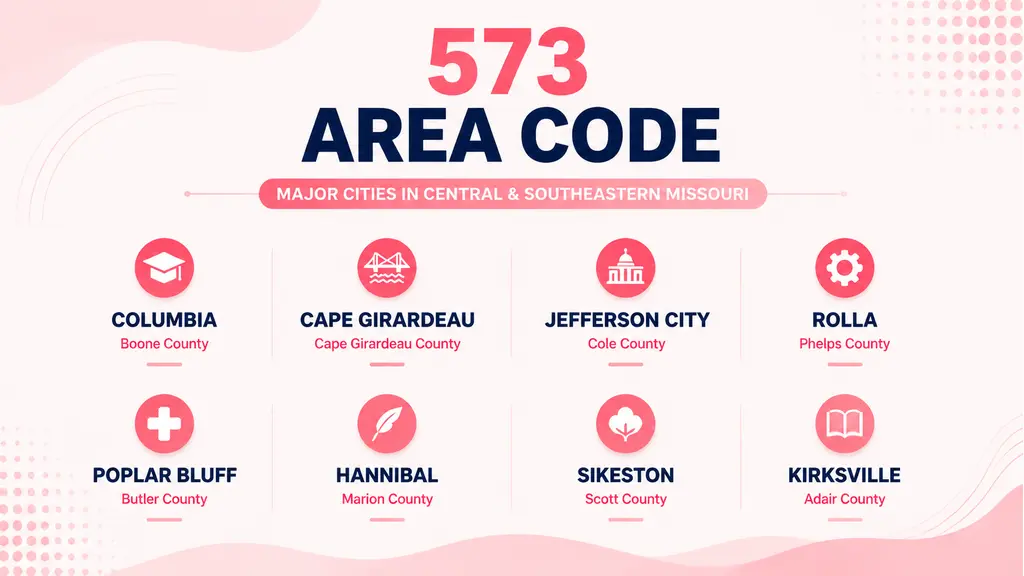
Central and southeastern Missouri contains university cities, the state capital, Ozark resort communities, river towns, and agricultural centres. The main population and business hubs in the 573 region are:
| City | County | Known for |
|---|---|---|
| Columbia | Boone | University of Missouri, healthcare, media |
| Cape Girardeau | Cape Girardeau | SEMO, Mississippi River, Rush Limbaugh birthplace |
| Jefferson City | Cole | Missouri state capital, government campus |
| Rolla | Phelps | Missouri S&T engineering university, Ozark gateway |
| Poplar Bluff | Butler | Ozark Foothills, regional medical hub |
| Hannibal | Marion | Mark Twain birthplace, Mississippi River tourism |
| Sikeston | Scott | Cotton country, Bootheel commerce |
| Kirksville | Adair | Truman State University, osteopathic medicine birthplace |
Columbia anchors the northern end of the 573 region as Missouri's fourth-largest city, home to the flagship University of Missouri campus and a cluster of major healthcare systems. Cape Girardeau anchors the southeast as a Mississippi River commercial hub and the home of Southeast Missouri State University. Jefferson City, though a relatively small capital city, ties together the region's government identity.
How to dial a 573 number
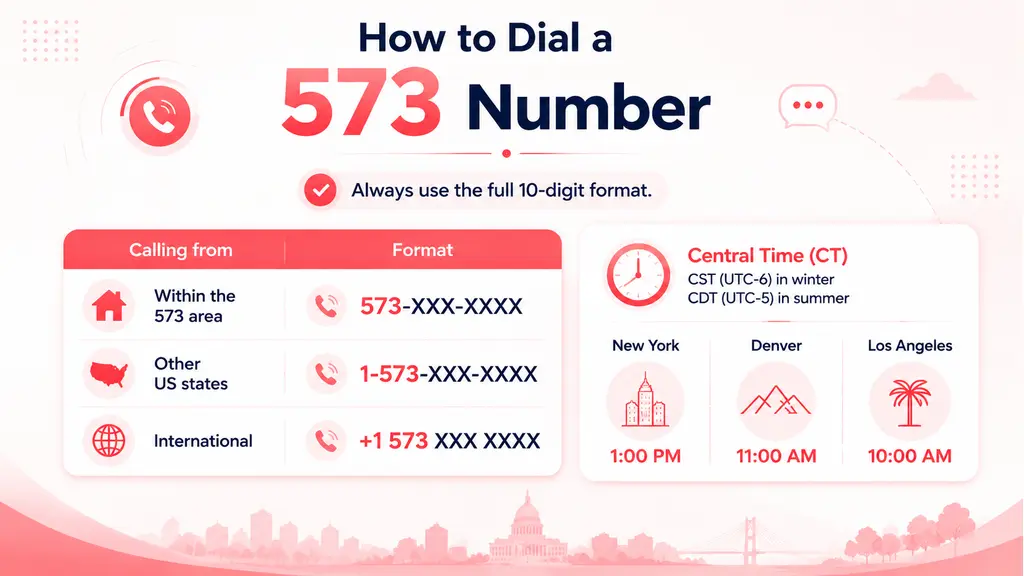
573 is a standalone code — not an overlay — which means ten-digit dialing is encouraged but local seven-digit dialing may still work within some exchanges in the region. For reliability across all carriers and VoIP systems, always use the full ten-digit format:
| Calling from | Format |
|---|---|
| Within the 573 area | 573-XXX-XXXX |
| Other US states | 1-573-XXX-XXXX |
| International | +1 573 XXX XXXX |
Dialing with the full area code always works from anywhere and is the recommended practice for any business phone system or VoIP service, which cannot assume the caller's local context.
The 573 area code sits in Central Time — Central Standard Time (UTC−6) in winter and Central Daylight Time (UTC−5) in summer. At noon in Columbia or Cape Girardeau it is 1 PM in New York, 11 AM in Denver, and 10 AM in Los Angeles. Missouri's central time zone puts the 573 business day within easy reach of all major US markets simultaneously. To the east, the 557 area overlays 314 across St. Louis and its Missouri suburbs on the same Central Time schedule.
Why choose a 573 number
A 573 number signals central or southeastern Missouri to every caller before the conversation begins. For businesses serving the University of Missouri community in Columbia, state government contacts in Jefferson City, healthcare networks across the Ozark region, or agricultural and industrial clients along the Mississippi, a local prefix establishes credibility and lifts answer rates in a way that out-of-state or toll-free numbers cannot replicate.
The 573 footprint covers a region where personal relationships and community trust drive business decisions. A local phone number is part of that trust signal — and holding one requires no Missouri address. Virtual phone providers issue a 573 number and forward calls to any device you choose. My Country Mobile can provision a 573 number the same day and integrate it with your existing phone system, letting your team project a genuine central Missouri presence from anywhere in the world.
Staying safe from 573 scam calls
A 573 number on your caller ID does not confirm the caller is in Columbia, Cape Girardeau, or anywhere in Missouri. Caller-ID spoofing lets bad actors display any local-looking prefix from anywhere in the world. Common scams targeting the 573 region include fake utility threats impersonating Ameren Missouri or local co-ops, IRS and Social Security impersonators, lottery and prize fraud targeting rural communities, and neighbour-spoofing robocalls that cycle through local number sequences to maximise pickup rates.
The FCC's FCC verification requires carriers to verify call origin and label likely spoofed calls as "Spam Risk" or "Scam Likely" on compatible phones. The most reliable defence is behavioural: if an unexpected 573 caller creates urgency, demands immediate payment by gift card or wire transfer, or refuses to provide a verifiable callback number, hang up and call the organisation back through a number from its official website.
Conclusion
The 573 area code is the telephone identity of a Missouri that most visitors never see — a region of river bluffs and Ozark hollows, state government and flagship universities, small-city commerce and deep agricultural roots. Carved out of the original 314 code in 1996, 573 has connected Columbia, Cape Girardeau, Jefferson City, and their surrounding communities for three decades, serving as the quiet but essential backbone of central and southeastern Missouri's economy.
For businesses building a presence in this region — whether targeting the University of Missouri ecosystem in Columbia, the state government market in Jefferson City, or the healthcare and agricultural networks that spread across the 573 footprint — a local number is still one of the most effective signals of community investment. My Country Mobile can activate a 573 line the same day, with no hardware and no Missouri address required.
Key takeaways
- The 573 area code covers Columbia, Cape Girardeau, Jefferson City, and central-southeastern Missouri, split from 314 in 1996.
- Unlike many modern codes, 573 is a standalone code — not an overlay — with its own dedicated number pool.
- Ten-digit dialing is the recommended practice for all carriers and VoIP systems, even though 573 has no overlay.
- 573 operates on Central Time (UTC−6 winter / UTC−5 summer).
- A virtual 573 number delivers local credibility across one of Missouri's most geographically diverse regions with no physical office required.
- Scammers spoof 573 numbers — verify unexpected callers before sharing money or personal information.
Ready when you are
Ready to sound local everywhere you sell?
MCM activates business numbers in minutes, with call routing, analytics, and CRM-ready integrations. Start your free trial — no card to browse inventory.
Frequently asked questions
Where is the 573 area code located?
The 573 area code covers central and southeastern Missouri, including Columbia, Cape Girardeau, Jefferson City, Rolla, Poplar Bluff, Hannibal, Sikeston, and Kirksville.
Is 573 an overlay code?
No. Unlike many modern area codes, 573 is a standalone code — not an overlay. It was split directly from the 314 area code in 1996 and has its own dedicated geographic footprint and number pool.
What time zone is the 573 area code in?
Central Time. Missouri observes CST (UTC−6) in winter and CDT (UTC−5) in summer.
What are the largest cities in the 573 area code?
Columbia is the largest city, home to the University of Missouri. Cape Girardeau is the largest city in southeastern Missouri. Jefferson City, the state capital, and Rolla, home to Missouri S&T, are also major centres.
Do I need to dial ten digits when calling a 573 number?
Ten-digit dialing is always recommended and required when calling from outside the region or using any VoIP or cloud phone system. Some local exchanges within 573 may still support seven-digit dialing, but ten-digit dialing works everywhere.
Can I get a 573 number without living in Missouri?
Yes. Virtual phone providers let you obtain a 573 number and forward calls to any device, anywhere, with no Missouri address required.
Are calls to 573 numbers long distance?
Calls within the central and southeastern Missouri region are treated as local. Calls from other states to a 573 number follow standard long-distance or calling-plan rates.