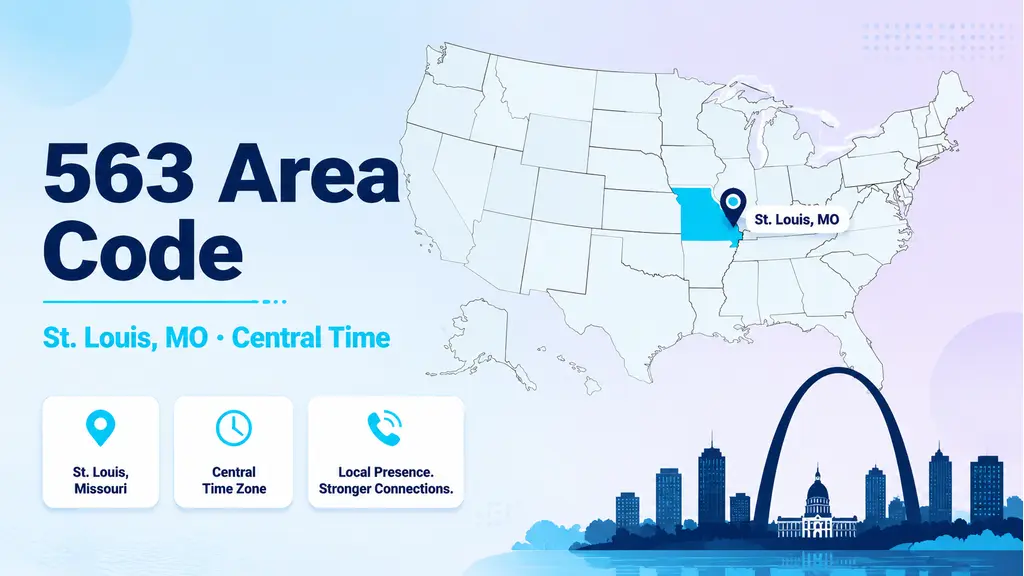
Quick answer: The 563 area code serves St. Louis, Missouri and the wider metro region. St. Louis sits at the confluence of the Missouri and Mississippi rivers and is home to the iconic Gateway Arch, major league sports franchises, and one of the Midwest's leading healthcare and financial-services economies. You can get a local 563 number through a virtual phone provider without relocating to St. Louis.
Introduction
St. Louis is one of those American cities that feels bigger than its population suggests. Perched at the junction of two great rivers, it has served as the country's gateway to the West since the early 1800s — a role memorialized by the soaring 630-foot Gateway Arch that dominates the downtown skyline. Today the city is a hub for healthcare, financial services, defense contracting, and a growing technology sector anchored by research universities and innovation campuses.
The 563 area code is the telecommunications backbone of this metro. Every business call, customer inquiry, and local conversation that flows through a St. Louis number carries this prefix. Understanding it — where it reaches, how to dial it, and what it signals to callers — gives businesses and residents a clearer picture of how to use their local numbers effectively.
This guide walks you through the geographic footprint of the 563 code, the cities it covers, a brief history of the code's origins, practical dialing rules, and tips for holding and protecting a 563 number.
Where the 563 area code reaches
The 563 area code covers the St. Louis metropolitan area — a bi-state urban region that straddles the Missouri-Illinois border along the Mississippi River. On the Missouri side the footprint includes the independent city of St. Louis, and suburban communities such as Clayton, Chesterfield, Kirkwood, and O'Fallon. On the Illinois side it reaches East St. Louis, Belleville, and Edwardsville.
Together these communities form one of the largest metro economies in the central United States, with more than 2.8 million residents. The diversity of the footprint — from downtown financial towers to quiet suburban corridors to river-edge municipalities — means the 563 code connects a wide range of callers and businesses under one recognisable prefix.
For a sense of how a single area code can unify a large geographic region, the 557 area overlays the St. Louis metro and Missouri suburbs — a different model of code-sharing across a dense urban footprint.
A short history of St. Louis's 563 code

Area codes in the United States were first introduced under the North American Numbering Plan in 1947, and the system has expanded steadily ever since to accommodate surging subscriber demand. The St. Louis metro, like most large American cities, needed additional numbering capacity as mobile phones, VoIP lines, fax machines, and internet-connected devices multiplied the draw on available number pools.
The 563 area code was introduced to give the St. Louis region the dedicated capacity it needed. At the time of its creation, existing codes serving parts of Missouri were feeling the pressure of rapid subscriber growth across the suburbs and edge cities surrounding downtown St. Louis. By assigning 563 to the metro, regulators gave the area enough numbers to sustain continued expansion without forcing a complex overlay arrangement on an already busy market.
Today 563 is fully embedded in the St. Louis identity. From the medical campuses of the Central West End to the corporate parks near Lambert-St. Louis International Airport, 563 numbers are how this metro does business.
Ready when you are
Protect your business line.
MCM's local numbers ship with verified caller ID and smart call filtering — customers always know it's really you, and spam never reaches your team.
Major cities in the 563 area code
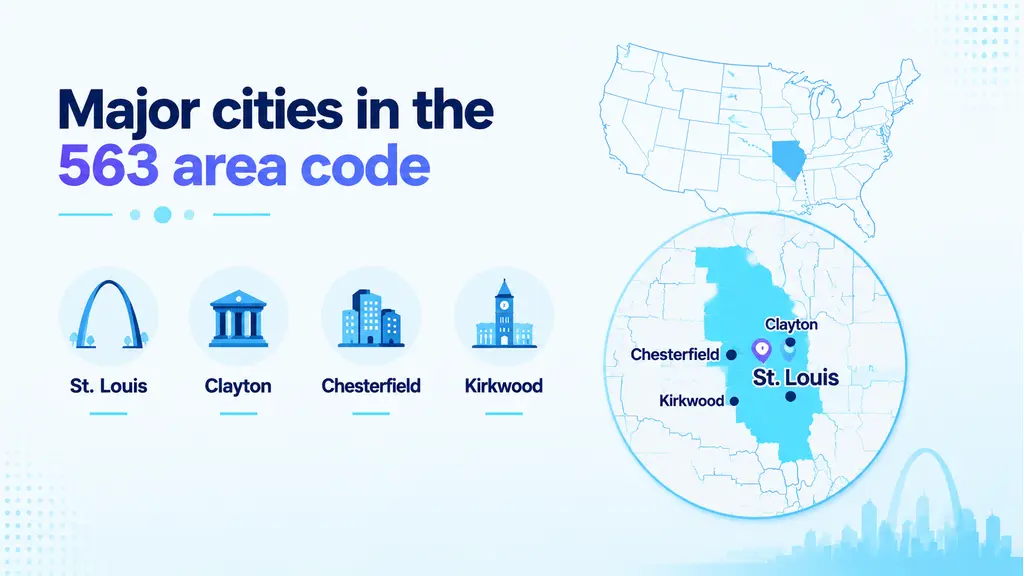
The 563 code reaches communities across a broad bi-state metro. Below are the most significant population and business centres:
| City | County / State | Known for |
|---|---|---|
| St. Louis | Independent city, MO | Gateway Arch, Cardinals, Blues, Anheuser-Busch |
| Clayton | St. Louis County, MO | Financial and legal services hub |
| Chesterfield | St. Louis County, MO | Corporate campuses, suburban retail |
| Kirkwood | St. Louis County, MO | Historic downtown, Amtrak station |
| O'Fallon | St. Charles County, MO | Fastest-growing western suburb |
| Belleville | St. Clair County, IL | Largest city in Metro East Illinois |
| Edwardsville | Madison County, IL | Southern Illinois University campus |
| Florissant | St. Louis County, MO | Northern suburban hub |
St. Louis city itself — legally an independent municipality separate from St. Louis County since 1876 — anchors the region's culture and economy. Clayton serves as the metro's legal and financial core, while Chesterfield and O'Fallon represent the fast-growing western corridor.
How to dial a 563 number
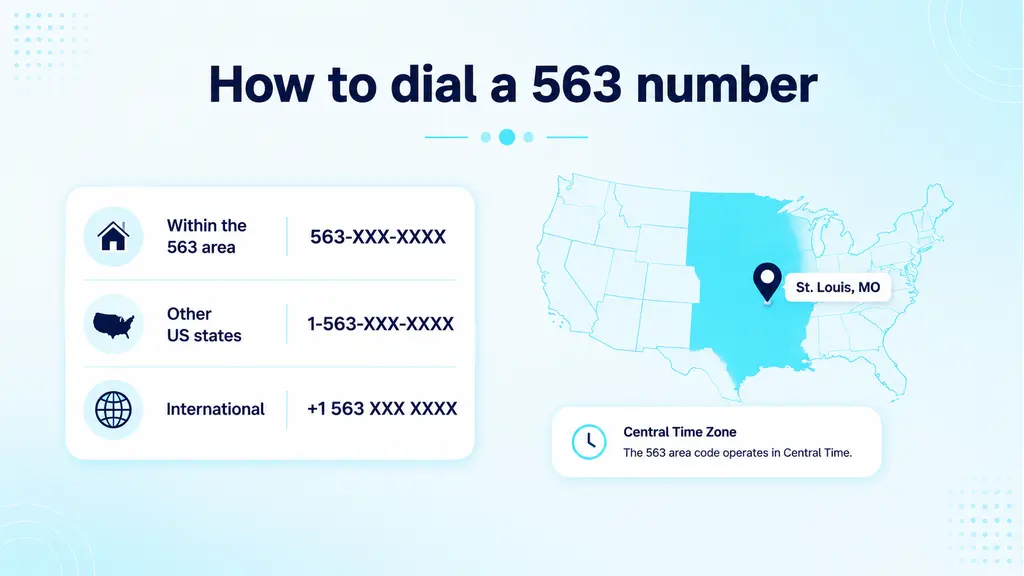
Dialing a 563 number is consistent whether you call from across town or across the country:
| Calling from | Format |
|---|---|
| Within the 563 area | 563-XXX-XXXX |
| Other US states | 1-563-XXX-XXXX |
| International | +1 563 XXX XXXX |
Ten-digit dialing is mandatory throughout the 563 metro — always include the area code even when calling a neighbour a few blocks away. Seven-digit local dialing is not permitted in the St. Louis region.
The 563 area code sits in Central Time — Central Standard Time (UTC−6) in winter and Central Daylight Time (UTC−5) in summer. At noon in St. Louis it is 1 PM in New York, 11 AM in Denver, and 10 AM in Los Angeles.
Keep the Central time zone in mind when scheduling calls with partners or customers on either coast. Across the Missouri River, the 531 area overlays 402 in eastern Nebraska around Omaha and Lincoln, also on Central Time.
Why choose a 563 number

A 563 number projects St. Louis before your contact even picks up. Research consistently shows that calls from local area codes earn significantly higher answer rates than those from toll-free or out-of-state numbers — and in a city as community-minded as St. Louis, local identity carries weight on every call.
The practical barrier to holding a 563 number is lower than most businesses expect. Virtual phone providers issue the number and forward calls to any device — a mobile phone, a desk phone, a softphone app, or a call-centre platform. You do not need a physical St. Louis address or even a Missouri business registration. My Country Mobile can provision a 563 number the same day and route it through your existing setup with no hardware required.
Staying safe from 563 scam calls
Caller-ID spoofing means a St. Louis-looking 563 number is no guarantee the caller is actually in the metro. Fraudsters cycle through local-area codes specifically because familiar prefixes feel trustworthy. Common scams riding the 563 prefix include fake utility disconnection threats, IRS impersonators, Medicare fraud calls, and "neighbour spoofing" robocalls that display a number just one or two digits away from yours.
The FCC's STIR/SHAKEN requires carriers to verify call origin and flag likely spoofed calls as "Spam Risk" or "Scam Likely" on compatible phones. Your clearest line of defence remains behavioural: if an unexpected 563 caller creates urgency, requests payment via gift card or wire transfer, or asks for personal information you did not volunteer, hang up and call the organisation back on a number from its official website.
Conclusion
The 563 area code is St. Louis's dial-tone identity — the three digits that tell callers, customers, and partners where you are rooted. The metro it serves spans two states, dozens of communities, and one of the most historically significant rivers in North America, yet 563 pulls them all into a single recognisable call signature.
For any business that wants a genuine foothold in the St. Louis market, a 563 number is one of the most efficient investments available. It works with existing infrastructure, activates the same day, and signals local commitment in a way that toll-free numbers simply cannot match. My Country Mobile makes that activation straightforward, leaving your team free to focus on the conversations that grow your St. Louis presence.
Key takeaways
- The 563 area code covers St. Louis, Missouri and the wider bi-state metropolitan region.
- Ten-digit dialing is mandatory — always include the 563 prefix when placing calls in the area.
- 563 operates on Central Time (UTC−6 winter / UTC−5 summer).
- A virtual 563 number builds instant local credibility in the St. Louis market with no physical office required.
- Scammers spoof 563 numbers — always verify unexpected callers before sharing money or personal information.
Ready when you are
Ready to sound local everywhere you sell?
MCM activates business numbers in minutes, with call routing, analytics, and CRM-ready integrations. Start your free trial — no card to browse inventory.
Frequently asked questions
Where is the 563 area code located?
The 563 area code covers St. Louis, Missouri and the surrounding metropolitan region, including communities on both the Missouri and Illinois sides of the Mississippi River.
What time zone is the 563 area code in?
Central Time. The St. Louis area observes CST (UTC−6) in winter and CDT (UTC−5) in summer.
What is the largest city in the 563 area code?
St. Louis is the primary city of the 563 area code, home to the Gateway Arch, major league sports franchises, and a large healthcare and financial-services economy.
Can I get a 563 number without living in St. Louis?
Yes. Virtual phone providers let you obtain a 563 number and forward calls to any device, anywhere in the world, with no St. Louis address required.
Is ten-digit dialing required in the 563 area?
Yes. Always dial the full 563 area code plus the seven-digit number, whether you are calling from within the metro or from another state.
How do I spot a 563 scam call?
Be cautious of any 563 caller who creates urgency, demands payment by gift card or wire transfer, or asks for personal information you did not volunteer. Hang up and call the organisation back using a number from its official website.
Are calls to 563 numbers considered long distance?
Calls within the St. Louis metro area are treated as local. Calls placed from other states to a 563 number follow standard long-distance or calling-plan rates.