Pittsburgh and southwestern Pennsylvania share the 878 area code, a third overlay covering the same footprint as 412 (Pittsburgh proper) and 724 (the surrounding suburbs). Regulators activated 878 on August 17, 2001 — but no 878 number was actually issued until April 2013, a full 12 years later, once conservation measures on 412 and 724 finally ran their course.
This guide covers 878's counties and cities, the unusually long dormancy that makes its history unlike any other code in this series, what's driving demand across Pittsburgh's healthcare and tech corridor, and which features are worth adding to a 878 line.
Counties and cities at a glance
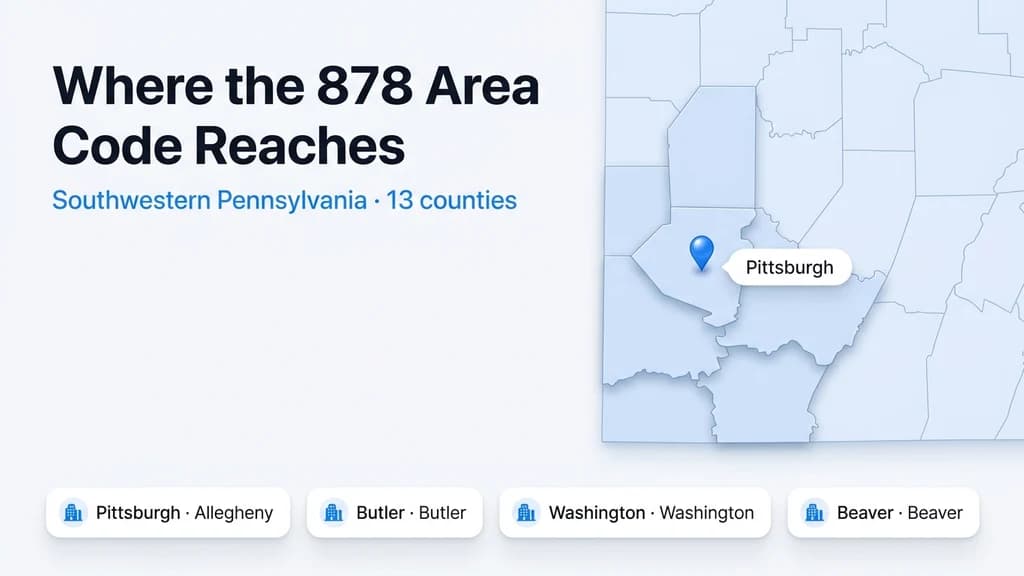
878/412/724 covers roughly 13 counties across southwestern Pennsylvania — Allegheny, Westmoreland, Washington, Butler, Beaver, Fayette, Mercer, Lawrence, Indiana, and Armstrong among them, anchored by Pittsburgh at the center.
The overlay that sat dormant for 12 years
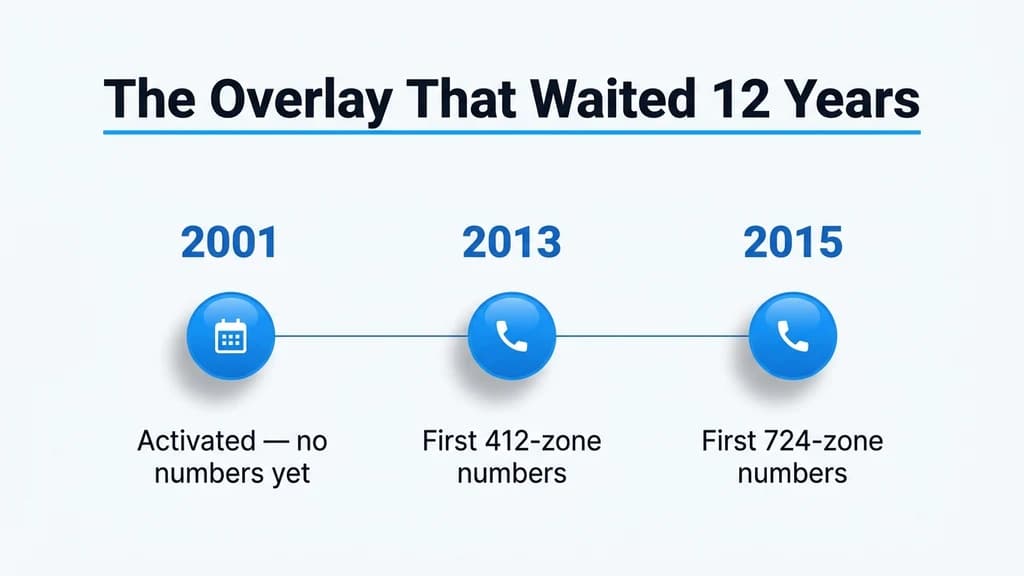
August 17, 2001 — 878 was activated as a third overlay on the same territory as 412 and 724, but no numbers were assigned yet.
April 2013 — The first 878 numbers were finally issued, but only in the 412 (Pittsburgh proper) zone, once rate-center consolidation and number pooling could no longer stretch 412's supply further.
2015 — The 724 (suburban/rural) zone needed its first 878 numbers as well, completing the rollout across the entire southwestern Pennsylvania footprint.
What's driving demand across Pittsburgh's healthcare and tech corridor

Pittsburgh's economy has shifted from steel toward healthcare, education, and technology:
UPMC and healthcare One of the region's largest employers, UPMC anchors a huge base of medical and administrative lines across the metro.
Universities Carnegie Mellon and the University of Pittsburgh drive steady student, faculty, and research-staff phone demand.
Corporate headquarters A cluster of corporate and tech company offices keeps adding commercial lines across the city and suburbs.
Many of these Pittsburgh-area businesses are moving their phone systems onto UCaaS (Unified Communications as a Service) — one cloud platform for calling, video, and messaging that scales as a company adds offices across the region, the same pattern behind newer overlays like 938 in north Alabama. Contact us to set up a 412, 724, or 878 number for your Pittsburgh-area business.
Ready when you are
Protect your business line.
MCM's local numbers ship with verified caller ID and smart call filtering — customers always know it's really you, and spam never reaches your team.
Features worth adding on a 878 number
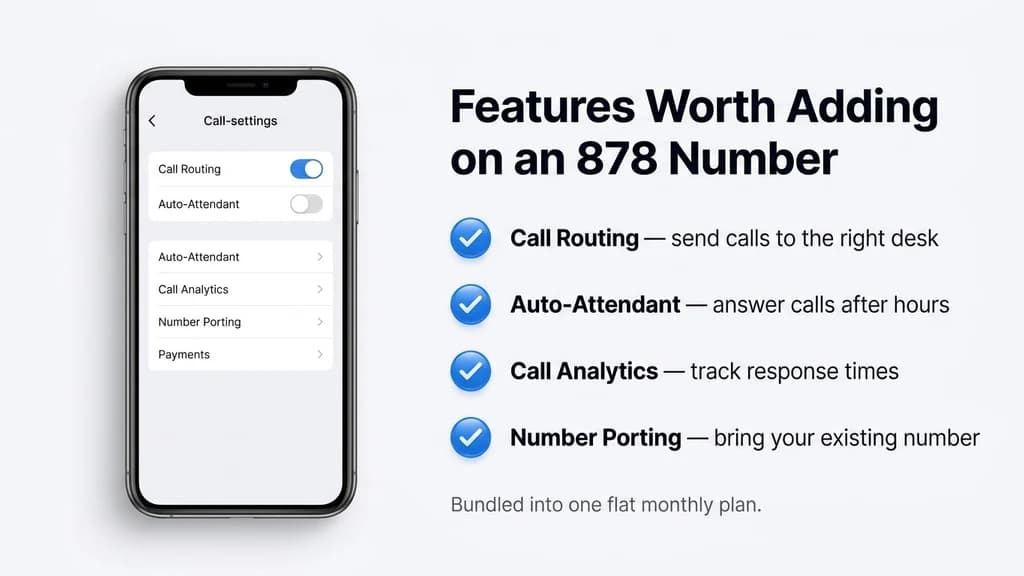
A hosted 878, 412, or 724 line pairs well with call routing across multiple office or clinic extensions, an auto-attendant for after-hours patient or client calls, and call analytics for tracking response times. Most providers bundle these into a flat monthly plan rather than pricing each feature separately.
Time zone & how to dial an 878 number
Southwestern Pennsylvania runs on Eastern Time (ET) — EST (UTC −5) in winter, EDT (UTC −4) during Daylight Saving Time. Ten-digit dialing has been mandatory across the 412/724/878 complex since July 12, 2001: dial 1, then the area code, then the seven-digit number, for every local call.
Key takeaways
- 878 is a third overlay covering the same southwestern Pennsylvania footprint as 412 and 724.
- It activated in 2001 but no numbers were issued until 2013 — a 12-year gap unlike any other code in this guide series.
- Anchors include UPMC, Carnegie Mellon, the University of Pittsburgh, and corporate headquarters.
- All three codes cover identical territory at identical rates.
- Time zone: Eastern (ET), with mandatory 10-digit dialing since July 2001.
Ready when you are
Ready to sound local everywhere you sell?
MCM activates business numbers in minutes, with call routing, analytics, and CRM-ready integrations. Start your free trial — no card to browse inventory.
Frequently asked questions
What is the 878 area code?
It's a third overlay covering southwestern Pennsylvania, including Pittsburgh, sharing the same footprint as 412 and 724.
Where is the 878 area code located?
Roughly 13 counties across southwestern Pennsylvania, anchored by Pittsburgh.
Is 878 a Florida area code?
No. It has never been assigned to Florida — this is strictly a Pennsylvania code.
What state is the 878 area code in?
Pennsylvania — specifically the southwestern part of the state, anchored by Pittsburgh.
What time zone is the 878 area code?
Eastern Time Zone (ET) — EST (UTC −5) in winter and EDT (UTC −4) during Daylight Saving Time.
Why did 878 sit unused for 12 years after activation?
Regulators activated it in 2001 as a precaution, but number-conservation measures kept 412 and 724 supplied until 2013, when 878 numbers finally started being issued.
How do I get a 878 area code number?
Sign up with a VoIP provider such as My Country Mobile, search for available numbers in any of the three codes, choose a Pittsburgh-area prefix, select a plan, and activate.