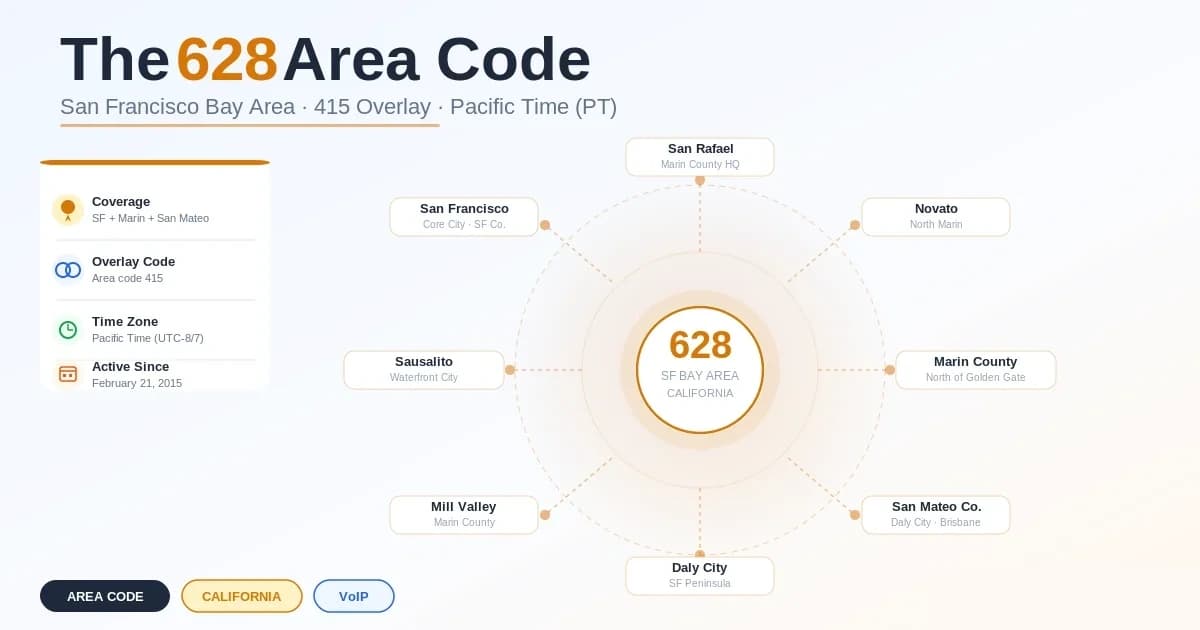
Quick answer: The 628 area code is an overlay of 415, covering the same map — the City and County of San Francisco, most of Marin County, and a small northeastern corner of San Mateo County. It went live on March 21, 2015 after the California PUC chose an overlay over splitting 415 (the split proposal drew heavy public opposition). Because two codes now share one region, 10-digit dialing is mandatory for every local call, but there are no toll charges between 415 and 628 — they're equally local. The only meaningful difference: 628 has more inventory, so clean numbers are easier to grab.
628 area code: the number that shares San Francisco with 415
If you've tried to get a new San Francisco phone line recently, you may have been handed a 628 number instead of the city's iconic 415. That's not a downgrade or a mistake — it's an overlay, and the two codes are functionally twins.
This guide explains what the 628 area code is, exactly which cities and counties it reaches, why every local call now needs all 10 digits, and how a 628 number stacks up against a 415 for a Bay Area business.
What is the 628 area code?
The 628 area code is a California telephone code that covers San Francisco, most of Marin County, and a small northeastern corner of San Mateo County.
It's an overlay — a second code layered onto the same map as an existing one. Here, that existing code is the long-established 415. Both serve identical territory.
Why overlays exist
When a region runs low on available phone numbers, regulators have two choices. They can split the area geographically, forcing some residents to change their numbers — or they can overlay a new code on top.
The overlay won out for San Francisco. Existing 415 holders kept their numbers, and new lines simply started drawing from a fresh 628 pool.
The history behind 628
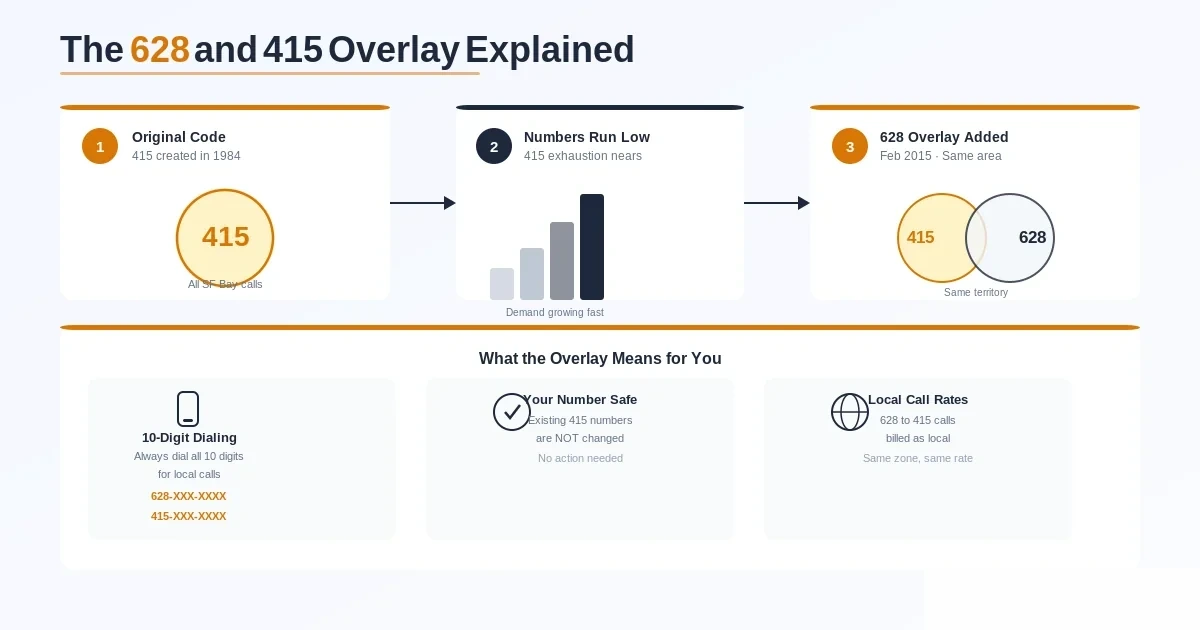
The 415 code dates back to 1947, one of California's first. For decades it covered San Francisco, Marin, and the surrounding area without strain.
Then the tech boom hit. As companies and residents poured in, 415 numbers ran short by the late 1990s.
Split vs. overlay
The California Public Utilities Commission first proposed splitting 415 in two. The plan drew heavy public opposition — nobody wanted to reprint business cards and signage.
So the CPUC chose an overlay instead. On March 21, 2015, the 628 area code went live, sharing the 415 footprint and ending the number shortage without disrupting a single existing line.
Ready when you are
Protect your business line.
MCM's local numbers ship with verified caller ID and smart call filtering — customers always know it's really you, and spam never reaches your team.
What the 628 area code covers
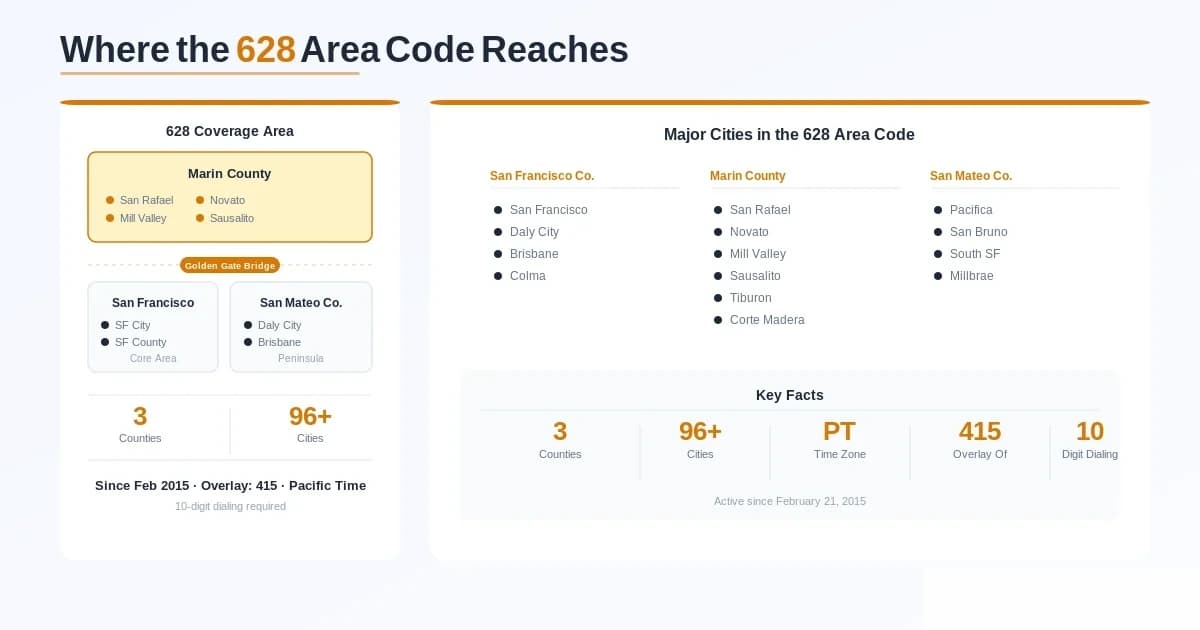
Because 628 overlays 415, the two share an identical service map. Here's what falls inside it.
San Francisco and San Mateo
- City and County of San Francisco — the entire city
- San Mateo County — a small northeastern portion only
Marin County
Most of Marin County sits under the 415/628 overlay, including:
| Marin community | Marin community |
|---|---|
| San Rafael | Sausalito |
| Novato | Tiburon |
| Mill Valley | Corte Madera |
| Larkspur | Fairfax |
| San Anselmo | Kentfield |
The far northwest of Marin is the exception — that strip is served by the 707 area code instead.
Time zone
The 628 area code sits in the Pacific Time Zone (PT), observing daylight saving time. Worth noting if you're scheduling calls from the East Coast or overseas.
Why 10-digit dialing is now required
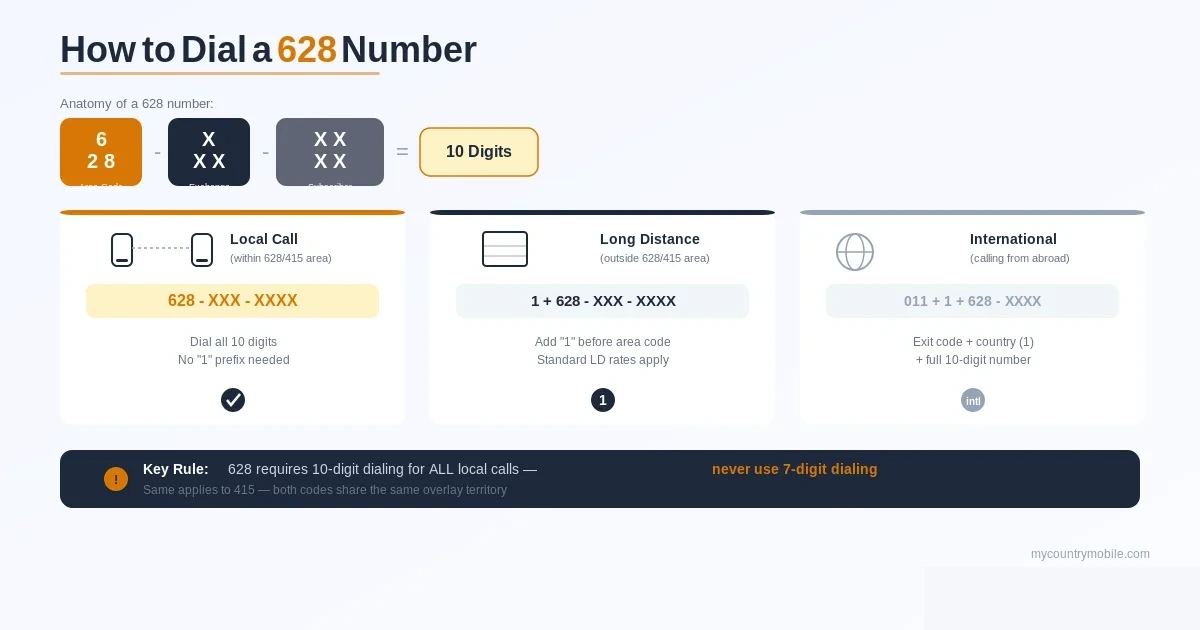
This is the one practical change overlays force on everyone. With two codes covering the same streets, the network can't assume which one you mean.
So every local call within the 415/628 zone — even to your next-door neighbor — must include the full 10-digit number. Seven-digit dialing no longer works here.
Good news: there are no toll or long-distance charges between 415 and 628. They cover the same ground, so a call between them is always a local call.
415 vs. 628: is there any real difference?
Short answer: no meaningful one. They're the same region, the same call rates, the same local identity.
| Factor | 415 | 628 |
|---|---|---|
| Coverage area | SF, Marin, NE San Mateo | Identical |
| Introduced | 1947 | 2015 |
| Local status | Local SF number | Equally local SF number |
| Call charges between them | None | None |
| Number availability | Limited | Wider |
The only edge worth noting: because 628 is newer, there's more inventory, so it's often easier to land a clean, memorable number.
Why a 628 number helps a Bay Area business
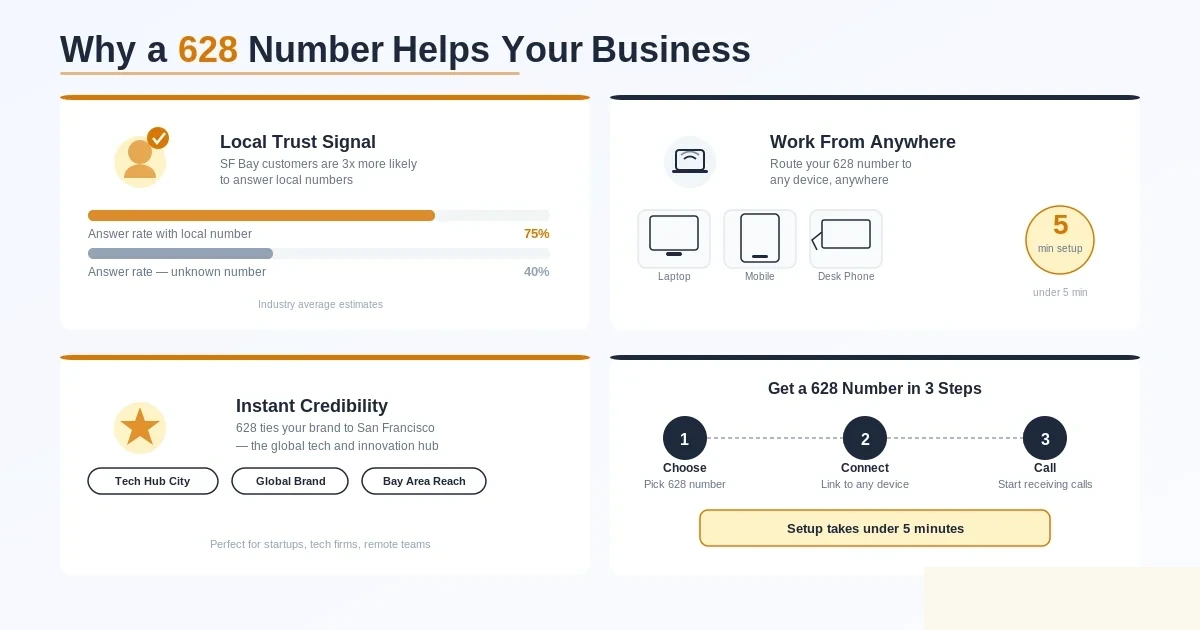
A local number isn't decoration — it changes how customers respond. People are measurably more likely to answer and trust a number that looks like theirs.
A 628 line signals that you're part of the San Francisco market, whether your team works downtown or remotely. For startups and expanding companies alike, that local cue builds credibility before a word is spoken.
Who benefits most
Some business types get an outsized return from a San Francisco number:
- Startups establishing a first foothold in the city
- Remote teams serving Bay Area clients without an office there
- Expanding companies opening a local point of contact
- Service providers and e-commerce brands running geo-targeted ads
A virtual phone number makes this practical — you get the local code without a physical SF address, and calls route to any device.
How to get a 628 number
Setting up a San Francisco number through a virtual provider takes minutes, not days. The general flow looks like this:
Search and select
Check availability for the 628 area code, browse the open numbers, and pick one — ideally something easy for customers to remember.
Choose a plan and activate
Select a plan that fits your call volume, create your account, and complete checkout. Activation is usually instant.
Configure routing
Log in and point the number wherever you need — a mobile, a desk phone, or a full VoIP setup. Add call forwarding, voicemail-to-email, or an auto attendant as you go.
Want to try it before committing? You can start a free trial and test call quality on a live 628 line.
A note on 628 scams
No area code is immune to fraud, and 628 is no exception. A few patterns are worth recognizing.
Watch for one-ring calls designed to bait a callback, agency impersonation (the IRS never demands payment by phone), and tech-support cons asking for remote access.
The rule of thumb: let unknown numbers go to voicemail, and verify any caller by dialing the organization back on a number you trust.
The bottom line on 628
The 628 area code isn't a lesser version of 415 — it's the same San Francisco, the same Marin towns, the same local rates. The only thing that's changed is that you'll dial 10 digits and you'll find more numbers available.
If you want a Bay Area presence, the smartest move is to grab a clean number now while the 628 pool is still deep. Pick something memorable, route it to your team, and you've got a local San Francisco line without the local overhead.
Ready when you are
Ready to sound local everywhere you sell?
MCM activates business numbers in minutes, with call routing, analytics, and CRM-ready integrations. Start your free trial — no card to browse inventory.
Frequently asked questions about the 628 area code
What is the difference between the 415 and 628 area codes?
There's no geographic difference. Both serve San Francisco, most of Marin County, and a corner of San Mateo County. 628 was added in 2015 as an overlay to supply more numbers.
Is a 628 number considered local to San Francisco?
Yes. A 628 number is a fully local San Francisco line. It carries the same local identity and credibility as a 415 number.
Do I have to dial all 10 digits in the 628 area?
Yes. Because 415 and 628 overlay the same region, every local call requires the full 10-digit number. Seven-digit dialing is no longer supported there.
Can I choose between a 415 and a 628 number?
It depends on availability. New numbers are assigned from whichever code has open inventory. A virtual provider will show you every available option in both.
Are there toll charges for calls between 415 and 628?
No. Both codes cover the same geographic zone, so calls between them are always treated as local. Standard local rates apply.
Can I port my existing number to a 628 area code?
Porting moves your current number and its existing area code to a new provider — it doesn't change the area code itself. To get a 628 number, you activate a new line.
What time zone does the 628 area code use?
The 628 area code is in the Pacific Time Zone and observes daylight saving time, the same as the rest of the San Francisco Bay Area.
Get a 628 number for your business
An SF presence used to mean leasing space in SoMa or the Financial District. Now it's a few-minute signup — and 628 inventory is still deep while 415 has been picked over for decades.
My Country Mobile offers 628 virtual numbers with call forwarding, voicemail-to-email, SMS, and AI call transcription. Calls route to any device worldwide, and over 17,500 businesses already trust MCM with their virtual phone presence.