Every retail VoIP service — the business phone system your company uses, the calling feature inside a messaging app, the contact center platform that handles your customer support — is built on wholesale VoIP infrastructure underneath. Understanding wholesale VoIP means understanding how voice communication actually works at the carrier level.
This guide explains what wholesale VoIP is, how it works, who buys it, the business models built on top of it, and what to look for when choosing a provider. If you want to go deeper on the technical routing side, our wholesale VoIP termination guide covers quality metrics, codecs, and route tiers in detail.
Wholesale VoIP: A Simple Definition
Wholesale VoIP is voice-over-IP telephony sold in bulk at carrier rates — to resellers, telecom operators, call centers, and platforms — rather than to end users. Instead of buying a phone number and a monthly plan, wholesale buyers purchase raw call capacity: per-minute rates, SIP trunk access, and carrier-grade infrastructure.
Think of it like electricity. A power company generates electricity at wholesale rates and sells it to utilities, who then distribute and retail it to homes and businesses. Wholesale VoIP works the same way: tier-1 and tier-2 carriers sell call capacity at wholesale rates to the businesses that build retail phone services on top of it.
The defining characteristics of wholesale VoIP:
- Sold per minute (not per user or per month)
- No user-facing interface — just SIP trunk access and an API
- Rates set by destination country, number type, and route quality
- Volume discounts available at scale (typically from 100k+ min/month)
- Quality measured in carrier metrics (ASR, ACD, PDD) not customer satisfaction
Wholesale VoIP vs. Retail VoIP: Key Differences
Most businesses use retail VoIP without ever interacting with the wholesale layer. Here's how the two differ:
| Factor | Wholesale VoIP | Retail VoIP |
|---|---|---|
| Buyer | Carriers, resellers, enterprises, platforms | End businesses and consumers |
| Pricing | Per-minute, carrier rates, volume tiers | Per-user/month or per-seat plans |
| Access method | SIP trunk, softswitch interconnect, API | Phone app, web portal, desk phone |
| Minimum scale | Thousands to millions of minutes/month | 1 user and up |
| Support model | Technical NOC, SIP engineers, CDR access | Customer support, user onboarding |
| Quality metrics | ASR, ACD, PDD, MOS, FAS | Uptime %, customer satisfaction |
| Who manages it | Telecom engineers | IT admin or end user |
The key insight: retail VoIP providers buy wholesale capacity and mark it up. A business paying $20/user/month for a cloud phone system is ultimately paying for wholesale VoIP minutes, a SIP platform, a management interface, and a support team — bundled together. Wholesale buyers skip everything except the minutes.
How Wholesale VoIP Works
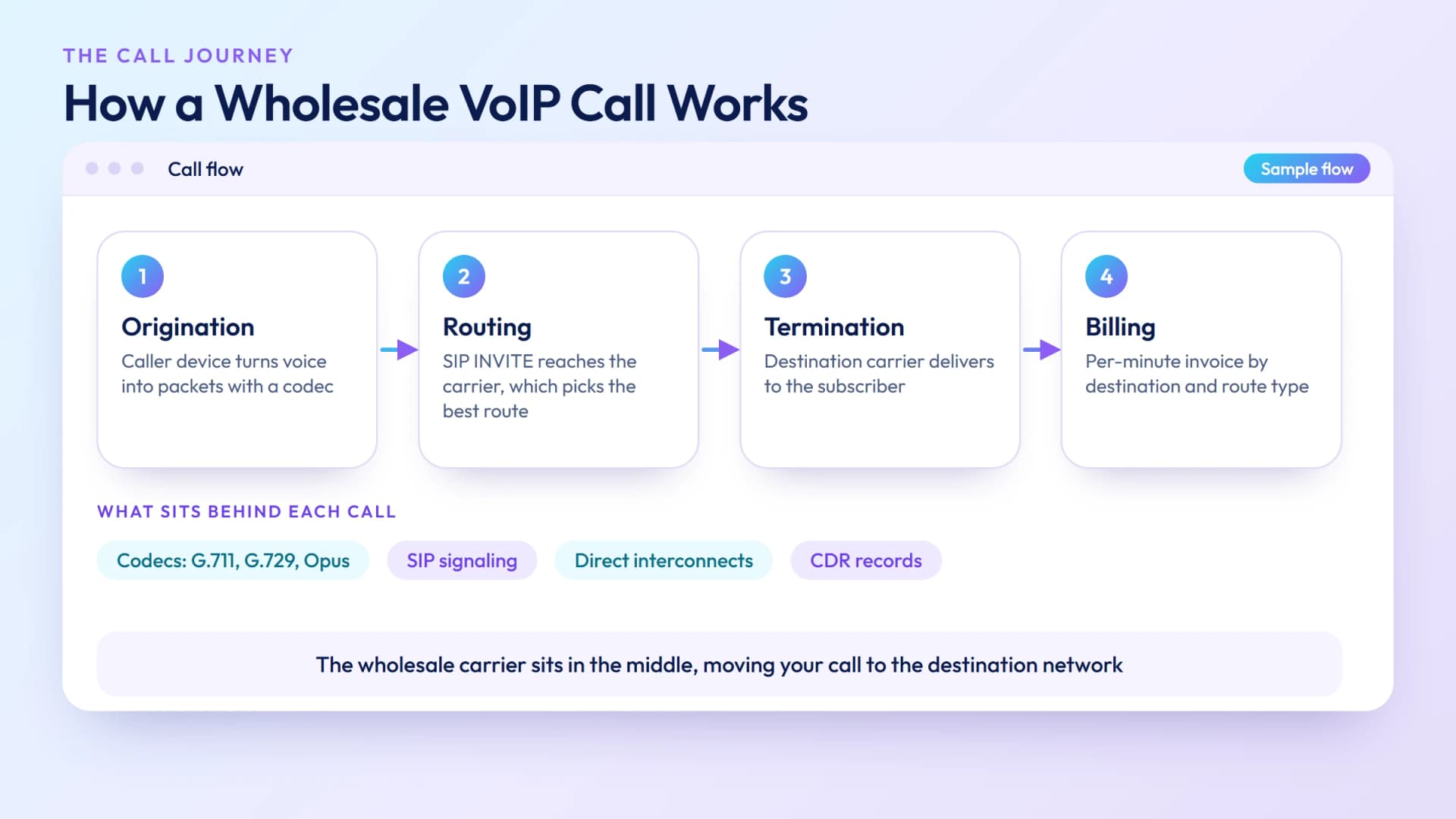
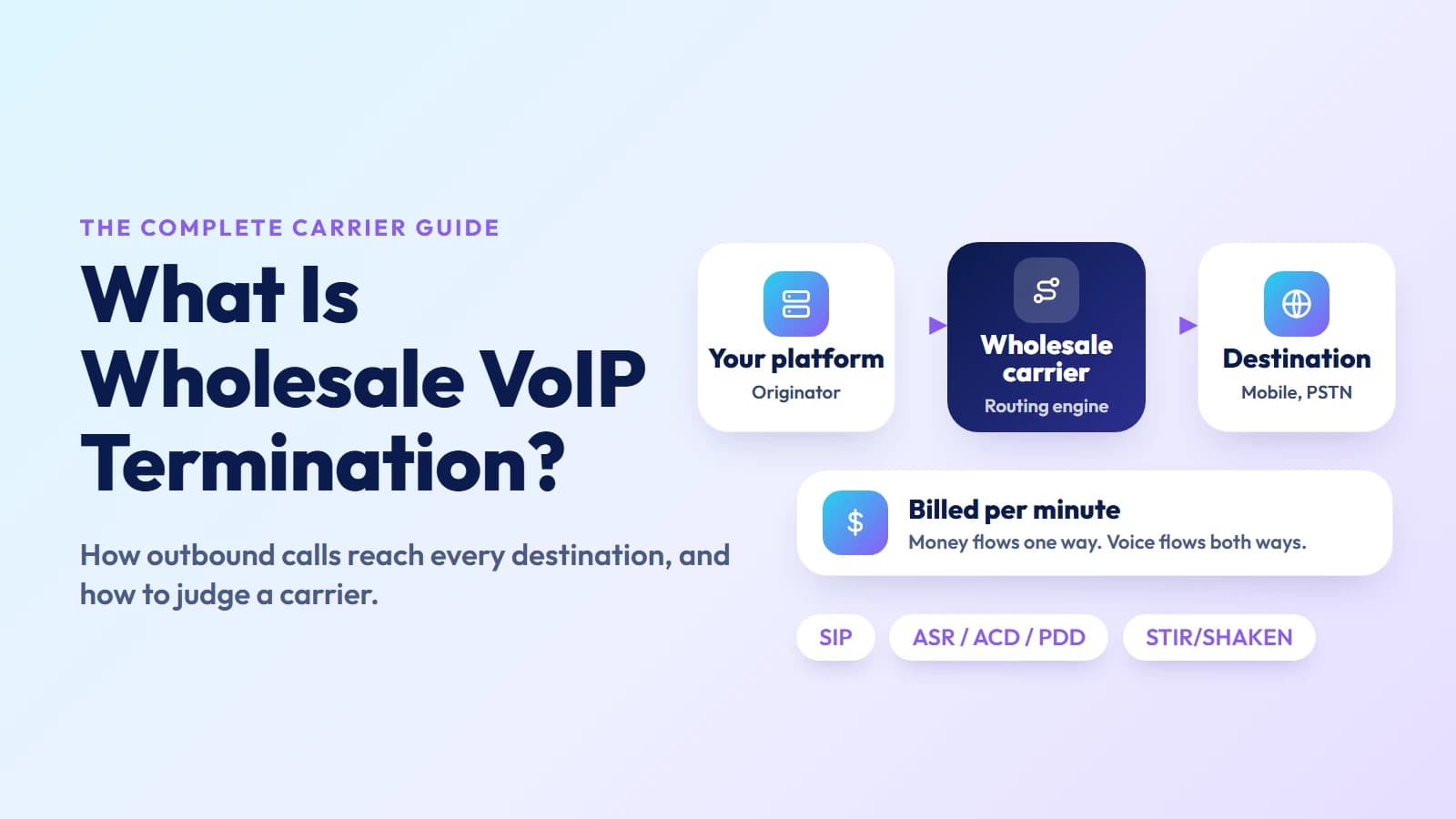
When a call is placed over a wholesale VoIP network, it moves through four stages:
- Origination — The caller's device (a SIP phone, softphone, or PBX) converts the voice signal into digital packets using a codec (G.711, G.729, or Opus are the most common).
- Routing — The SIP INVITE message travels from the originating system to the wholesale carrier's network, which determines the best route to the destination based on quality and cost.
- Termination — The call reaches the destination country's terminating carrier, which delivers it to the end subscriber's number.
- Billing — The call starts billing when the called party answers (or in some cases, when the ringback starts — depending on the billing model). The wholesale carrier invoices the buyer per minute.
The wholesale carrier is the entity in the middle — taking the call from your network and getting it to the destination network. They maintain direct interconnects with local carriers around the world, which is how your SIP traffic reaches a Verizon subscriber in the US or a Vivo subscriber in Brazil.
Ready when you are
Protect your business line.
MCM's local numbers ship with verified caller ID and smart call filtering — customers always know it's really you, and spam never reaches your team.
The Three Layers of a Wholesale VoIP Network
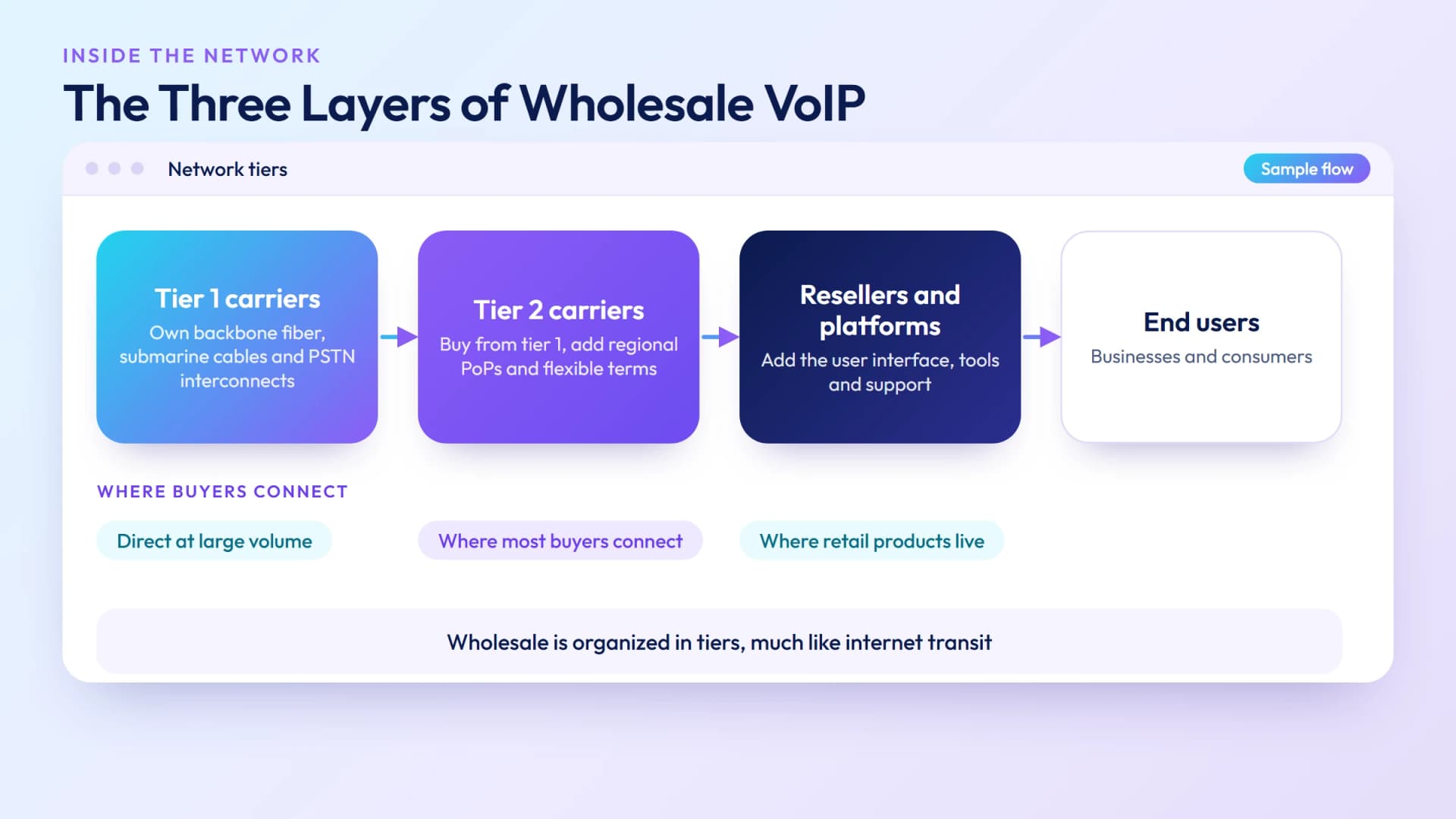
Wholesale VoIP infrastructure is organized into tiers, similar to how internet transit works:
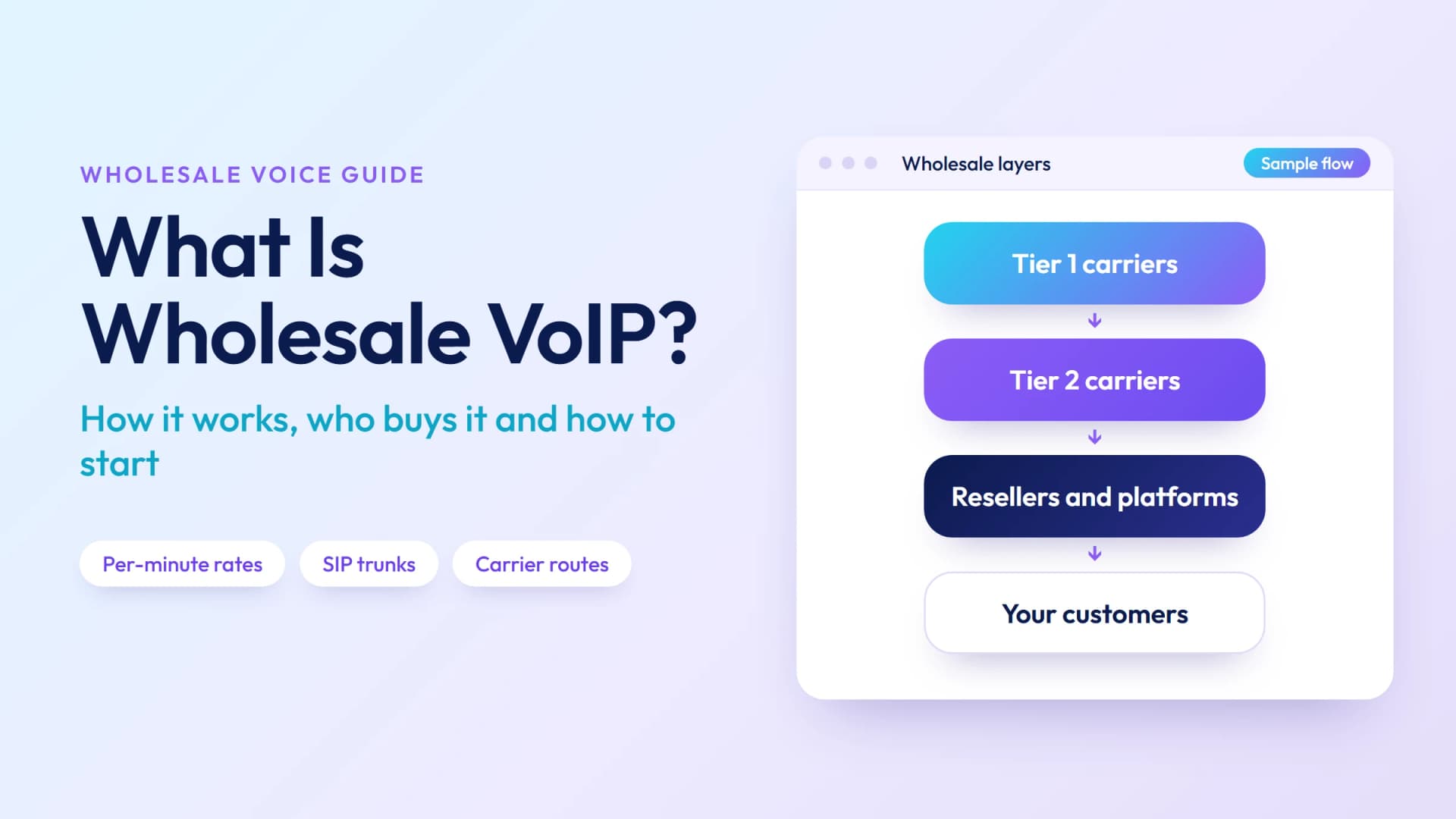
Tier 1 Carriers own the backbone infrastructure: fiber networks, international submarine cables, and direct PSTN interconnects in major markets. They sell wholesale capacity to tier-2 providers and large enterprises. Examples: AT&T, BT, Deutsche Telekom, Tata Communications.
Tier 2 Carriers buy capacity from tier-1 providers and resell it, often with regional expertise, better pricing for specific destinations, and more flexible commercial terms. Most wholesale VoIP providers you'll work with are tier-2 carriers with their own Points of Presence (PoPs) in key regions.
Resellers & VoIP Platforms buy from tier-1 or tier-2 carriers and build retail products on top: cloud PBX platforms, UCaaS solutions, call center software, CPaaS APIs. They add the user interface, management tools, and support layer.
When you buy wholesale VoIP, you're typically connecting to a tier-2 carrier or directly to a tier-1 if your volumes justify it.
Who Uses Wholesale VoIP?
Six categories of buyers make up the wholesale VoIP market:
Telecom Carriers & MVNOs: Mobile virtual network operators and regional carriers that don't own their own global interconnects buy wholesale termination to complete calls to destinations outside their own network footprint.
VoIP Resellers: Companies that buy wholesale minutes and repackage them as retail calling plans for businesses or consumers. The margin is the difference between the wholesale per-minute rate and what their customers pay.
Call Center & Contact Center Operators: Outbound contact centers often place millions of calls per month to specific destination markets. Buying wholesale capacity for those destinations directly — rather than through a retail plan — reduces per-minute costs by 40–70%.
CPaaS Platforms: Communications Platform as a Service companies like Twilio, Vonage, and Bandwidth need underlying voice capacity to power the calling features they sell to developers. They buy wholesale in very high volumes and route it through their APIs.
Enterprises with High Call Volumes: Large organizations with contact centers, automated calling systems, or global operations sometimes negotiate wholesale rates directly when their monthly call volumes make it economically viable (typically 500k+ minutes/month).
SMS & OTP Platforms: Platforms that use voice-based one-time passwords (voice OTP) or telephone verification need reliable, high-ASR wholesale routes to mobile numbers worldwide. Call completion rate directly impacts conversion.
Business Models: How Companies Make Money with Wholesale VoIP
Understanding the business model is essential before entering the wholesale market. Three models dominate:
| Model | How It Works | Margin Driver | Best For |
|---|---|---|---|
| Reseller / White Label | Buy wholesale at carrier rates, resell at retail markup to end businesses | Markup per minute or per seat | VoIP service providers, UCaaS companies |
| Aggregation | Buy from multiple tier-1/2 carriers, offer a single interconnect point with route optimization | Volume leverage + route arbitrage | Tier-2 carriers, wholesale brokers |
| Own-use High-volume | Negotiate direct rates to reduce cost of internally placed calls | Cost savings vs. retail rates | Large contact centers, CPaaS platforms |
The reseller model is the most common entry point. A business registers as a wholesale customer, receives wholesale per-minute rates, and sells calling services (via a white-label PBX, a calling app, or an API) at a markup. The key cost to manage is the "cost per minute" vs. the "revenue per minute" — every route upgrade or volume discount improvement flows directly to margin.
Wholesale VoIP Pricing: How Billing Works
Wholesale VoIP is priced per minute, with rates varying across several dimensions:
| Pricing Factor | Effect on Rate |
|---|---|
| Destination country | Largest factor — US fixed is ~$0.001/min; some Pacific island mobile can be $0.50+/min |
| Number type (fixed vs. mobile) | Mobile typically 2–5x higher than fixed in same country |
| Route type (direct vs. partner) | Direct CLI routes cost 10–30% more than partner-routed |
| Monthly volume tier | Rates drop 10–35% from list price at 100k–500k+ min/month |
| Billing increment | 6/6 (6-second intervals) vs. 60/60 — affects cost on short calls |
| Commitment | Pre-paid vs. post-paid; committed volume minimums reduce rates further |
Most providers bill on a 6/6 or 1/6 increment — meaning the minimum billable unit is 6 seconds, then billed in 6-second blocks after that. A 30-second call on 6/6 billing costs the same as a 6-second call (one 6-second block). This matters for automated calls and short-duration traffic where a large portion of calls don't complete a full minute.
For current destination rates, see our international wholesale rates page.
What to Look For in a Wholesale VoIP Provider
Five criteria that separate a reliable wholesale partner from a rate-first vendor:
- Route quality and direct interconnects: Ask which tier-1 carriers they have direct relationships with for your key destination markets. Direct interconnects mean fewer hops, better ASR, and lower PDD.
- Transparent quality reporting: You should get real-time ASR, ACD, and PDD visibility — not just end-of-month summary reports. Quality degradation needs to be caught within hours, not billing cycles.
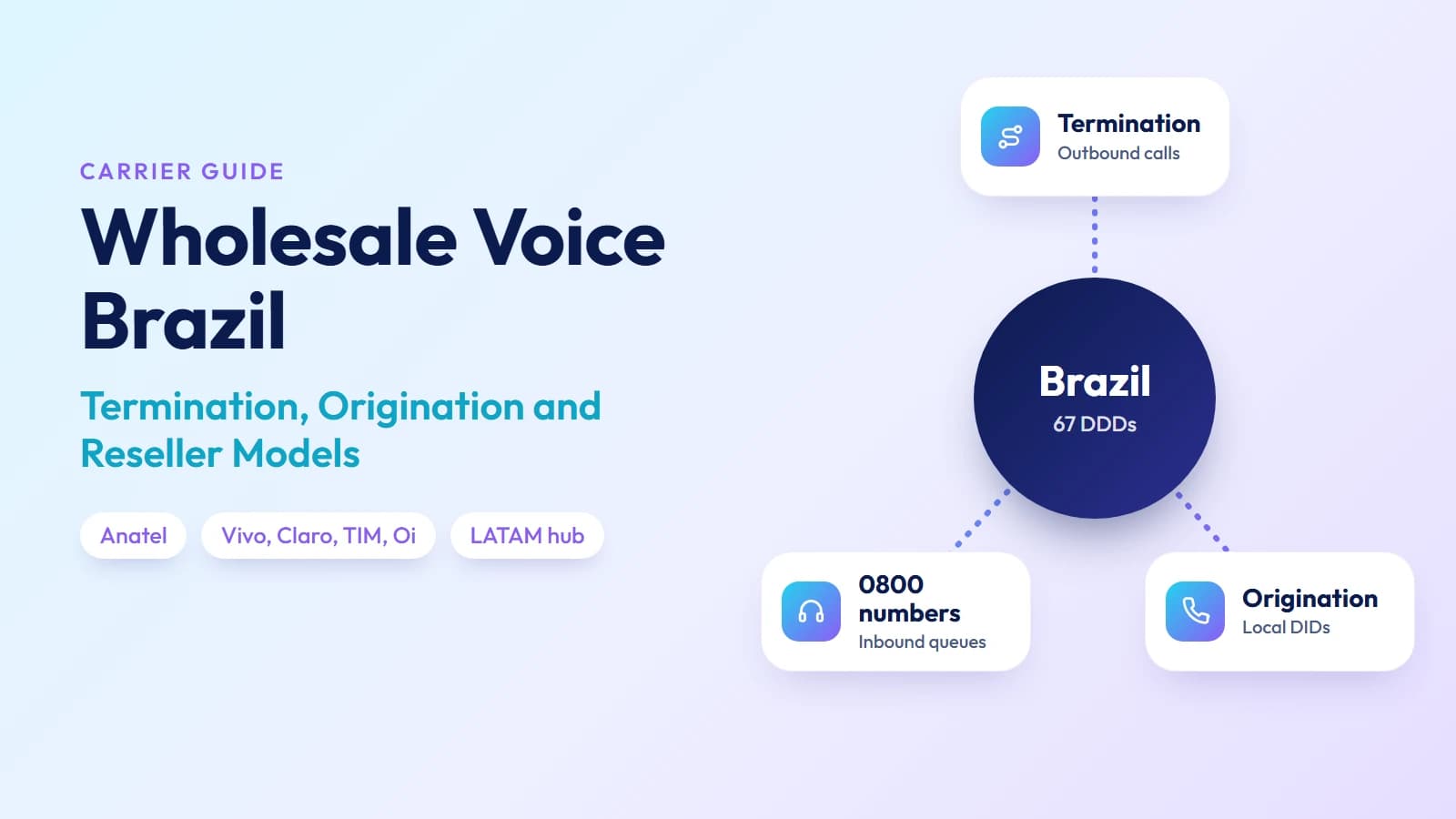
- CLI compliance: Especially important for destinations with regulatory CLI requirements (Brazil, the UK, the EU; see our Brazil wholesale VoIP guide). Confirm that routes pass caller ID through and comply with local regulations.
- SLA with financial backing: What's their uptime guarantee, and what compensation applies when it's missed? A well-capitalized provider can back an SLA; a rate-only aggregator usually cannot.
- CDR access and dispute process: You should be able to pull your own call detail records independently. Billing disputes happen; having your own CDR data is the only way to resolve them fairly.
How to Get Started with Wholesale VoIP
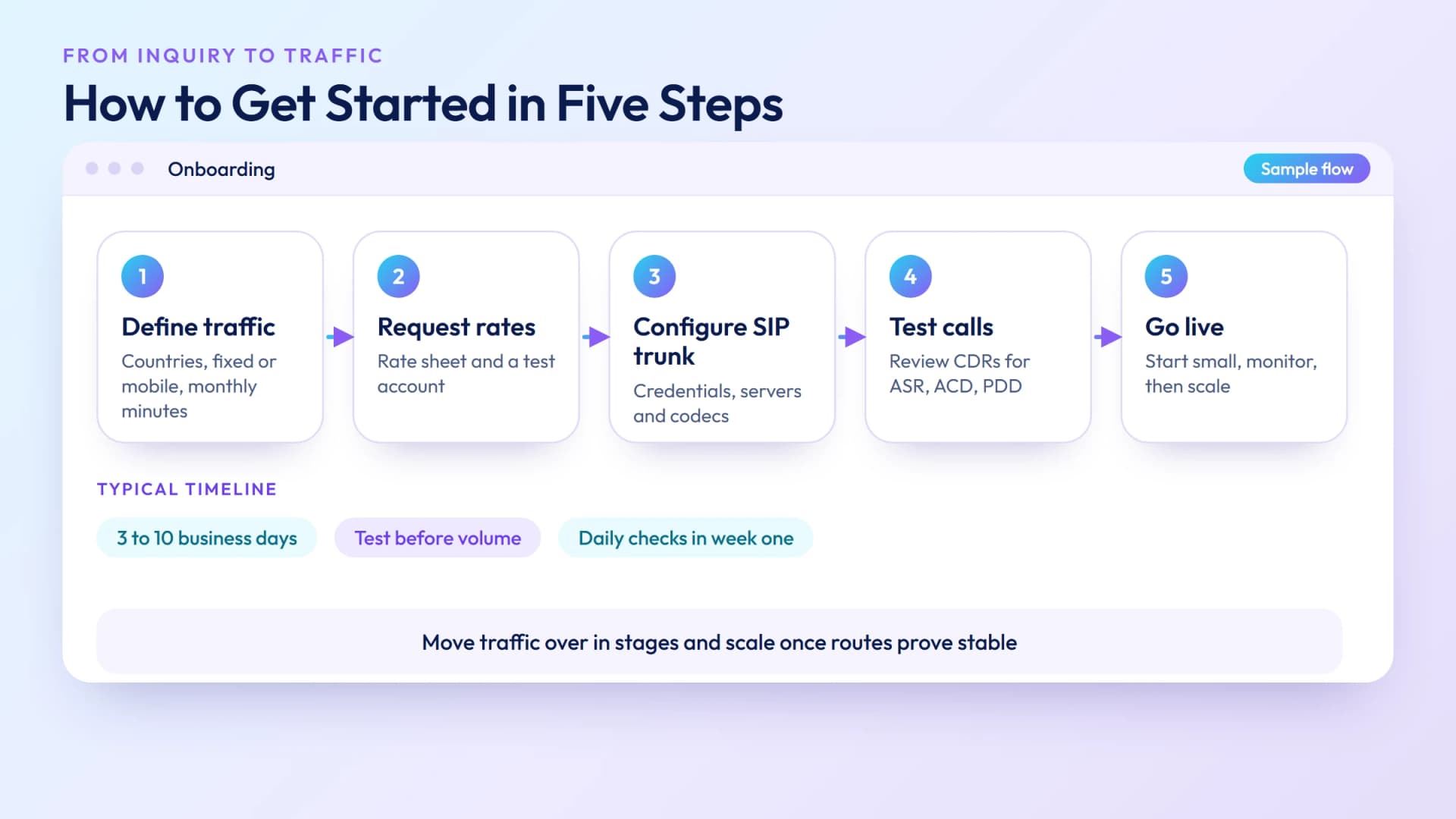
The typical path from inquiry to live traffic takes 3–10 business days:
- Define your traffic profile — Which destination countries, fixed or mobile, estimated monthly minutes, peak concurrent calls. This determines which routes and pricing tiers apply.
- Request rates and a test account — A reputable provider will give you rate sheets and a trial environment where you can test routes with real calls before committing volume.
- Configure your SIP trunk — You'll need a SIP-capable PBX or softswitch (Asterisk, FreeSWITCH, Cisco, or a cloud equivalent). The provider gives you SIP server details, authentication credentials, and codec preferences.
- Run test calls and review CDRs — Before routing live traffic, test calls to your key destination types (fixed and mobile) and review the resulting CDRs for ASR, ACD, and PDD.
- Go live and monitor — Start with a portion of your traffic, monitor quality metrics daily for the first week, then scale once you're satisfied with route stability.
Why Businesses Choose My Country Mobile
Carrier-grade wholesale voice for resellers, carriers & enterprises
Direct interconnects with tier-1 carriers across 150+ destinations. CLI-compliant routes, real-time quality monitoring, and commercial terms that scale with your business. Get wholesale rates →
My Country Mobile provides wholesale voice termination to resellers, contact center operators, and CPaaS platforms across 150+ destination countries. Our network includes direct interconnects with major tier-1 carriers, SLA-backed quality guarantees, and a technical support team available around the clock.
We offer both CLI and non-CLI routes across fixed and mobile destinations, with volume pricing starting at 50,000 minutes per month. Transparent CDR access is included as standard — not an add-on.
Compare wholesale VoIP providers →
Ready when you are
Ready to sound local everywhere you sell?
MCM activates business numbers in minutes, with call routing, analytics, and CRM-ready integrations. Start your trial — no card to browse inventory.
Frequently asked questions
What is wholesale VoIP?
Wholesale VoIP is voice-over-IP telephony sold in bulk at carrier rates to resellers, telecom carriers, call centers, and enterprises — rather than to end users. Wholesale buyers purchase call capacity by the minute and either resell it or use it to power their own communication services.
What is the difference between wholesale VoIP and retail VoIP?
Retail VoIP is sold to end users as a phone number, a monthly plan, and a calling app. Wholesale VoIP is sold to businesses that need raw call capacity: per-minute rates, SIP trunk access, and carrier-grade infrastructure with no user-facing interface. Retail VoIP providers typically buy wholesale capacity and mark it up.
How does wholesale VoIP work?
A wholesale VoIP call travels from the originating caller's SIP endpoint to a wholesale carrier's network, which routes it via the most efficient path to the destination country's terminating carrier, which delivers the call to the end subscriber. The wholesale provider bills the buyer per minute based on destination and route type.
Who are the main buyers of wholesale VoIP?
The main buyers are: telecom carriers and MVNOs, VoIP resellers building retail services, call center operators, CPaaS platforms like Twilio or Vonage, large enterprises with very high call volumes, and SMS/OTP verification platforms.
How is wholesale VoIP priced?
Wholesale VoIP is priced per minute, varying by destination country, number type (fixed vs. mobile), route quality, and monthly volume. Most providers offer meaningful discounts starting at 100,000+ minutes per month, with further reductions at 500k+ minutes per month.
What is a SIP trunk in wholesale VoIP?
A SIP trunk is the virtual connection between your phone system (PBX or softswitch) and the wholesale VoIP carrier's network. It uses the SIP protocol to set up, manage, and terminate calls. Unlike traditional phone lines, SIP trunks are software-defined and can carry many simultaneous calls over a single internet connection.