SMS is older than most of the apps built on top of it
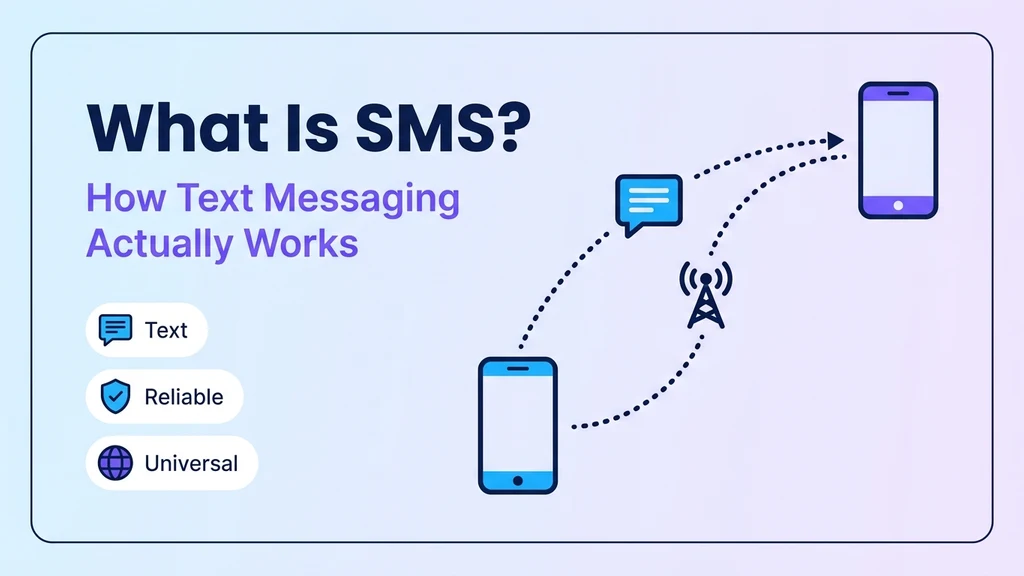
SMS — Short Message Service — is the original text messaging protocol, running on cellular networks since the early 1990s, decades before iMessage, WhatsApp, or any chat app existed. Every one of those newer apps still falls back to SMS when messaging someone who doesn't have the app installed, which is exactly why understanding what SMS actually is still matters.
This guide covers how a text message actually travels from one phone to another, the character limit that shapes everything about the format, how SMS differs from MMS and RCS, and what businesses specifically need to know before sending it at volume.
How a text message actually travels
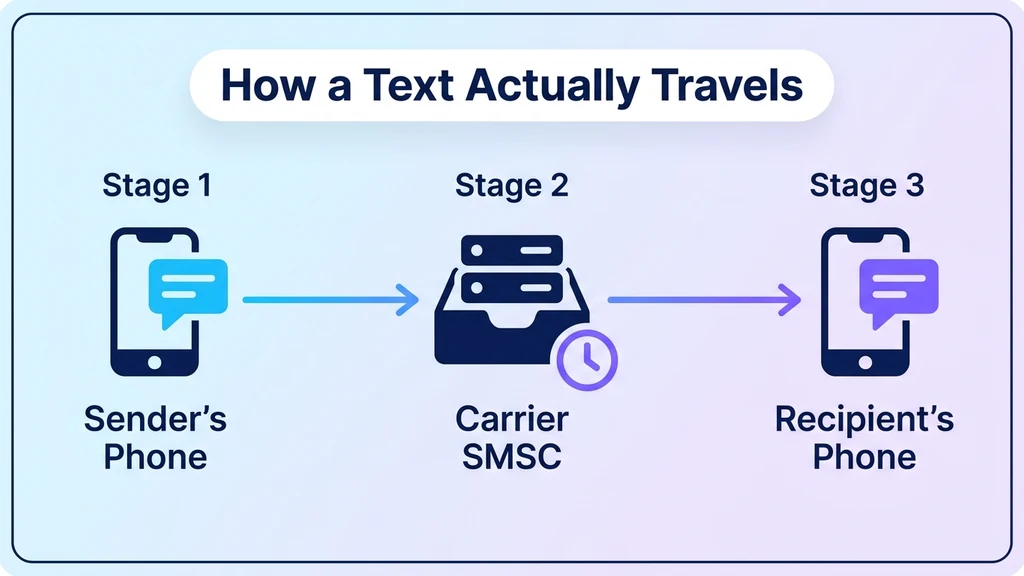
A text message doesn't go directly from one phone to another. It travels through the sending carrier's SMSC (Short Message Service Center) — a store-and-forward system that receives the message, holds it briefly, and routes it toward the recipient's carrier network, which delivers it to the destination phone. This store-and-forward design is why a text can still arrive minutes later if the recipient's phone was briefly out of coverage when it was sent.
Unlike a phone call, SMS doesn't require both phones to be connected to the network at the same moment — the SMSC holds the message and retries delivery, which is part of why SMS delivery is generally more reliable than a phone call reaching someone with a weak signal.
The 160-character limit and why it exists
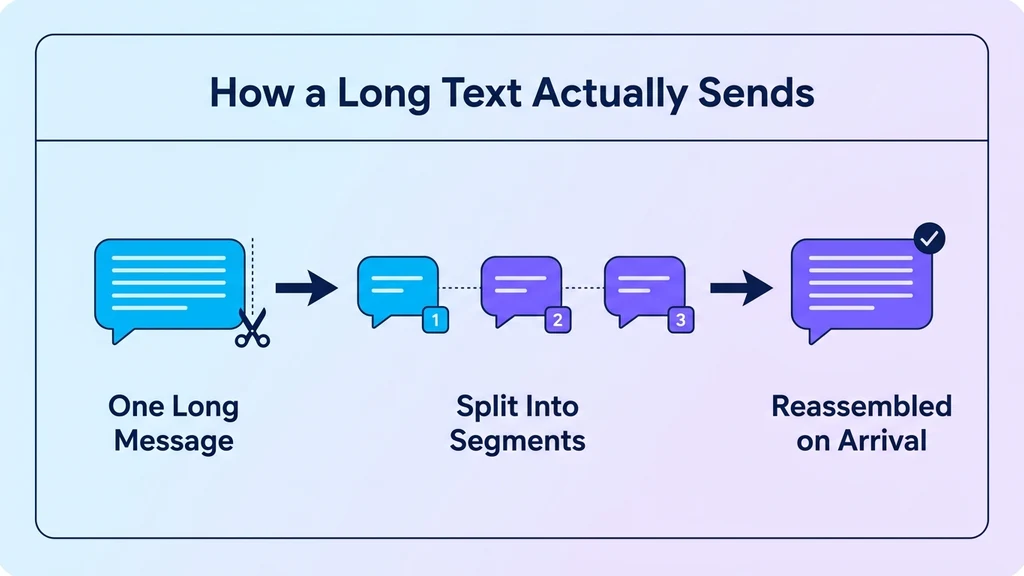
SMS messages are capped at 160 characters when using standard GSM encoding, a limit that comes from the original technical design of the signaling channel SMS was built to use — it was engineered to fit inside a small amount of unused capacity on the control channel already used to manage cellular calls. Messages using non-GSM characters (like most emoji or non-Latin scripts) drop to a lower limit, typically 70 characters, since those require a different encoding standard that uses more data per character.
Longer messages get sent as concatenated SMS — split into multiple 153-character segments (the limit drops slightly to make room for a small header on each part) that the receiving phone reassembles into one message, which is why a long text sometimes arrives, and is billed, as multiple messages even though it displays as one.
당신이있을 때 준비
귀하의 비즈니스 라인을 보호하십시오.
MCM의 지역 번호에는 확인된 발신자 ID 및 스마트 통화 필터링 기능이 포함되어 있습니다. 고객은 항상 본인임을 알 수 있으며 스팸이 귀하의 팀에 도달하지 않습니다.
SMS vs. MMS vs. RCS
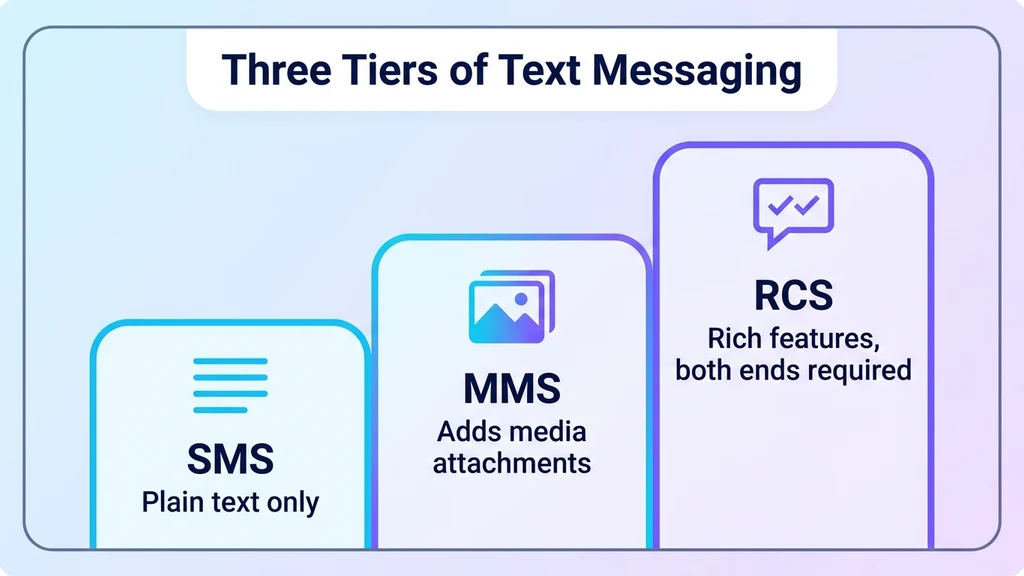
SMS carries plain text only, within the character limits above, over the same signaling channel used for basic cellular control — no photos, no read receipts, no typing indicators.
MMS (Multimedia Messaging Service) extends the same underlying system to carry photos, videos, and audio, and it's also what carriers use to deliver a text that's grown too long for even concatenated SMS to handle cleanly.
RCS (Rich Communication Services) is the newer standard meant to eventually replace SMS entirely, adding read receipts, typing indicators, higher-quality media, and group chat features closer to what a modern chat app offers — but it requires both the sender and recipient's carriers and devices to support it, which is why SMS still exists as the universal fallback.
What businesses actually need to know about SMS
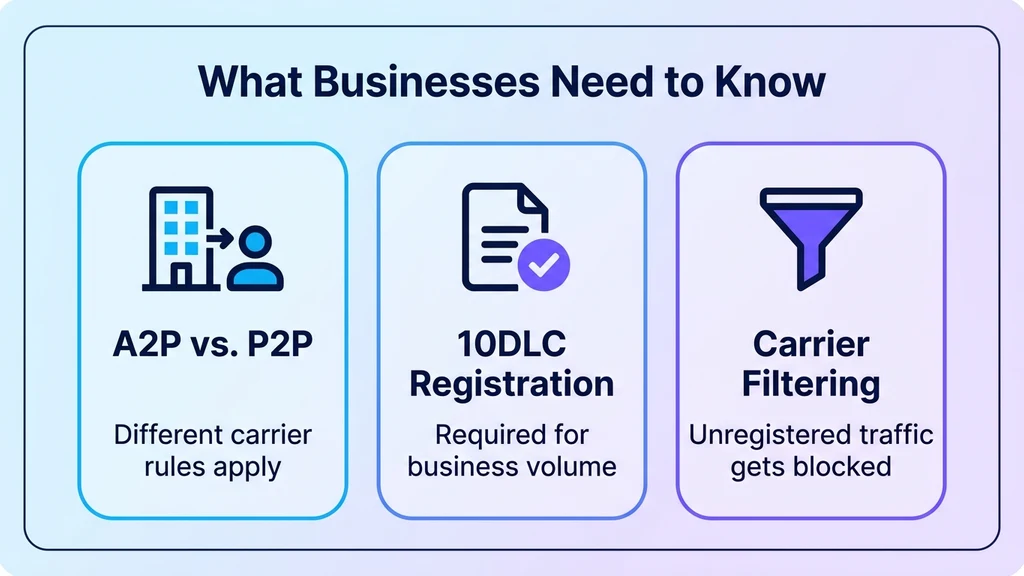
A2P vs. P2P messaging. Application-to-Person (A2P) messaging — automated texts from a business system rather than a person typing on a phone — is treated differently by carriers than Person-to-Person (P2P) messaging, with different rate limits, registration requirements, and filtering rules.
10DLC registration in the US. 실제 볼륨에 관계없이 표준 10자리 지역 번호로 SMS를 보내는 기업은 해당 번호를 등록해야 합니다. 10DLC(10자리 롱코드) messaging with carriers, which is what separates legitimate business texting from the kind of unregistered bulk sending that gets silently filtered as spam. CTIA의 메시징 원칙 및 모범 사례 document the industry standards this registration system is built around.
캐리어 필터링. Carriers run every text through spam-detection systems that weigh sending volume, message content, and link patterns — a message that trips those filters can fail delivery with no error shown to the sender, which is why registration and sending patterns matter even when the message content itself is completely legitimate.
Businesses sending SMS at any real scale typically do it through a UCaaS(서비스형 통합 커뮤니케이션) platform — a single cloud system for calling, messaging, and video — that handles carrier registration and delivery monitoring as part of the underlying service rather than leaving it to guesswork, the same registration issue covered in more depth in our 문자 메시지 전달 실패 안내. 문의하기 to set up business SMS with registration and delivery tracking built in from the start.
결론
SMS is a decades-old protocol that still underpins nearly every text-based communication channel today, precisely because of its universal fallback status — every phone with cellular service can receive it, regardless of app installed. Understanding the character limit, the SMS/MMS/RCS distinction, and the A2P registration requirements that apply to business texting is what separates messages that reliably arrive from ones that silently disappear into a carrier's spam filter.
주요 시사점
- SMS routes through a carrier's SMSC, 직접 전화 대 전화 연결이 아닌 저장 및 전달 시스템입니다.
- 그만큼 160-character limit comes from SMS's original design fitting inside a cellular control channel; longer texts split into 연결된 세그먼트.
- MMS adds media attachments; RCS 채팅 앱 스타일 기능을 추가하지만 이를 지원하려면 양쪽 끝이 필요합니다.
- A2P messaging (자동 비즈니스 텍스트)는 운송업체에서 다른 문서와 다르게 취급됩니다. P2P (개인 대 개인), 별도의 등록 규칙이 있습니다.
- 10DLC 등록 is required for US businesses texting at volume from a standard local number, and skipping it is a common cause of silent delivery failure.
당신이있을 때 준비
판매하는 모든 곳에서 현지 사운드를 들을 준비가 되셨나요?
MCM은 통화 라우팅, 분석 및 CRM 지원 통합을 통해 몇 분 안에 비즈니스 번호를 활성화합니다. 무료 평가판을 시작하세요. 카드 없이 인벤토리를 탐색할 수 있습니다.
FAQ
What does SMS actually stand for?
Short Message Service. 이는 최신 채팅 앱보다 수십 년 앞서 셀룰러 네트워크에서 사용되는 원래의 문자 메시지 프로토콜입니다.
Why is SMS limited to 160 characters?
The limit comes from SMS's original design, which fit messages into unused capacity on the same signaling channel used for basic cellular network control — a technical constraint from how the protocol was built, not an arbitrary choice.
What happens when I send a text longer than 160 characters?
It gets split into multiple concatenated segments (each slightly under 160 characters to leave room for a reassembly header), sent as multiple messages, and reassembled into one message on the recipient's phone.
What's the difference between SMS, MMS, and RCS?
SMS is plain text only. MMS adds photos, videos, and audio. RCS is the newest standard, adding read receipts and richer features similar to a modern chat app, but only when both sender and recipient support it.
What is 10DLC and why does it matter for business texting?
10DLC (10-Digit Long Code) is the registration system US carriers require for businesses sending SMS from a standard local number at volume. Skipping it is a common cause of business texts silently failing to deliver.
Why do some of my business texts fail to deliver with no error shown?
Carriers run texts through spam-detection filters based on volume, content, and sending patterns. An unregistered or high-volume sending number can get silently filtered even when the message itself is completely legitimate.