Introduction
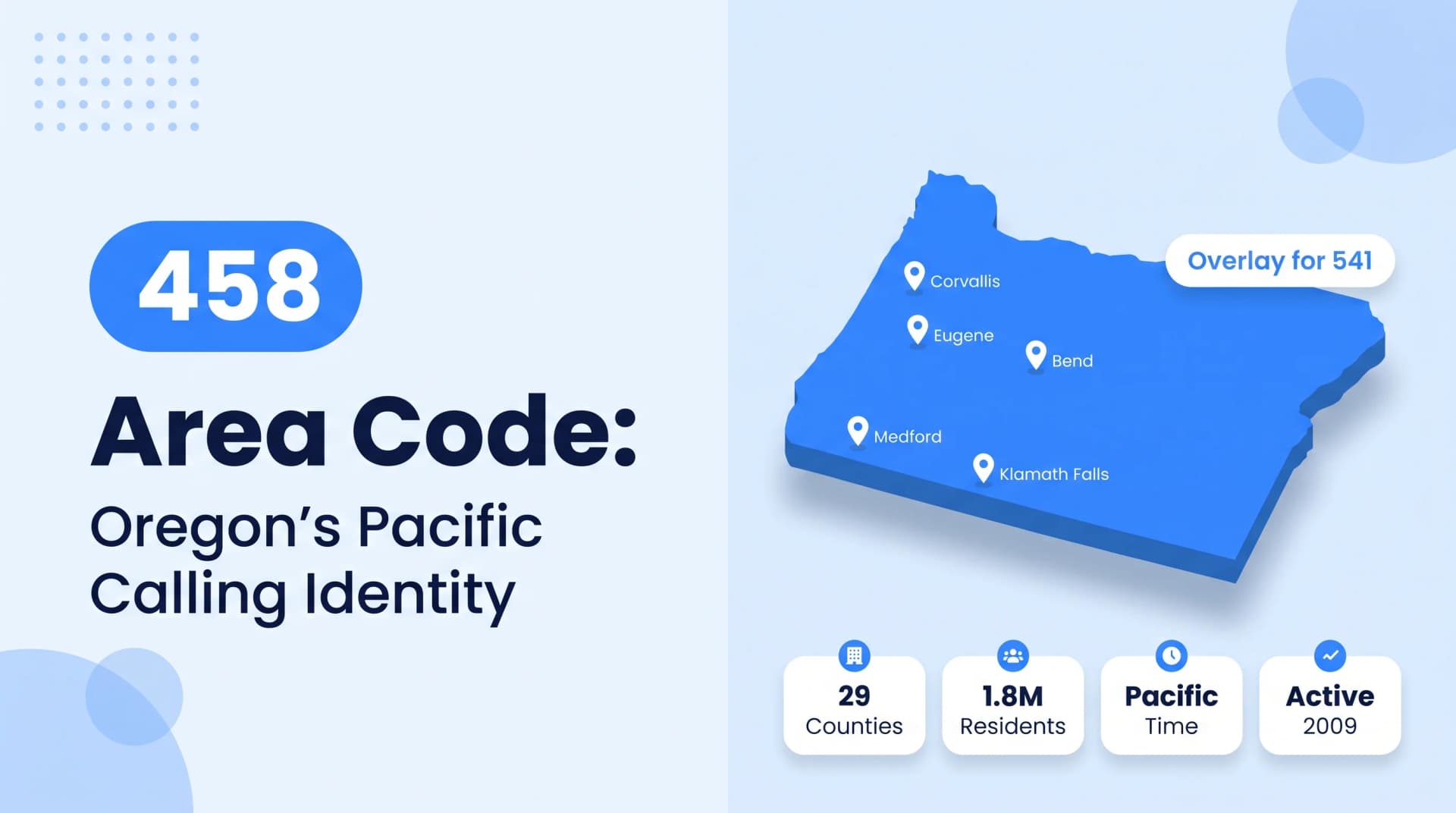
The 458 area code covers most of Oregon outside the Portland metropolitan area — a vast, scenically diverse region stretching from the Pacific coast through the Cascade corridor and into the high desert of eastern Oregon. Introduced as an all-services overlay for area code 541, it shares the same geography and local dialing identity.
From the university city of Eugene to the outdoor recreation hub of Bend, and from the Rogue Valley wine country around Medford to the research corridors of Corvallis, the 458 region contains some of Oregon's most economically distinct communities. This guide covers where 458 reaches, its dialing rules, history, business applications, and scam awareness.
Quick answer: The 458 area code covers most of Oregon outside the Portland metro, activated as an all-services overlay for area code 541. It spans cities including Eugene, Bend, Medford, Corvallis, Roseburg, Klamath Falls, and Coos Bay across approximately 29 counties. The primary time zone is Pacific Time, with far eastern Oregon (Malheur County) observing Mountain Time. Existing 541 numbers stay unchanged; all new lines receive 458.
The 458 area code at a glance
Area code 458 is Oregon's newest telephone prefix outside the Portland metro, placed into active service in September 2009 by the North American Numbering Plan Administration. It functions as a full all-services overlay for area code 541 — the same model used when the 457 area code was introduced for northern Louisiana, with both codes sharing identical territory and no geographic boundary separating them.
Every existing 541 number across the region stayed exactly as it was when 458 launched. All new lines activated from September 2009 onward receive 458 numbers. With a substantial portion of 458's available prefixes still unassigned, the region carries ample capacity for years to come.
Oregon cities and counties covered

The 458 area code spans approximately 29 counties across Oregon — every county outside the Willamette Valley metro area served by 503 and 971.
| County | Notable cities |
|---|---|
| Lane County | Eugene, Springfield, Cottage Grove |
| Deschutes County | Bend, Redmond, Sisters |
| Jackson County | Medford, Ashland, Jacksonville |
| Benton County | Corvallis, Philomath |
| Douglas County | Roseburg, Sutherlin, Myrtle Creek |
| Klamath County | Klamath Falls |
| Coos County | Coos Bay, North Bend, Bandon |
| Lincoln County | Newport, Lincoln City |
| Malheur County | Ontario, Nyssa, Vale |
Additional counties include Curry, Josephine, Linn, Jefferson, Crook, Lake, Harney, Umatilla, Union, Wallowa, Baker, Grant, Wasco, and Clatsop. The region's population stands at approximately 1.8 million residents, with Lane County (Eugene/Springfield) and Deschutes County (Bend) as the largest centres.
The economy is driven by higher education at the University of Oregon in Eugene and Oregon State University in Corvallis, outdoor recreation and tourism anchored in Bend's Cascade resort corridor and the Oregon Coast, a healthcare and wine industry hub in the Medford-Rogue Valley corridor, and a rapidly expanding technology sector that has made Bend one of the Pacific Northwest's fastest-growing startup markets.
Ready when you are
Protect your business line.
MCM's local numbers ship with verified caller ID and smart call filtering — customers always know it's really you, and spam never reaches your team.
From 541 to 458 — Oregon's telephone history
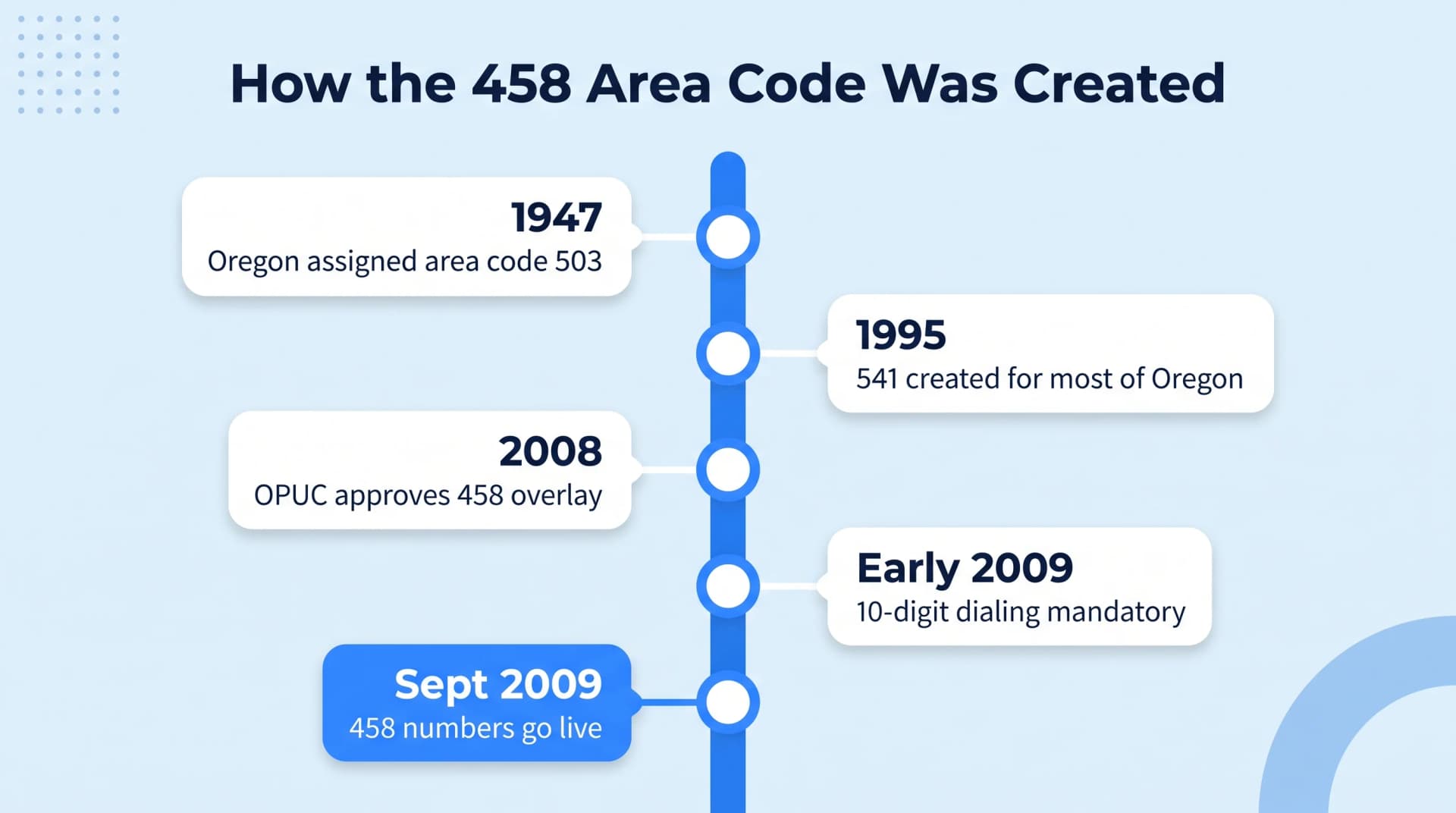
When AT&T established the North American Numbering Plan in 1947, Oregon received area code 503 to serve the entire state. For five decades, 503 held as a single code. By the mid-1990s, Oregon's rapid population growth — driven by technology migration, cellular phone adoption, and internet dial-up lines — pushed 503 toward exhaustion.
In 1995, the state was split: area code 503 was retained for the Portland metro and Willamette Valley, while 541 was assigned to cover all remaining Oregon counties, from the coast to the high desert. For over a decade, 541 served this vast region alone.
By the mid-2000s, wireless subscriber growth, VoIP adoption, and machine-to-machine connected devices had depleted 541's available prefixes faster than originally projected. The Oregon Public Utility Commission (OPUC) approved the 458 overlay to prevent exhaustion — choosing an all-services solution over a disruptive geographic split that would have forced existing 541 customers to change their numbers.
Key milestones:
- 1947 — Oregon assigned area code 503
- 1995 — 503 split; area code 541 created for most of Oregon
- 2008 — OPUC approves 458 as an all-services overlay for 541
- Early 2009 — Mandatory 10-digit dialing takes effect across the 541 region
- September 2009 — 458 numbers begin active assignment in Oregon
Dialing rules and time zones
Because 458 overlays 541 across the same territory, ten-digit dialing is mandatory for every call in the region — including calls between two neighbours in the same Eugene street or Bend neighbourhood.
| Calling from | Format to use |
|---|---|
| Within the 458 / 541 area | 458-XXX-XXXX (10 digits mandatory) |
| Elsewhere in the US / Canada | 1-458-XXX-XXXX |
| International | +1 458 XXX XXXX |
Time zones: The 458 area code spans two time zones — a feature shared by very few US area codes. The vast majority of the coverage area observes Pacific Time (Pacific Standard Time UTC−8 in winter, Pacific Daylight Time UTC−7 in summer).
However, Malheur County in far eastern Oregon — home to Ontario, Nyssa, and Vale — observes Mountain Time (UTC−7 standard, UTC−6 daylight), the same zone as Boise, Idaho, directly across the border.
| Location | Time zone | UTC offset (standard) |
|---|---|---|
| Eugene, Bend, Medford, Corvallis, Roseburg, Coast counties | Pacific Time (PT) | UTC−8 |
| Malheur County (Ontario, Nyssa, Vale) | Mountain Time (MT) | UTC−7 |
Practical note: When it is noon in Eugene or Bend, it is 1:00 PM in Ontario (Malheur County) — even though both communities share the 458 area code. Anyone scheduling calls across the region should confirm the recipient's time zone.
458 vs 541 — same Oregon, two eras
| Detail | 541 | 458 |
|---|---|---|
| Active since | 1995 | September 2009 |
| Geographic area | Most of Oregon — 29 counties | Identical — same territory |
| Who holds it | Subscribers before September 2009 | All new lines from 2009 |
| Time zones | Pacific + Mountain | Pacific + Mountain |
| Dialing | 10-digit mandatory | 10-digit mandatory |
| Capacity | Nearly exhausted | Substantial capacity remaining |
A call from a Eugene 541 number to a Bend 458 number is a local call billed at local rates. Neither code carries more geographic reach or prestige — the only practical difference is the year each number was assigned.
Why a 458 number works for Oregon businesses
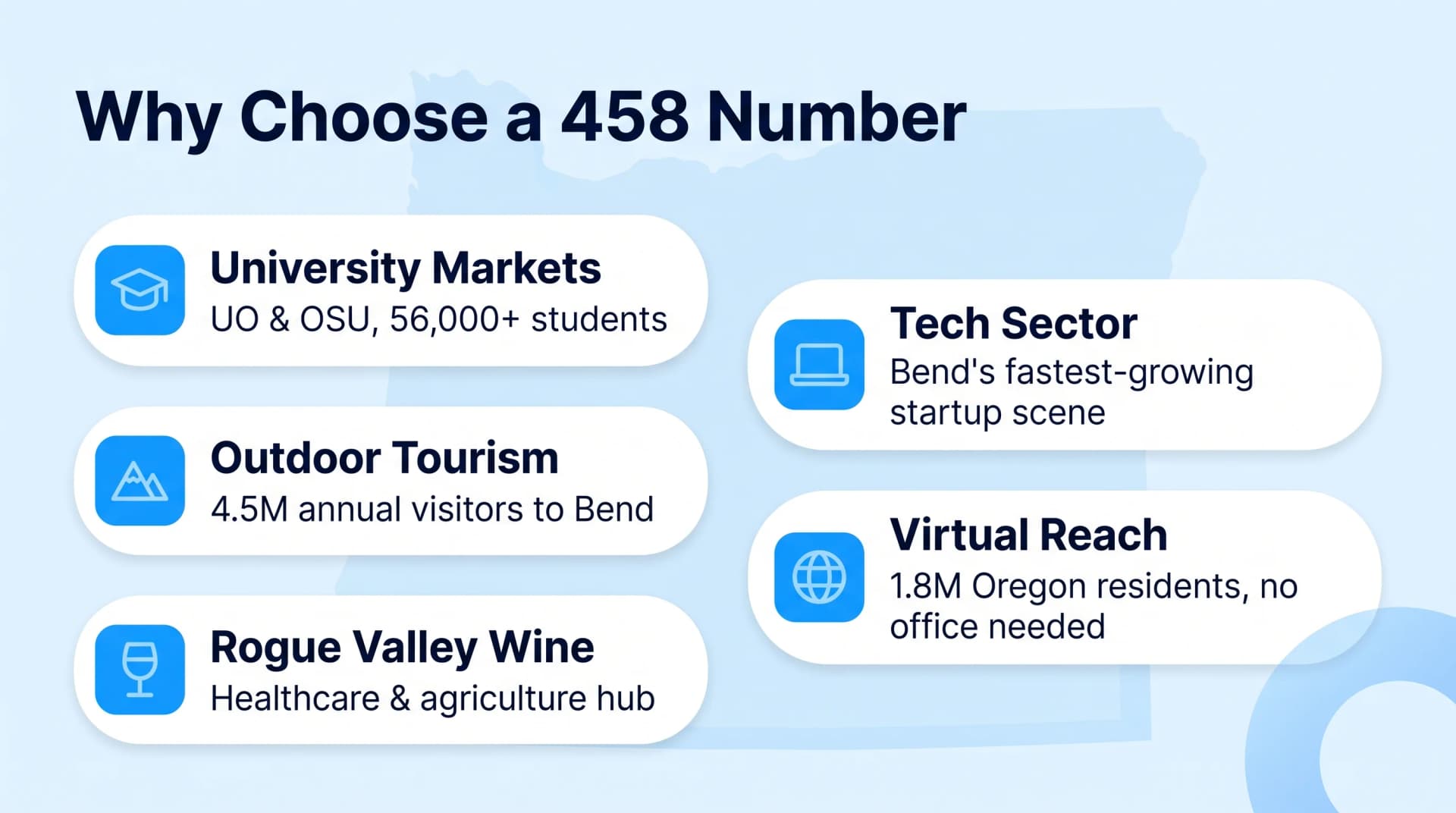
Oregon's 458 territory is a collection of economically distinct markets, each anchored by a different industry. A local 458 number positions your business directly inside every one of them:
- University access — the University of Oregon (24,000 students) and Oregon State University (32,000 students) collectively generate billions for the state economy; a 458 number signals direct participation in the region's academic and research ecosystem
- Outdoor and tourism economy — Bend alone draws more than 4.5 million annual visitors to its ski resorts, hiking trails, and craft breweries; a local number converts travellers into long-term customers
- Rogue Valley wine and healthcare — Medford and Ashland anchor a fast-growing wine region and a major healthcare corridor serving southern Oregon and northern California, with strong demand for local B2B vendors
- Technology sector — Bend has emerged as one of the Pacific Northwest's fastest-growing tech hubs, with software companies and outdoor-tech firms relocating from Portland and the Bay Area
- Virtual reach — just as businesses target Northeast Ohio through a 436 area code number without a physical Lorain office, a 458 line routes calls to any device, connecting you to 1.8 million Oregon residents from anywhere
Recognising and avoiding 458 scam calls

The 458 area code is an attractive spoofing target because its territory spans university cities, high-tourism coastal and mountain areas, and remote rural communities where residents are less likely to recognise unfamiliar call patterns.
Common scam types reported on 458 numbers:
- University and scholarship fraud — callers posing as UO or OSU financial aid offices, requesting student ID numbers, Social Security details, or processing fees for fake grants and housing assistance
- Outdoor rental and vacation scams — fraudulent cabin, RV, and vacation rental listings targeting visitors planning Oregon Coast or Cascade mountain getaways, with scammers demanding upfront deposits for properties that do not exist
- IRS and government impersonation — fake federal agents threatening arrest for unpaid taxes, particularly targeting self-employed residents and small business owners in the Bend tech corridor
- Medicare and health insurance fraud — callers targeting Medford's large retiree population with fake policy lapses or "free" medical equipment offers requiring personal information to process
- Neighbour spoofing — scammers display a 458 number matching your own exchange prefix to appear local to Eugene, Bend, or your own neighbourhood, boosting answer rates before requesting payment or credentials
If an unexpected 458 caller requests payment, personal information, or Social Security details, hang up immediately and verify the organisation through an official contact number. Report suspected scams to the FTC at reportfraud.ftc.gov.
Key takeaways
- The 458 area code covers most of Oregon outside the Portland metro — approximately 29 counties including Lane (Eugene), Deschutes (Bend), Jackson (Medford), and Benton (Corvallis)
- It was activated in September 2009 as an all-services overlay for area code 541, following OPUC approval in 2008
- 458 spans two time zones — Pacific Time for most of the region, Mountain Time for Malheur County in far eastern Oregon
- 10-digit dialing is mandatory throughout the entire 541/458 area
- The regional economy is anchored by higher education, outdoor tourism, the Rogue Valley wine and healthcare industry, and a growing tech sector in Bend
- Existing 541 numbers stay active permanently — 458 is assigned only to new lines going forward
- Top scam types include university fraud, vacation rental scams, IRS impersonation, and Medicare fraud
Conclusion
The 458 area code is Oregon's answer to a region that grew too active, too connected, and too diverse for one prefix to carry alone. From the cascading rivers and volcanic peaks of the Cascades to the sun-bleached plateaus of eastern Oregon, 458 and 541 now share a calling identity that stretches across one of the geographically largest area code territories in the American West.
For businesses, a 458 number is a direct entry point into 1.8 million Oregon residents spread across university cities, tourism hubs, wine country, and a rising technology economy. My Country Mobile makes it straightforward to activate a 458 line and start connecting with any corner of this extraordinary region from day one.
Ready when you are
Ready to sound local everywhere you sell?
MCM activates business numbers in minutes, with call routing, analytics, and CRM-ready integrations. Start your free trial — no card to browse inventory.
Frequently asked questions
Where is the 458 area code located?
The 458 area code covers most of Oregon outside the Portland metropolitan area. It spans approximately 29 counties including Lane County (Eugene), Deschutes County (Bend), Jackson County (Medford), Benton County (Corvallis), Douglas County (Roseburg), and Klamath County (Klamath Falls).
What cities are in the 458 area code?
Major cities include Eugene, Springfield, Bend, Redmond, Medford, Ashland, Corvallis, Roseburg, Klamath Falls, Coos Bay, Newport, Grants Pass, Ontario, and Hermiston, among hundreds of communities across 29 Oregon counties.
When did the 458 area code start?
Area code 458 entered active service in September 2009. The Oregon Public Utility Commission approved the overlay in 2008, and mandatory 10-digit dialing took effect across the 541 region in early 2009 in preparation for the launch.
Does 458 replace 541?
No. Area code 541 is permanent and will not be retired. The 458 overlay means all new phone lines in the region receive 458 numbers, while every existing 541 number stays exactly as it is.
What time zone is the 458 area code in?
Most of the 458 area code observes Pacific Time — Pacific Standard Time (UTC−8) in winter and Pacific Daylight Time (UTC−7) in summer. Malheur County in far eastern Oregon observes Mountain Time, making 458 one of the few US area codes to span two time zones.
Why does the 458 area code cover two time zones?
Oregon's 541/458 territory is geographically enormous, stretching from the Pacific Coast to the Idaho border. Malheur County, bordering Idaho, officially observes Mountain Time — the same zone as Boise — despite sharing the 458 area code with Pacific Time communities like Eugene and Bend.
Can I get a 458 number without living in Oregon?
Yes. Virtual phone providers let you obtain a 458 number from any location and route calls to any device — a mobile phone, desktop softphone, or office phone system — with no Oregon address required.
Is the 458 area code used for scams?
Scammers spoof 458 numbers to appear local to Eugene, Bend, Medford, and other Oregon communities. Common types include university scholarship fraud, vacation rental scams, and IRS impersonation targeting self-employed residents. If an unexpected 458 caller requests payment or personal details, hang up and verify the organisation through an official number.