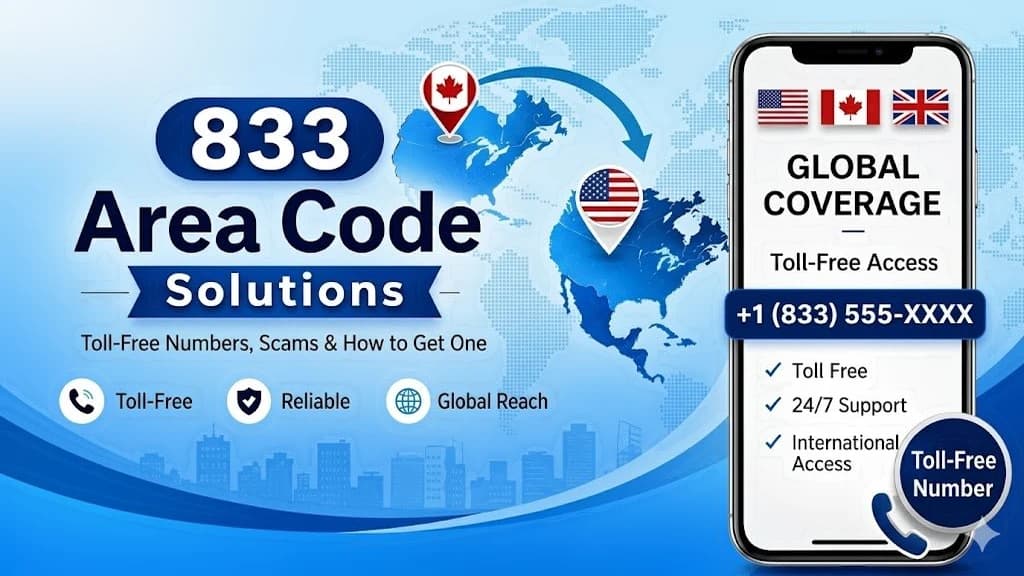
Quick answer: The 833 area code isn't a place — it's a toll-free prefix in the North American Numbering Plan, added in 2017 alongside 800, 888, 877, 866, 855, and 844. Calls to an 833 number are free for the caller; the business that owns the number pays. The prefix is neutral — most 833 lines are legitimate, but scammers exploit the trust toll-free numbers carry, so verify the caller, not the digits.
833 area code: toll-free numbers, scams & how to get one
A call comes in from "833." It looks official, almost like an 800 number — so you pick up. Here's the part most people don't know: 833 isn't a place. No city, no state, no region. It's a toll-free prefix, and that single fact explains both why businesses love it and why scammers abuse it.
This guide breaks down what an 833 number actually is, who legitimately uses one, how the scam playbook works, and how to get your own — including what it costs.
What the 833 prefix really is
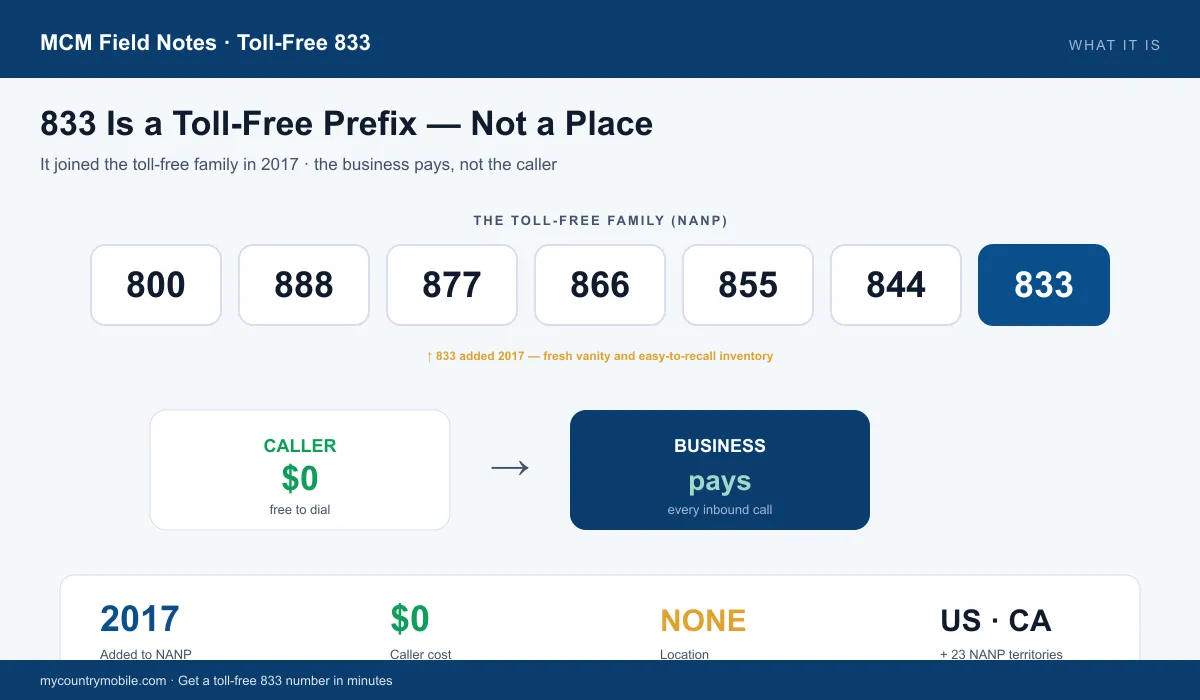
The 833 area code is a toll-free prefix in the North American Numbering Plan, the system that governs phone numbers across the US, Canada, and 23 other territories. It joined the toll-free family in 2017, after the older codes — 800, 888, 877, 866, 855, 844 — had run dry on memorable combinations. So 833 was opened up to give businesses a fresh pool of vanity and easy-to-recall numbers.
Toll-free means the business pays. When you dial an 833 number, you are not charged — not on a landline, a cell phone, or a VoIP line. The business that owns the number pays for every inbound call instead. That's the whole point of "toll-free." For the caller it behaves exactly like an 800 number: free to dial, reaches the company wherever they are.
Why 833 has no location
This is the most misunderstood thing about toll-free numbers. A standard area code like 212 or 415 maps to a geographic region. Toll-free prefixes don't. A business in Vermont and a business in California can both hold 833 numbers, and a caller dialing from anywhere in the country reaches them at no cost. The number is tied to a company, not a map.
What that means in practice. You can't tell where an 833 caller is sitting — not the state, not the city, not even the country within the NANP. That's a feature for legitimate businesses: national reach, one memorable number. It's also exactly what makes the prefix attractive to bad actors.
Ready when you are
Protect your business line.
MCM's local numbers ship with verified caller ID and smart call filtering — customers always know it's really you, and spam never reaches your team.
Who legitimately uses 833 numbers
Plenty of trusted organizations run 833 lines — banks, hospitals, government agencies, and customer service desks all use them. The appeal is straightforward: a toll-free number signals an established, customer-friendly business, and studies have long shown callers trust toll-free lines more than local ones for support. For a growing company, an 833 number also removes a real barrier — customers never hesitate to call because of cost.
Common business use cases:
- Customer support lines — one national number, free for every caller
- Sales and order hotlines — removes cost as a reason not to call
- Vanity numbers — spell a word or brand the 800 range ran out of decades ago
- Multi-location brands — a single number that routes to the nearest branch
If you're weighing a toll-free line for your own business, MCM's number-availability search lets you check open 833 combinations in a couple of minutes.
The 833 scam problem — and how to spot it
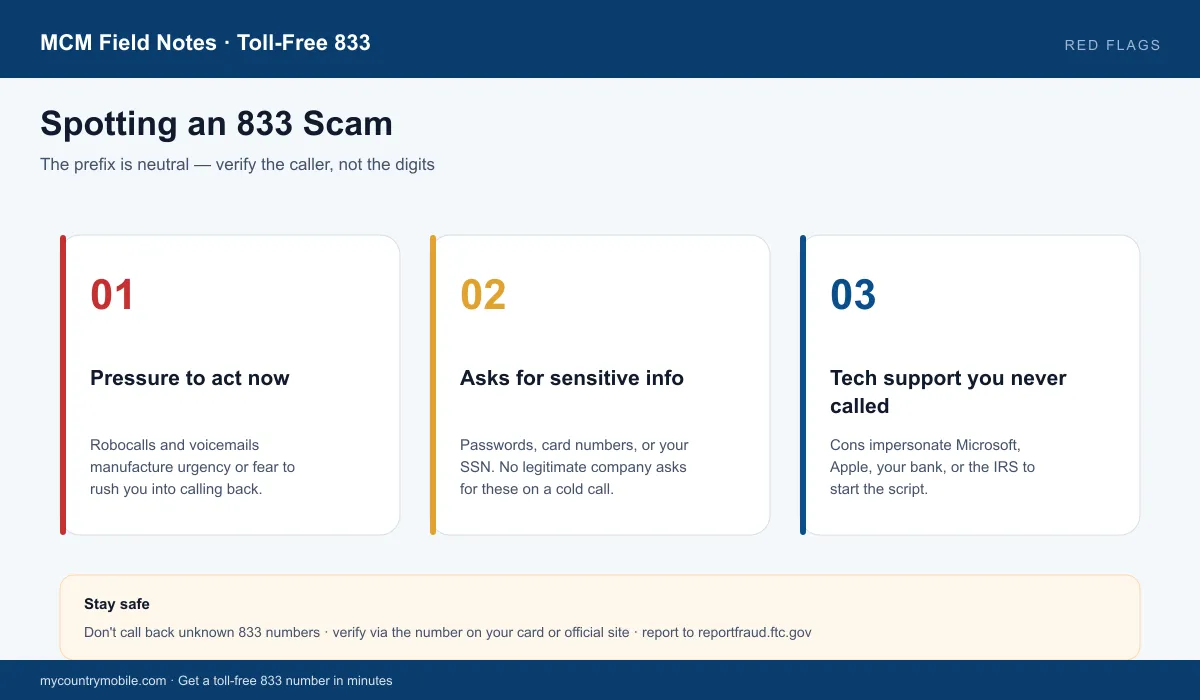
Now the uncomfortable part. The same trust that helps legitimate businesses also helps fraudsters. Scammers exploit two things at once: people are conditioned to trust toll-free numbers, and 833's lack of a location makes calls harder to trace. The Association of Certified Fraud Examiners has flagged toll-free prefixes, including 833, as tools used in identity-theft and refund scams.
How the scam playbook works. Most 833 scams follow a familiar script: a robocall or voicemail tries to create urgency or fear. Tech-support cons impersonate Microsoft or Apple, claiming your device has a virus. Others pose as your bank, the IRS, or a "refund" department. The goal is always the same — get you to call back, then hand over personal or financial information.
Red flags on an 833 call:
- The caller pressures you to act right now
- They ask for passwords, card numbers, or your Social Security number
- They claim to be tech support you never contacted
- A voicemail urges you to call an unfamiliar 833 number back
How to stay safe. Don't call back unknown 833 numbers — callback scams count on your curiosity. If a caller claims to be a company you use, hang up, then dial that company using the number printed on your card or its official website.
A real business won't object. Report suspicious calls to the Federal Trade Commission — reporting is what helps regulators trace and shut down the operations behind these numbers.
Is every 833 call a scam? No.
It's worth being clear: the prefix itself is neutral. An 833 number is no more "dangerous" than an 800 number, and the vast majority of 833 lines belong to legitimate businesses doing ordinary customer service. The rule isn't "never trust 833." It's verify the caller, not the prefix — judge the request, not the digits.
How to get an 833 number for your business
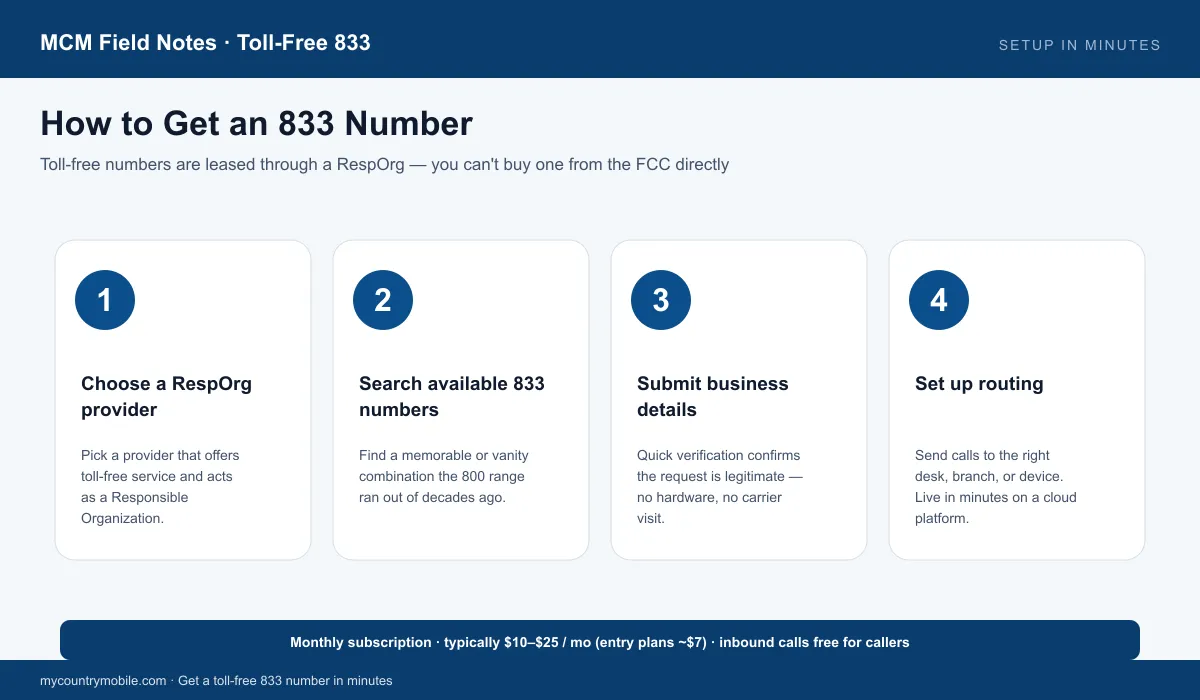
Getting an 833 number isn't like buying a regular phone line. You can't purchase one directly from the FCC or a carrier. Toll-free numbers are managed by providers called RespOrgs (Responsible Organizations), which hold the inventory and lease numbers on a subscription. A modern VoIP provider acts as your RespOrg, so the process is fast and fully online.
The steps to activate one:
- Choose a provider that offers toll-free service and acts as a RespOrg
- Search available 833 numbers — pick a memorable or vanity combination
- Submit business details to verify the request is legitimate
- Set up routing so calls land at the right desk, branch, or device
With a cloud platform, the whole thing takes minutes — no hardware, no carrier visit.
What an 833 number costs. Pricing is a monthly subscription, not a one-time purchase. Across providers, plans generally run $10 to $25 per month, with entry options as low as around $7. Remember: inbound calls are free for callers, but you pay to register and keep the number active. Most plans bundle a block of minutes plus business calling features.
What to do next
The takeaway is simple. The 833 prefix is a toll-free code with national reach and zero geographic meaning — useful for businesses, occasionally exploited by scammers. If you receive an unexpected 833 call, verify the company independently before sharing anything. If you're a business, an 833 line is a low-cost way to look established and make calling you effortless.
Ready to claim one? Check open 833 numbers and set up routing at My Country Mobile — no contracts, live in minutes, cancel anytime.
Ready when you are
Ready to sound local everywhere you sell?
MCM activates business numbers in minutes, with call routing, analytics, and CRM-ready integrations. Start your trial — no card to browse inventory.
FAQs
Is the 833 area code toll-free?
Yes. The 833 area code is a toll-free prefix in the North American Numbering Plan, alongside 800, 888, 877, 866, 855, and 844. Calls to it are free for the caller; the business that owns the number pays.
Where is the 833 area code located?
Nowhere specific. Toll-free prefixes are non-geographic, so an 833 number isn't tied to any city, state, or region. The business behind it could be located anywhere in the US or Canada.
Are 833 numbers safe to answer?
The prefix itself is neutral — most 833 lines belong to legitimate businesses. But scammers do misuse it. Answer if you like, but never share personal information, and verify any caller before calling back.
Why do scammers use 833 numbers?
Two reasons. Toll-free numbers look official, so people trust them, and the lack of a tied location makes the calls harder to trace. Scammers use 833 lines for tech-support, IRS, and bank fraud scripts.
How do I report a suspicious 833 call?
Report it to the Federal Trade Commission (FTC) at reportfraud.ftc.gov, or your country's consumer protection agency. Reporting helps regulators trace the operations behind fraudulent toll-free numbers.
How much does an 833 number cost for a business?
Most providers charge a monthly subscription between $10 and $25, with some entry plans around $7. There's no one-time purchase — you lease the number, and plans usually bundle minutes and calling features.
How is 833 different from 800?
For callers, there's no difference — both are toll-free and free to dial. The only real distinction is age: 800 launched decades ago and ran out of good combinations, so 833 was added in 2017 with fresh inventory.
Get an 833 toll-free number for your business
A toll-free number is the cheapest way to look national and make calling you effortless.
My Country Mobile sets up 833 toll-free numbers with call forwarding, voicemail-to-email, IVR routing, and vanity-number search. Calls route to any device worldwide, and over 17,500 businesses already trust MCM with their phone presence.