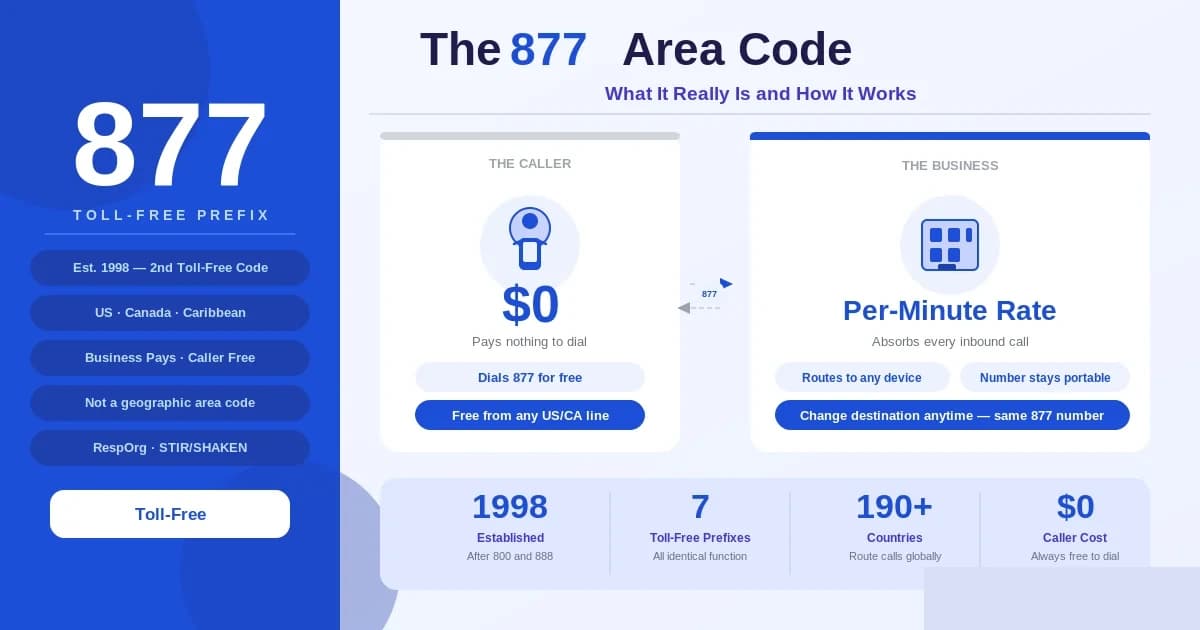
Quick answer: 877 is not a geographic area code. It's a toll-free prefix in the North American Numbering Plan, alongside 800, 888, 866, 855, 844, and 833. There is no "877 city" — the number routes to wherever the business owner points it, and the business (not the caller) pays for inbound calls. 877 launched in 1998 as the second toll-free expansion after 800. Functionally, all toll-free prefixes are identical — same routing, same cost, just different inventories of available numbers.
877 area code: what it really is and how it works
Quick answer: 877 is not an area code at all. It looks like one when it appears at the front of a phone number, but it does not point to a city, a state, or even a country.
It is a toll-free prefix. That single fact clears up most of the confusion people have when an 877 number shows up on caller ID — and it changes how you should think about both calling one and owning one.
This guide explains what the 877 prefix actually is, how toll-free routing works behind the scenes, what it costs, why scammers spoof these numbers, and how to get one for your business.
We run a global voice network at My Country Mobile (MCM), so we will keep the technical parts plain.
The myth worth killing first
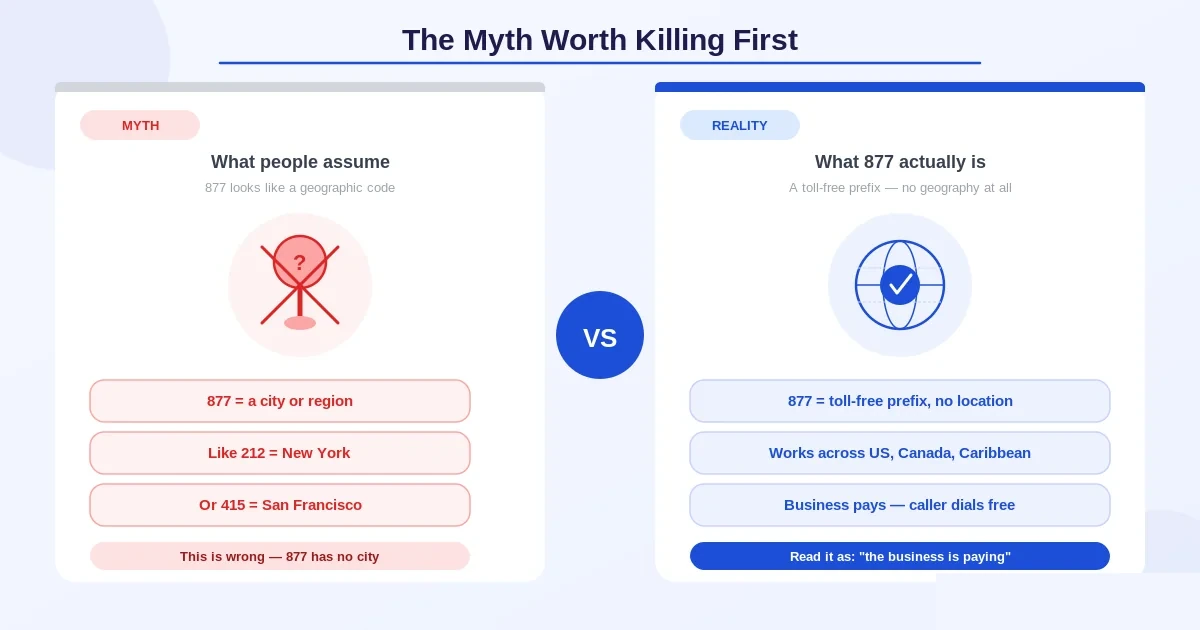
Most articles about the 877 area code start by listing "regions where 877 is used." That list is misleading.
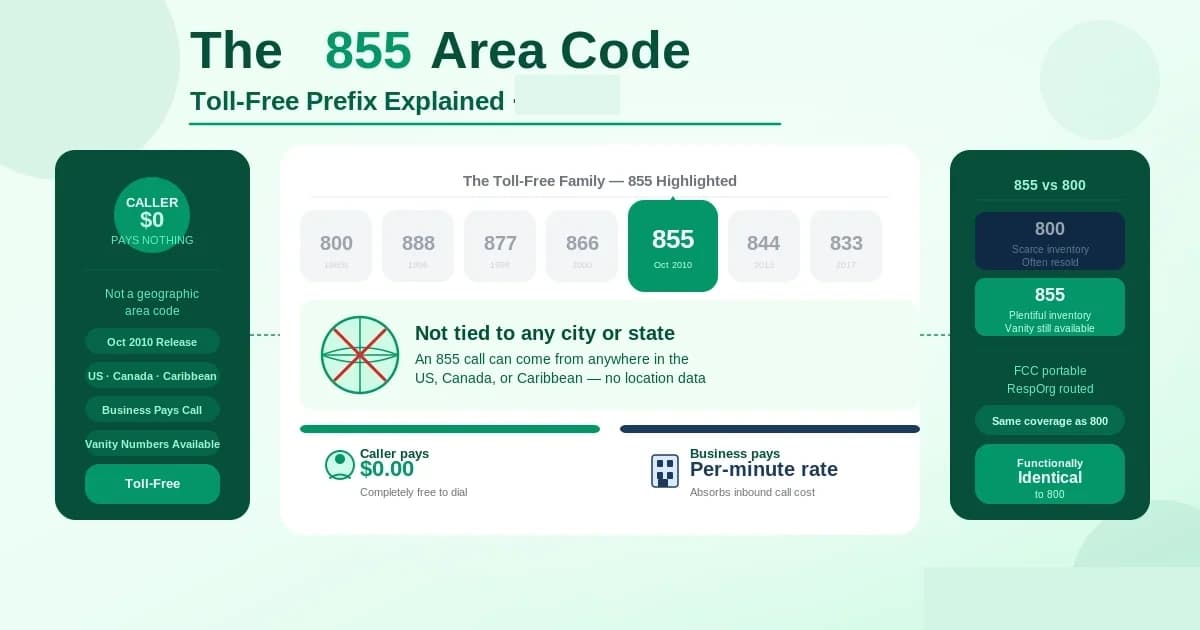
Toll-free numbers reach across the entire North American Numbering Plan — the US, Canada, and many Caribbean nations — because they are tied to a destination, not a place. There is no 877 city to look up.
Why people think it's geographic
Every other three-digit code they know — 212, 661, 305 — maps to a region. The brain pattern-matches 877 the same way. It just does not work like that.
What 877 actually signals
When you see 877, read it as "the business is paying for this call." Nothing more, nothing less. The geography of the caller and the company is irrelevant to the number itself.
How toll-free numbers work
A toll-free call flips the normal billing arrangement. Instead of the caller paying, the business that owns the number gets billed for every inbound minute.
That is the whole concept. The "free" in toll-free means free for the person dialing in — a customer can call a support line from anywhere in the country at no charge.
The routing behind the scenes
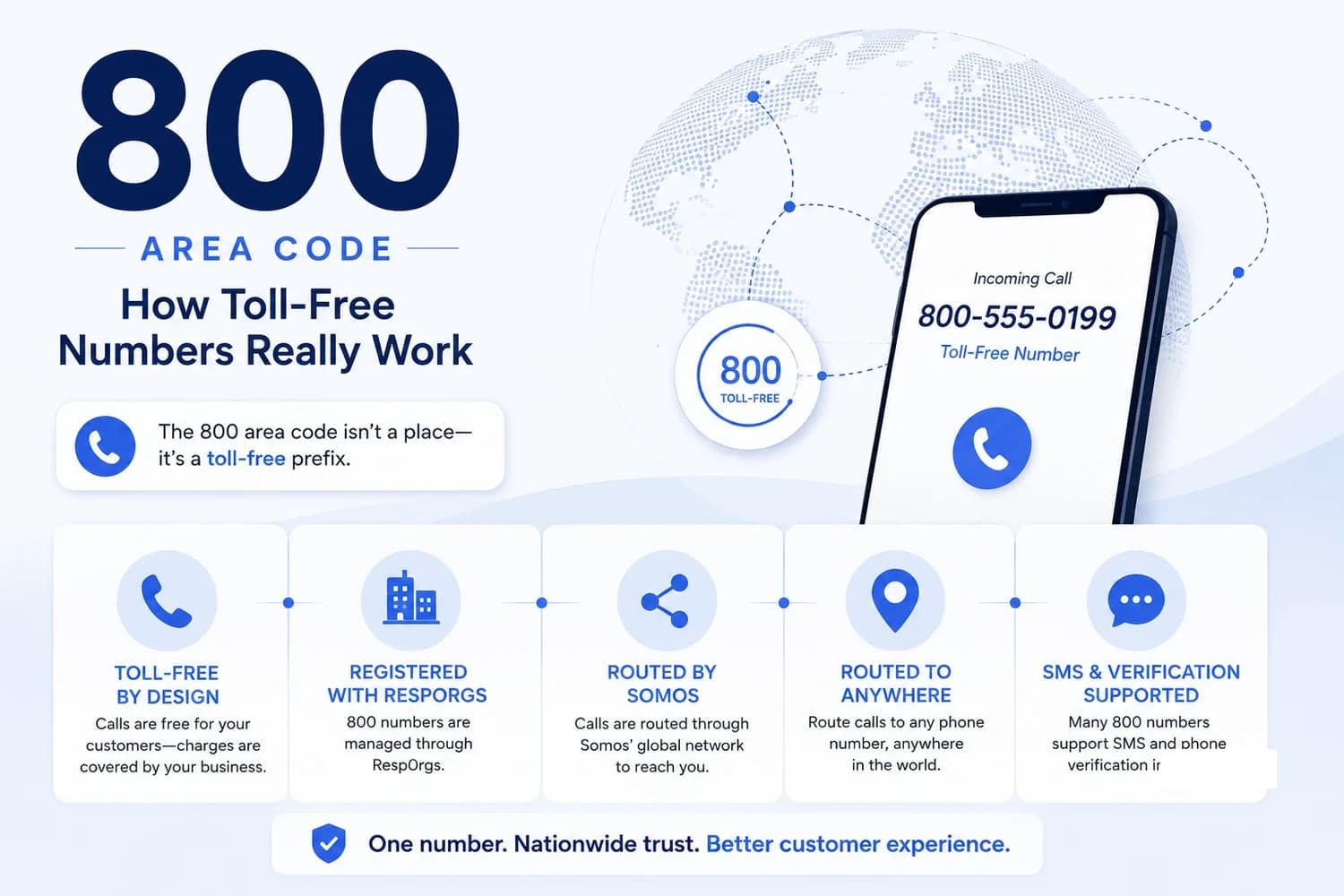
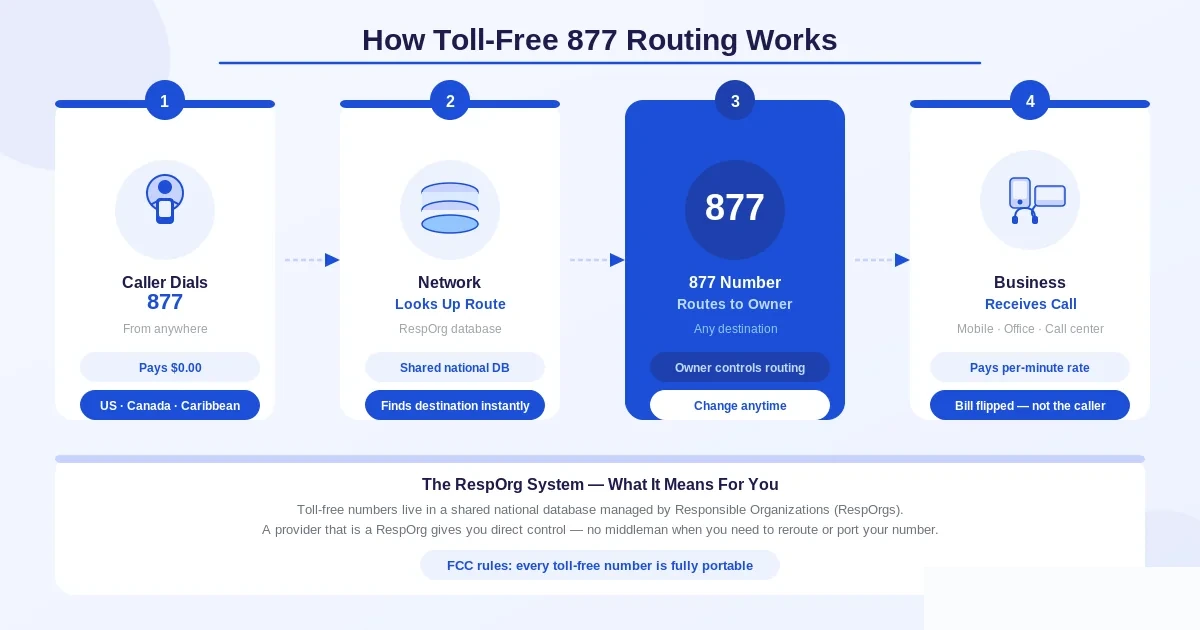
An 877 number is not wired to a physical phone. It is a database entry that points to a real destination — an office line, a call center, or a cloud phone system.
When someone dials it, the network looks up where that number should ring and forwards the call there. The owner can change the destination any time without changing the published number.
The RespOrg system
Here is the part most guides skip. You cannot buy a toll-free number directly from the FCC or pluck one out of thin air.
Toll-free numbers are managed by entities called Responsible Organizations, or RespOrgs. A RespOrg reserves and administers numbers in the shared national toll-free database on behalf of subscribers.
If you are evaluating providers, this matters: a real toll-free provider works through that RespOrg system.
Ready when you are
Protect your business line.
MCM's local numbers ship with verified caller ID and smart call filtering — customers always know it's really you, and spam never reaches your team.
Where 877 came from
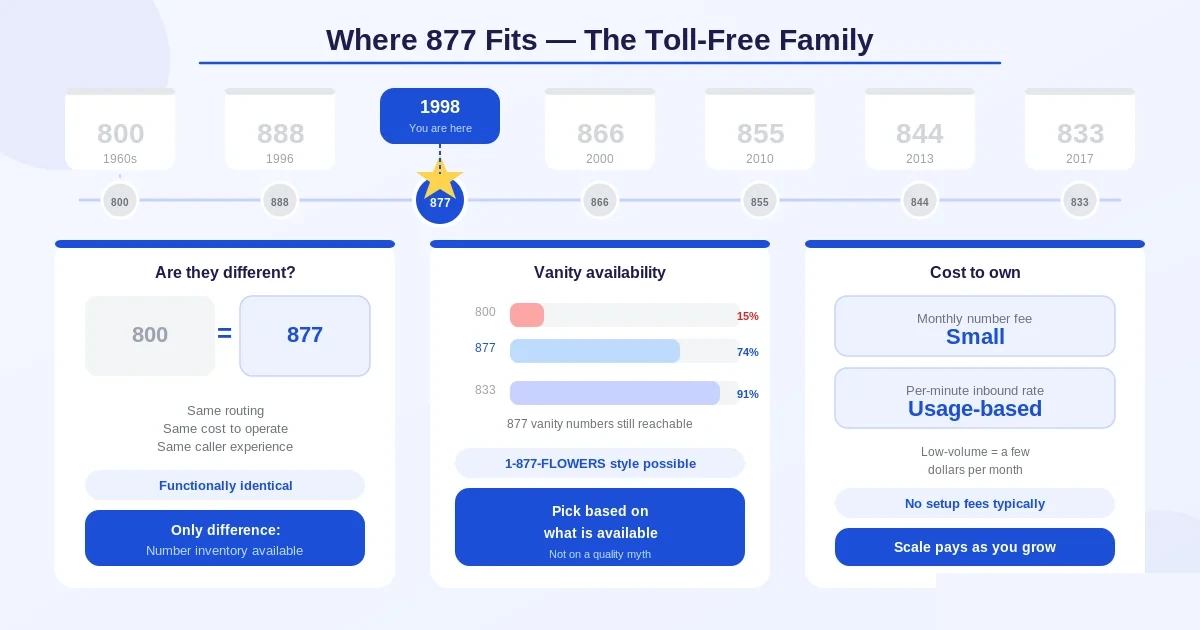
The original toll-free pool was just 800. As demand exploded, that pool ran dry.
The FCC introduced new prefixes to expand supply. 888 arrived in 1996, and 877 followed in 1998 — same toll-free function, just more numbers to go around.
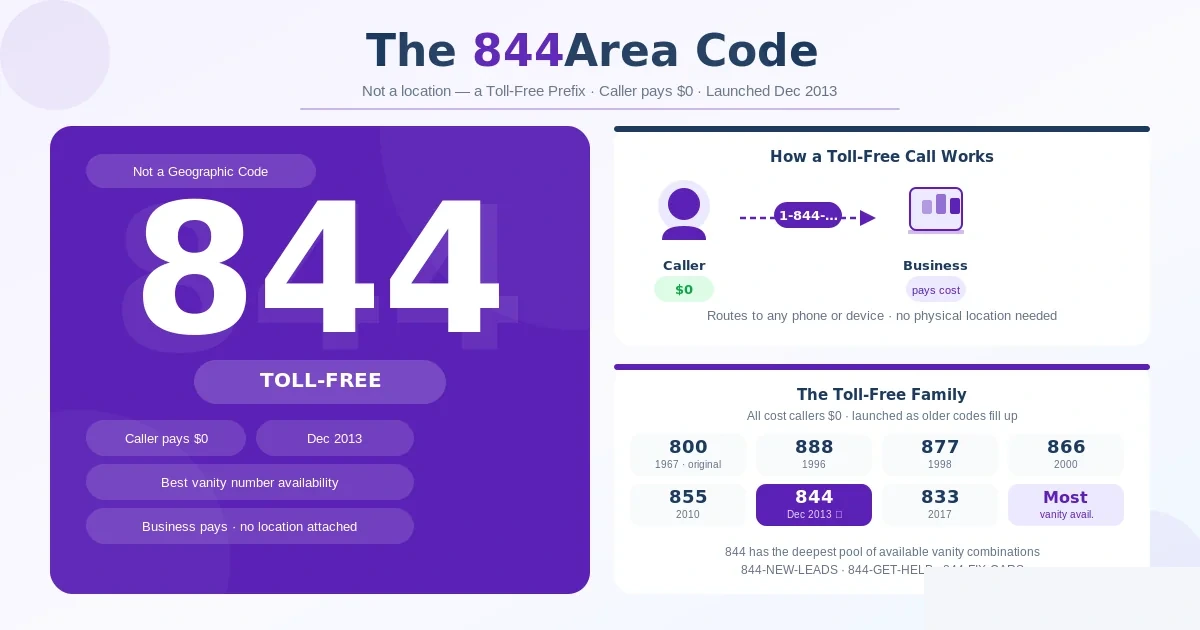
The full toll-free family
| Prefix | Introduced | Notes |
|---|---|---|
| 800 | 1960s | The original, most recognized |
| 888 | 1996 | First expansion code |
| 877 | 1998 | Second expansion code |
| 866 | 2000 | Widely available |
| 855 / 844 / 833 | 2010–2017 | Newest, largest inventory |
Are they different in quality?
No. A call to an 877 number costs the same and routes the same as a call to an 800 number.
The only practical difference is vanity availability — older prefixes like 800 have fewer memorable number combinations left. Pick based on what is available, not on a quality myth.
What it costs to own one
Toll-free numbers are inexpensive to hold and priced by inbound usage. You typically pay a small monthly fee for the number plus a per-minute rate for calls received.
For a low-volume business, that can be a few dollars a month. For a busy support line, usage is the real cost driver — which is why call routing efficiency matters.
Why scammers spoof 877 numbers
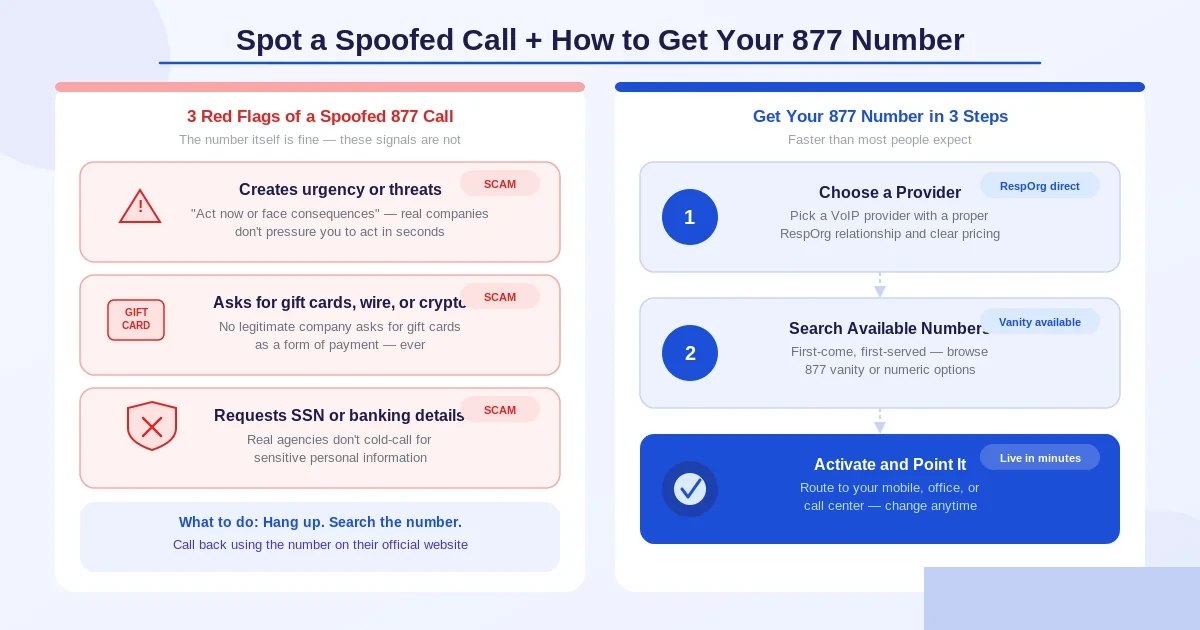
A toll-free number on caller ID looks official. Scammers exploit that, displaying spoofed 877 numbers so a call appears to come from a bank, a delivery service, or a government office.
The number itself is not the problem. Spoofing fakes the displayed number — the call may have nothing to do with the real owner of that 877 line.
How to spot a suspicious 877 call
- They create urgency — "act now or face consequences"
- They ask for payment in gift cards, wire transfers, or crypto
- They request your Social Security number or banking details
- They claim to be a federal agency (real agencies do not cold-call for payment)
What to do about it
Hang up and call the organization back using a number from its official website. On most smartphones you can block the specific number and report it as spam in a couple of taps.
Modern voice networks fight spoofing at the source. MCM's network uses STIR/SHAKEN caller authentication, which verifies caller identity and helps cut down on fraudulent traffic before it reaches anyone.
How to get an 877 number for your business
Getting a toll-free number is faster than most people expect. Here is the path.
Step 1: Choose a provider
Pick a VoIP or telecom provider that offers toll-free service through a proper RespOrg relationship. Look for transparent per-minute pricing and call routing controls.
Step 2: Search available numbers
Toll-free numbers are first-come, first-served. Your provider will show you what is open across 877 and the other prefixes — including vanity options like 1-877-FLOWERS-style numbers.
Step 3: Point it wherever you want
Once activated, route the number to any destination — a desk phone, a mobile, or a full call center. You can change that target whenever your setup changes.
With MCM, businesses across 190+ countries provision toll-free and local numbers through one platform, with calls carried on a network built for 99.99% uptime.
The bottom line
If you remember one thing, make it this: 877 is a toll-free prefix, not a place. Treating it like a geographic code is where most confusion starts.
For a caller, an 877 number means the business is footing the bill. For a business, it means a clean, portable, professional-looking line that customers can reach for free.
Want to see which toll-free numbers are available right now? Start a free trial — no credit card, setup in minutes.
Ready when you are
Ready to sound local everywhere you sell?
MCM activates business numbers in minutes, with call routing, analytics, and CRM-ready integrations. Start your free trial — no card to browse inventory.
Frequently asked questions about the 877 area code
Is 877 a real area code?
Not in the geographic sense. 877 is a toll-free prefix in the North American Numbering Plan. It is not assigned to any city, state, or country.
Is calling an 877 number free?
Yes. The business that owns the number pays for inbound calls, so dialing an 877 number costs you nothing from a standard US or Canadian line.
Is 877 the same as 800?
Functionally, yes. 800, 888, 877, 866, 855, 844, and 833 are all toll-free prefixes. They route the same way and cost callers the same — nothing.
Why do I keep getting calls from 877 numbers?
Often it is legitimate businesses returning calls or running support lines. But scammers also spoof toll-free numbers to look credible. If a call pressures you for money or personal data, hang up.
Can I get an 877 number if my business is outside the US?
Yes. Toll-free numbers are not tied to a location, so a business anywhere can own one and route it globally through a VoIP provider.
Can I pick a custom 877 vanity number?
If it is available. Vanity numbers spell a word on the keypad and are first-come, first-served. Your provider can check what 877 combinations are still open.
Do 877 numbers expire?
They do not expire on a fixed date, but a number can be released if the account is closed or unpaid. As long as the account is active, the number stays yours and is portable between providers.
Get an 877 number for your business
Customers don't care which toll-free prefix you use. They care that the line works, sounds professional, and doesn't drop calls.
My Country Mobile provisions 877 and the rest of the toll-free family through a proper RespOrg relationship, with transparent per-minute pricing, STIR/SHAKEN caller authentication, and routing to any destination worldwide. Over 17,500 businesses already trust MCM with their toll-free presence.