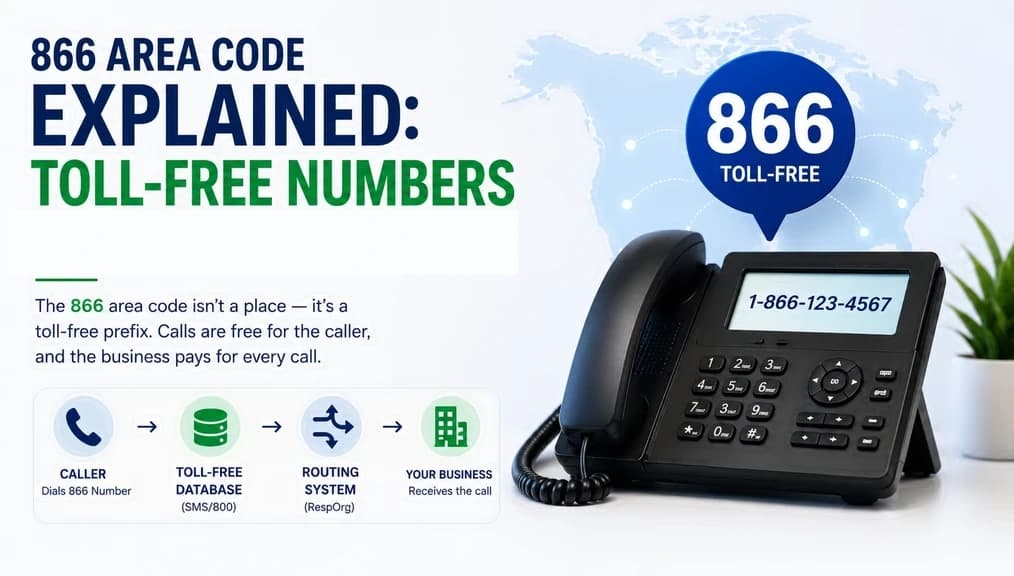
Quick answer: The 866 area code isn't a place — it's a toll-free prefix in the North American Numbering Plan, released in 1999 alongside 800, 888, 877, and (later) 855, 844, and 833. Calls to an 866 number are free for the caller inside NANP countries; the business that owns the number pays. The prefix itself is neutral — most 866 lines are legitimate (banks, airlines, support teams), but scammers spoof them. The five signals below separate a real 866 call from a fake one.
866 area code explained: why it's not a place at all
Quick question: where is the 866 area code? Trick question. It isn't anywhere. Unlike 212 or 415, the digits 866 don't point to a city, a state, or even a country region. They point to a routing rule.
That single fact trips up callers, confuses business owners, and gives scammers a gap to exploit. So let's clear it up. This guide covers what the 866 prefix actually does, how toll-free calls get routed and billed, what an 866 number really costs in 2026, and the exact way to tell a legitimate call from a fraud attempt.
The short version
The 866 area code is a toll-free prefix, not a geographic code. The caller pays nothing — the business that owns the number pays for the call. It works identically to 800, 888, 877, 855, 844, and 833 — same service, different era of release.
If you want a national-feeling number with no long-distance barrier for customers, an 866 line does the job. Just know how it works before you buy.
What "toll-free prefix" actually means
A regular phone number tells the network where to send a call. A toll-free number tells the network who pays for it. When someone dials an 866 number, the network recognizes the toll-free code and reverses the charge. The cost lands on the subscriber — your business — instead of the caller.
That's why these numbers are called non-geographic. There's no zip code behind them. An 866 line in Texas behaves exactly like one in Ontario.
Where the 866 prefix comes from
All toll-free codes live inside the North American Numbering Plan (NANP). The FCC sets the rules; a private database tracks every number. The prefixes rolled out as demand grew: 800 first in 1967, then 888 in 1996, 877 in 1998, and 866 in 1999.
The newest — 855, 844, 833 — arrived in the 2010s. So 866 isn't "lesser" than 800. It's the same toll-free service, released later, with better number availability today.
Ready when you are
Protect your business line.
MCM's local numbers ship with verified caller ID and smart call filtering — customers always know it's really you, and spam never reaches your team.
How an 866 call gets routed and billed
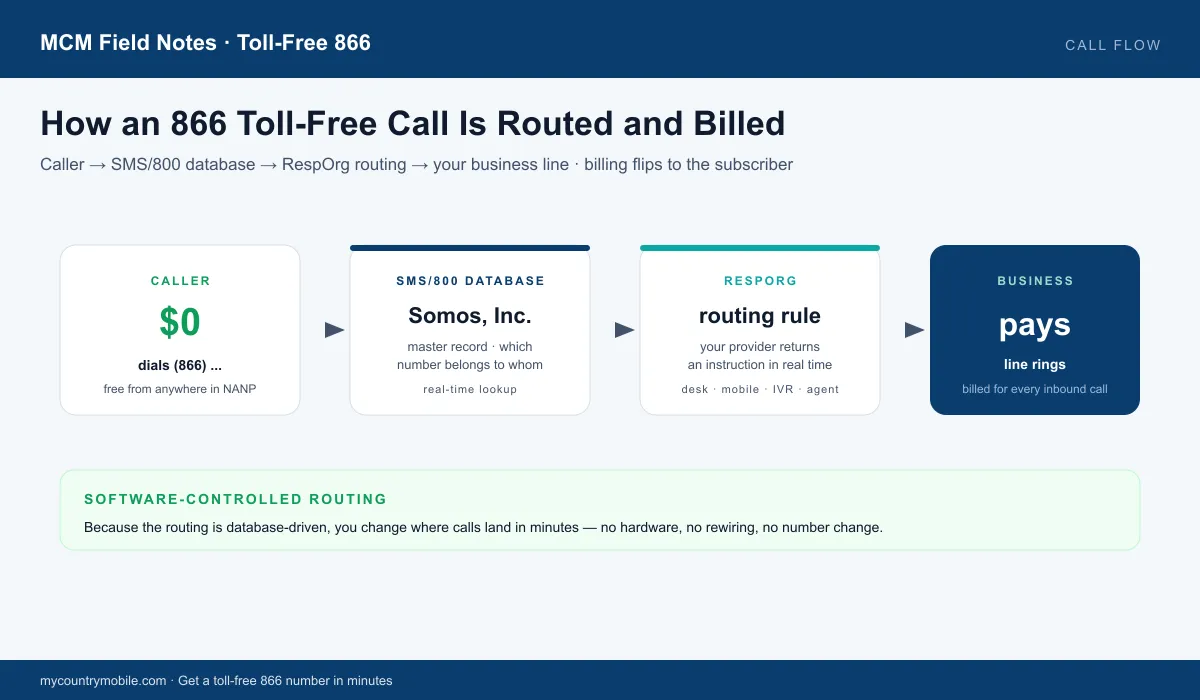
Here's the part most guides skip. Toll-free numbers aren't owned the way local numbers are — they're managed through a system built specifically for them.
Behind every toll-free number sits the SMS/800 database, administered by Somos, Inc. It's the master record of which number belongs to which subscriber. Your number is reserved and managed by a RespOrg (Responsible Organization) — an entity certified to handle toll-free records. Many phone providers act as RespOrgs themselves.
What happens when someone dials
The caller dials your 866 number. The network checks the toll-free database in real time. The database returns a routing instruction — send this call to the subscriber's line, VoIP system, or call center. The billing flips to you.
Because the routing is software-controlled, you decide where calls land: a desk phone, a mobile, a remote agent, or a full IVR menu based on time of day or call volume. If you're already running a cloud phone system, My Country Mobile lets you point an 866 number at any device or team in a few clicks — no hardware, no rewiring.
Is an 866 number legit, or a scam signal?
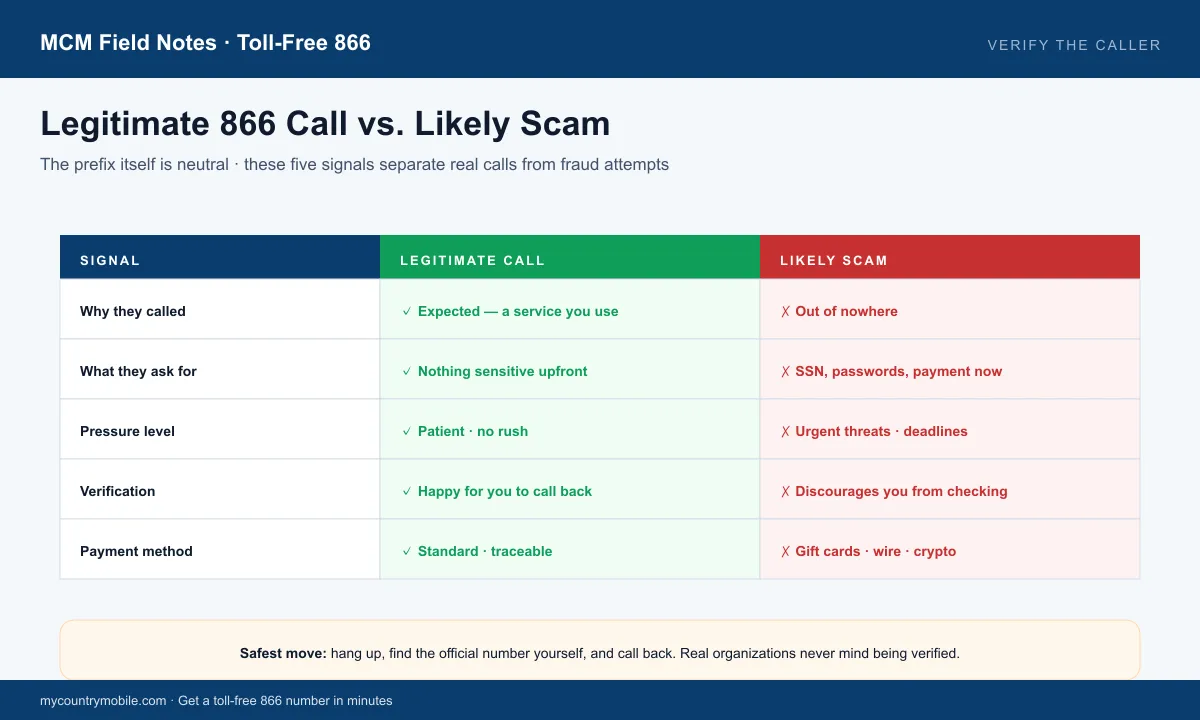
Both — and that's the honest answer. The prefix itself is completely legitimate. Banks, government agencies, airlines, and support teams all use 866 lines. But scammers exploit the trust those numbers carry. An 866 caller ID looks official, so fraudsters spoof it to seem credible.
The prefix isn't the red flag. The caller's behavior is.
How to tell a real 866 call from a fake one
Use this quick check. A legitimate 866 caller will pass every line; a scam call usually fails two or more.
| Signal | Legitimate call | Likely scam |
|---|---|---|
| Why they called | Expected — a service you use | Out of nowhere |
| What they ask for | Nothing sensitive upfront | SSN, passwords, payment now |
| Pressure level | Patient · no rush | Urgent threats · deadlines |
| Verification | Happy for you to call back | Discourages you from checking |
| Payment method | Standard · traceable | Gift cards · wire · crypto |
The safest move: hang up, find the official number yourself, and call back. Real organizations never mind being verified — they expect it.
866 vs 800 vs 888: does the prefix matter?
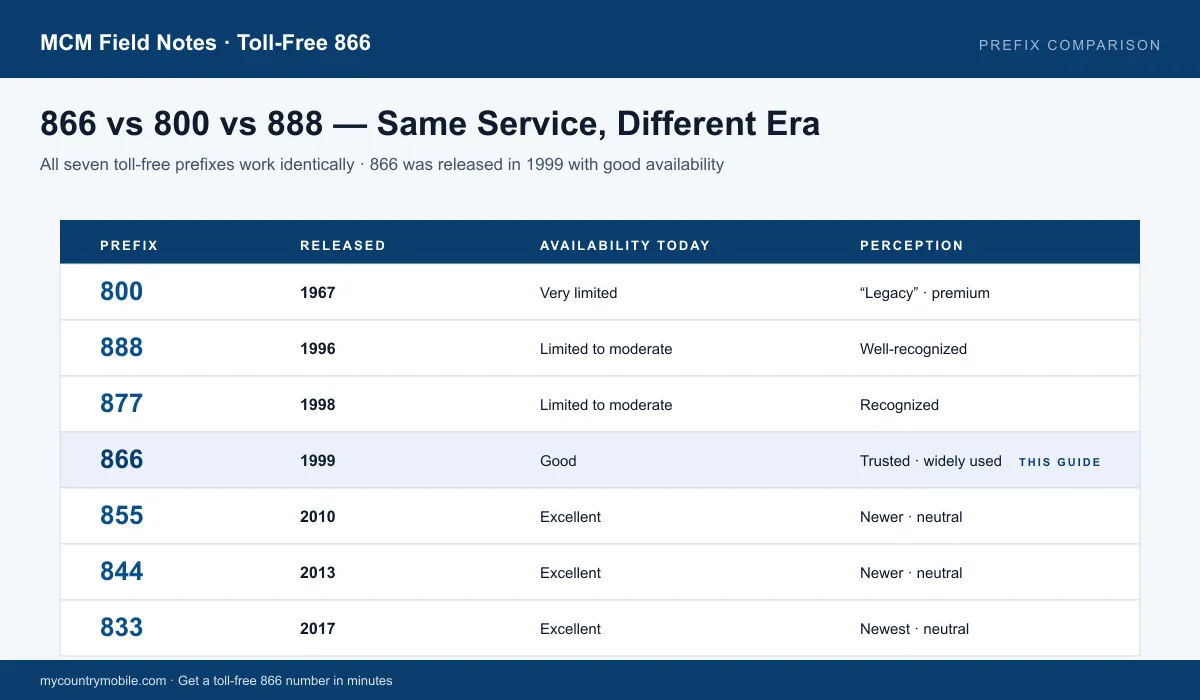
Functionally? No. All toll-free prefixes deliver the identical service — free for the caller, billed to the subscriber. The real differences are perception and availability.
| Prefix | Released | Availability today | Perception |
|---|---|---|---|
| 800 | 1967 | Very limited | "Legacy" · premium |
| 888 | 1996 | Limited to moderate | Well-recognized |
| 877 | 1998 | Limited to moderate | Recognized |
| 866 | 1999 | Good | Trusted · widely used |
| 855 | 2010 | Excellent | Newer · neutral |
| 844 | 2013 | Excellent | Newer · neutral |
| 833 | 2017 | Excellent | Newest · neutral |
An 800 number carries a slight prestige halo because it's the original. But an 866 line gives you far better odds of landing a clean, memorable number — including vanity combinations like 1-866-CALL-NOW.
What an 866 number costs
There's no flat industry price. Cost depends on your provider, included minutes, and the features you bundle in. As a benchmark, toll-free service typically runs $10 to $30 per number per month. Some FCC-approved providers sit at the low end; premium feature sets push higher. Most plans follow the same shape: a monthly base fee with included minutes, then per-minute charges if you go over.
Where the extra costs hide
- Setup fees — common, but often waived on annual plans
- Per-minute overage — the line item that surprises people most
- Premium add-ons — advanced IVR, call analytics, CRM integration
- Vanity number premiums — memorable combinations cost more
How to keep the bill predictable
Match your plan to actual call volume, not your best-case projection. Bundle the toll-free line into a wider communication package when possible. Check your analytics monthly and drop features you're not using.
How to get your own 866 number
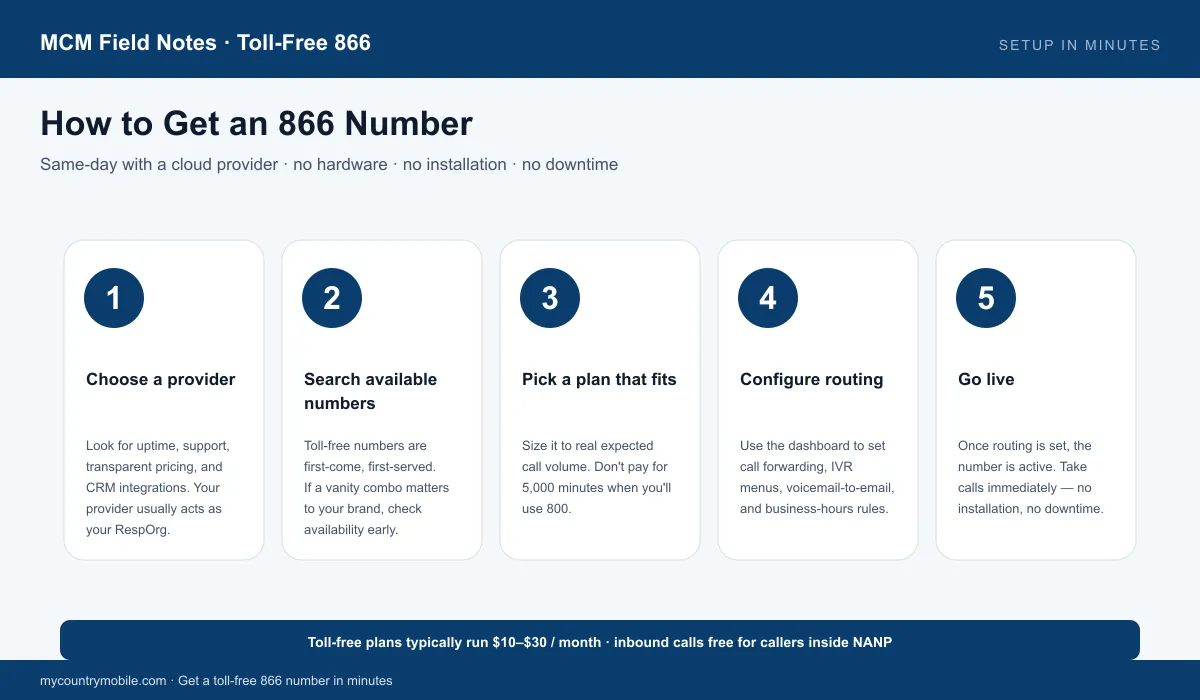
Setting one up is a same-day job with a cloud provider. Five steps:
- Choose a provider (and RespOrg). Look for strong uptime, responsive support, transparent pricing, and integrations with your CRM. Your provider usually handles the RespOrg side for you.
- Search available numbers. Toll-free numbers are first-come, first-served. If a vanity combo like
1-866-BIZ-HELPmatters to your brand, check availability early. - Pick a plan that fits. Size it to your real expected call volume. Don't pay for 5,000 minutes when you'll use 800.
- Configure routing. Use the dashboard to set call forwarding, IVR menus, voicemail-to-email, and business-hours rules.
- Go live. Once routing is set, the number is active. You can take calls immediately — no installation, no downtime.
Who should actually get an 866 number
A toll-free line isn't right for everyone. Be honest about your model.
Strong fit:
- Small and mid-size businesses wanting a national presence
- E-commerce brands serving customers across the US and Canada
- Support and sales teams that need centralized, professional routing
- Marketing campaigns that benefit from a memorable, trackable number
Probably skip it:
- Hyper-local businesses whose customers are all nearby
- Very early startups watching every monthly dollar
- Personal use — it's more capability than you need
One caveat for everyone: 866 numbers are only toll-free inside NANP countries. International callers pay their own carrier's rates.
The bottom line on 866 numbers
Here's the takeaway worth keeping: 866 isn't a location, it's an instruction — "bill the business, not the caller." Once that clicks, everything else makes sense.
Decide what you need first. If you serve customers nationally and want them to call without a second thought, a toll-free line earns its keep. If your market is a five-mile radius, a local number does more for less.
Ready to test it? You can search available 866 numbers and route your first call in minutes with MCM's free trial — no contract, no credit card.
Ready when you are
Ready to sound local everywhere you sell?
MCM activates business numbers in minutes, with call routing, analytics, and CRM-ready integrations. Start your trial — no card to browse inventory.
FAQs
Is 866 free to call?
Yes — for callers within the US, Canada, and covered Caribbean NANP regions. The business that owns the number absorbs the cost. Callers outside NANP pay their own international rates.
Where is the 866 area code located?
Nowhere specific. It's a non-geographic toll-free prefix that works identically across the entire NANP zone, from Alaska to the Caribbean.
How is 866 different from 800?
Functionally, they're the same toll-free service. The 800 prefix is older and carries a "legacy" perception, while 866 was released in 1999 and has far better number availability today.
Can I keep my 866 number if I switch providers?
Yes. FCC rules require toll-free numbers to be portable. You move the number to a new RespOrg without losing service — just confirm timing before you cancel anything.
Can I get a vanity 866 number?
Usually, yes. Memorable combinations like 1-866-YOUR-BIZ are available if no one has claimed them. Vanity numbers often carry a premium but pay off in ad recall.
Are 866 numbers only for businesses?
Mostly. The features and monthly fees are built around business use, though an individual can technically register one.
How do I report a suspicious 866 call?
Hang up, verify the organization through an official number you look up yourself, and report fraud to the FCC at fcc.gov/complaints. Never act on payment demands made during an unexpected call.
Get an 866 toll-free number for your business
A toll-free number is the cheapest way to look national and make calling you effortless.
My Country Mobile sets up 866 toll-free numbers with call forwarding, voicemail-to-email, IVR routing, and vanity-number search. Calls route to any device worldwide, and over 17,500 businesses already trust MCM with their phone presence.