Introduction
Americans still field billions of unwanted calls every year — scam pitches, spoofed numbers, and recorded messages that waste time and, too often, money. Behind every one of those calls is a network that either let it through or stopped it.
Carriers sit at the chokepoint. The decisions a voice network makes about authentication, monitoring, and traffic vetting determine whether a fraudulent call ever reaches a phone.
This post explains, in plain terms, how My Country Mobile (MCM) combats robocalls, scam calls, toll fraud, and spam — the standards it follows, the systems it runs, and the industry work that backs it up.
WHY CARRIER-LEVEL DEFENSE MATTERS
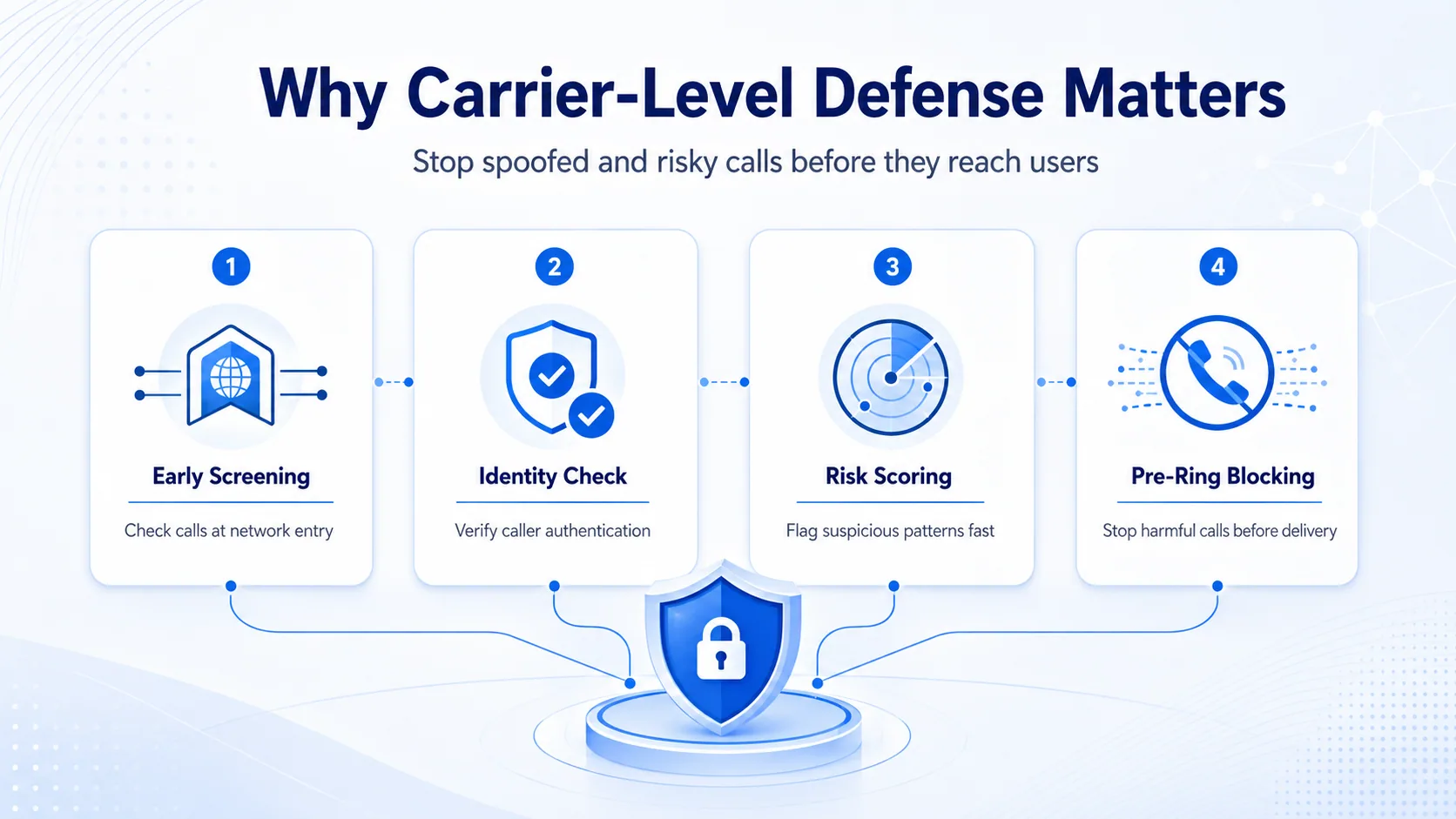
Consumer call-blocking apps catch calls after they arrive. By then the spoofed number, the scam script, and the cost have already done their job.
Stopping abuse at the carrier level is different. It means a fraudulent or unauthenticated call gets flagged, scored, or blocked before it ever lands — protecting end users who never see the threat.
That is the principle behind MCM's approach: defense in layers, applied as early in the call path as possible.
LAYER 1: CALL AUTHENTICATION WITH STIR/SHAKEN
The first question for any incoming call is simple — is the caller ID real? Spoofing a trusted number is the oldest trick in the scam playbook.
What STIR/SHAKEN Does
STIR/SHAKEN is the industry framework for verifying caller identity. It attaches a cryptographic signature to a call as it originates, so the receiving network can confirm the number was not faked.
How It Helps
When a call carries a valid attestation, downstream networks can trust the caller ID. When it does not, the call can be treated with suspicion. MCM works to authenticate traffic from its sources, end clients, and carrier partners so legitimate calls travel with verified identity.
The short version: STIR/SHAKEN turns caller ID from a guess into a checkable fact.
Ready when you are
Protect your business line.
MCM's local numbers ship with verified caller ID and smart call filtering — customers always know it's really you, and spam never reaches your team.
LAYER 2: REAL-TIME AI MONITORING
Authentication tells you who is calling. It does not tell you whether the calling pattern looks like fraud. That is where continuous monitoring comes in.
Spotting Suspicious Patterns
MCM's network runs AI-driven monitoring that watches signaling behavior, routing anomalies, and call patterns around the clock. Sudden traffic spikes, odd routing, and known fraud signatures all raise flags.
Acting Fast
When the system detects a likely threat, it can score the traffic, alert operators, and block abusive routes — often within seconds. Speed matters, because fraud schemes are designed to extract value before anyone notices.
If you want the wider picture of network safeguards, see our overview of telecom security and compliance.
LAYER 3: TOLL FRAUD PREVENTION
Toll fraud is a quieter threat than robocalls, but it is expensive. Attackers hijack accounts or PBX systems to pump traffic to high-cost destinations, leaving someone else with the bill.
How MCM Limits Exposure
MCM applies anomaly detection tuned for the fingerprints of toll fraud — unusual destinations, sudden volume to premium-rate numbers, and traffic that does not match an account's normal behavior.
Protecting Partner Revenue
Automated alerting and route controls let suspicious traffic be stopped before losses pile up. For carriers and resellers, that protection guards real revenue, not just call quality.
LAYER 4: INDUSTRY COOPERATION AND TRACEBACK
No single carrier can see the whole call path. Fraud crosses networks, which means stopping it requires carriers to work together.
Traceback Participation
When fraudulent traffic is found, traceback is the process of tracing it hop by hop to its origin. MCM participates in industry traceback efforts, cooperating with partners and authorities to identify the actual source of bad calls.
Standards and Compliance
MCM aligns with recognized telecom compliance frameworks, including registration in the Robocall Mitigation Database for traffic delivered into the US ecosystem. It also engages with industry bodies that set anti-fraud standards.
This combination of standards, traceback, and cooperation is what makes individual blocking efforts add up to real deterrence.
LAYER 5: EDUCATING CLIENTS AND PARTNERS
Technology alone does not finish the job. A network is only as clean as the traffic its customers send into it.
MCM treats client education as part of fraud prevention — sharing best practices so partners send legitimate, well-formed traffic and avoid practices that look abusive.
When customers follow good sending habits, the whole network gets cleaner, and legitimate calls are less likely to be caught in the same nets as fraud.
THE DEFENSE, SUMMARIZED
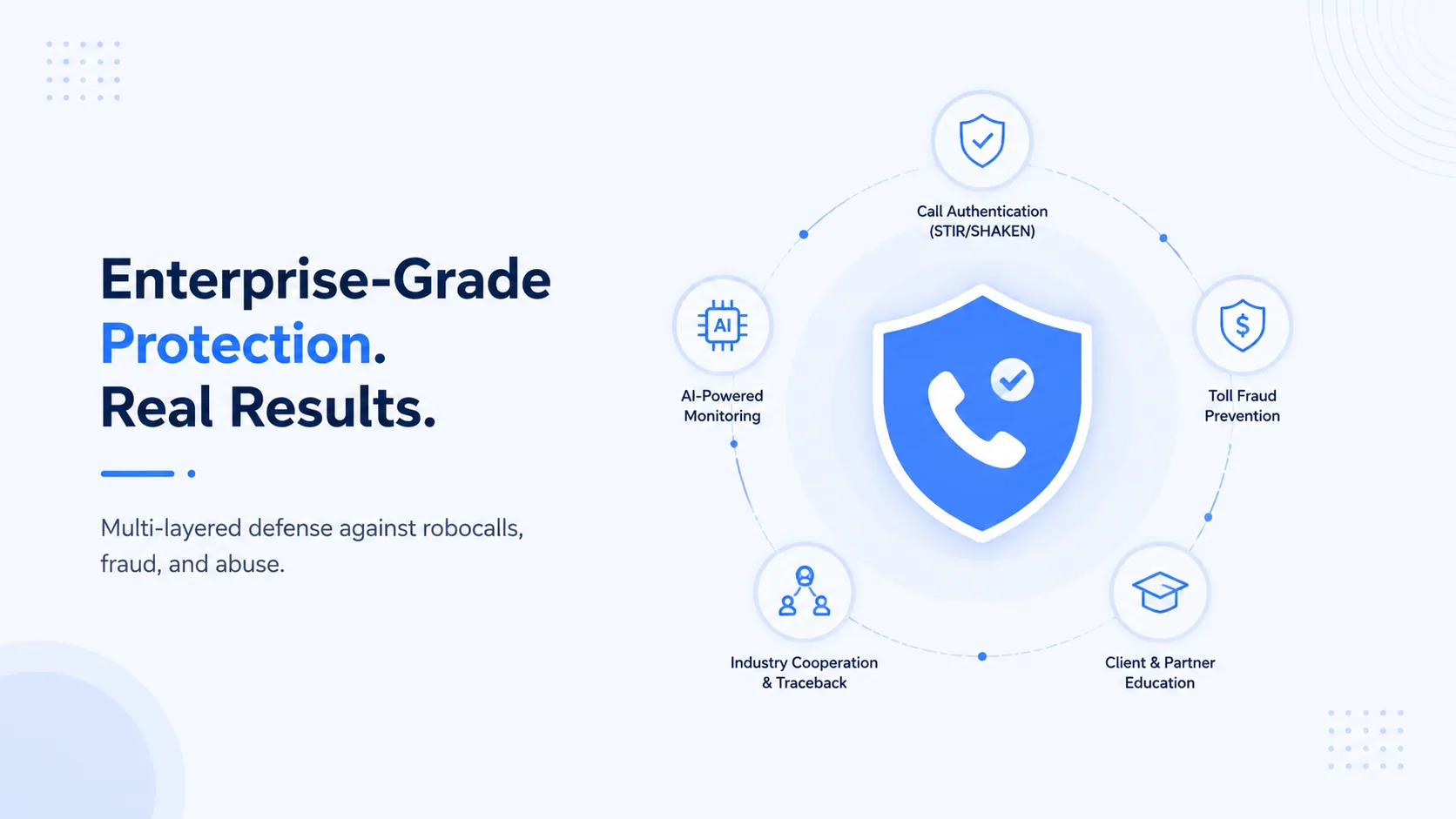
| Layer | What It Does | Threat Addressed |
|---|---|---|
| STIR/SHAKEN | Verifies caller identity | Spoofing, fake caller ID |
| AI monitoring | Watches patterns 24/7 | Robocalls, anomalies |
| Toll fraud controls | Flags abnormal high-cost traffic | Account and PBX abuse |
| Traceback | Traces fraud to its source | Cross-network scam traffic |
| Client education | Promotes clean sending habits | Spam, low-quality traffic |
No single layer is perfect. Together, they make abuse far harder to pull off.
WHAT THIS MEANS FOR YOU
If you run a business phone system or route voice traffic, the network underneath you shapes your risk. A carrier that authenticates calls, monitors in real time, and joins traceback efforts protects both your customers and your costs.
The practical step is to ask any provider how they handle each of the five layers above. Vague answers are a warning sign; specific ones are a good one.
Want voice infrastructure built with these safeguards in place? Talk to MCM about secure, compliant call routing for your business.
Ready when you are
Ready to sound local everywhere you sell?
MCM activates business numbers in minutes, with call routing, analytics, and CRM-ready integrations. Start your free trial — no card to browse inventory.
FAQs
What is STIR/SHAKEN in simple terms?
It is a framework that adds a verified digital signature to a call, letting the receiving network confirm the caller ID was not spoofed.
Can robocalls be stopped completely?
Not entirely, but layered defenses — authentication, monitoring, and traceback — sharply reduce how many reach real phones.
What is toll fraud?
Toll fraud is when attackers hijack a phone account or system to route calls to costly destinations, leaving the victim with the charges.
How does traceback help fight scam calls?
Traceback follows a fraudulent call backward across networks to find its origin, so carriers and authorities can act on the actual source.
Does My Country Mobile block legitimate business calls?
The goal is the opposite — authentication and monitoring are tuned to clear legitimate traffic while isolating fraud and abuse.
What is the Robocall Mitigation Database?
It is a registry carriers use to document their robocall-prevention efforts for traffic entering the US telecom system.
How can my business avoid being flagged as spam?
Send well-formed, authenticated traffic, keep caller ID accurate, and follow your provider's sending best practices.