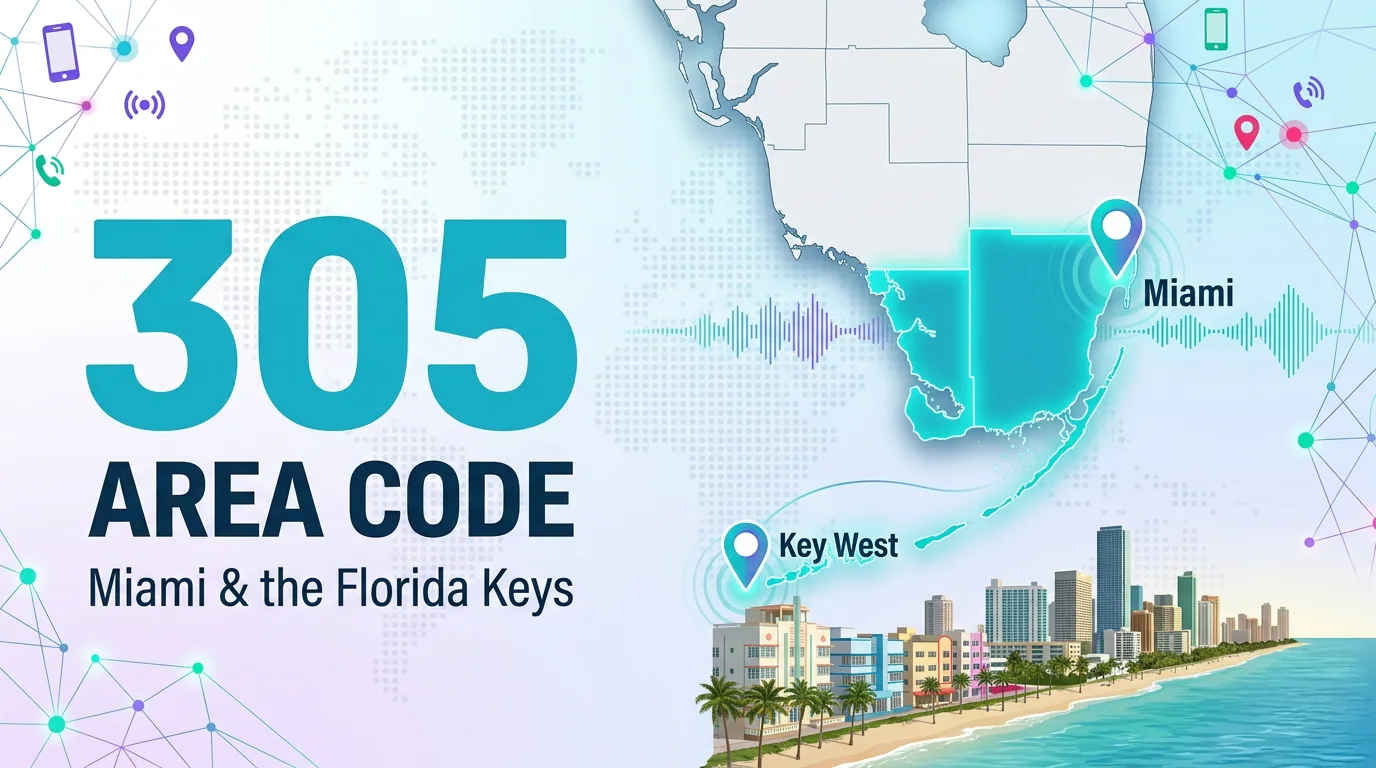
Quick answer: The 305 area code covers South Florida — Miami-Dade, the Florida Keys (Monroe County), and a slice of Broward — on Eastern Time. A 1947 original code, it now shares its territory with two overlays, 786 (1998) and 645 (2023), so every local call requires ten-digit dialing.
Few area codes carry as much identity as 305. Locals call themselves "the 305." It's stitched into Miami's culture the way 212 belongs to New York.
But behind the icon status is a practical question most guides skip: what does 305 actually cover today, and how do its overlay codes work? Miami's number supply has been stretched for years, and that has shaped how everyone in South Florida dials.
This guide breaks it down — the cities, the counties, the time zone, the two overlays, and how a business can get a Miami number without an office in Florida.
What the 305 Area Code Covers
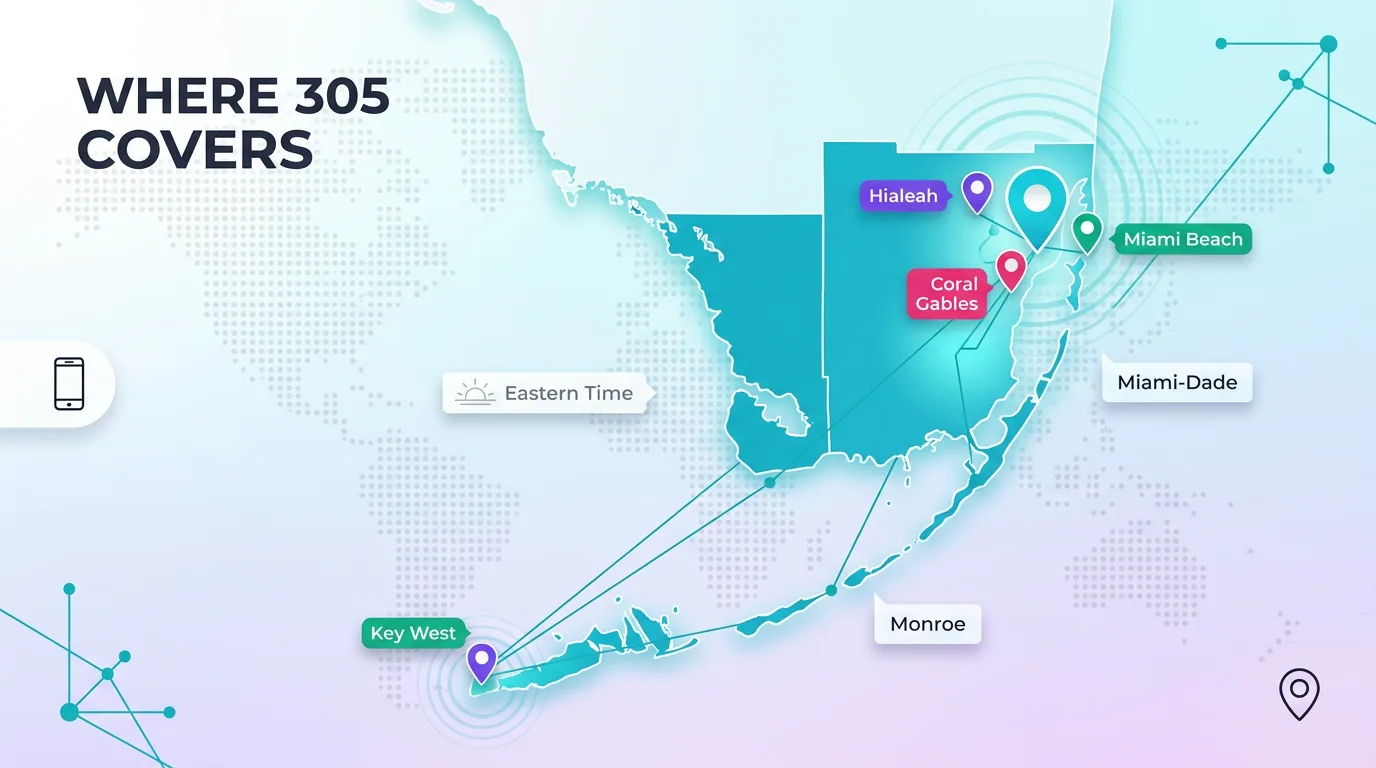
The 305 area code serves South Florida — anchored by the city of Miami and stretching all the way down through the Florida Keys.
Its reach is wider than people assume. It's not just downtown Miami; it pulls in a dense cluster of metro cities and a long, thin coastal tail.
Counties in the Region
The code spans three counties:
- Miami-Dade County — the core, including Miami itself
- Monroe County — the Florida Keys portion
- Broward County — a small adjoining slice
That mix of dense urban metro and stretched-out island geography makes 305 one of the more distinctive codes in the state.
Time Zone
South Florida sits in the Eastern Time Zone. That's EST (UTC-5) in winter and EDT (UTC-4) during daylight saving. Miami runs on the same clock as New York, Atlanta, and Boston.
Cities Inside the 305 Footprint
| City | County | Known For |
|---|---|---|
| Miami | Miami-Dade | Finance, tourism, trade, culture |
| Hialeah | Miami-Dade | Large residential and commercial base |
| Miami Gardens | Miami-Dade | Sports and entertainment hub |
| Miami Beach | Miami-Dade | Tourism, hospitality, nightlife |
| Coral Gables | Miami-Dade | Business and professional services |
| Key West | Monroe | Tourism anchor of the Florida Keys |
Population and Demographics of the 305 Region
Miami-Dade County — the core of the 305 footprint — is home to approximately 2.84 million people, making it the 7th-most-populous county in the US. The county ranked #1 nationally for international migration in 2024, adding 64,211 residents in a single year.
| Metric | Value |
|---|---|
| Miami-Dade County population | 2,840,000+ |
| Monroe County (Keys) | 82,000+ |
| 305 region total | ~2,920,000 |
| Median household income | $71,753 |
| Median age | 40.7 years |
| Poverty rate (families) | 11.3% |
Racial and Ethnic Composition
Miami-Dade is the largest majority-Hispanic county in the US — and it's not close:
| Race / Ethnicity | Share of Population |
|---|---|
| Hispanic / Latino | 70.3% |
| Black or African American | 13.7% |
| White (non-Hispanic) | 12.4% |
| Asian | 1.8% |
| Two or more races / Other | 1.8% |
The Hispanic population is predominantly Cuban-American (the largest Cuban diaspora in the world), with large Colombian, Venezuelan, Nicaraguan, and Haitian communities. Spanish is the primary language for roughly 65% of residents — making bilingual business operations standard, not optional, across the 305 footprint.
Economic Profile
Miami's economy runs on international trade and banking (the city handles more trade with Latin America and the Caribbean than any other US metro), tourism and hospitality (Miami Beach, Wynwood, and the cruise port generate $18B+ in annual visitor spending), healthcare (Baptist Health, Jackson Health System, University of Miami Health), real estate and construction (one of the most active condo and commercial markets in the US), and logistics (Miami International Airport is the #1 US airport for international freight, and PortMiami is the "Cruise Capital of the World").
For businesses, a 305 number reaches nearly 3 million consumers in the most internationally connected metro in the US — and carries cultural weight that the overlay codes (786 and 645) have not yet matched.
Ready when you are
Protect your business line.
MCM's local numbers ship with verified caller ID and smart call filtering — customers always know it's really you, and spam never reaches your team.
A Short History of 305
Florida got 305 in 1947 as one of the original North American Numbering Plan codes. At the start, it covered the entire state. Florida grew fast, and new codes were carved off again and again, shrinking 305 down toward the southern tip of the peninsula and the Keys.
What's left is small in area but heavy in population — exactly the kind of dense market where phone numbers run out quickly.
The Overlays: 786 and 645 Explained
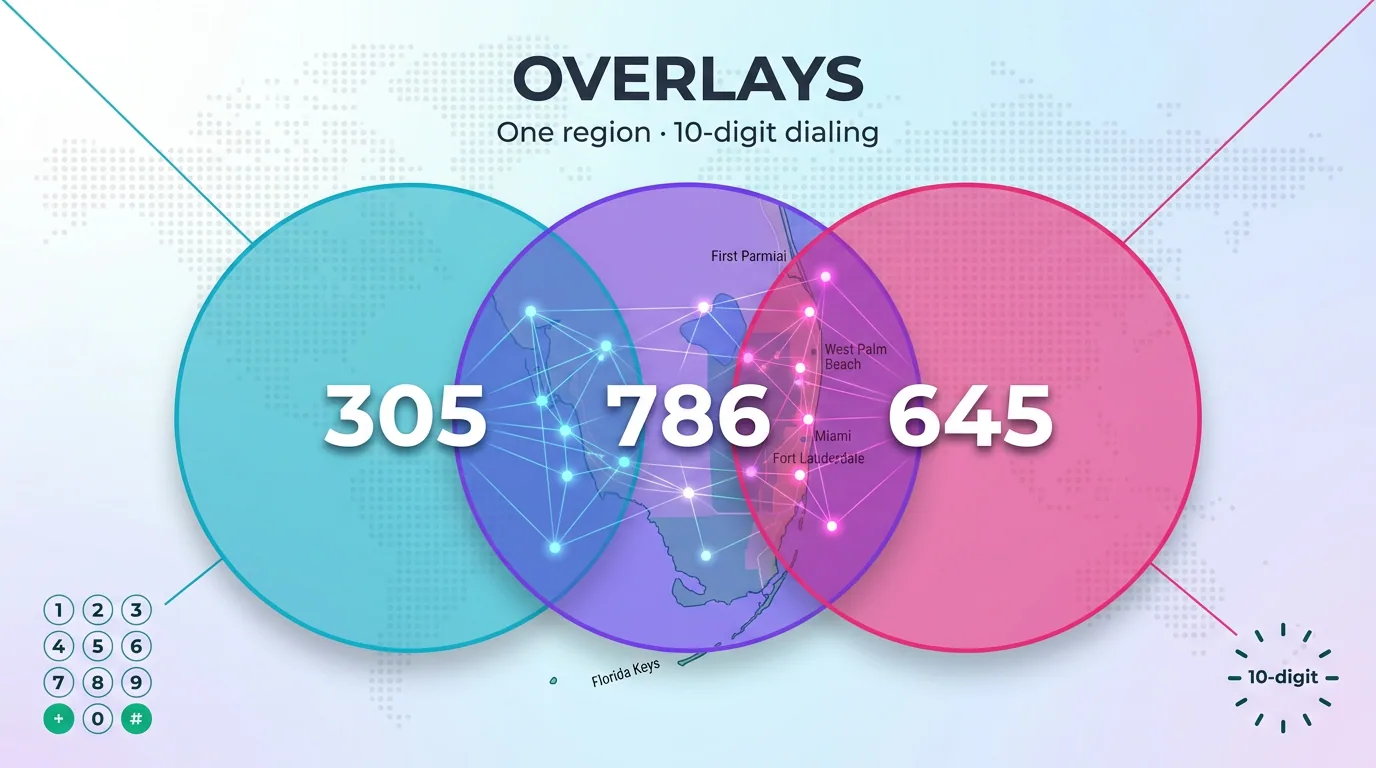
Overlay 1: Area Code 786
The 786 overlay was added on March 1, 1998. It was the first answer to Miami's number shortage. For more than two decades, 786 and 305 served the same area side by side — both equally "Miami."
Overlay 2: Area Code 645
Demand kept climbing, so a third code joined in. The 645 overlay was activated on August 4, 2023, ahead of 305 and 786 running dry. Today, 305, 786, and 645 all cover the identical region. There's no difference in coverage, quality, or status between them.
What This Means for Dialing
Three overlapping codes means one rule: always dial 10 digits. Even a local Miami-to-Miami call needs the area code plus the seven-digit number.
If you already have a 305 number, none of this affects you. Overlays only assign newer codes — 786 or 645 — to brand-new lines.
Why a 305 Number Still Carries Weight
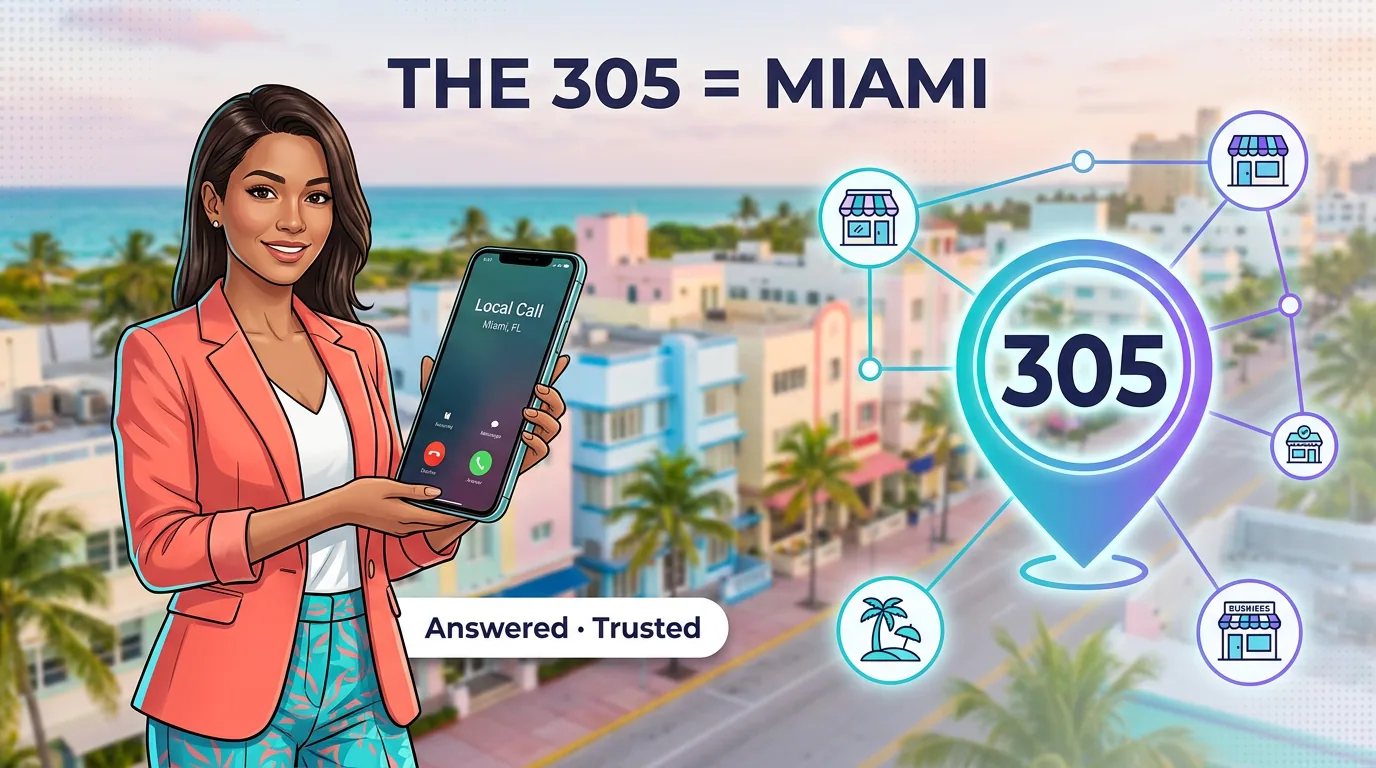
A local number gets answered. People recognize 305, trust it, and pick up — where an unknown or out-of-state code often goes to voicemail.
The practical benefits:
- Better answer rates — locals trust a code they know
- Cultural pull — 305 carries genuine Miami identity
- Stronger marketing — local numbers lift ad and campaign response
- No office needed — remote teams still look local
305 Scam Calls — What the Data Shows
The 305 area code is legitimate — a 1947 original. But Miami's size, wealth, and large immigrant population make it a high-value target for phone scams. FTC Do Not Call data logged 380 unwanted-call reports naming 305 numbers in a two-week period in late July 2026. Live voice and prerecorded calls split nearly evenly (37% each), with scam texts accounting for the remaining 26%.
Common 305 Scam Types
| Scam Type | Share of Complaints |
|---|---|
| Health insurance | 9.01% |
| Auto warranty | 9.01% |
| Medicare / Medicaid | 8.41% |
| Mortgage loans | 7.81% |
| Home improvement | 3.90% |
FPL (Florida Power & Light) impersonation — now AI-powered: The signature 305 scam. FPL warned in May 2026 of a surge in AI-generated scam calls — robocalls using realistic synthetic voices that offer "up to $3,000 in energy rebates and a new air conditioner at no cost." Older versions threaten same-day shutoff unless you pay with a Green Dot MoneyPak card. A variant specifically targets Hispanic FPL customers in Spanish. FPL never calls to demand immediate payment, offer rebates by phone, or threaten disconnection without written notice.
Immigration attorney impersonation: Scammers use AI to steal the identities of real South Florida immigration lawyers — using their photos, names, and signatures to build fake websites and social media profiles. They target immigrants seeking legal help, collecting thousands in upfront fees for services never delivered. A related $20 million immigration fraud ring was shut down in Orange County in 2026. USCIS and legitimate attorneys never demand cash payment upfront via phone.
Medicare and health insurance scams: At a combined 17.42%, health-related calls are the top category. Callers impersonate Medicare or private insurers, offering "updated" plans or "free" medical equipment — targeting Miami-Dade's large 65+ population and recent immigrants navigating the US healthcare system for the first time.
How to Protect Yourself
- FPL never calls to demand payment, offer rebates, or threaten same-day shutoffs by phone.
- Verify any immigration attorney's license status directly with the Florida Bar before paying.
- Never share personal data with an unexpected caller, even if the caller ID shows 305.
- Register your number with the National Do Not Call Registry at donotcall.gov.
How to Report 305 Scam Calls
- FTC: ReportFraud.ftc.gov or 1-877-FTC-HELP
- FCC: consumercomplaints.fcc.gov
- Florida Attorney General: (866) 966-7226
- Forward scam texts to 7726 (SPAM)
How to Get a Number in the 305 Region
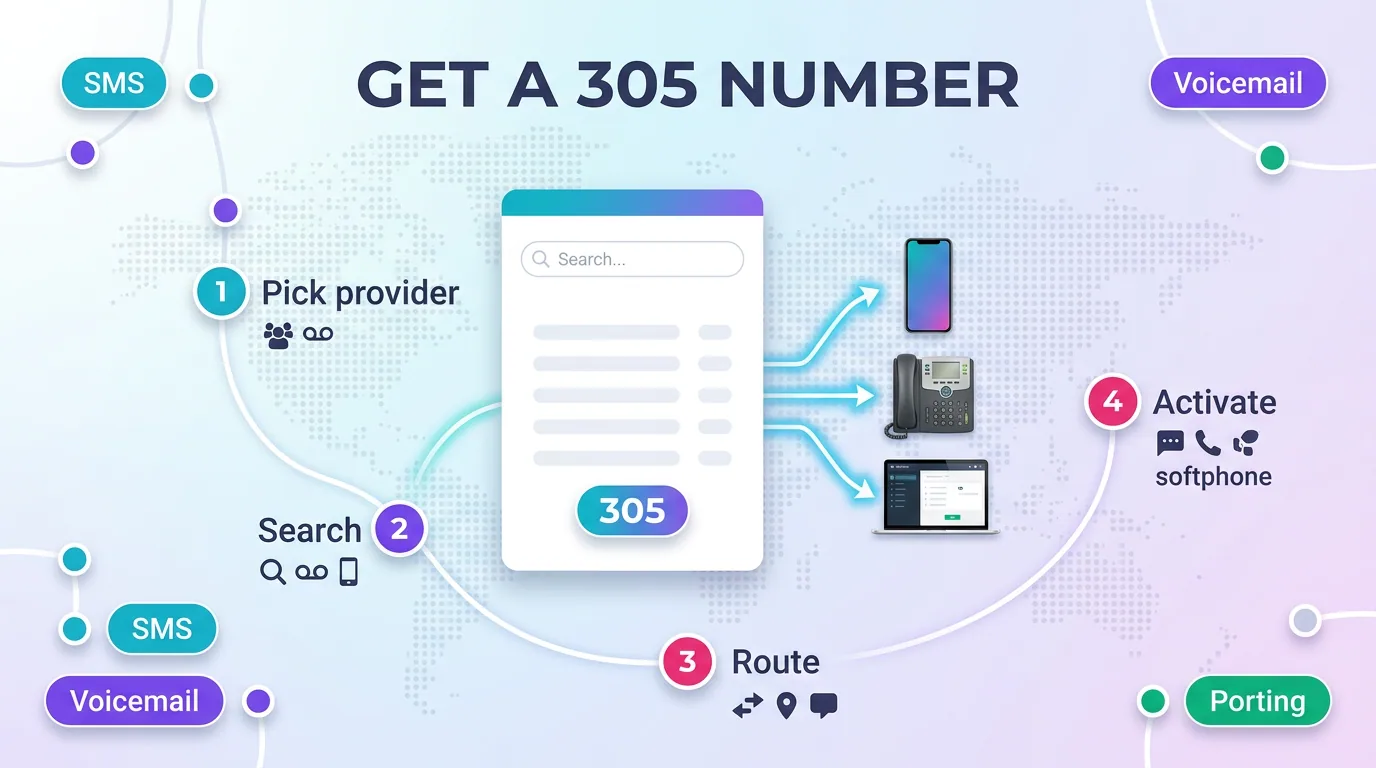
You don't need a Florida address. A cloud phone provider can assign you a Miami-area number that rings on your current phone, laptop, or app.
The process is quick:
- Pick a provider with South Florida number inventory
- Search available numbers in the 305 region
- Verify your account and activate
- Route your calls to a mobile, desk phone, or whole team
Ready to claim one? Explore available 305 numbers and route calls anywhere you work.
Ready when you are
Ready to sound local everywhere you sell?
MCM activates business numbers in minutes, with call routing, analytics, and CRM-ready integrations. Start your free trial — no card to browse inventory.
FAQs
What cities does the 305 area code cover?
It covers Miami and surrounding South Florida cities like Hialeah, Miami Gardens, Miami Beach, and Coral Gables, plus Key West and the Florida Keys.
What counties are in the 305 area code?
Three counties: Miami-Dade, Monroe (the Florida Keys), and a small part of Broward.
What time zone is the 305 area code in?
Eastern Time — EST (UTC-5) in winter and EDT (UTC-4) during daylight saving. It runs on the same clock as New York.
What are the 786 and 645 area codes?
They're overlays for the same region. The 786 code was added in 1998 and 645 in 2023, both because Miami ran low on available numbers. All three serve the identical area.
Do I need to dial 10 digits for a 305 number?
Yes. Because three codes overlay the same territory, every call — even a local one — requires the area code plus the seven-digit number.
Can I get a 305 number without living in Miami?
Yes. A virtual phone provider can assign you a Miami-area number that rings anywhere you have internet — no Florida address required.
How fast can I set up a 305 number?
With a cloud provider, activation usually takes just a few minutes once your account is verified.
What is the population of the 305 area code?
The 305 area code covers approximately 2.92 million people — 2.84 million in Miami-Dade County and 82,000+ in Monroe County (the Florida Keys). Miami-Dade is the 7th-most-populous county in the US and ranked #1 nationally for international migration. The median household income is $71,753, and 70.3% of residents identify as Hispanic or Latino.
How can I tell if a 305 call is a scam?
The most common 305 scam is FPL impersonation — callers now use AI-generated voices to offer fake energy rebates or threaten power shutoffs. FPL never calls to demand payment or offer rebates by phone. Other red flags include immigration attorney impersonation (verify any lawyer through the Florida Bar), Medicare enrollment scams, and auto warranty "final notice" robocalls. Health-related scams account for 17.42% of all 305 complaints combined.
Is 305 or 786 better for a Miami business?
Both 305 and 786 cover the exact same Miami-Dade territory with no technical difference. However, 305 is the original 1947 code and carries stronger cultural recognition — locals call themselves "the 305," and the prefix appears in music, clothing, and Miami identity. For brand positioning, 305 signals established Miami roots. If 305 availability is limited, 786 is a perfectly normal Miami number. The newest overlay, 645, is the same operationally but has less name recognition so far.
Sources
- North American Numbering Plan Administrator (NANPA)
- U.S. Census Bureau — Miami-Dade County QuickFacts
- Florida Public Service Commission
- Florida Attorney General — Consumer Protection
- FPL — Protect Yourself from Scams
- FTC — Report Fraud