Should Your Business Pick a 925 Number? An East Bay Buyer's Guide
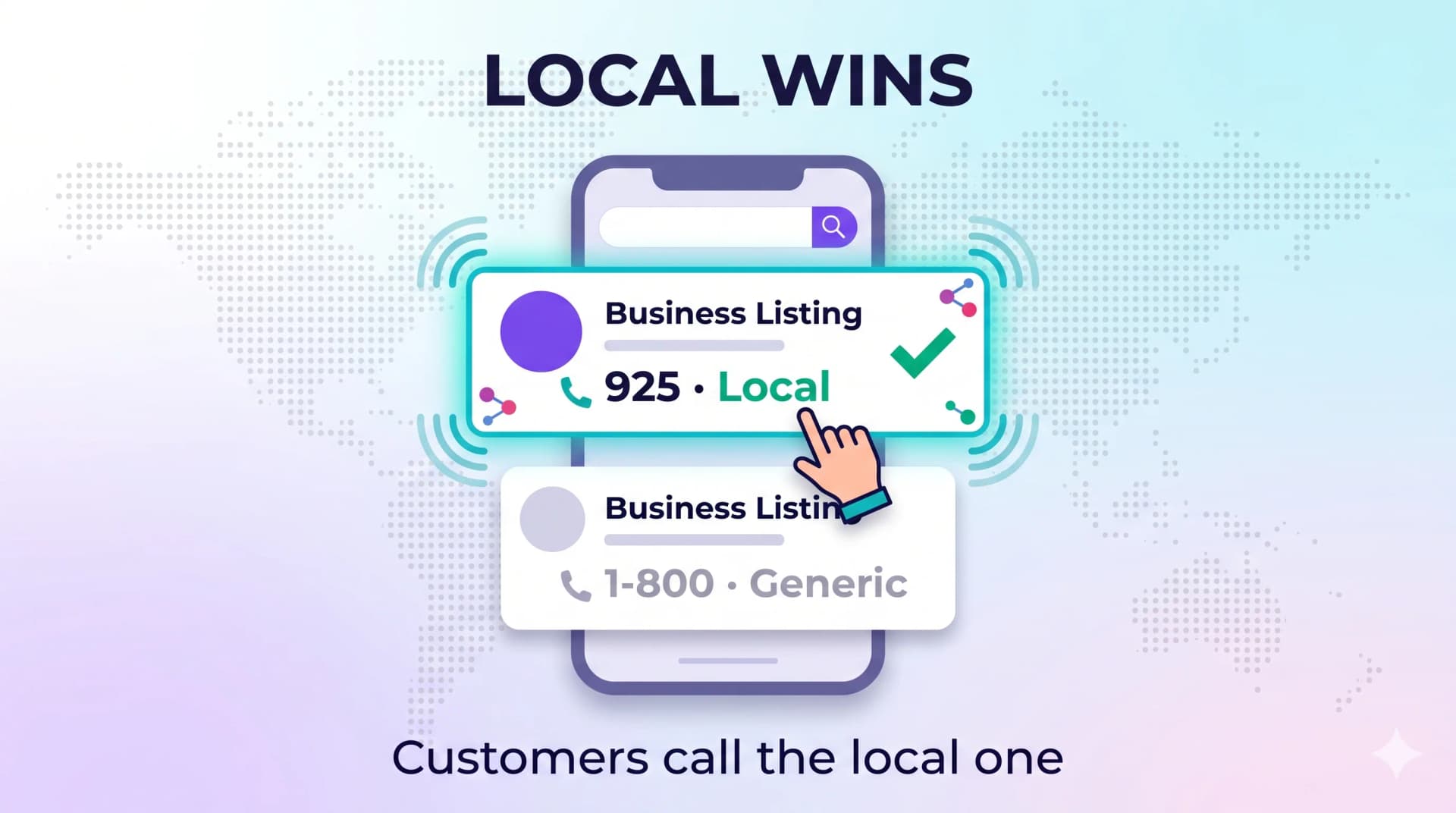
A customer in Walnut Creek sees two phone numbers on a search result. One starts with 925. The other is an 800 number from who-knows-where. They call the local one. That small bias decides more sales than most owners realize.
If you sell to the inland East Bay, the prefix on your number is doing quiet work before anyone says hello. This guide skips the trivia and answers the real questions: who actually sees a 925 line as "local," whether the code is stable for the long haul, and how to get one without a contract.
WHERE THE 925 REGION SITS
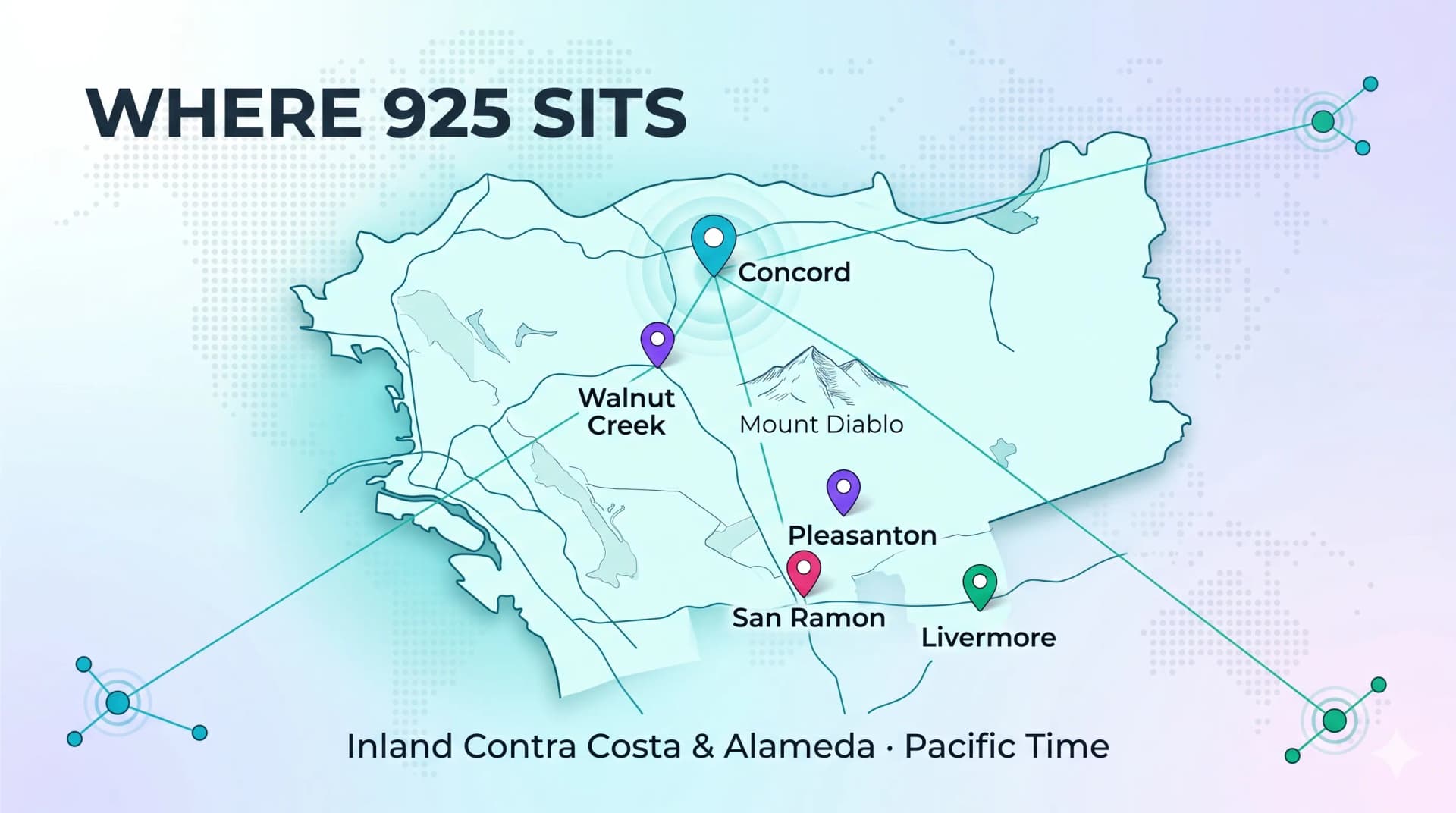
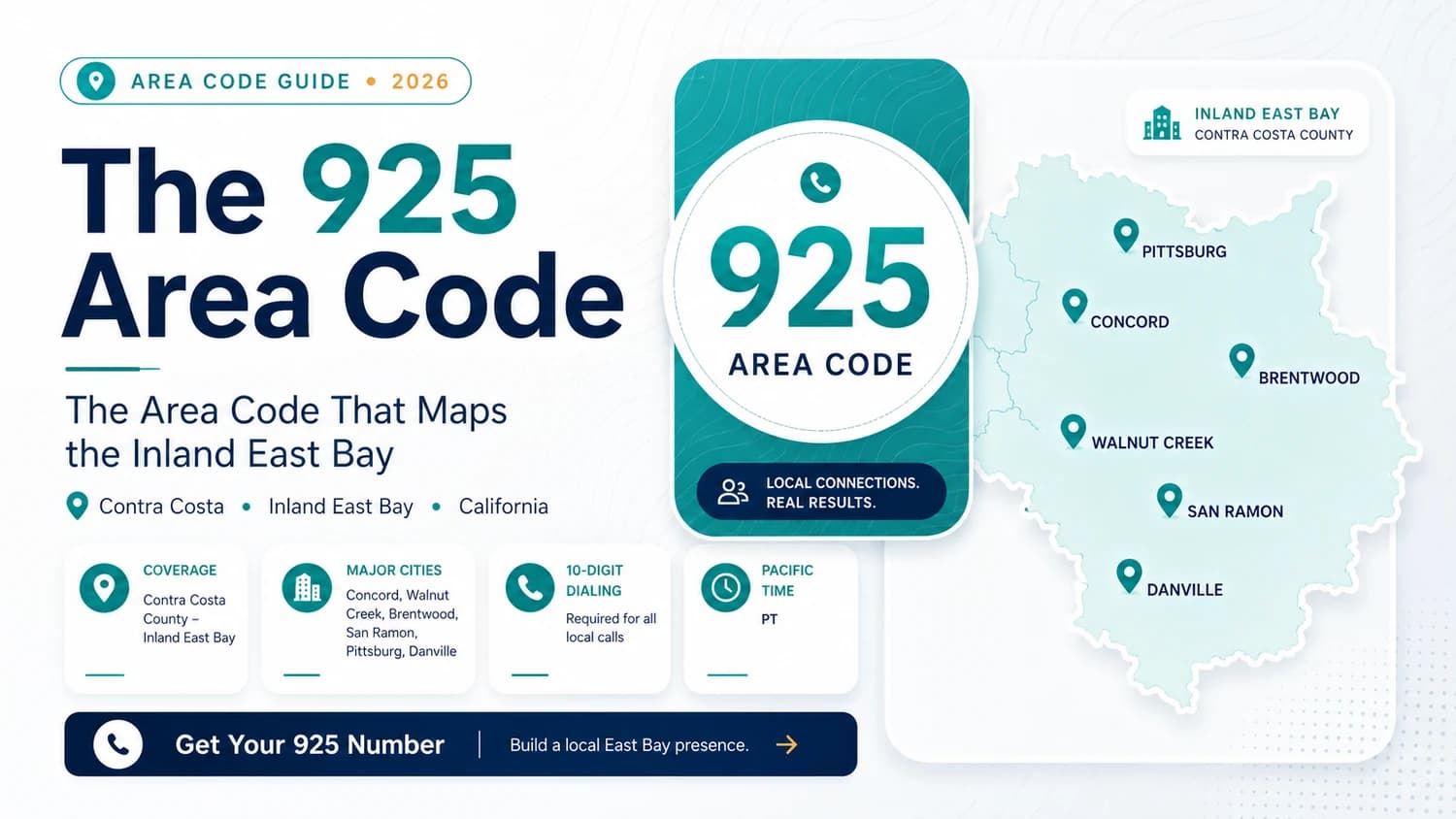
The 925 numbering plan covers the inland East Bay — the suburban and business corridors east of the Oakland-Berkeley hills. It is a Pacific Time Zone region inside the broader San Francisco Bay Area economy.
Counties It Reaches
The footprint spans inland Contra Costa County and inland Alameda County. Together these areas are home to roughly 2.8 million residents, making this one of California's denser suburban markets.
Cities Worth Knowing
The code anchors a long list of commuter and business hubs. The largest population centers shape where local-number trust matters most.
| City | County | Why It Matters for Business |
|---|---|---|
| Concord | Contra Costa | Largest city in the region, retail and services hub |
| Antioch | Contra Costa | Fast-growing residential and trades market |
| Pleasanton | Alameda | Corporate offices and Tri-Valley tech employers |
| San Ramon | Contra Costa | Headquarters belt, professional services |
| Walnut Creek | Contra Costa | Affluent retail and healthcare center |
| Livermore | Alameda | Manufacturing, wine country tourism, labs |
| Danville | Contra Costa | High-income residential clientele |
Smaller communities — Lafayette, Orinda, Martinez, Brentwood, Dublin, Pittsburg, Oakley and Pleasant Hill — round out a market that blends commuter wealth with active small-business demand.
IS THE CODE STABLE, OR ABOUT TO CHANGE?
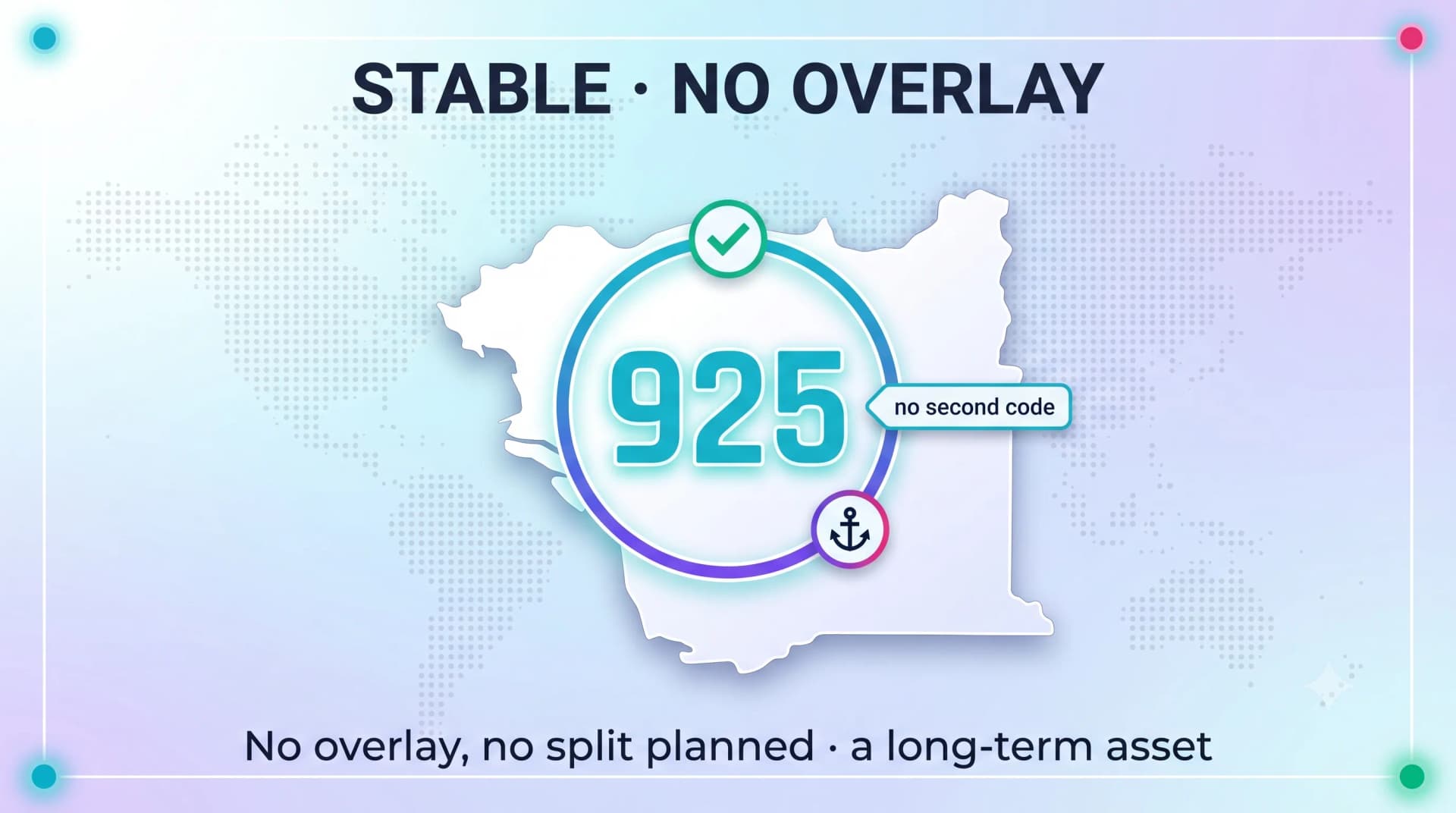
This is the question that actually affects a buying decision, and the answer is reassuring.
No Overlay, No Split Planned
Unlike most California metros, the 925 region still operates as a single, standalone code with no overlay layered on top. It was carved out of 510 back in 1998 and has not needed a numbering rescue since.
What That Means for You
Practically, callers inside the region can still recognize a seven-digit pattern instantly, and your number won't be disrupted by a forced renumbering. A number here is a stable, long-term asset — not a short-term placeholder.
If you're weighing locations, that stability is a quiet point in this region's favor. A local number you claim today is a local number you keep.
Ready when you are
Protect your business line.
MCM's local numbers ship with verified caller ID and smart call filtering — customers always know it's really you, and spam never reaches your team.
WHY A LOCAL PREFIX BEATS A GENERIC ONE
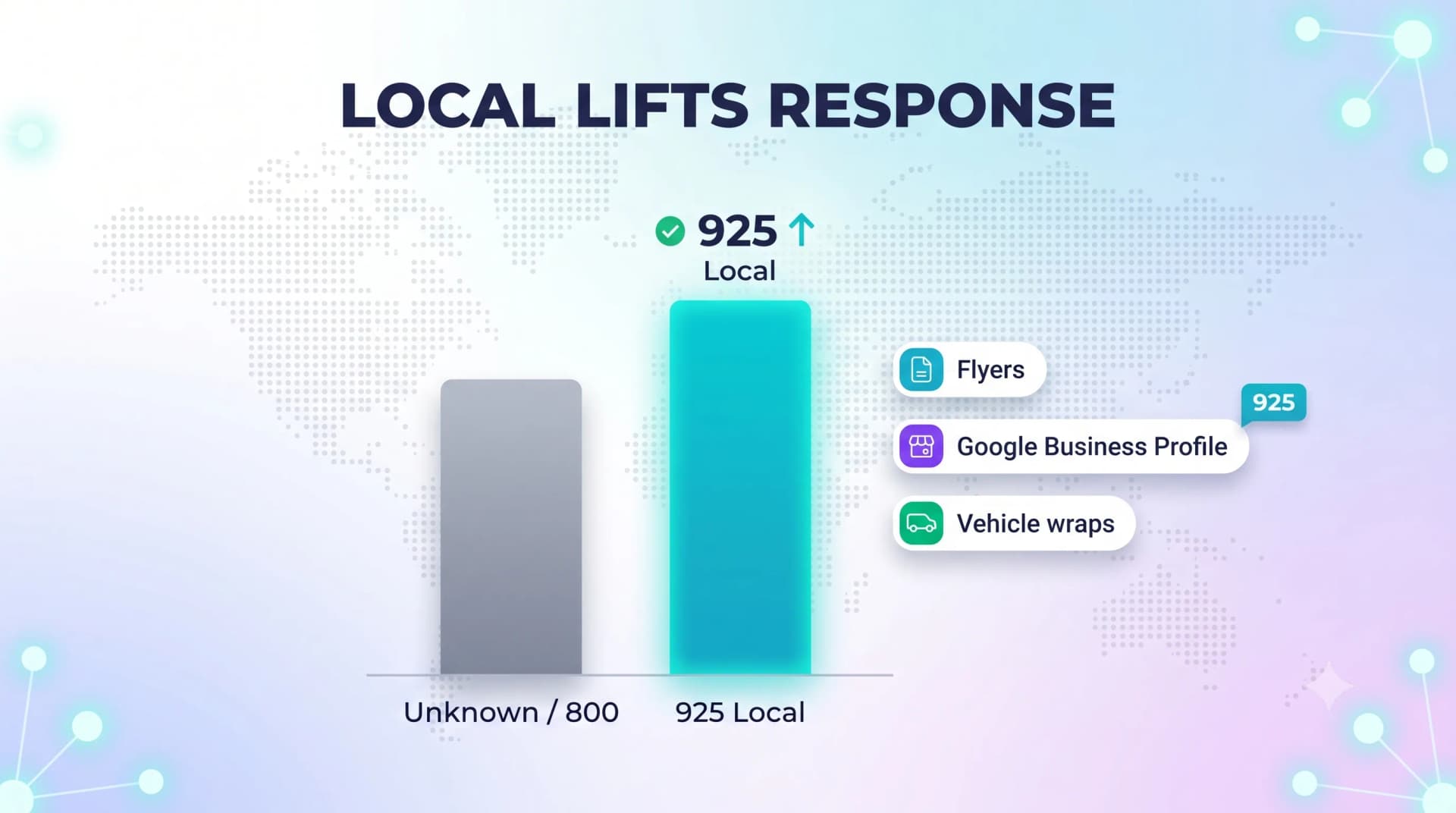
People answer, call back, and trust numbers that look like home. That instinct is measurable.
The Trust Signal
A familiar prefix tells a prospect "this business is part of my community." For service trades, clinics, agents and consultants, that perceived proximity often decides whether a call gets returned at all.
The Answer-Rate Effect
Unknown and toll-free numbers get screened harder than ever. A recognizable local number lifts pickup rates simply by not looking like a spam risk.
The Marketing Math
Put a local line on a flyer, a Google Business Profile, or a vehicle wrap and response rates climb. You're not changing the offer — you're removing a reason to hesitate.
If you already run ads in the Tri-Valley or Diablo Valley, swapping a generic number for a local one is one of the cheapest conversion fixes available. It costs less than a single week of ad spend.
YOU DON'T NEED A BAY AREA OFFICE
Here's what trips up remote and growing businesses: a local presence is no longer tied to a physical address.
Virtual Numbers, Explained
A virtual phone number is a real, dialable line that lives in software instead of on a copper wire. It rings wherever you want — a cell phone, a laptop, a call center — regardless of where you sit.
Who This Helps Most
- Remote firms entering the East Bay market without leasing space
- Multi-location brands that want a separate local line per metro
- Solo operators who need a business line that isn't their personal cell
- Campaign teams tracking which region drives which calls
The takeaway: a local identity is now a setting, not a real-estate decision.
HOW TO CLAIM A NUMBER — STEP BY STEP
Getting set up takes minutes, not weeks. Here's the realistic sequence.
Step 1: Search the Code
Open a virtual number provider and search for available lines in the 925 region. You'll see a list of options to pick from.
Step 2: Choose Memorable Digits
If you can find a number with a clean pattern or a sequence customers can recall, grab it. Easy-to-remember numbers pay off on print and signage.
Step 3: Set Routing Rules
Decide where calls land — your mobile, a team, or an IVR menu. Add business hours and after-hours voicemail so no call is lost.
Step 4: Add Numbers as You Grow
Need a second metro later? Add another local line under the same account. One dashboard, many markets.
For businesses comparing regions, MCM also publishes guides to other California codes — handy if you're deciding between East Bay and, say, a 415 San Francisco number for a multi-city footprint.
COMMON MISTAKES TO AVOID
A few avoidable errors weaken an otherwise smart local-number strategy.
Mixing One Number Across Regions
Using a single line for several metros muddies your call analytics. Use one local number per market you target.
Ignoring Call Routing
A local number that rings into the void wastes the trust it earned. Configure routing and voicemail before you publish it anywhere.
Locking Into Long Contracts
Numbering needs change. Choose a provider with month-to-month flexibility so growth doesn't get expensive.
WHAT TO DO NEXT
If your customers are in the inland East Bay, a recognizable local line is one of the simplest credibility upgrades you can make — and with no overlay on the horizon, it's a stable one.
Pick your routing rules, search for an available number, and put it on every customer touchpoint. The whole setup takes about five minutes.
Ready to claim one? Explore available East Bay numbers at mycountrymobile.com — no credit card, no contract, and live calling the same day.
Ready when you are
Ready to sound local everywhere you sell?
MCM activates business numbers in minutes, with call routing, analytics, and CRM-ready integrations. Start your free trial — no card to browse inventory.
FAQs
What region does the 925 area code cover?
It covers the inland East Bay of California — inland portions of Contra Costa and Alameda counties — including Concord, Pleasanton, Walnut Creek, San Ramon, Livermore and Antioch. The region runs on Pacific Time.
Is the 925 code being overlaid with a new code?
No. As of 2026 the region remains a single standalone code with no overlay and no split planned, so existing numbers are not at risk of disruption.
Can I get a 925 number without living in California?
Yes. A virtual number gives you a local East Bay line that rings to any phone or device anywhere — no Bay Area address or office lease required.
Does a local number really increase answer rates?
It does. Calls from recognizable local prefixes are screened less often than unknown or toll-free numbers, which lifts pickup and callback rates measurably.
How fast can I start using a new number?
With a virtual provider, you can search, select, configure routing and begin making and taking calls within minutes — often the same day.
Can I keep my number if I switch providers later?
Yes. Local numbers are portable. You can transfer an existing line to another provider without losing it, so you're never locked in.
How many numbers can one business have?
As many as you need. Many businesses run a separate local line per market they serve, all managed from a single account dashboard.