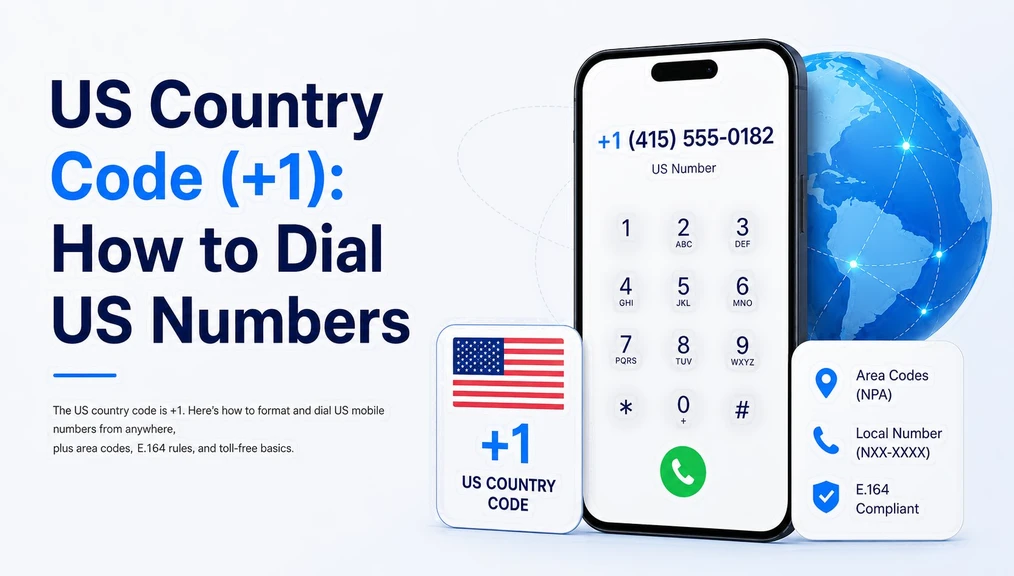
Quick answer: The US country code is +1. From abroad, dial your exit code, then
1, then the 10-digit US number — on a mobile, just press+and1. A US number is built as+1 (NPA) NXX-XXXX: country code, three-digit area code, then a seven-digit local number. For business systems, store every US number in E.164 (+14155550182— plus sign, country code, number, no separators). CRMs, SMS gateways, and voice APIs all require it.
US country code (+1): how to dial a US number from anywhere
You're trying to call, text, or save a US phone number — and it won't connect. Nine times out of ten, the problem isn't the number. It's a missing or misplaced country code.
The fix is simple once you see how a US number is built. This guide breaks down the +1 prefix, the 10-digit structure behind it, how to dial from inside and outside the country, and the formatting rules that keep numbers working in software and CRMs. No padding — just the parts that actually matter.
The short answer
The US country code is +1. You place it in front of the 10-digit number when calling from another country. A full US number looks like this: +1 (415) 555-0182 — country code, area code, then the seven-digit local number.
If your call fails from abroad, you're almost always missing the +1 or your country's exit code. We'll cover both below.
How a US phone number is built
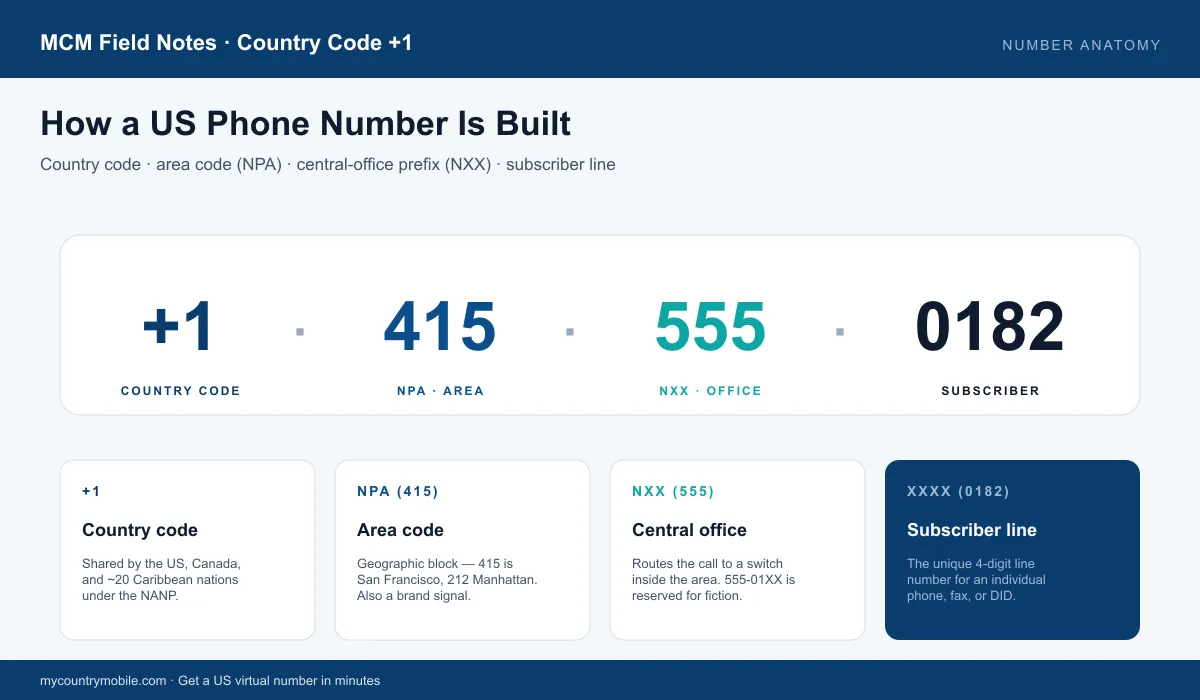
Every US number follows the same structure, governed by the North American Numbering Plan (NANP). Once you know the three parts, every number makes sense.
The standard format is: +1 (NPA) NXX-XXXX
- +1 — the country code shared by the US, Canada, and around 20 Caribbean nations
- NPA — the three-digit area code (212 for Manhattan, 415 for San Francisco)
- NXX-XXXX — the seven-digit local number: a central-office code plus a line number
A quick note on "555"
You've seen 555 numbers in movies for decades. That's deliberate. The range 555-0100 through 555-0199 is reserved for fictional use, so films can show a number without it ringing a real person. The rest of the 555 range is used for directory services and other special purposes.
Ready when you are
Protect your business line.
MCM's local numbers ship with verified caller ID and smart call filtering — customers always know it's really you, and spam never reaches your team.
How to dial a US number
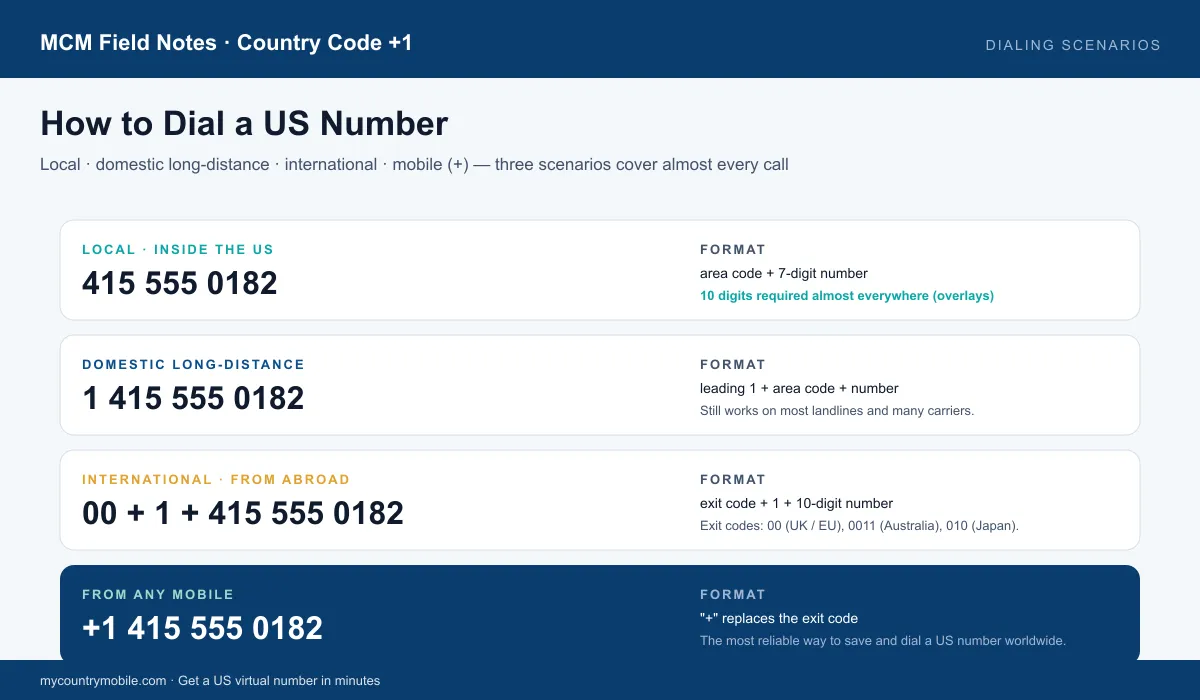
Dialing depends on where you're calling from. The biggest rule today: 10-digit dialing is standard for almost every local call in the US, thanks to area code overlays.
| Your situation | How to dial | Example |
|---|---|---|
| Local call (within the US) | Area code + number | 415-555-0182 |
| Domestic long-distance | 1 + area code + number | 1-415-555-0182 |
| International (from abroad) | Exit code + 1 + area code + number | 00 + 1 + 415-555-0182 |
On a mobile phone, you can usually replace your exit code with a + symbol — so +1-415-555-0182 works from almost anywhere. That's the most reliable way to save a number.
Why exit codes trip people up
An exit code is the number that lets you dial out of your country — and it isn't universal. Most of Europe and India use 00. Japan uses 010.
Australia uses 0011. Get the exit code wrong and the call fails before it ever reaches the +1. Using the + symbol skips this problem entirely on mobile.
If you make a lot of inbound or outbound international calls, a VoIP provider like My Country Mobile routes them over the internet — which sidesteps expensive per-minute carrier rates. Worth comparing if international calling is a regular cost for you.
The E.164 format: why it matters for business
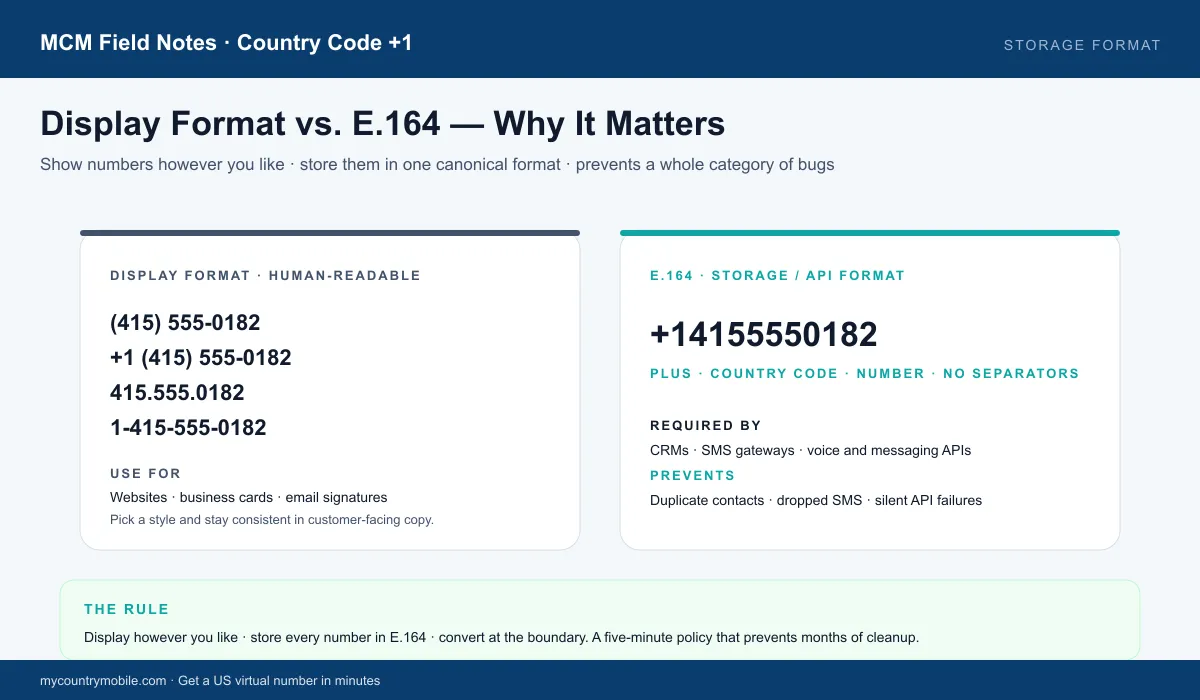
Here's something most dialing guides skip. If you store phone numbers in software, the display format isn't enough — you need E.164.
E.164 is the global standard for writing phone numbers. A US number in E.164 looks like +14155550182 — plus sign, country code, number, no spaces, no dashes, no parentheses. Why it matters: CRMs, SMS platforms, and APIs expect this exact format.
Where bad formatting breaks things
- CRM imports — inconsistent formats create duplicate or unreachable contacts
- SMS delivery — many gateways reject numbers that aren't in E.164
- API calls — voice and messaging APIs fail silently on malformed numbers
The rule for any business handling numbers at scale: display them however you like, but store them in E.164. It prevents a whole category of integration bugs.
Area codes: more than just geography
An area code is the three-digit block after +1. It started as a pure geographic marker — and it still signals location — but for businesses it's also a branding decision.
A local area code tells customers you're nearby. A Boston customer is far more likely to answer a 617 number than an unfamiliar out-of-state code. Some codes carry prestige: a 212 Manhattan number or a 312 Chicago number can lend a national brand an air of being at the center of its industry.
Why cities have multiple area codes
As populations grew, single area codes ran out of numbers. The fix was the overlay — adding a new code to the same region. That's why Houston spans 713, 281, 832, and 346, all covering the same city.
The side effect: in any overlay region, you must dial all 10 digits locally, because seven digits no longer uniquely identifies a line.
Choosing the right type of US number
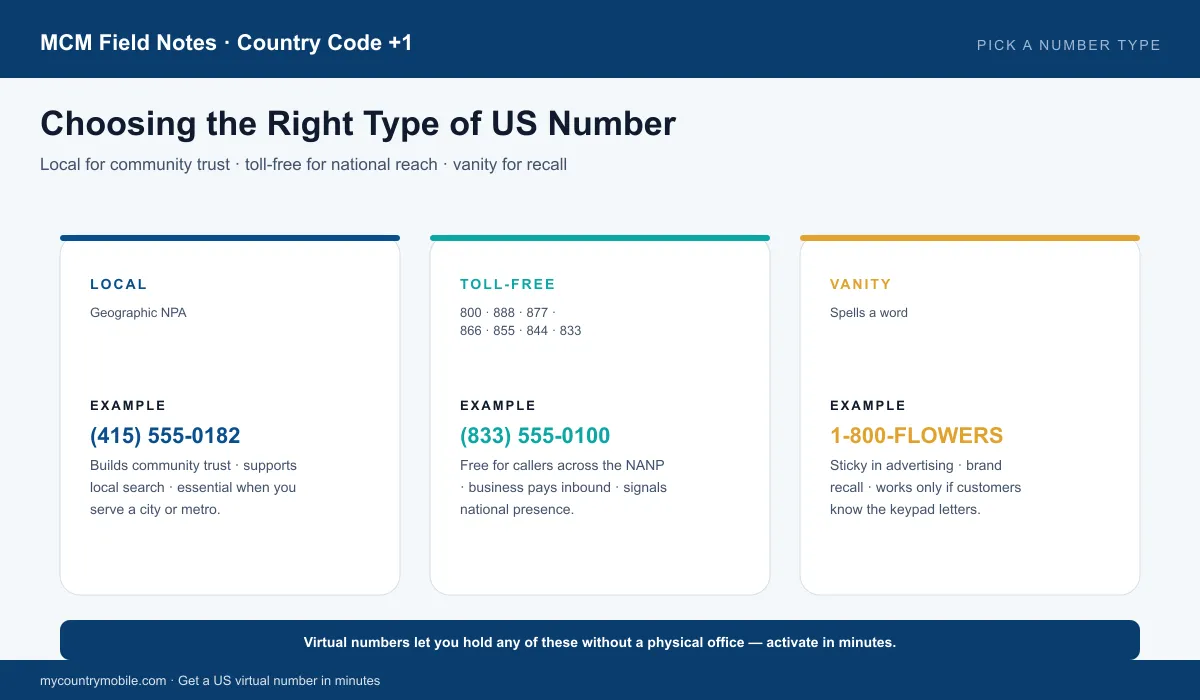
Not every business needs the same kind of number. Match the number type to the impression you want to make.
Local numbers — for community trust
If you serve a specific city, a local number is essential. It builds trust and supports local search visibility. With a virtual number, you can hold a local presence in any city without a physical office there.
Toll-free numbers — for national reach
Toll-free prefixes — 800, 888, 877, 866, 855, 844, 833 — let customers call free from anywhere in the NANP. The business pays for the call. All toll-free prefixes work identically; the 800 prefix carries the most prestige, while newer ones offer better availability.
Vanity numbers — for recall
A vanity number spells a word, like 1-800-FLOWERS. They're powerful in advertising because they stick in memory. They cost more and depend on customers knowing the keypad letters — but for brand-driven marketing, the recall is often worth it.
What to do next
The real lesson here: a phone number isn't just contact info — it's infrastructure. Get the +1 prefix and E.164 formatting right, and everything downstream (calls, texts, CRM syncs, API integrations) just works.
Start with the basics. Save every US number with its country code and a leading +. If you handle numbers in software, standardize on E.164 today — it's a five-minute policy that prevents months of cleanup.
If you're choosing a US number for your business, you can search local, toll-free, and virtual options and activate one in minutes with MCM's free trial — no contract, no credit card.
Ready when you are
Ready to sound local everywhere you sell?
MCM activates business numbers in minutes, with call routing, analytics, and CRM-ready integrations. Start your free trial — no card to browse inventory.
FAQs
What is the US country code?
The US country code is +1. It's shared with Canada and around 20 Caribbean nations under the North American Numbering Plan. You add it when dialing a US number from outside the country.
How do I call a US number from another country?
Dial your country's exit code, then 1, then the 10-digit number. On a mobile phone, you can replace the exit code with a + symbol — for example, +1-415-555-0182.
How many digits is a US phone number?
A US number is 10 digits: a three-digit area code plus a seven-digit local number. With the +1 country code, the full international number is 11 digits.
What is the E.164 format for a US number?
E.164 is the global standard format: +1 followed by the 10-digit number, with no spaces or symbols — for example, +14155550182. CRMs, SMS gateways, and APIs require it.
Why do I have to dial 10 digits for local US calls?
Most regions now use area code overlays — multiple codes covering one area. Because seven digits no longer identifies a unique line, you must dial the full 10 digits.
Can I keep my US number if I change phone providers?
Yes. Local Number Portability (LNP) lets you move your number to a new provider. Don't cancel your old service until the transfer is confirmed complete.
Are toll-free numbers free to call within the US?
Yes — for callers inside the US, Canada, and covered NANP regions. The business that owns the number pays. International callers pay their own carrier's rates.
Get a US +1 number for your business
A US presence used to require a US office. Now it's a few-minute sign-up.
My Country Mobile offers local, toll-free, and vanity +1 numbers with call forwarding, voicemail-to-email, SMS, IVR, and integrations with HubSpot, Zoho, Pipedrive, and Zendesk. Calls route to any device worldwide, and over 17,500 businesses already trust MCM with their virtual phone presence.