Introduction
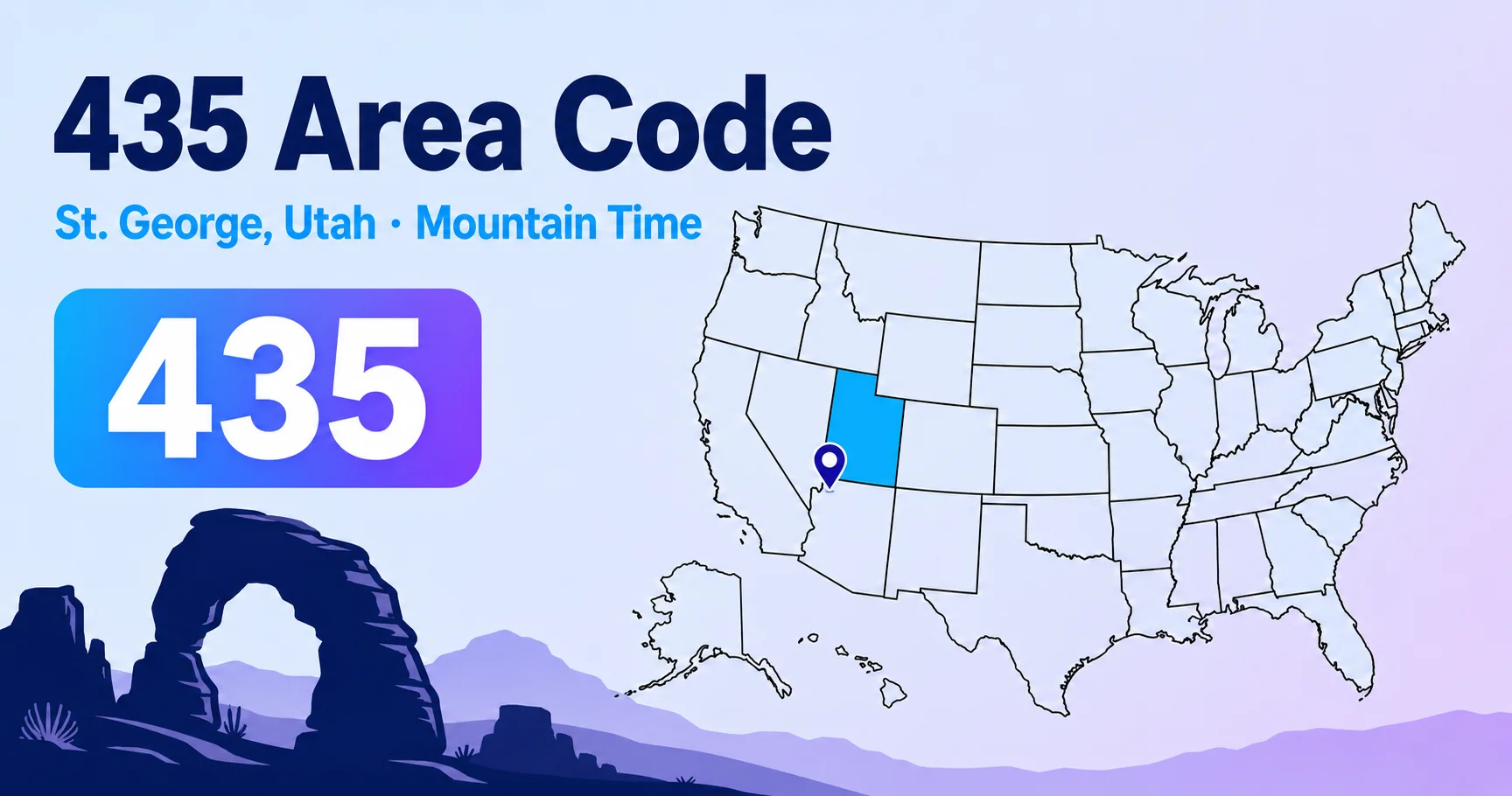
The 435 area code covers most of Utah outside the Wasatch Front — every phone number in St. George, Logan, Cedar City, Park City, and Moab begins with 435. Created in 1997 when Utah's original 801 code was split to handle rapid growth, 435 now spans 25 counties and more than 100 cities across the state's rural, scenic, and outdoor-recreation heartland.
Utah's 435 region is not a sleepy backwater — it is home to five national parks, the fastest-growing metro in the American West, a world-class ski industry, and a growing remote-work population drawn by scenery and lower costs. Understanding the 435 area code means understanding the geography and character of the state that surrounds it.
This guide breaks down exactly where 435 reaches, its major cities, dialing rules, time zone, why a local 435 number still matters for businesses, and how to stay safe from the scams that target it.
Where the 435 area code reaches

The 435 area code covers the vast geographic majority of Utah — roughly 82,000 square miles across 25 counties. What it does not cover is the Wasatch Front, the densely populated urban corridor running north-south through the center of the state. Salt Lake City, Ogden, and Provo — served by area codes 801 and 385 — sit outside 435's boundary.
Everything else is 435 territory: the red-rock canyon country of Moab and southeastern Utah, the world-class ski towns of Park City and Brian Head, the agricultural communities of Cache Valley around Logan, the booming southern hub of St. George, and the rural expanse of the Colorado Plateau stretching toward Nevada and Arizona.
Some US states still operate under a single area code for the entire state — Maine's 207 area code is one example, covering every county from Kittery to Fort Kent without a split. Utah's faster population growth and larger geography made a second code necessary before the end of the 1990s.
A short history of Utah's 435 code
When AT&T and the Bell System designed the North American Numbering Plan in 1947, Utah received area code 801 to serve the entire state. For five decades, 801 held.
By the mid-1990s, Utah's population was growing at one of the fastest rates in the country, and new technologies — cellular phones, pagers, fax machines, internet dial-up modems — were consuming telephone numbers faster than the original plan anticipated. The public utility commission determined that 801 would exhaust its available prefixes within years.
On September 21, 1997, Utah performed a geographic split. Area code 801 was narrowed to the Wasatch Front counties (Weber, Morgan, Davis, Salt Lake, and Utah), and the newly created 435 was assigned to the remaining 24 counties covering most of the state's land area. In 2015, area code 385 was introduced as an overlay for the Wasatch Front to supplement 801, but 435 has remained the sole code for its region with no overlay needed.
Ready when you are
Protect your business line.
MCM's local numbers ship with verified caller ID and smart call filtering — customers always know it's really you, and spam never reaches your team.
Major cities in the 435 area code
Every city and town outside Utah's Wasatch Front urban corridor falls under 435. The main population and economic centers are:
| City | County | Known for |
|---|---|---|
| St. George | Washington | Fastest-growing Utah city, gateway to Zion |
| Logan | Cache | Utah State University, Cache Valley farms |
| Park City | Summit | World-class ski resorts, Sundance Film Festival |
| Cedar City | Iron | Southern Utah University, Utah Shakespeare Festival |
| Moab | Grand | Arches & Canyonlands National Parks |
| Tooele | Tooele | Industrial hub west of Salt Lake metro |
| Hurricane | Washington | Southern gateway to Zion National Park |
| Price | Carbon | Castle Country, energy and mining history |
St. George anchors the southern end with a metro area approaching 200,000 residents and one of the fastest growth rates in the American West — driven by retirees, remote workers, and tourism tied to the nearby national parks. Logan anchors the north, serving Cache Valley's agricultural base and the university community at Utah State.
How to dial a 435 number
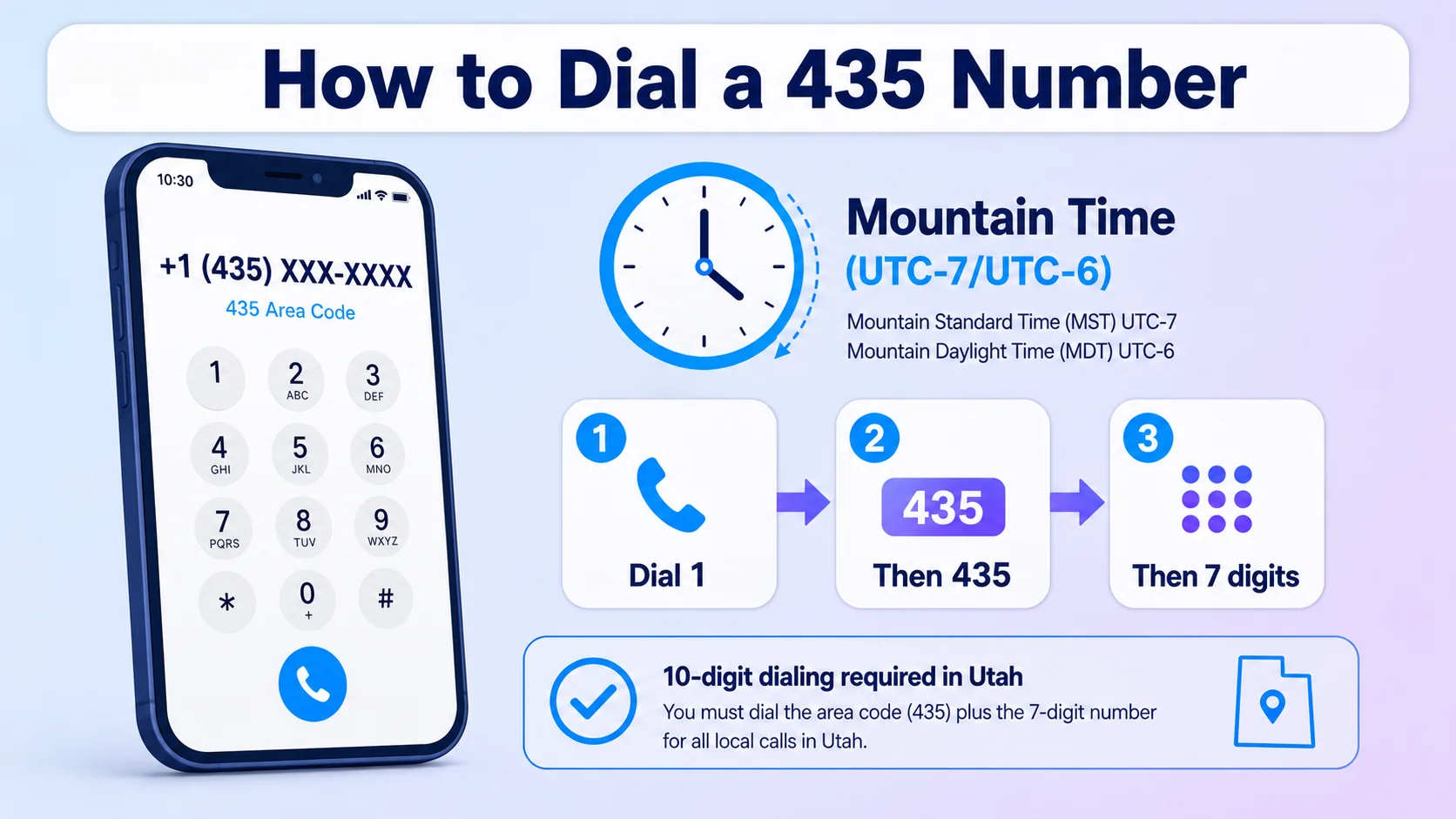
Dialing a 435 number follows the standard US format:
| Calling from | Format |
|---|---|
| Within the 435 area | 435-XXX-XXXX |
| Other US states (including 801/385) | 1-435-XXX-XXXX |
| International | +1 435 XXX XXXX |
Because Utah has three active area codes (435, 801, and 385), seven-digit local dialing is not used — ten-digit dialing has been required across the state since the 1997 split. Always dial all ten digits, even when calling a neighbor across the street.
The 435 area code sits in Mountain Time — Mountain Standard Time (UTC−7) from November to March and Mountain Daylight Time (UTC−6) from March to November. At noon in St. George, it is 2 PM in New York, 1 PM in Chicago, and 11 AM in Los Angeles.
Why choose a 435 number
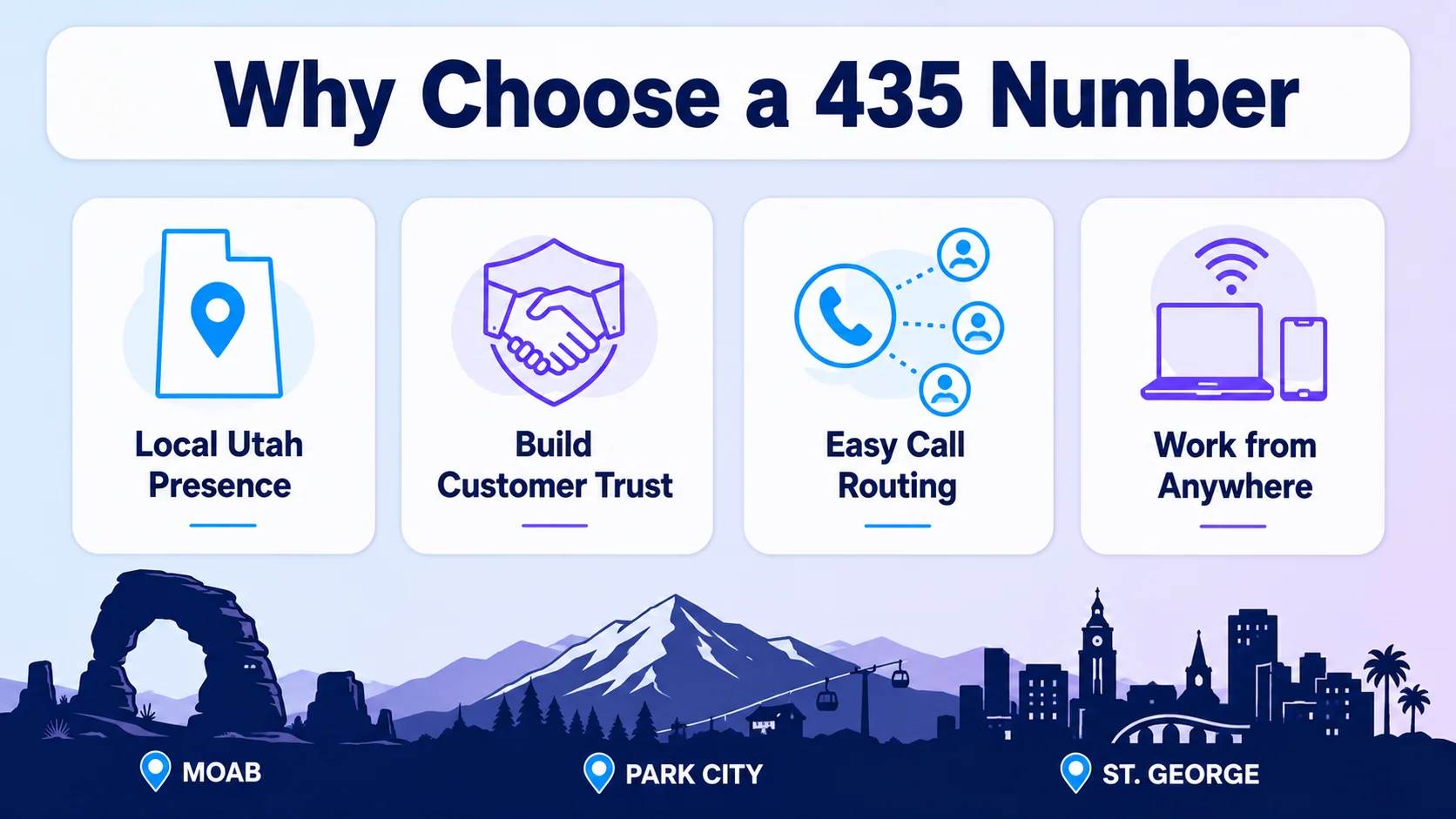
A local 435 number signals an immediate Utah presence — useful whether your business is based in St. George or you're serving Utah customers from a different state. Local numbers consistently earn higher answer rates than unfamiliar out-of-state codes, and a 435 number reads as "we're part of this community" on a business card, a website, or a job listing.
You do not need to live in Utah to hold a 435 number. Virtual phone providers assign the number and route calls to any device — a mobile phone, a desk phone, or a softphone app. That makes 435 a smart fit for businesses expanding into Utah's fast-growing southern corridor, for remote workers who relocated but kept Utah clients, or for e-commerce brands targeting outdoor enthusiasts traveling to Moab, Park City, or Zion.
NANPA confirms 435 still holds substantial unassigned capacity, making it the most available Utah business code today — a live number can be set up the same day, ringing on the devices you already use, with no long-term contracts.
Staying safe from 435 scam calls
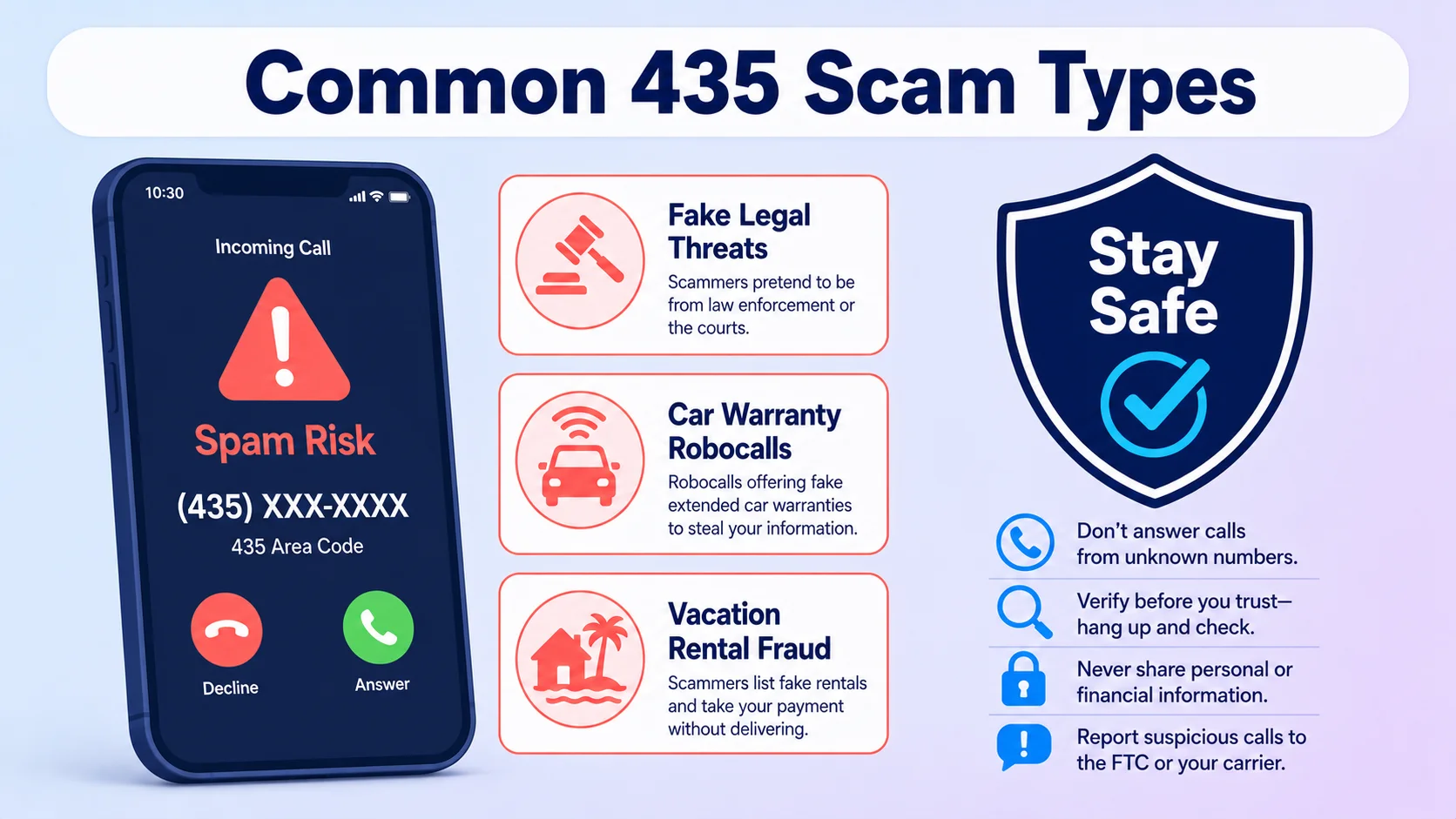
The 435 area code is a frequent target for caller-ID spoofing. Scammers display a Utah number on your screen while calling from anywhere in the world — a 435 prefix does not confirm the caller is local or legitimate.
Common patterns targeting 435 numbers include fake legal threats claiming outstanding lawsuits, Social Security impersonators, extended car-warranty robocallers, and "neighbor spoofing" that shows a number matching your own prefix. Utah's strong tourism profile also attracts vacation-rental scammers targeting travelers booking trips near Zion, Arches, Bryce Canyon, or Park City ski resorts.
Scam tactics targeting 435 echo patterns seen across the country — including in the 436 area code covering Northeast Ohio. Modern smartphones automatically label many suspicious numbers as "Spam Risk" or "Scam Likely" thanks to nationwide call authentication standards. The safest rule: if an unexpected 435 caller pressures you for payment or personal details, hang up and call the organization back on a number you find yourself.
Key takeaways
- The 435 area code covers most of Utah outside the Wasatch Front — 25 counties, 100+ cities including St. George, Logan, Park City, Cedar City, and Moab
- It was created on September 21, 1997, split from the original 801 code due to rapid population growth and technology demand
- 435 runs on Mountain Time — UTC−7 in winter, UTC−6 in summer
- Ten-digit dialing is required throughout Utah; seven-digit local dialing is not used
- A local 435 number builds instant Utah credibility and can be held from anywhere via a virtual provider
- Scammers actively spoof 435 numbers — verify unexpected callers before sharing money or personal information
Conclusion
The 435 area code is more than a telephone prefix — it is the calling identity of the vast, scenic majority of Utah. From the red-rock canyons of Moab to the ski runs of Park City, from the university halls of Logan to the sun-baked growth corridors of St. George, every community outside the Wasatch Front shares this single code. That geographic sweep makes 435 one of the most geographically diverse area codes in the Mountain West.
For individuals, knowing where 435 reaches helps you dial correctly, read your caller ID accurately, and spot spoofed numbers before you answer. For businesses, a local 435 number is a credibility signal in a region where community ties still carry weight — whether you're serving retirees in Washington County, tourists in the national park belt, or university families in Cache Valley.
Whatever your reason for looking up 435, the takeaway is the same: it is a legitimate, long-standing Utah area code that has served its region since 1997 and shows no signs of splitting or overlaying anytime soon.
Ready when you are
Ready to sound local everywhere you sell?
MCM activates business numbers in minutes, with call routing, analytics, and CRM-ready integrations. Start your free trial — no card to browse inventory.
Frequently asked questions
Where is the 435 area code located?
The 435 area code covers most of Utah outside the Wasatch Front — all counties except the Salt Lake City, Ogden, and Provo metro areas, which use area codes 801 and 385.
What cities are in the 435 area code?
Major cities include St. George, Logan, Park City, Cedar City, Moab, Tooele, Hurricane, and Price. Over 100 cities and towns across 25 Utah counties fall under 435.
What time zone is the 435 area code in?
Mountain Time. The 435 area code observes Mountain Standard Time (UTC−7) in winter and Mountain Daylight Time (UTC−6) in summer.
When was the 435 area code created?
Area code 435 went into service on September 21, 1997, when it was split from the original 801 area code to address Utah's rapid population and technology growth.
Does the 435 area code cover Salt Lake City?
No. Salt Lake City and the broader Wasatch Front are served by area codes 801 and 385. The 435 area code begins where those metro regions end.
Can I get a 435 number without living in Utah?
Yes. Virtual phone providers let you obtain and use a 435 number from any location, routing calls to whichever device you choose.
Is seven-digit dialing allowed in the 435 area code?
No. Because Utah has multiple area codes, ten-digit dialing is required throughout the state. Always dial the full 435 + seven-digit number.
Is the 435 area code used for scams?
The 435 area code itself is legitimate, but scammers do spoof 435 numbers to appear local. If an unexpected caller with a 435 number pressures you for money or personal information, hang up and verify the organization through a trusted contact number.