Quick answer: Area code 737 is a telephone overlay covering Austin and its Central Texas suburbs — sharing the exact same territory as area code 512. Activated on July 1, 2013, it was introduced to relieve number exhaustion driven by Austin's booming tech sector and population growth. The territory operates in the Central Time Zone, and ten-digit dialing has been mandatory since 737 launched.
What area code 737 covers across the Austin metro
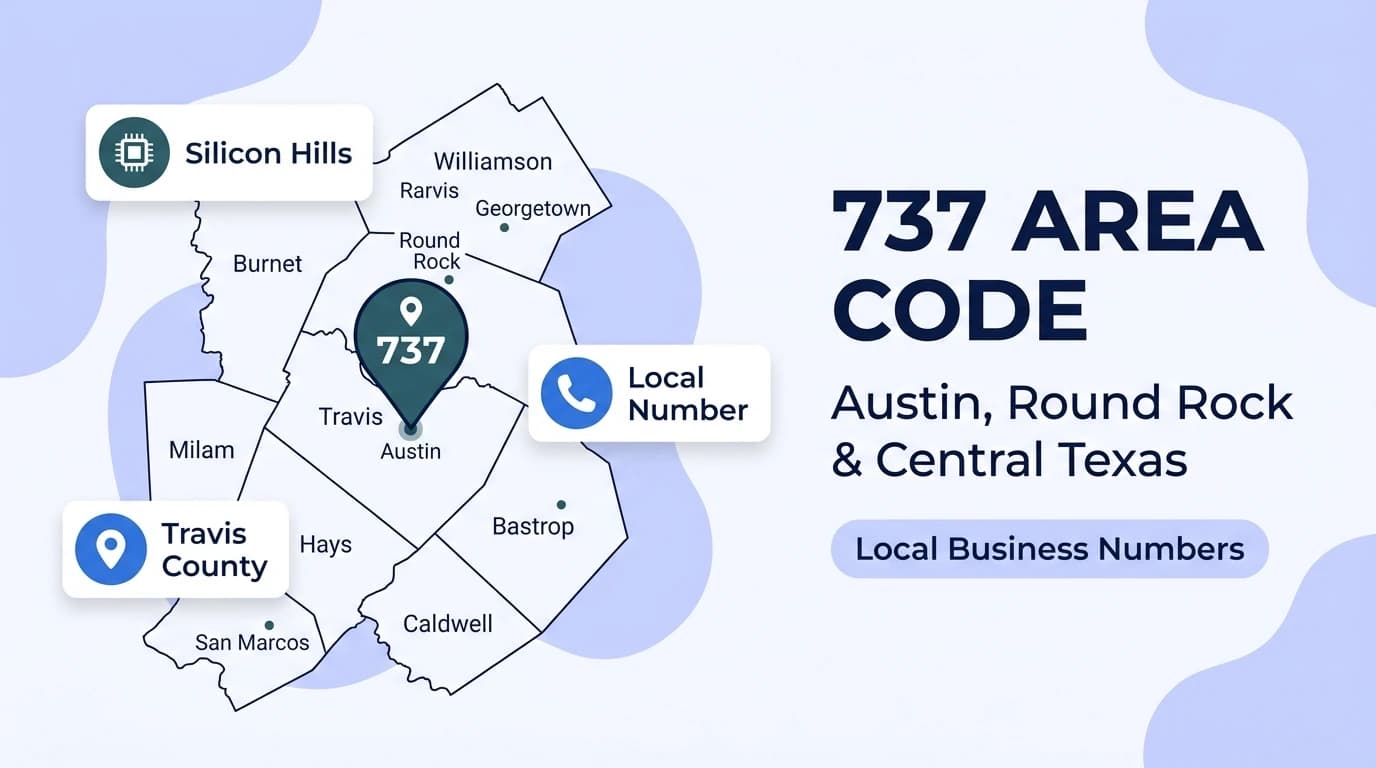
Area code 737 does not mark out its own territory — it is layered directly on top of the region already served by 512. Both codes cover the exact same footprint: Austin, the capital of Texas, and the fast-growing suburban counties that ring it.
This all-services overlay means new phone numbers issued anywhere in the region can carry a 512 or 737 prefix, regardless of which one a caller's neighbor happens to have. No existing number changed when 737 launched — it simply expanded the pool of numbers available as Austin's population and its "Silicon Hills" tech sector kept expanding.
Pairing a 737 number with a 621 area code Houston presence creates a natural Texas Triangle corridor, connecting Austin's technology and state-government economy with Houston's energy, healthcare, and port-driven markets.
| Detail | Value |
|---|---|
| Number Plan Area (NPA) | 737 |
| Overlay for | 512 |
| Location | Austin metro, Central Texas |
| Type | All-services overlay |
| Time Zone | Central Time (CT) |
| Activated | July 1, 2013 |
| State | Texas |
| Country Code | +1 |
Austin, Round Rock, and the cities sharing a 737 number

The 737 territory spans seven counties across Central Texas, stretching from the Hill Country west of Austin to the fast-growing suburban corridors north and south of the capital.
Travis County and the Austin core:
- Austin — The capital of Texas and the region's tech, government, and music-industry anchor
- Pflugerville and Manor — Fast-growing eastern Travis County suburbs
Williamson County suburbs:
- Round Rock — Home to Dell Technologies' global headquarters and a major supplier and logistics base
- Georgetown — The Williamson County seat and one of the fastest-growing cities in the United States
- Cedar Park and Leander — Dense residential and commercial growth corridors along US-183
Hays and outer counties:
- San Marcos (Hays County) — Home to Texas State University, positioned between Austin and San Antonio
- Kyle and Buda (Hays County) — Rapidly expanding bedroom communities south of Austin
- Bastrop and Burnet — Hill Country and rural communities anchoring the territory's outer edges
| Sub-region | Key communities |
|---|---|
| Travis County / Austin core | Austin, Pflugerville, Manor |
| Williamson County | Round Rock, Georgetown, Cedar Park, Leander |
| Hays County | San Marcos, Kyle, Buda |
| Outer counties | Bastrop, Burnet, Caldwell |
From one code to two: how 512 became 512 and 737
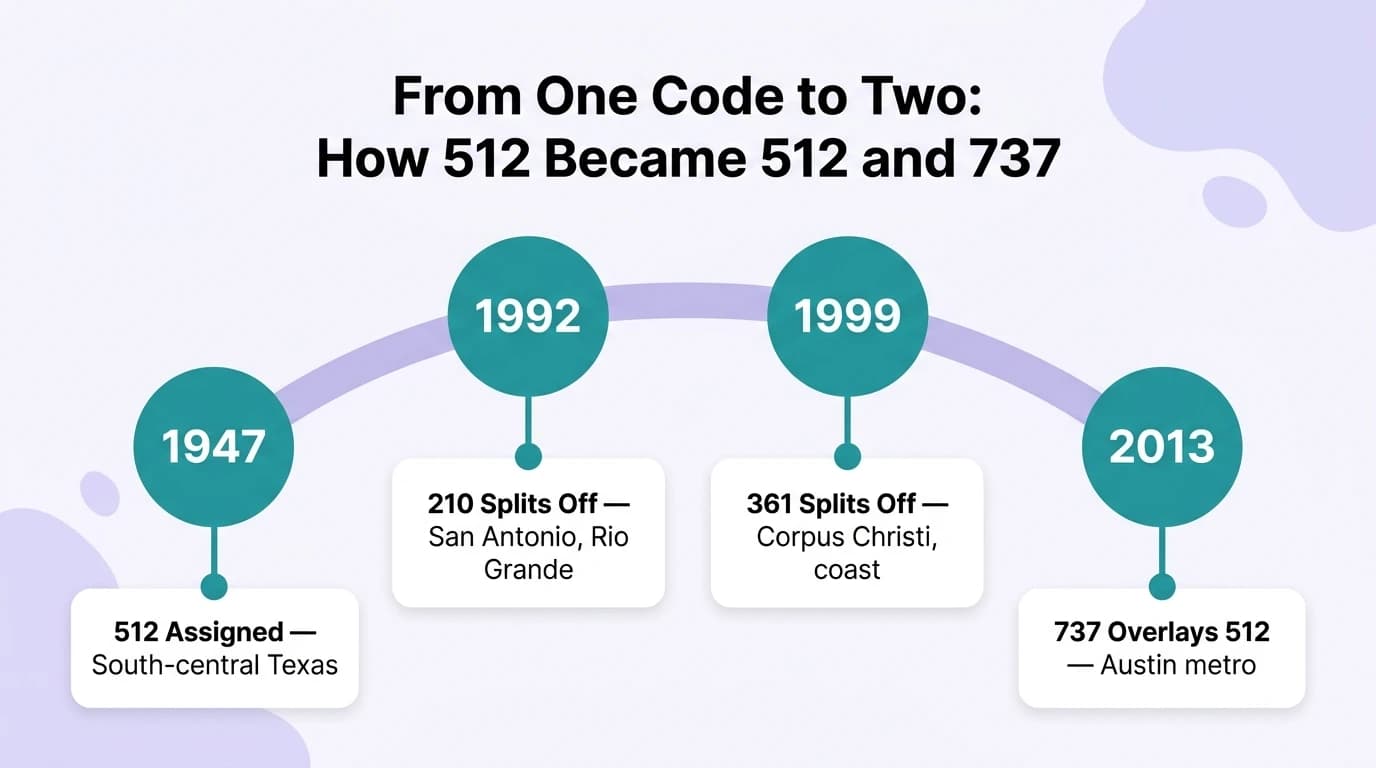
Area code 512 was one of the original area codes assigned in October 1947, covering the entire south-central swath of Texas from the Gulf of Mexico to the Mexican border, including Austin, San Antonio, Corpus Christi, and the Rio Grande Valley.
As South Texas grew, 512 was split twice to keep pace. In 1992, San Antonio and the Rio Grande Valley split off to form area code 210. In February 1999, Corpus Christi and the coastal region split off to form area code 361, leaving 512 covering only Austin and its immediate surroundings.
Even with a much smaller footprint, Austin's population boom and its rise as a major technology hub pushed 512 toward exhaustion again within just over a decade. Rather than force another disruptive split, the Public Utility Commission of Texas approved an overlay. Area code 737 entered service on July 1, 2013, adding a fresh supply of numbers to the same Austin-area footprint.
| Milestone | Detail |
|---|---|
| October 1947 | Area code 512 assigned to south-central Texas, including Austin |
| 1992 | Area code 210 splits off for San Antonio and the Rio Grande Valley |
| February 1999 | Area code 361 splits off for Corpus Christi and the coast |
| July 1, 2013 | Area code 737 overlays 512 for the Austin metro |
Ready when you are
Protect your business line.
MCM's local numbers ship with verified caller ID and smart call filtering — customers always know it's really you, and spam never reaches your team.
Ten-digit dialing across the 512 and 737 territory
Because two area codes share one territory, every call placed within the region — even between two phones in the same Austin neighborhood — must include the area code.
| Calling scenario | Format |
|---|---|
| Any local call within the 512/737 territory | 737-XXX-XXXX (ten digits mandatory) |
| Anywhere else in the US or Canada | 1-737-XXX-XXXX |
| International call to a 737 number | +1 737 XXX XXXX |
Time zone: The entire 737 territory observes Central Time — the same zone as Dallas, Houston, and San Antonio. Businesses coordinating between Austin and the rest of the Texas Triangle never need to account for a time difference.
Why Austin's Silicon Hills businesses choose a 737 number
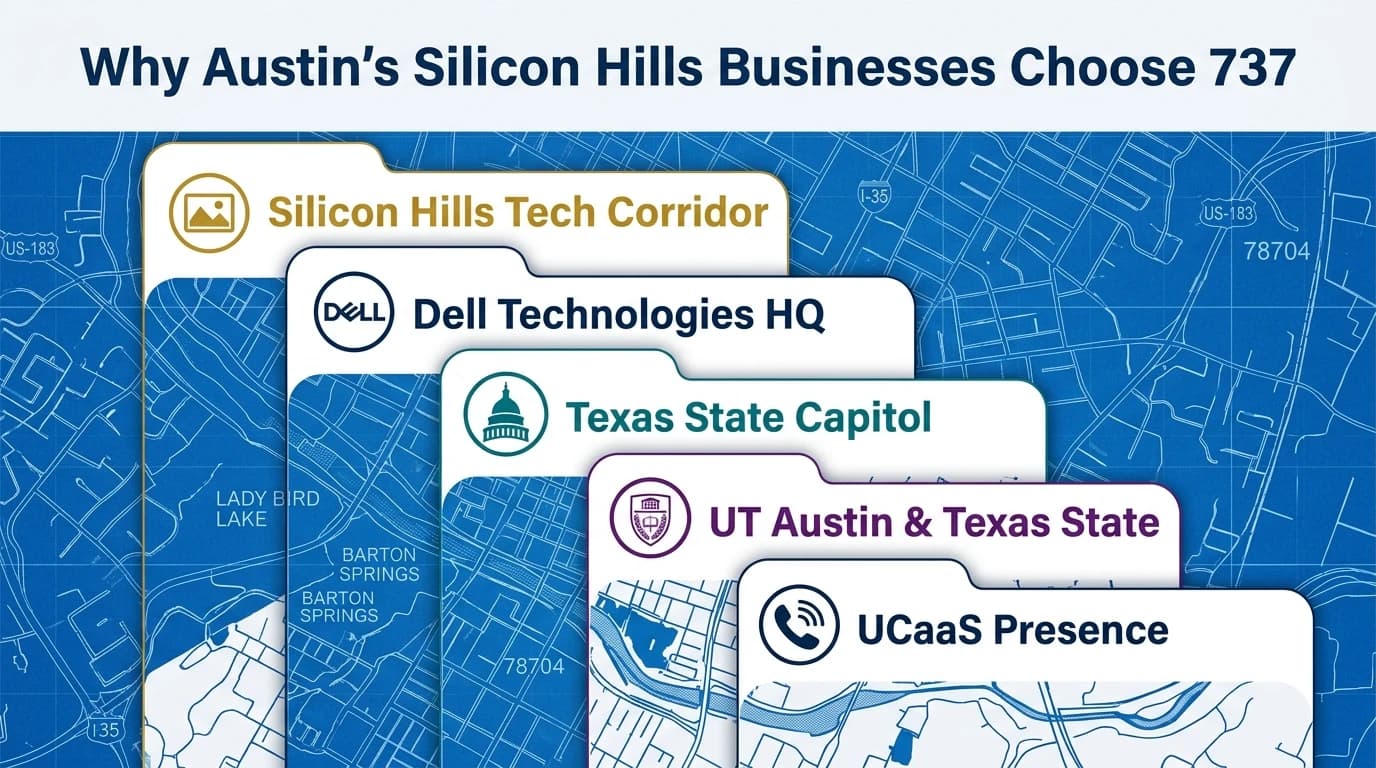
A 737 area code number places a business inside one of the fastest-growing technology and innovation economies in the country.
Key reasons to establish a 737 area code number:
- Silicon Hills tech corridor — Apple, Tesla, Oracle, and a dense cluster of venture-backed startups have built a major technology hub across Austin and Williamson County, alongside long-established anchors like IBM and AMD
- Dell Technologies headquarters (Round Rock) — One of the world's largest technology companies anchors a substantial supplier, logistics, and enterprise IT services economy in Williamson County
- Texas State Capitol and state government — As the seat of Texas government, Austin supports a deep base of public-sector contracting, legal, and lobbying firms
- University of Texas at Austin and Texas State University — Two major research universities feed a steady pipeline of engineering, business, and technology talent across the region
- UCaaS virtual Austin presence — Businesses targeting Austin's tech, government, or education markets from outside Texas can establish immediate local credibility through a Unified Communications as a Service (UCaaS) platform, provisioning a 737 number with cloud-hosted voice, video, messaging, and analytics routed to any device worldwide; pairing a 737 number with a 734 area code Ann Arbor presence creates a natural university-anchored tech corridor connecting Austin's Silicon Hills with Michigan's own research-driven innovation economy
AI voice cloning and other 737 area code scam calls

Area code 737 is a legitimate telephone prefix serving Austin and Central Texas residents and businesses — but Austin's 512/737 territory consistently ranks among the highest in Texas for robocall complaints, and scammers actively spoof 737 numbers to appear local.
Most frequently reported 737 scam types:
- Debt relief robocalls — Now the single most reported scam nationally, with prerecorded calls offering to erase credit card or loan debt in exchange for upfront fees
- AI voice cloning fraud — A fast-growing high-tech twist on the classic "grandparent scam," using cloned voices of family members to request emergency wire transfers
- Government agency impersonation — Callers pose as the IRS, Social Security Administration, or FTC, threatening legal action or benefit suspension unless personal information or payment is provided immediately
- Medicare and health insurance fraud — Calls offering fraudulent insurance enrollment or discount coverage, often targeting seniors across the Austin metro
Staying protected: No legitimate government agency, family member emergency, or debt collector demands immediate payment over an unsolicited call. Report suspected 737 scam calls to the FTC at reportfraud.ftc.gov or complaints.donotcall.gov.
737 area code: key numbers to know
- Area code 737 overlays 512 across Austin, Round Rock, Georgetown, San Marcos, and the surrounding Central Texas counties
- It was activated on July 1, 2013, to relieve number exhaustion driven by Austin's tech-sector growth
- Ten-digit dialing is mandatory for every call, local or long-distance
- The entire territory observes Central Time — aligned with Dallas, Houston, and San Antonio
- Major economic anchors include Dell Technologies, the Texas State Capitol, the University of Texas at Austin, and the Silicon Hills tech corridor
- The most reported 737 scam types are debt relief robocalls, AI voice cloning fraud, government agency impersonation, and Medicare fraud
Ready when you are
Ready to sound local everywhere you sell?
MCM activates business numbers in minutes, with call routing, analytics, and CRM-ready integrations. Start your free trial — no card to browse inventory.
Frequently asked questions
What is the 737 area code?
Area code 737 is a telephone overlay code serving Austin, Texas, and its Central Texas suburbs. Activated on July 1, 2013, it shares the exact same territory as area code 512, meaning new numbers issued anywhere in the region can carry either prefix.
Where is the 737 area code located?
Area code 737 covers Austin and the surrounding Central Texas counties of Travis, Williamson, Hays, Bastrop, Burnet, Caldwell, and Milam, including the cities of Round Rock, Georgetown, San Marcos, Cedar Park, Pflugerville, Kyle, and Buda.
Is 737 the same as the 512 area code?
Not exactly the same code, but the same territory. Area code 737 is an overlay, meaning it covers the identical geographic footprint as 512 rather than a separate region. A 737 number is just as local to Austin as a 512 number.
When was the 737 area code created?
Area code 737 was activated on July 1, 2013. It followed area code 512, which originally covered south-central Texas from 1947 until San Antonio split off as 210 in 1992 and Corpus Christi split off as 361 in 1999, leaving 512 covering only the Austin area before the 737 overlay was added.
What time zone is the 737 area code in?
Area code 737 is in the Central Time Zone. The entire territory observes Central Standard Time (UTC−6) in winter and Central Daylight Time (UTC−5) during daylight saving time, the same zone as Dallas, Houston, and San Antonio.
Why does Austin have two area codes?
Austin and its Central Texas suburbs share two overlapping area codes, 512 and 737, because an overlay was chosen over another geographic split. Regulators determined that adding a new overlay code was less disruptive to the region's booming tech and business community than forcing existing residents to change their phone numbers.
Can I get a 737 number for a business outside Texas?
Yes. Virtual phone providers and UCaaS platforms offer 737 area code numbers to businesses and individuals regardless of physical location. A virtual 737 number establishes authentic Austin presence, routes all calls to any device anywhere in the world, and connects your business with Austin's technology, government, and education markets without a physical Texas office.
Is the 737 area code associated with scam calls?
Area code 737 is a legitimate telephone prefix for Austin and Central Texas, but the shared 512/737 territory ranks among the highest in the state for robocall complaints, and scammers actively spoof 737 numbers to appear local.
The most heavily reported fraud types include debt relief robocalls, AI voice cloning scams, government agency impersonation, and Medicare fraud. Any unsolicited call demanding immediate payment or personal information is a scam regardless of caller ID.