Quick answer: The 956 area code covers South Texas's border region — Laredo, McAllen, Brownsville, Harlingen, Edinburg, and the rest of the Rio Grande Valley. It has been its own dedicated area code since 1997, runs on Central Time, and anchors one of the busiest international trade corridors in the country.
Introduction
Few area codes sit on an international border, and even fewer anchor a trade route as busy as this one. The 956 area code covers the strip of South Texas that runs along the Rio Grande, from Laredo — the largest inland port in the United States — down through the Rio Grande Valley cities of McAllen, Brownsville, and Harlingen.
This is a region defined by cross-border commerce, bilingual culture, and agriculture. Trucks loaded with goods bound for Mexico and beyond cross the World Trade Bridge in Laredo around the clock, while the Rio Grande Valley further east supports citrus farms, medical tourism, and a fast-growing population split across four counties.
This guide covers exactly where 956 reaches, how it became its own code, the cities it serves, how to dial it correctly, the business case for a local number, and how to stay safe from the scams that increasingly target the border region.
Where the 956 area code reaches
The 956 area code covers the entire South Texas border region, stretching along the Rio Grande from Laredo in the west to Brownsville at the Gulf Coast. It reaches Webb, Hidalgo, Cameron, and Starr counties, covering both the inland trade hub of Laredo and the more densely populated Rio Grande Valley cities further east.
956 is a geographic split, not an overlay — every number inside its boundary belongs to 956 alone. That mirrors how the 952 area came to exist, carved out of a larger parent code once growth made a single region impossible to serve. In South Texas's case, the parent code was 210, and 956 took over the border counties when San Antonio's growth pushed the two regions apart.
A short history of Texas's 956 code
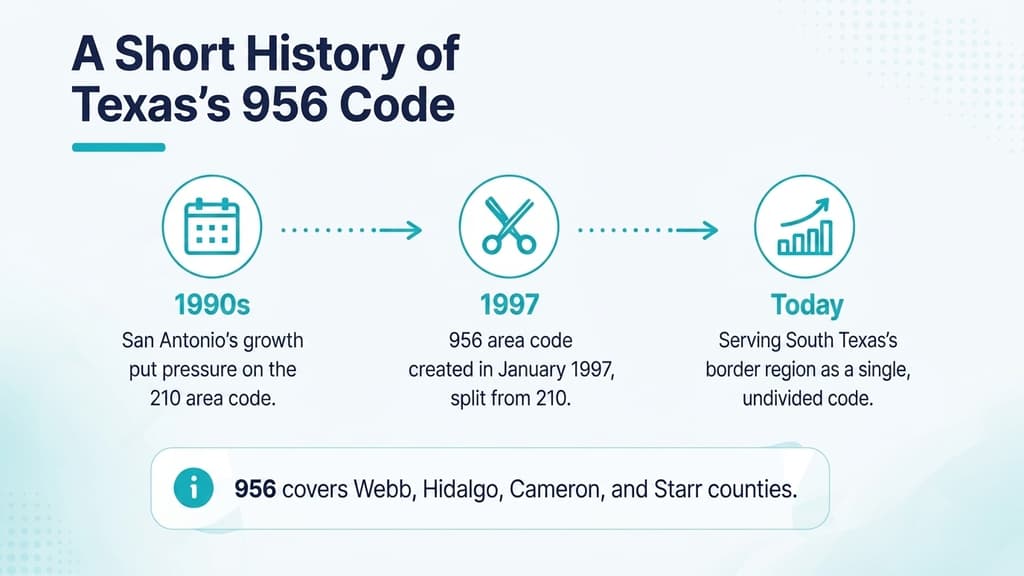
Before 1997, South Texas's border cities were served by 210, the same code covering San Antonio and its suburbs. As San Antonio's population climbed through the 1990s, regulators split 210 to give the border region — an area with its own distinct economy and growth pattern — a dedicated code of its own.
The 956 area code went into service in January 1997, covering Laredo, the Rio Grande Valley, and every South Texas border county from Starr to Cameron. Since then, cross-border trade volume through Laredo has grown dramatically, and the Rio Grande Valley's population has more than doubled, but 956 has held as a single, undivided code for the entire region — no further splits, no overlay, just steady demand met by careful number-block management.
Ready when you are
Protect your business line.
MCM's local numbers ship with verified caller ID and smart call filtering — customers always know it's really you, and spam never reaches your team.
Major cities in the 956 area code
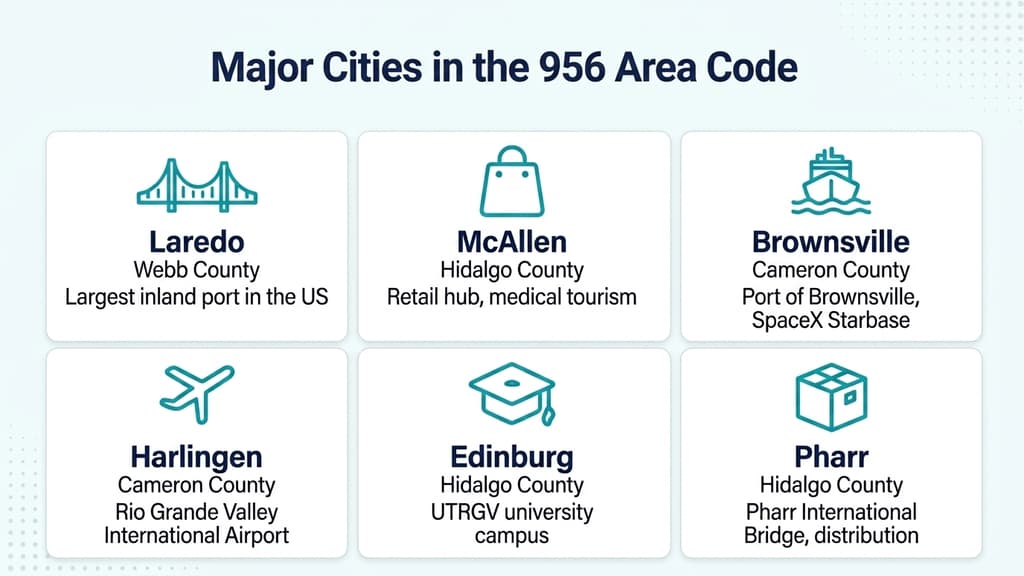
The 956 region spans South Texas's border counties. The largest and most notable cities include:
| City | County | Known for |
|---|---|---|
| Laredo | Webb | Largest inland port in the US, World Trade Bridge |
| McAllen | Hidalgo | Retail hub, medical tourism |
| Brownsville | Cameron | Port of Brownsville, SpaceX Starbase |
| Harlingen | Cameron | Rio Grande Valley International Airport |
| Edinburg | Hidalgo | UTRGV university campus |
| Pharr | Hidalgo | Pharr International Bridge, produce distribution |
| Mission | Hidalgo | Citrus and agriculture |
| Rio Grande City | Starr | Border trade, historic downtown |
Laredo dominates the western half of the region as a logistics and freight powerhouse, moving more truck-borne trade than any other US port of entry. The Rio Grande Valley cities further east — McAllen, Brownsville, Harlingen — form a more densely populated corridor built on retail, healthcare, and agriculture.
How to dial a 956 number
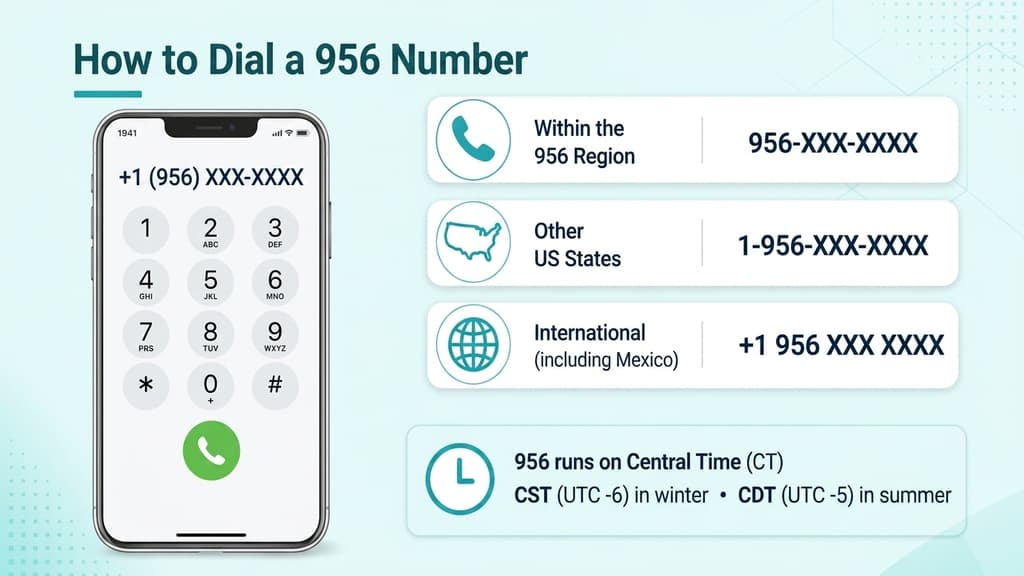
Dialing within the 956 region follows standard North American formatting.
| Calling from | Format |
|---|---|
| Within the 956 region | 956-XXX-XXXX |
| Other US states | 1-956-XXX-XXXX |
| International (including Mexico) | +1 956 XXX XXXX |
Ten-digit dialing is standard practice across South Texas, and calls to and from neighboring Mexican cities like Nuevo Laredo and Reynosa follow standard international dialing formats rather than domestic ones. The 956 region runs on Central Time — Central Standard Time (UTC−6) in winter and Central Daylight Time (UTC−5) in summer, the same clock as Houston and San Antonio.
At noon in Laredo it is 1 PM in New York, 11 AM in Denver, and 10 AM in Los Angeles. Further north, the 983 area overlays 940 across Wichita Falls and Denton on the same Central Time schedule.
Why choose a 956 number
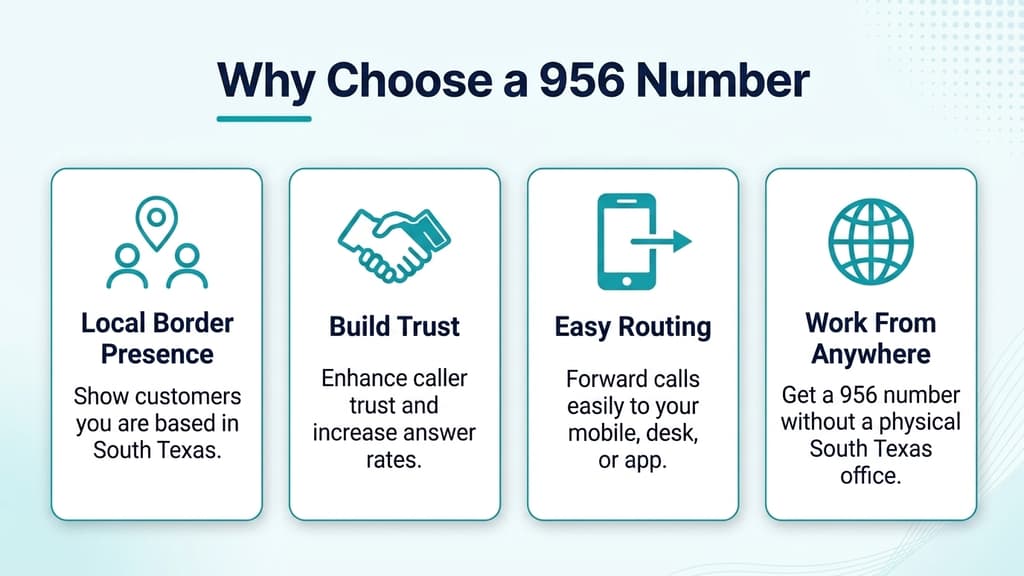
A 956 number puts a business inside one of the busiest trade corridors in North America, without requiring a physical office in Laredo or the Rio Grande Valley. Local numbers earn higher answer rates than unfamiliar out-of-state codes, and a 956 prefix immediately signals a South Texas or border-trade presence to customers and partners on both sides of the Rio Grande.
That signal matters for logistics and freight-forwarding companies working the Laredo trade corridor, healthcare providers serving Rio Grande Valley patients, and remote teams supporting bilingual customers without relocating. A virtual provider issues the number and routes calls to whatever device is already in use — a mobile phone, a desk line, or a softphone app. My Country Mobile can activate a 956 number the same day, letting a business start answering as a local South Texas line immediately.
Staying safe from 956 scam calls
Border-region area codes are frequent spoofing targets, since callers assume a local 956 number is more trustworthy than an out-of-state one. Common scams include fake customs or import-fee demands aimed at logistics businesses, fraudulent utility disconnection notices, and robocalls impersonating Mexican consulate or immigration offices.
Carriers increasingly rely on the FCC's FCC verification framework to flag likely spoofed numbers as "Spam Risk." Still, the safest habit is manual verification: if an unexpected 956 caller demands payment, wire transfers, or personal information, hang up and contact the organization directly using a number you already trust.
Conclusion
The 956 area code exists because South Texas's border economy needed its own numbering identity — one covering both Laredo's massive freight corridor and the Rio Grande Valley's growing residential and healthcare centers. Since splitting from 210 in 1997, it has stayed a single, undivided code for the entire border region, serving four counties without ever needing a split or overlay.
For businesses, that stability is an advantage: a 956 number puts you inside one of the country's most active trade regions instantly, with no office lease required. Whether the goal is a logistics presence near Laredo, a healthcare or retail footprint in the Rio Grande Valley, or simply a South Texas identity, a provider like My Country Mobile can have that number live the same day.
Key takeaways
- The 956 area code covers South Texas's border region, including Laredo, McAllen, Brownsville, and Harlingen.
- It has served the region as a single, undivided code since January 1997, when it split from 210.
- Laredo is the largest inland port in the United States, anchoring a major North American trade corridor.
- 956 runs on Central Time, matching Houston and San Antonio.
- A local 956 number builds instant South Texas credibility and can be activated from anywhere.
- Scammers spoof 956 numbers, so verify unexpected callers before sharing money or personal details.
Ready when you are
Ready to sound local everywhere you sell?
MCM activates business numbers in minutes, with call routing, analytics, and CRM-ready integrations. Start your free trial — no card to browse inventory.
Frequently asked questions
Where is the 956 area code located?
The 956 area code covers South Texas's border region, including Laredo, McAllen, Brownsville, Harlingen, and Edinburg, across Webb, Hidalgo, Cameron, and Starr counties.
Is 956 an overlay code?
No. 956 is a geographic split from the former 210 region, with its own fixed boundary — it does not share numbers with another area code.
What time zone is the 956 area code in?
Central Time. The region observes CST (UTC−6) in winter and CDT (UTC−5) in summer.
When was the 956 area code created?
The 956 area code went into service in January 1997, when regulators split it off from 210 to give South Texas's border counties their own code.
Is Laredo the largest city in the 956 area code?
Laredo is the largest single city, but the combined Rio Grande Valley cities of McAllen, Brownsville, Edinburg, and Harlingen together form a larger metropolitan population.
Can I get a 956 number without living in South Texas?
Yes. Virtual phone providers can issue a 956 number from anywhere and forward calls to any device you already use.
Do calls between 956 and Mexican border cities count as international?
Yes. Calls to cities like Nuevo Laredo or Reynosa use standard international dialing formats, even though they sit just across the Rio Grande.
Has the 956 area code ever needed a split or overlay?
No. Despite significant population and trade growth since 1997, 956 has remained a single, undivided area code for the entire region.