Quick answer: The 787 area code is a territory-wide overlay that shares its footprint with 939, covering the entire island of Puerto Rico — San Juan, Bayamón, Carolina, Ponce, and Caguas among them. It runs on Atlantic Standard Time year-round and requires 10-digit dialing for every local call.
Introduction
Puerto Rico's phone numbering history is unlike any US state's, and 787 is the code that finally gave the island its own dedicated identity. Before 787 existed, Puerto Rico shared a single area code with much of the wider Caribbean, a numbering arrangement that dated back to the earliest days of the North American Numbering Plan.
That shared arrangement made sense when phone demand across the Caribbean was modest, but it couldn't keep up as San Juan grew into a major financial and tourism hub and mobile phone adoption accelerated across the island. Puerto Rico needed a code of its own, and eventually a second one layered on top of it.
This guide covers exactly where 787 reaches, how Puerto Rico went from a shared Caribbean code to its own overlay pair, the cities it serves, how to dial it correctly, why a local number matters for business, and how to stay safe from the scams that increasingly target the island.
Where the 787 area code reaches

The 787 area code covers the entire island of Puerto Rico, from the San Juan metro area on the north coast through Bayamón, Carolina, and Caguas, down to Ponce on the south coast and Mayagüez in the west. There is no part of the island outside 787's reach.
Because 787 is an overlay rather than a split, it does not claim a separate region of the island — every part of Puerto Rico has some numbers on 787 and some on 939. Puerto Rico's other area code, 939, covers the exact same island-wide footprint as 787 — the two together are one of the few overlay pairs in the entire numbering plan that share an entire territory rather than a single metro area.
A short history of Puerto Rico's 787 code

For decades after the North American Numbering Plan launched in 1947, Puerto Rico shared a single area code — 809 — with much of the rest of the Caribbean, including the Dominican Republic and several other island nations and territories. That shared pool worked while phone demand stayed modest, but it became increasingly strained as the region's population and business activity grew.
In 1996, Puerto Rico split away from the shared Caribbean numbering pool entirely, receiving its own dedicated area code: 787. That gave the island independent control over its own number supply for the first time. It didn't last long — mobile phone adoption exploded through the late 1990s, and by 2001, Puerto Rico needed more numbers than 787 alone could provide. Rather than split the island, regulators added the 939 area code as a territory-wide overlay, and 10-digit dialing became mandatory across Puerto Rico from that point forward.
Ready when you are
Protect your business line.
MCM's local numbers ship with verified caller ID and smart call filtering — customers always know it's really you, and spam never reaches your team.
Major cities in the 787 area code
The 787/939 overlay covers the entire island of Puerto Rico. The largest and most notable cities include:
| City | Municipality | Known for |
|---|---|---|
| San Juan | San Juan | Capital, Old San Juan and El Morro fortress |
| Bayamón | Bayamón | Major San Juan metro suburb |
| Carolina | Carolina | Luis Muñoz Marín International Airport |
| Ponce | Ponce | "La Perla del Sur," historic architecture |
| Caguas | Caguas | Central Puerto Rico commercial hub |
| Mayagüez | Mayagüez | Western coast, university city |
| Arecibo | Arecibo | Former site of the Arecibo Observatory |
| Guaynabo | Guaynabo | Corporate offices, San Juan suburb |
San Juan anchors the island as both its capital and its primary economic and tourism center, home to the historic walled city of Old San Juan and the centuries-old El Morro fortress. Ponce, on the south coast, carries its own distinct identity as Puerto Rico's second-largest city, known for its preserved Spanish colonial architecture.
How to dial a 787 number

Because 787 and 939 overlay the entire island, every call within Puerto Rico — even a call to your next-door neighbor — must include the area code.
| Calling from | Format |
|---|---|
| Within Puerto Rico | 787-XXX-XXXX (10 digits required) |
| Other US states | 1-787-XXX-XXXX |
| International | +1 787 XXX XXXX |
Seven-digit dialing has not worked in Puerto Rico since the 939 overlay took effect in 2001. The island runs on Atlantic Standard Time (UTC−4) year-round — Puerto Rico does not observe daylight saving time, so the offset to the US mainland shifts by season. At noon in San Juan it is noon in New York during Eastern Daylight Time, but 1 PM in New York during Eastern Standard Time in winter.
Why choose a 787 number
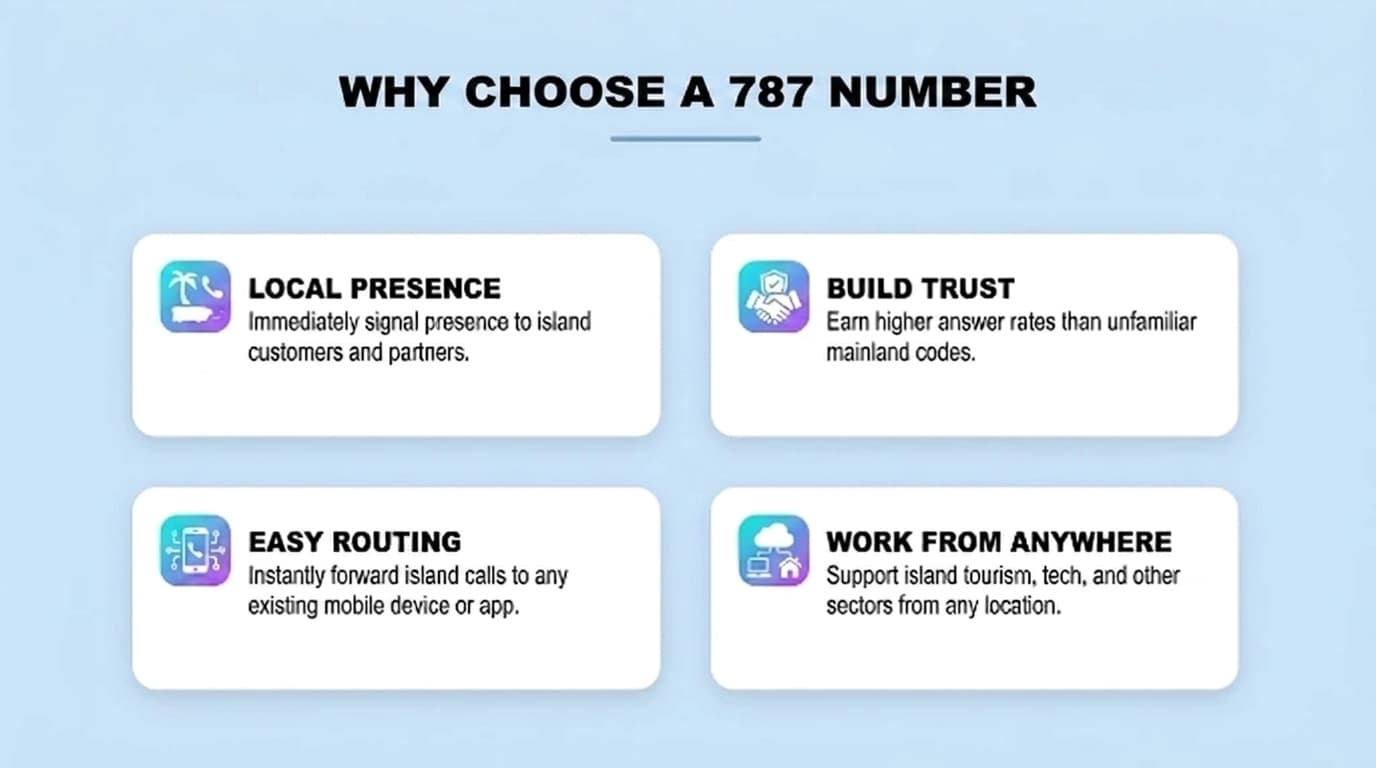
A 787 number puts a business inside one of the Caribbean's largest and most connected economies without requiring an office anywhere on the island. Local numbers earn higher answer rates than unfamiliar mainland codes, and a 787 or 939 prefix immediately signals a Puerto Rico presence to island customers and partners.
That local read matters for mainland companies serving Puerto Rico's tourism and hospitality sector, businesses supporting the island's growing tech and pharmaceutical manufacturing base, and remote teams working with bilingual Spanish-English customers without relocating. Many of these businesses run on UCaaS (Unified Communications as a Service) — a single cloud platform for calling, video, and messaging that forwards a 787 number to whatever device is already in use, a mobile phone, a desk line, or a softphone app. My Country Mobile can activate a 787 number the same day, letting a business start answering as a local Puerto Rico line immediately.
Staying safe from 787 scam calls
A territory-wide code like 787 is an especially attractive spoofing target, since virtually every legitimate business and resident on the island already uses one of the two overlay codes. Common scams include fake hurricane-relief or insurance-claim calls following Caribbean storms, robocalls impersonating Puerto Rico government agencies, and fraudulent utility-payment demands targeting island residents.
Area code 787 is a legitimate NANP code covering all of Puerto Rico, and carriers increasingly use call-authentication data to flag likely spoofed numbers as "Spam Risk." Still, the safest habit is manual verification: if an unexpected 787 caller demands payment, gift cards, or personal information, hang up and contact the organization directly using a number you already trust.
Conclusion
The 787 area code exists because Puerto Rico outgrew a shared Caribbean numbering pool and, later, outgrew even its own dedicated code. Since receiving 787 in 1996 and adding the 939 overlay in 2001, the island has covered its entire territory under one mandatory 10-digit dialing rule, from San Juan's financial district to Ponce's historic streets.
For businesses, that scale is an opportunity: a 787 number puts you inside one of the Caribbean's largest economies instantly, with no office lease required. Whether the goal is a San Juan-area presence, tourism-sector reach, or simply an island-wide Puerto Rico identity, a provider like My Country Mobile can have that number live the same day.
Key takeaways
- The 787 area code is a territory-wide overlay with 939, covering all of Puerto Rico.
- It includes San Juan, Bayamón, Carolina, Ponce, and Caguas.
- Puerto Rico split from the shared Caribbean 809 code in 1996, then added the 939 overlay in 2001.
- The island runs on Atlantic Standard Time year-round, with no daylight saving time.
- A local 787 number builds instant Puerto Rico credibility and can be activated from anywhere.
- Scammers spoof 787 numbers, so verify unexpected callers before sharing money or personal details.
Ready when you are
Ready to sound local everywhere you sell?
MCM activates business numbers in minutes, with call routing, analytics, and CRM-ready integrations. Start your free trial — no card to browse inventory.
Frequently asked questions
Where is the 787 area code located?
The 787 area code covers the entire island of Puerto Rico, including San Juan, Bayamón, Carolina, Ponce, and Caguas.
Is 787 the same region as 939?
Yes. 787 and 939 are overlay codes that share the exact same territory — all of Puerto Rico — with numbers mixed between the two.
What time zone is the 787 area code in?
Atlantic Standard Time (UTC−4), observed year-round. Puerto Rico does not switch to daylight saving time.
Do I need to dial the area code for local calls in Puerto Rico?
Yes. Since the 939 overlay took effect in 2001, every call on the island requires all 10 digits, even calls between neighbors.
Did Puerto Rico always have its own area code?
No. Puerto Rico shared area code 809 with much of the Caribbean until 1996, when it received its own dedicated code, 787.
Can I get a 787 number without living in Puerto Rico?
Yes. Virtual phone providers can issue a 787 number from anywhere and forward calls to any device you already use.
Is Old San Juan in the 787 area code?
Yes. Old San Juan, including El Morro fortress, falls within the 787/939 overlay region.
Are 787 and 939 numbers different in cost or quality?
No. Both codes are functionally identical — the only difference is which number block a given phone line was assigned from.