The 432 area code covers Midland, Odessa, and the entire Permian Basin region of West Texas — roughly 41,000 square miles of desert, oil fields, and ranchland stretching from the New Mexico border to the edge of the Big Bend.
It was created on April 5, 2003, split from the original 915 area code alongside 325, after the Permian Basin's oil and gas boom pushed 915's number pool toward exhaustion. The region operates entirely in the Central Time Zone.
This guide covers the ground 432 actually reaches, why the oil boom forced a three-way area code split, the timeline behind it, and the Permian Basin economy that makes this one of the most productive stretches of land in America.
The ground 432 actually covers
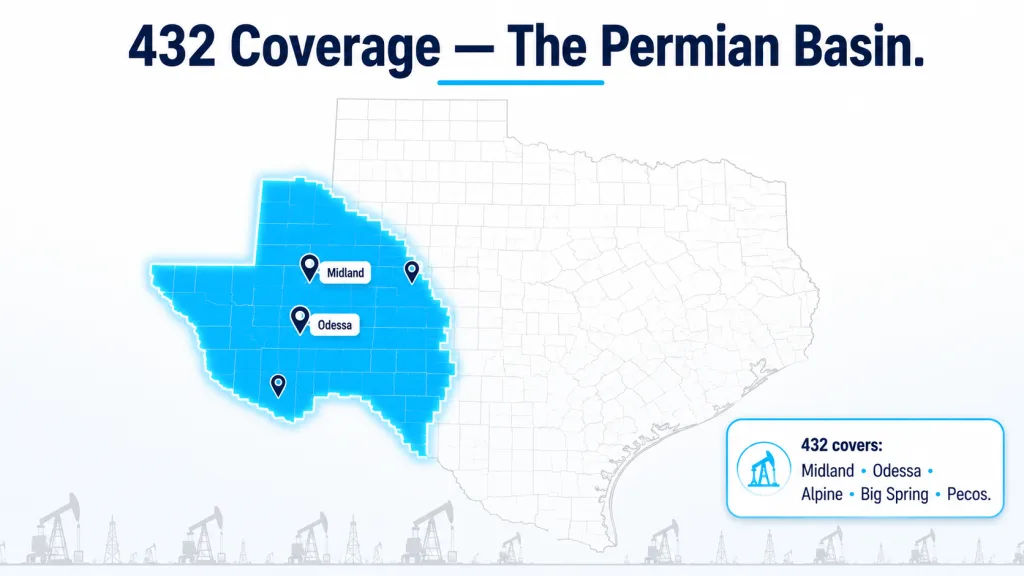
The 432 area code location is West Texas's Permian Basin and Trans-Pecos region — one of the largest area codes by land area in the state, but sparsely populated outside its two anchor cities.
Cities in the 432 area code:
| City | Known for |
|---|---|
| Midland | Permian Basin corporate headquarters hub |
| Odessa | Oilfield services and drilling operations |
| Alpine | Trans-Pecos gateway; Sul Ross State University |
| Big Spring | Howard County seat; refining |
| Pecos | Reeves County; oilfield boomtown |
| Fort Stockton | Pecos County seat; ranching and energy |
What 432 does NOT cover:
- El Paso → 915 (retained the original code)
- San Angelo and the Concho Valley → 325
- Lubbock and the South Plains → 806
Why one oil boom split a code into three

By the late 1990s, the Permian Basin's oil and gas boom was consuming phone numbers faster than almost anywhere else in Texas — every new well meant new business lines, fax numbers, and eventually cell phones for crews. The original 915 area code, which had covered all of far West Texas including El Paso since 1957, could not sustain growth in both El Paso and the oil patch simultaneously.
Regulators split 915 three ways on the same date:
- 915 stayed with El Paso, the region's largest population center.
- 325 took San Angelo and the Concho Valley to the east.
- 432 took Midland, Odessa, and the Permian Basin oil fields.
Unlike an overlay such as 430 in northeast Texas, this was a true geographic split — three distinct, non-overlapping territories, each keeping its own single code with no overlay added since.
432's timeline, start to today

1957 — Area code 915 launched, covering all of far West Texas, including El Paso, Midland, Odessa, and San Angelo under one code.
1990s — The Permian Basin's oil boom accelerated number consumption well beyond what the rest of far West Texas needed, straining the shared 915 pool.
April 5, 2003 — NANPA split 915 three ways in a single day: El Paso kept 915, San Angelo became 325, and Midland-Odessa-the Permian Basin became 432.
Today — 432 continues to serve Midland, Odessa, and the entire Permian Basin as a standalone code, with no overlay added in more than two decades.
Ready when you are
Protect your business line.
MCM's local numbers ship with verified caller ID and smart call filtering — customers always know it's really you, and spam never reaches your team.
The Permian Basin's outsized economy

Few regions in the country punch as far above their population as the Permian Basin:
8% of Texas's private-sector GDP comes from a region holding just 1.6% of the state's population — a concentration of oil wealth almost unmatched anywhere else in the United States.
The Permian Basin oil field underlying Midland and Odessa is the most productive oil-producing region in the country, driving crew, equipment, and trucking demand across the entire 432 footprint.
Midland functions as the corporate headquarters hub for Permian operators — often called the "Tall City" for its unusually dense cluster of downtown office towers built to house oil company headquarters staff, a skyline that looks more like a mid-size financial hub than a desert town of its size.
Energy companies operating across the 432 region increasingly rely on UCaaS (Unified Communications as a Service) to connect field offices, drilling sites, and headquarters staff on one unified calling and messaging platform — critical when crews and dispatch teams are spread across hundreds of miles of remote oil-field terrain. Contact us to explore 432 numbers and UCaaS plans for your Permian Basin operation.
Is 432 a legitimate number?
Yes — 432 is a standard Texas area code, not inherently suspicious. However, because West Texas's oil economy generates high call volumes to vendors, contractors, and out-of-state suppliers, robocallers do spoof 432 numbers to appear as legitimate oilfield business contacts. The FCC's STIR/SHAKEN call authentication protocol requires carriers to verify caller ID before connecting — treat any unexpected 432 call requesting payment or sensitive information with caution.
Key takeaways
- 432 covers Midland, Odessa, and the Permian Basin — created April 5, 2003, split from 915 alongside 325.
- No overlay — 432 remains a single geographic code across roughly 41,000 square miles of West Texas.
- The Permian Basin generates 8% of Texas's private-sector GDP with only 1.6% of its population.
- Time zone: Central (CT) throughout.
Ready when you are
Ready to sound local everywhere you sell?
MCM activates business numbers in minutes, with call routing, analytics, and CRM-ready integrations. Start your free trial — no card to browse inventory.
Frequently asked questions
What is the 432 area code?
Area code 432 covers Midland, Odessa, and the Permian Basin region of West Texas. It was created in 2003 when the original 915 area code was split three ways.
Where is the 432 area code located?
Area code 432 is in West Texas, covering Midland, Odessa, Alpine, Big Spring, Pecos, and Fort Stockton across the Permian Basin and Trans-Pecos region.
What time zone is the 432 area code?
Area code 432 is in the Central Time Zone (CT) — CST (UTC −6) in winter and CDT (UTC −5) during Daylight Saving Time.
Where did the 432 area code come from?
Area code 432 was created on April 5, 2003, when the original 915 area code — which covered all of far West Texas including El Paso — was split three ways to relieve number exhaustion driven by the Permian Basin oil boom.
Is 432 in El Paso?
No. El Paso kept the original 915 area code. 432 covers Midland, Odessa, and the Permian Basin, a separate region east of El Paso.
How do I get a 432 area code number?
Sign up with a VoIP provider such as My Country Mobile, search for available 432 numbers, choose a Midland or Odessa-area prefix, select a plan, and activate.