The 301 area code is one of the original 1947 area codes and today covers the Maryland suburbs of Washington, D.C., along with western and southern Maryland. From Silver Spring and Bethesda to Frederick, Hagerstown, and the southern Chesapeake shore, 301 is the number that says "I'm in the Maryland side of the capital region."
This guide explains where 301 reaches, how it was split and later overlaid, how 301 and its 240 partner code relate, how to dial correctly, how to avoid 301 scams, and how to get a 301 number for your business from anywhere.
Where is the 301 area code?

The 301 area code serves western and southern Maryland plus the DC suburbs — a broad arc wrapping the Maryland side of the Washington metro and stretching out to the Appalachian panhandle. It does not cover Baltimore, which uses 410 and 443.
Cities and communities inside the 301 footprint include:
| City | County | Known for |
|---|---|---|
| Silver Spring | Montgomery | Dense DC-border suburb, federal agencies |
| Rockville | Montgomery | County seat, biotech corridor |
| Bethesda | Montgomery | Affluent suburb, NIH and medical research |
| Gaithersburg | Montgomery | Tech and life-sciences employers |
| Frederick | Frederick | Historic city, I-270 biotech gateway |
| Bowie | Prince George's | Largest city in Prince George's County |
| Hagerstown | Washington | Western Maryland logistics hub |
| Waldorf | Charles | Fast-growing southern Maryland suburb |
Neighboring regions use their own codes — Washington, D.C. itself runs on 202, Northern Virginia on 703 and 571, and Baltimore on 410 and 443.
How 301 was split and then overlaid
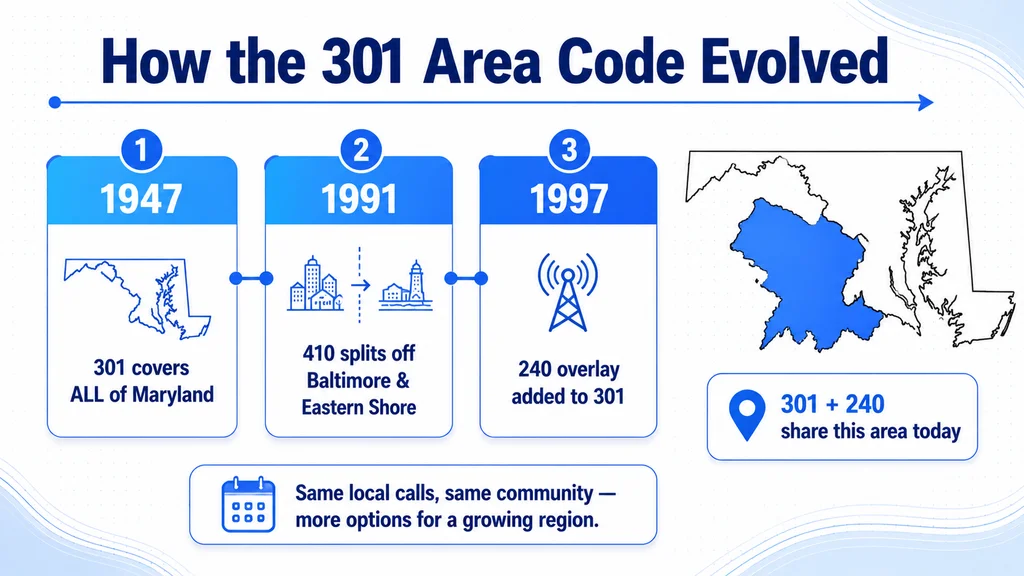
When the North American Numbering Plan launched in 1947, 301 covered the entire state of Maryland. As the state grew, that single code could not keep up.
The first big change came in 1991, when eastern Maryland — Baltimore and the Eastern Shore — was split off into the new 410 area code. That left 301 covering the western and southern two-thirds of the state, including the booming DC suburbs.
Demand kept climbing, so in 1997 regulators added the 240 overlay on top of 301 rather than splitting the region again. Since then, 301 and 240 have shared the exact same geography, and ten-digit dialing has been required throughout.
How 301 and 240 work together
Because 240 overlays 301, the two codes cover identical ground — neither one signals a different county or carrier. A Rockville law firm might have a 301 number while the startup next door gets a 240; both are equally local Maryland lines.
The pattern is common in dense, growing metros: rather than force everyone with an established 240 area code partner number to change, regulators layer a second code over the region. For the DC suburbs, that overlay is simply a sign of how much demand the Maryland capital region generates.
Ready when you are
Protect your business line.
MCM's local numbers ship with verified caller ID and smart call filtering — customers always know it's really you, and spam never reaches your team.
How to dial a 301 number
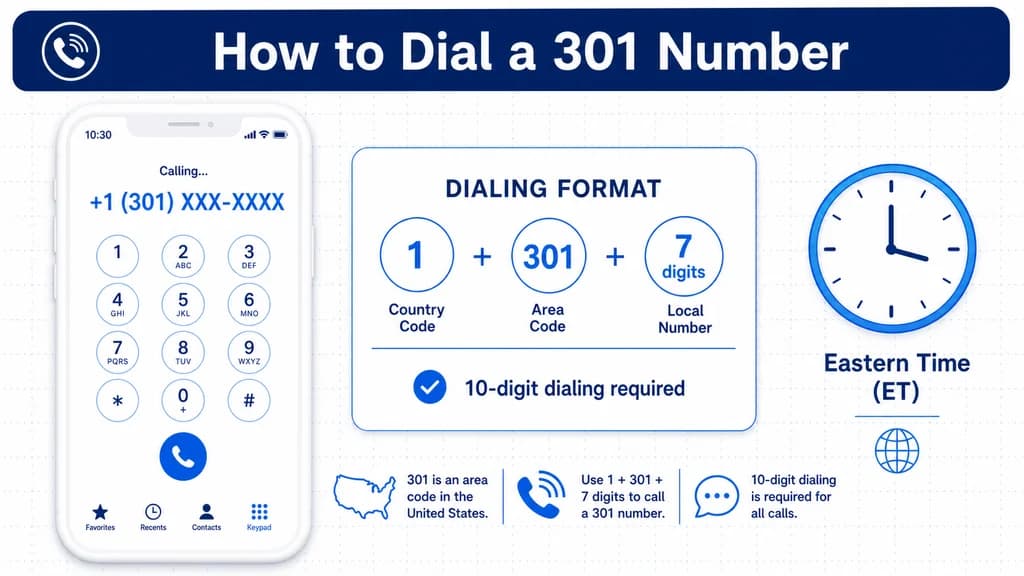
In an overlay region, ten-digit dialing is mandatory — there is no seven-digit shortcut, even for a call across the same street.
| Calling from | Dial |
|---|---|
| Within the Maryland region | 301 XXX XXXX or 240 XXX XXXX |
| Elsewhere in the US / Canada | 1 301 XXX XXXX |
| Outside North America | +1 301 XXX XXXX |
| Any mobile (worldwide) | +1 301 XXX XXXX |
The 301 area code sits in the Eastern Time Zone (ET) — EST (UTC−5) in winter and EDT (UTC−4) in summer, the same clock as Washington, D.C. and New York. At noon in Silver Spring it is 11 AM in Chicago, 10 AM in Denver, and 9 AM in Los Angeles.
Business uses for a 301 number
A 301 number puts a Maryland / DC-suburb address on your caller ID without a local lease. For any business courting customers in the capital region — government contractors, healthcare and biotech firms, real-estate teams, home services — a local code reads as familiar and lifts answer rates compared with an out-of-state or toll-free line.
The 301 footprint is one of the most affluent, federally connected markets in the country, anchored by Montgomery County's biotech corridor and a dense base of government contractors. Local presence carries real commercial weight here. You can get a local 301 number from My Country Mobile and route it to the phones, laptops, and apps your team already uses — no physical office required.
301 area code scams

A local-looking code is exactly what scammers want. Fraudsters spoof 301 numbers — faking a Maryland prefix, sometimes matching the first digits of your own number — so a call looks local and trustworthy. A 301 on your screen does not prove the caller is really in Maryland.
A few habits keep you safe:
- Let unknown 301 calls go to voicemail; legitimate callers leave a message.
- Never share one-time codes, card numbers, or login details with an inbound caller.
- Be skeptical of "IRS," "utility shutoff," or "your account is compromised" calls that pressure you to act fast — the DC region sees heavy government-impersonation fraud.
- Use carrier spam filtering. The FCC's STIR/SHAKEN call authentication framework is why many phones now label these calls as "Spam Risk."
Getting a 301 number for your business
If you sell into the Maryland market — Silver Spring, Rockville, Bethesda, Frederick, or anywhere in the 301/240 footprint — a 301 number signals you are plugged into the region. It lifts answer rates with local contacts and reads as credibility on a flyer, a van, or a pitch email.
You do not need a Maryland office to claim one. A cloud phone provider can assign you a 301 number that rings on your existing devices and routes calls anywhere in the world. With a provider like My Country Mobile, you can pick a 301 line, configure routing, an auto-attendant, and voicemail, and be live in minutes — whether you are a solo operator or a national brand opening a capital-region presence.
Key takeaways
- 301 covers the Maryland DC suburbs plus western and southern Maryland — not Baltimore.
- It is an original 1947 code; eastern Maryland split off as 410 in 1991.
- The 240 overlay was added in 1997, so 301 and 240 share the same geography.
- The region sits in Eastern Time; ten-digit dialing is mandatory.
- You can get a 301 number from the cloud without a Maryland address.
Ready when you are
Ready to sound local everywhere you sell?
MCM activates business numbers in minutes, with call routing, analytics, and CRM-ready integrations. Start your free trial — no card to browse inventory.
Frequently asked questions
Where is the 301 area code located?
The 301 area code covers the Maryland suburbs of Washington, D.C., plus western and southern Maryland — including Silver Spring, Rockville, Bethesda, Gaithersburg, Frederick, and Hagerstown. It does not cover Baltimore.
What is the 301 area code?
It is one of the original 1947 area codes. It once covered all of Maryland and now serves the state's western and southern regions and the DC suburbs, overlaid by 240.
Is 301 the same as 240?
Geographically, yes. The 240 overlay covers the identical territory, so a 301 number and a 240 number are equally local.
What time zone is the 301 area code in?
Eastern Time (ET), the same as Washington, D.C. and New York, including daylight saving time.
Why do I have to dial ten digits for a 301 call?
Because 301 and 240 share the same region, ten-digit dialing is required so the network knows which code you mean — even for local calls.
Why am I getting spam calls from 301 numbers?
Most are spoofed to look local. The DC region sees heavy government-impersonation fraud, so don't share personal information and let suspicious calls go to voicemail.
Can I get a 301 number if I don't live in Maryland?
Yes. A cloud phone provider can assign you a 301 number that works from anywhere and routes to your existing devices — no Maryland address required.
Is a 301 number toll-free?
No. It is a standard local geographic number for the Maryland DC-suburb region.