How to Choose Virtual Phone Number Providers in 2026
There are dozens of companies that will sell you a virtual phone number, and on the surface they all look the same. The differences only show up later — in a dropped call, a surprise charge, or a number you can't port out.
This guide gives you a clear framework for evaluating virtual phone number providers, so you pick one based on what actually matters instead of who has the slickest homepage.
WHAT A VIRTUAL NUMBER ACTUALLY IS
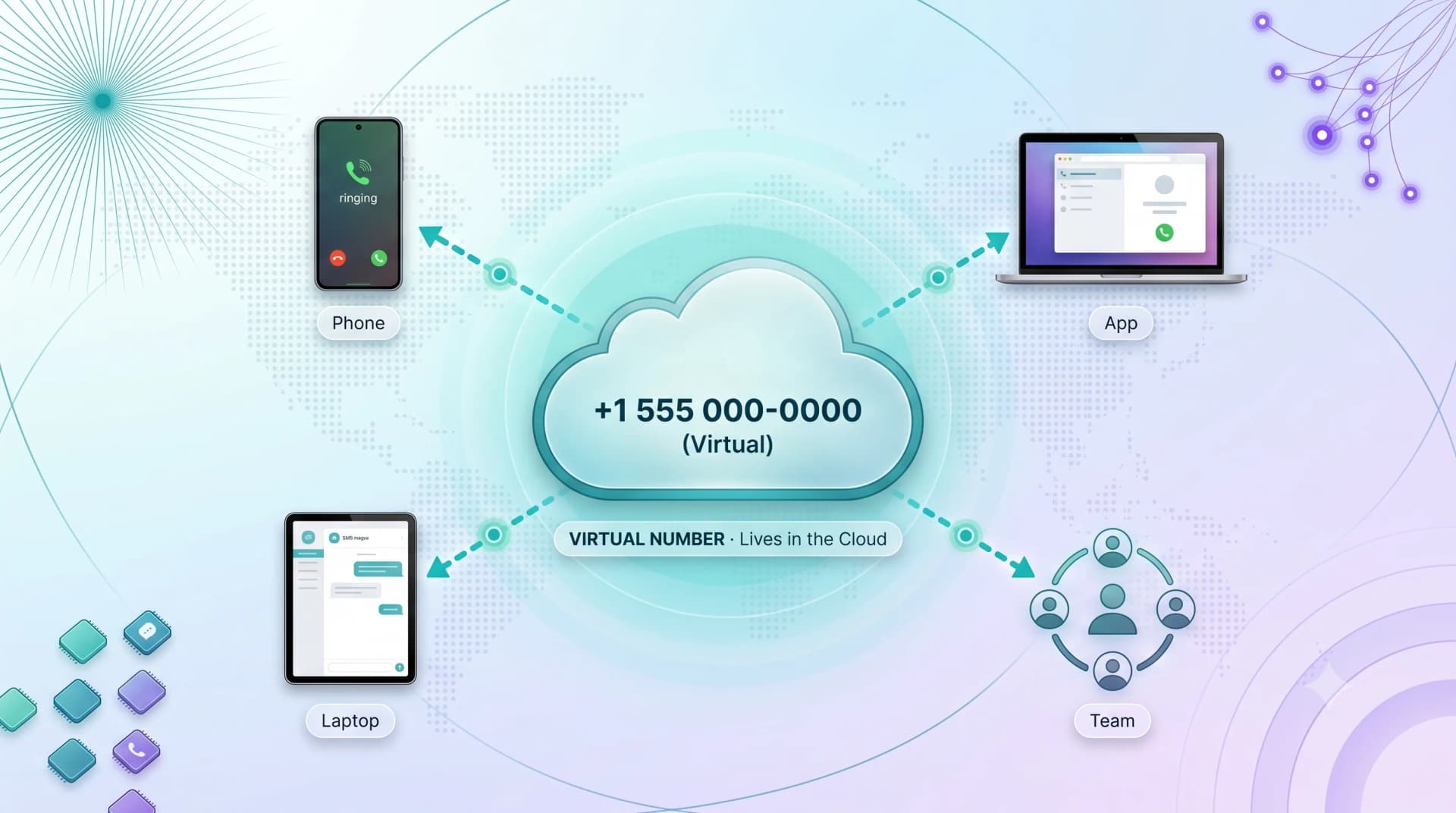
A virtual number isn't tied to a single SIM or copper line. It lives in the cloud and forwards calls and texts to whatever device you choose.
That's the core appeal: a local presence in any city or country, routed to a phone, app, or team — without hardware or a physical office there.
WHY THE PROVIDER CHOICE MATTERS
The number is a commodity. The provider behind it is not.
The Network Does the Heavy Lifting
Call quality, uptime, and delivery rates all depend on the carrier relationships and routing behind the number. Two providers can sell "the same" number with very different results.
A weak network shows up as choppy audio, failed texts, and calls that never ring.
Switching Later Is Painful
Your number becomes part of your brand. If a provider makes porting difficult, you're effectively locked in.
That's why the evaluation below weighs portability and contract terms heavily.
Ready when you are
Protect your business line.
MCM's local numbers ship with verified caller ID and smart call filtering — customers always know it's really you, and spam never reaches your team.
THE 7 CRITERIA THAT ACTUALLY MATTER
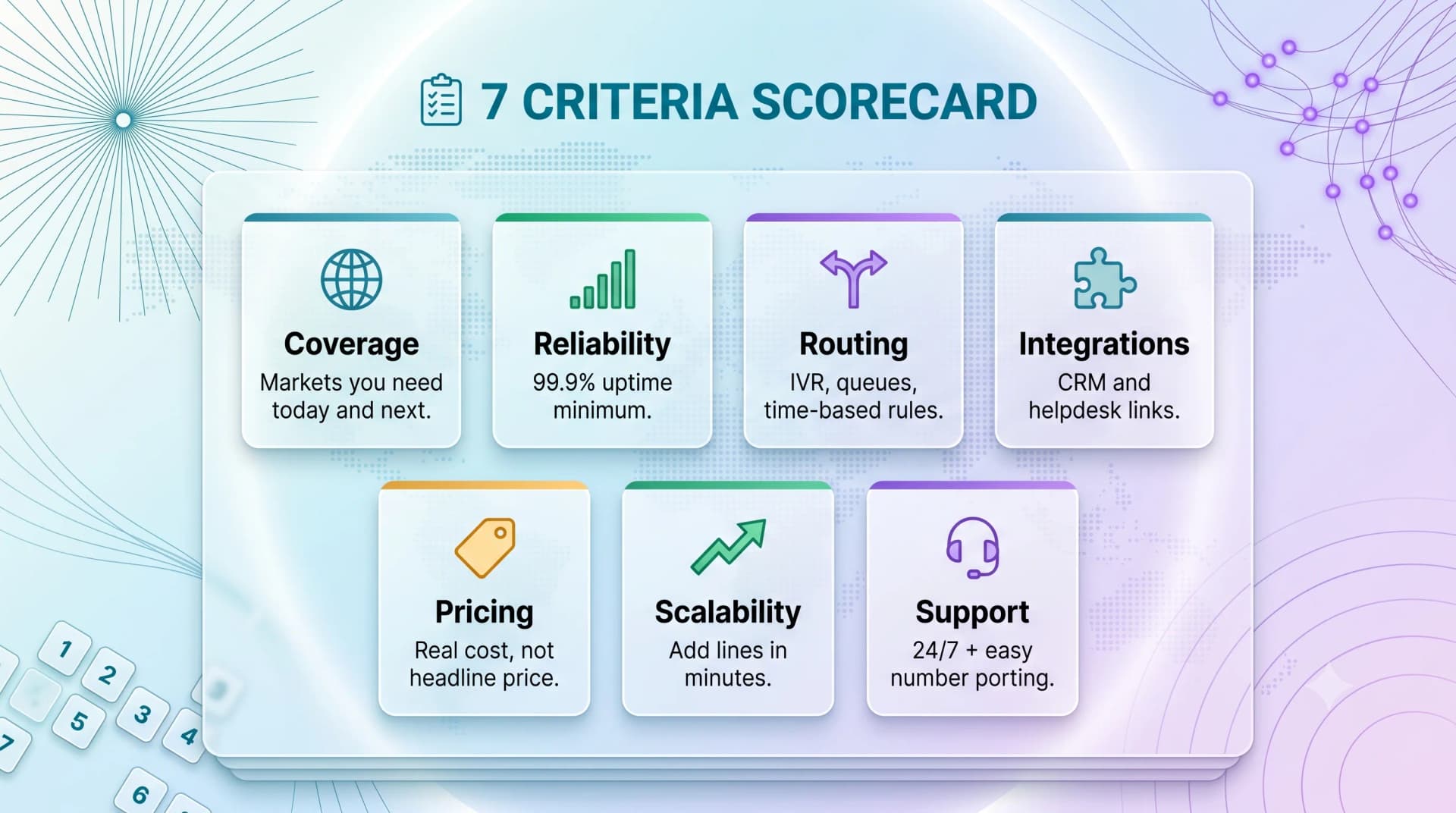
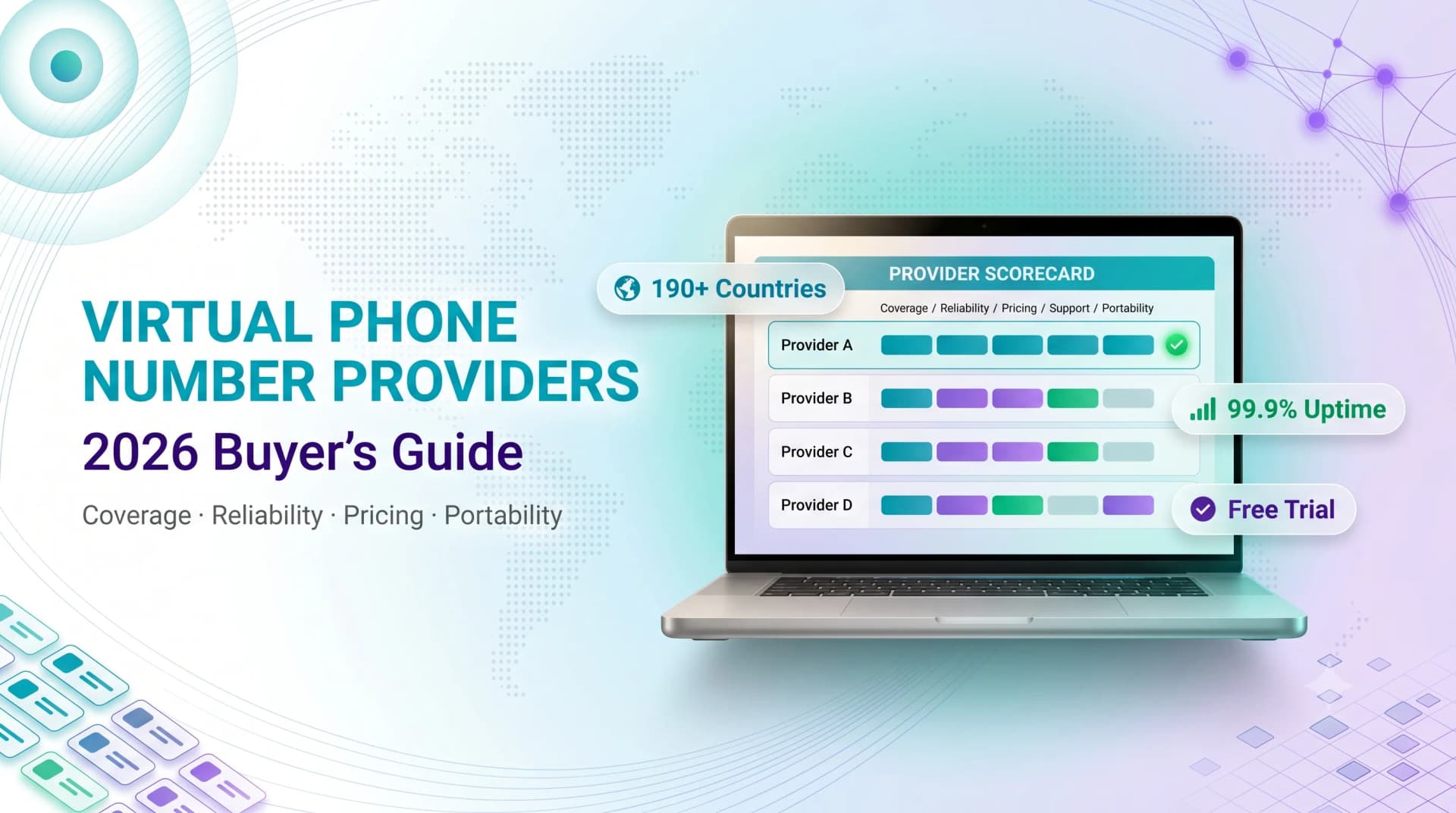
Use these as your scorecard. A strong provider does well on most of them — not just price.
1. Coverage and Number Types
Check that the provider offers the specific countries, cities, and number types you need. That includes local, toll-free, and mobile numbers.
If you plan to expand, confirm coverage in markets you'll enter next, not just today's.
2. Call Quality and Reliability
Look for a published uptime figure — 99.9% or higher is the modern baseline. Ask how calls are routed and whether there's failover.
A free trial is the real test: make calls at different times of day before committing.
3. Routing and Call Management
Good providers let you route calls by time, location, team, or menu. Features like IVR, queues, and voicemail-to-email turn a number into a phone system.
Match the feature depth to your needs — a solo founder and a 40-agent team want different things.
4. Integrations
Your phone number is more useful when it talks to your other tools. CRM and helpdesk integrations log calls automatically and save manual work.
If you rely on a specific CRM, confirm a native integration exists before signing up.
5. Pricing Transparency
Read past the headline monthly price. Check per-minute call rates, SMS fees, number setup costs, and international charges.
The cheapest sticker price often hides the highest real bill — model your actual usage.
6. Scalability
The right provider grows with you. Adding numbers, users, or countries should take minutes, not a sales call.
Avoid providers that require a contract renegotiation every time you add a line.
7. Support and Portability
Confirm support hours and channels — 24/7 matters if you operate across time zones. Just as important: ask how easy it is to port your number out.
A provider confident in its service won't make leaving difficult.
Tip before you buy: Write down your must-have countries, your monthly call volume, and the one CRM you can't live without. Test every shortlisted provider against that exact list.
A SIMPLE COMPARISON FRAMEWORK
Don't compare providers feature-by-feature in a vacuum. Score each one against your real needs.
| Criterion | Question to ask | Why it matters |
|---|---|---|
| Coverage | Do they have my markets? | A missing country is a dealbreaker |
| Reliability | What's the uptime SLA? | Downtime = missed revenue |
| Pricing | What's my real monthly cost? | Headline price hides fees |
| Integrations | Does it fit my stack? | Manual logging wastes hours |
| Portability | Can I leave easily? | Lock-in limits your options |
PROVIDER TYPES: WHO FITS WHOM
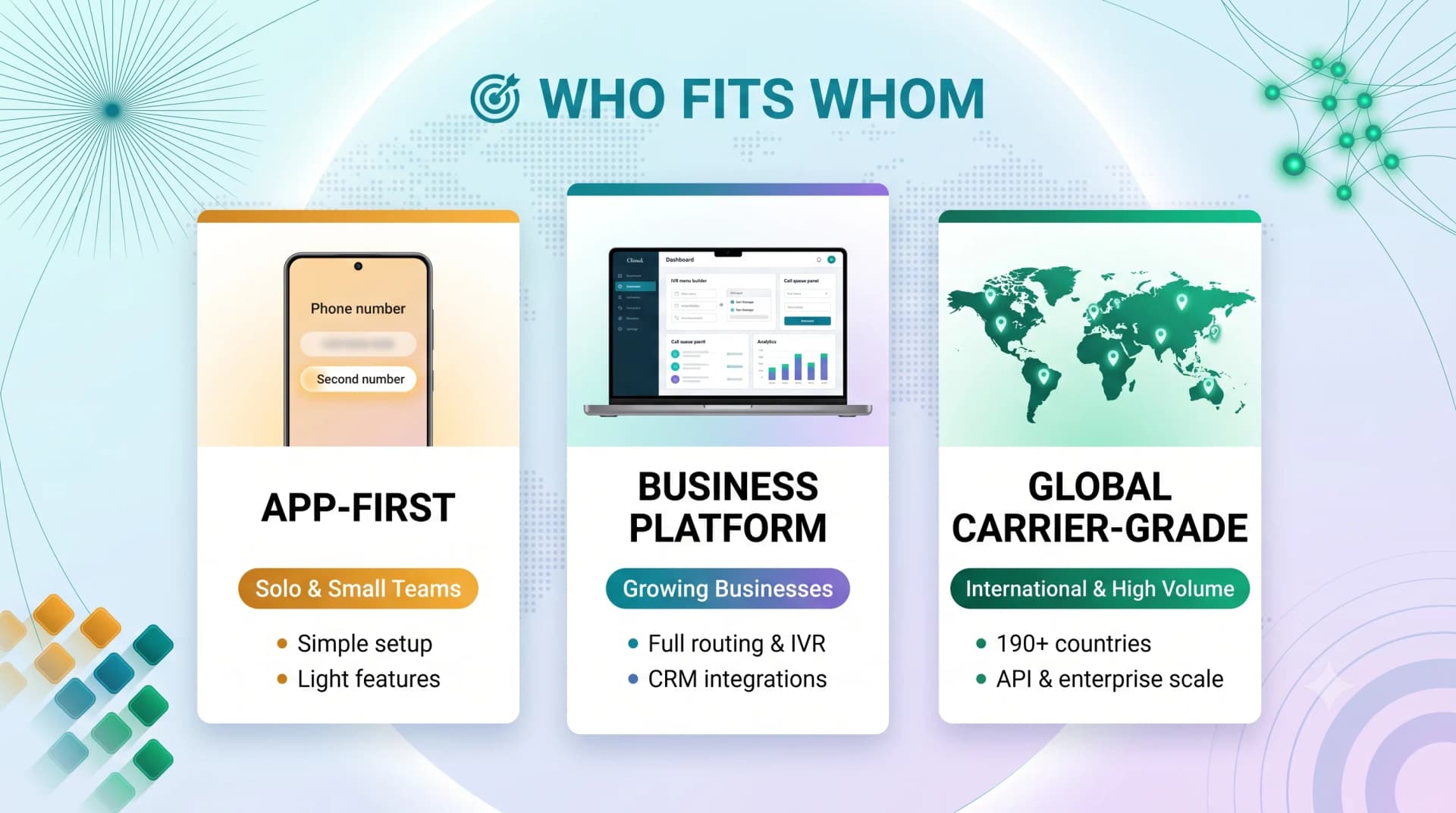
Not every provider is built for every buyer. Knowing the categories narrows your search fast.
App-First Providers
These focus on individuals and small teams who want a second number on a phone. They're simple and cheap, but light on advanced routing.
Business Phone Platforms
These bundle numbers with a full cloud phone system — IVR, analytics, team features. Best for growing businesses that want everything in one place.
Global and Carrier-Grade Providers
These specialize in international coverage and high call volumes. For example, My Country Mobile (MCM) is one option in this category, offering local numbers across 190+ countries with call routing and an app.
Match the category to your situation before comparing individual names.
Choosing your shortlist: Pick two or three providers from the right category, start a trial with each, and run real calls. The right fit becomes obvious within a week.
RED FLAGS TO WATCH FOR
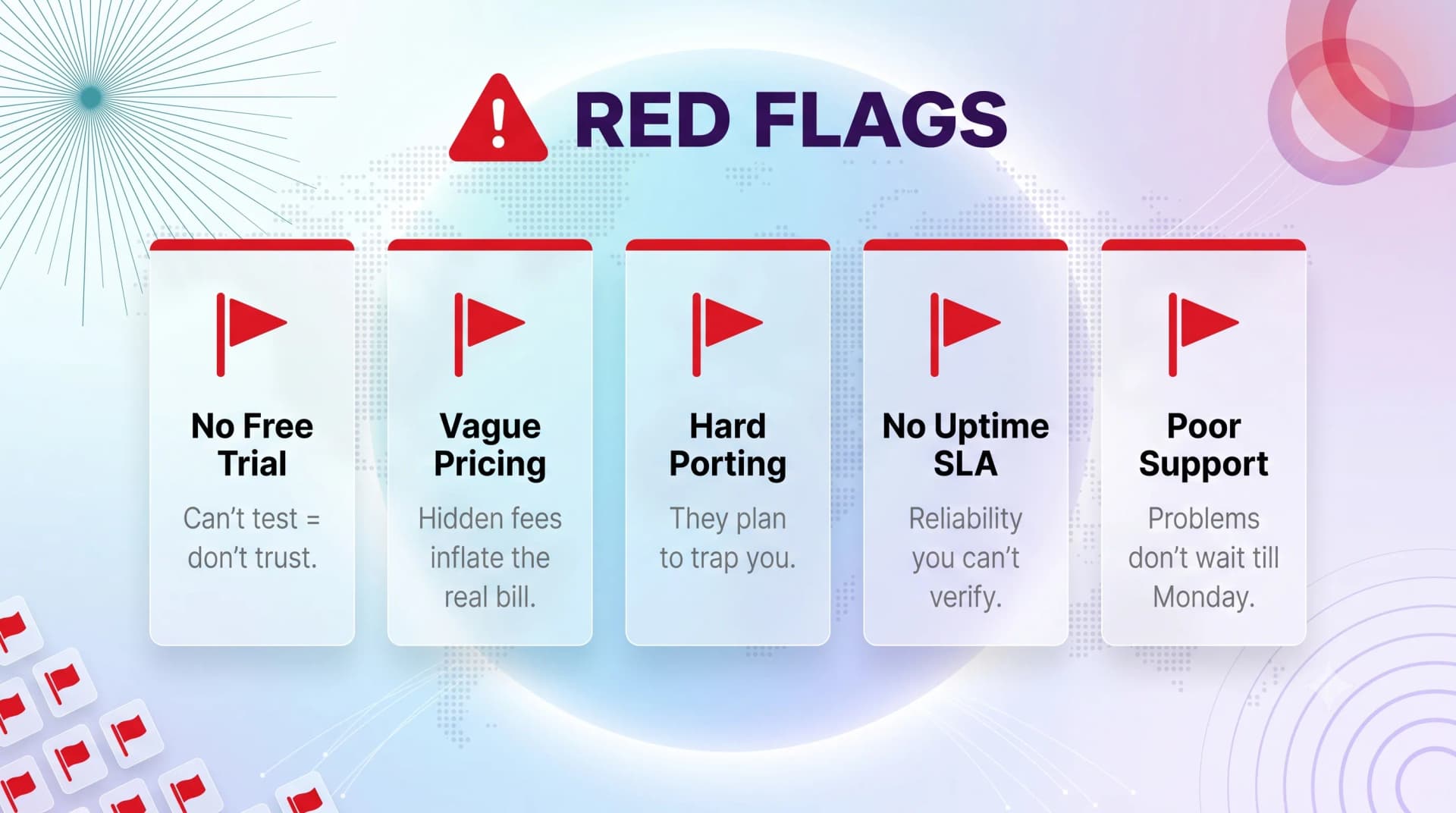
Some warning signs separate a frustrating provider from a reliable one.
- No free trial — if you can't test call quality first, walk away.
- Vague pricing — hidden per-minute or SMS fees inflate the real cost.
- Hard-to-find porting policy — a sign they expect to keep you trapped.
- No published uptime — reliability you can't verify isn't reliability.
- Slow or limited support — a problem at 2 a.m. shouldn't wait until Monday.
THE BOTTOM LINE
The best virtual phone number providers aren't the ones with the lowest price or the longest feature list — they're the ones that match your specific markets, tools, and growth plans.
Build your scorecard from the seven criteria above, shortlist two or three providers, and put each through a real free-trial test. The right choice will earn its place, not just claim it.
For deeper context, see our guides on how to get a 314 number, the 510 area code, and the Thailand phone number format.
Ready when you are
Ready to sound local everywhere you sell?
MCM activates business numbers in minutes, with call routing, analytics, and CRM-ready integrations. Start your trial — no card to browse inventory.
FAQs
What are virtual phone number providers?
They are companies that sell cloud-based phone numbers not tied to a SIM card or physical line. Calls and texts route to any device you choose.
How do I choose the right provider?
Score providers against seven criteria: coverage, reliability, routing features, integrations, pricing transparency, scalability, and support and portability.
Are virtual numbers reliable for business?
Yes, when the provider has a strong network. Look for a published uptime of 99.9% or higher and test call quality during a free trial.
How much do virtual phone numbers cost?
Pricing varies widely. Look beyond the monthly fee at per-minute rates, SMS charges, setup costs, and international fees to find the real cost.
Can I keep my number if I switch providers?
Usually yes, through number porting. Before signing up, confirm the provider has a clear, easy porting-out policy so you're not locked in.
How fast can I get a virtual number?
Most providers activate new numbers within minutes. Porting an existing number, however, can take days or weeks depending on the carrier.
Should I pick a local or toll-free number?
A local number boosts answer rates for sales and support in a specific city. A toll-free number suits brands that want a national, professional presence.