
Introduction
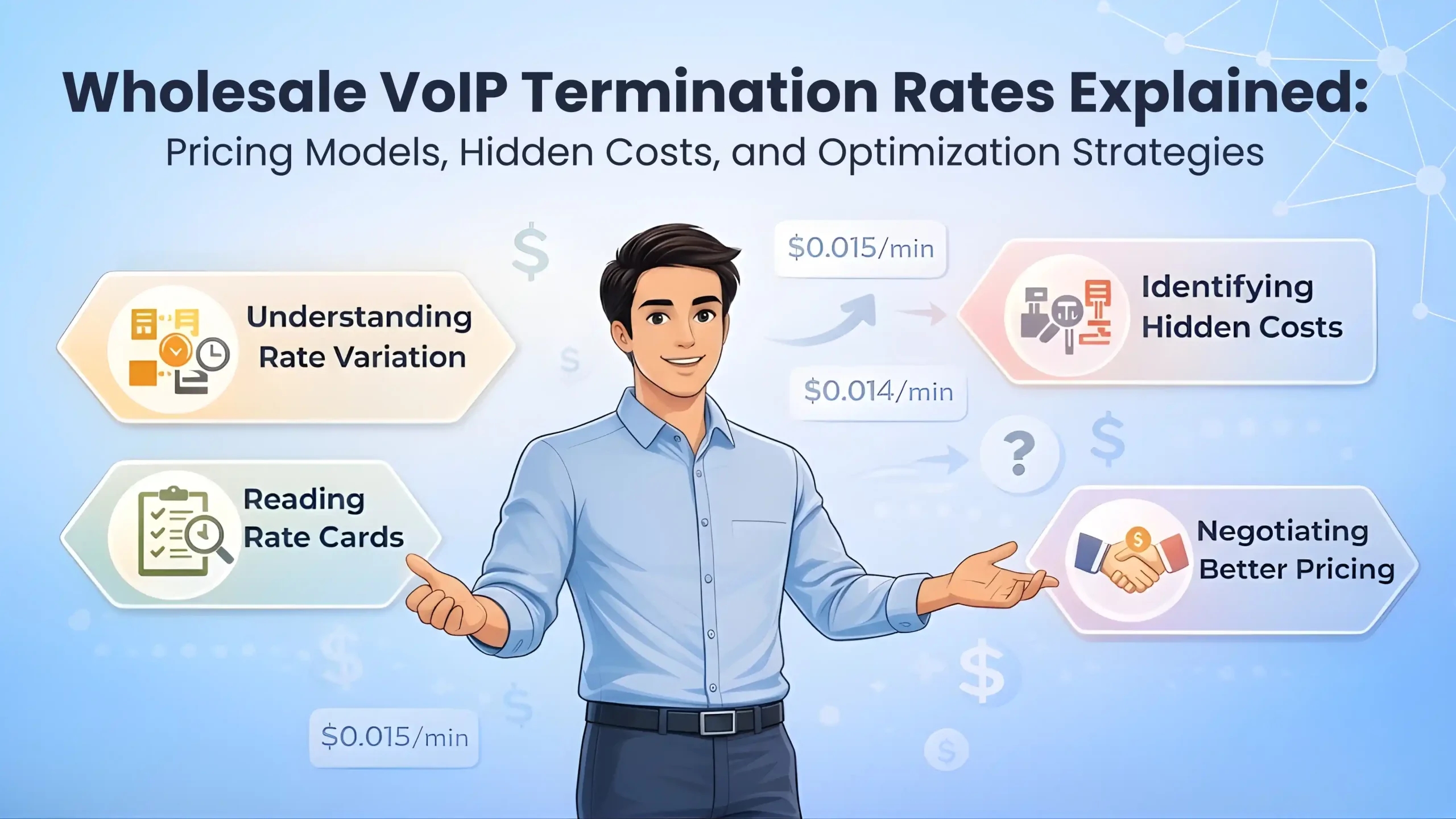
Wholesale VoIP termination rates aren’t simple. You can’t just look at a number like $0.015/minute and know what you’ll actually pay. Hidden factors billing increments, route selection, mobile vs. landline, minimum charges determine your actual cost.
This guide decodes wholesale rate structures. We’ll explain what creates rate variation, how to read rate cards accurately, and how to find and negotiate better pricing. Understanding these mechanics transforms a confusing price list into a predictable cost model.
If you’re comparing wholesale providers or trying to predict your actual costs, this clarifies the economics.
Understanding Rate Card Mechanics
Wholesale rate cards show per-minute prices, but that’s only part of the story. The actual price you pay depends on how charges are structured, what’s included, and what the provider charges for features.
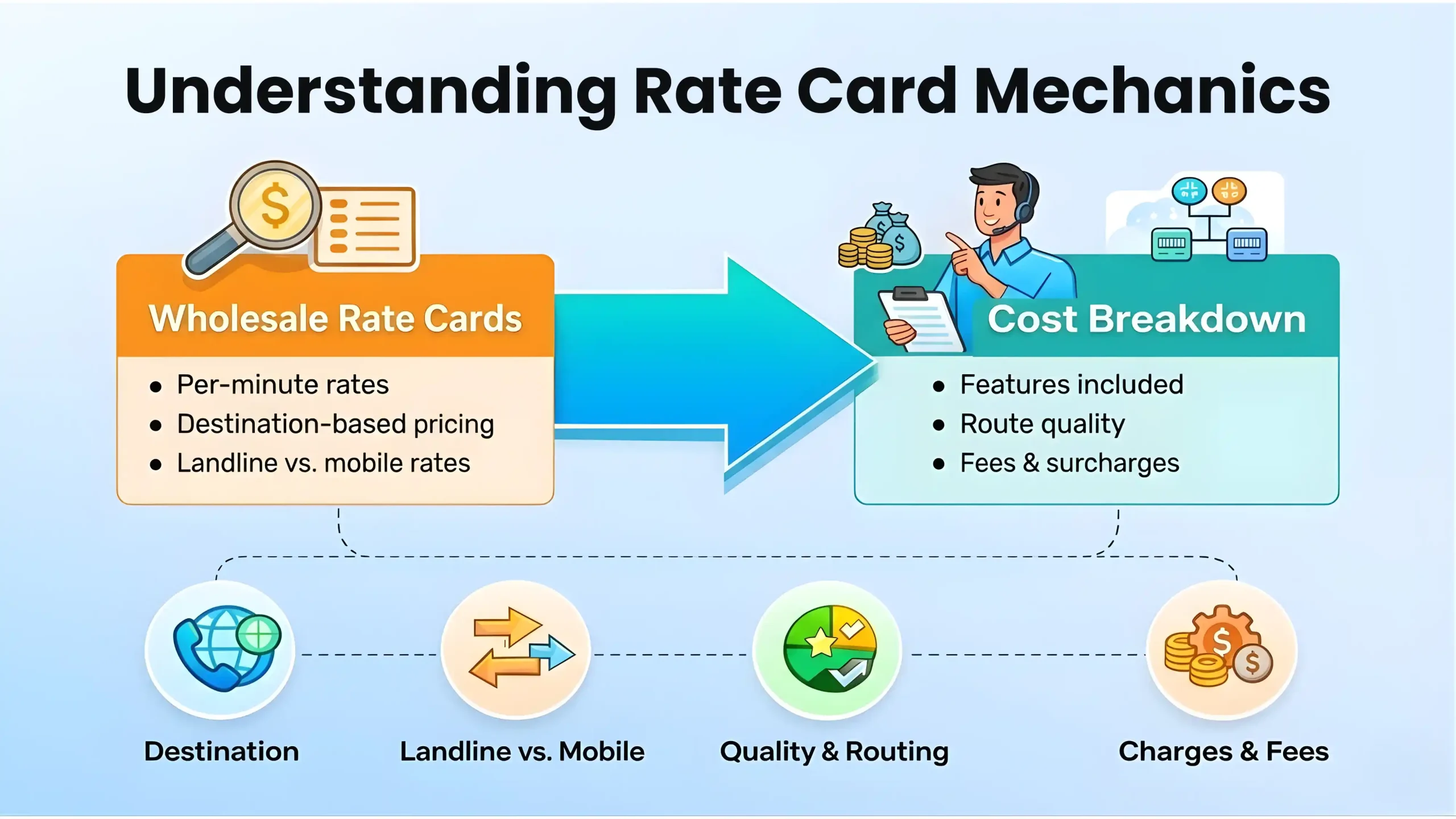
My Country Mobile (MCM) and other wholesale providers maintain detailed rate cards breaking costs down by destination, call type (landline vs. mobile), and route quality. Reading these correctly prevents surprises.
Destination-Based Rate Structure
Wholesale rates vary dramatically by destination. Cheap destinations like USA ($0.002-$0.005/min) have competition from hundreds of carriers. Expensive destinations like Papua New Guinea ($0.12-$0.20/min) have limited carrier options and higher terminating fees.
Wholesale providers group destinations into tiers. Tier 1 (USA, Canada, Western Europe) has the lowest rates. Tier 2 (emerging markets with decent competition) has mid-range rates. Tier 3 (difficult destinations with few carriers) has the highest rates. This isn’t arbitrary it reflects actual carrier economics.
Destination Tier | Examples | Typical Range | Key Factor |
Tier 1 (Cheap) | USA, Canada, UK, Germany | $0.002-$0.008/min | High competition |
Tier 2 (Medium) | India, Brazil, Mexico | $0.012-$0.035/min | Some competition |
Tier 3 (Expensive) | Remote regions, Africa | $0.080-$0.200/min | Limited carriers |
Call Type: Landline vs. Mobile
Mobile termination costs 2-3x more than landline. Not because of greed because mobile carriers charge higher interconnection fees than wireline carriers. When you route a call to a landline in India, the terminating carrier might charge us $0.008/minute. For mobile, they charge $0.020/minute. We pass those costs to you.
Most wholesale rate cards list landline and mobile separately. Make sure you know your calling mix what percentage of your calls go to mobile vs. landline. Your actual average cost depends entirely on this.
Hidden Costs and Rate Card Deceptions
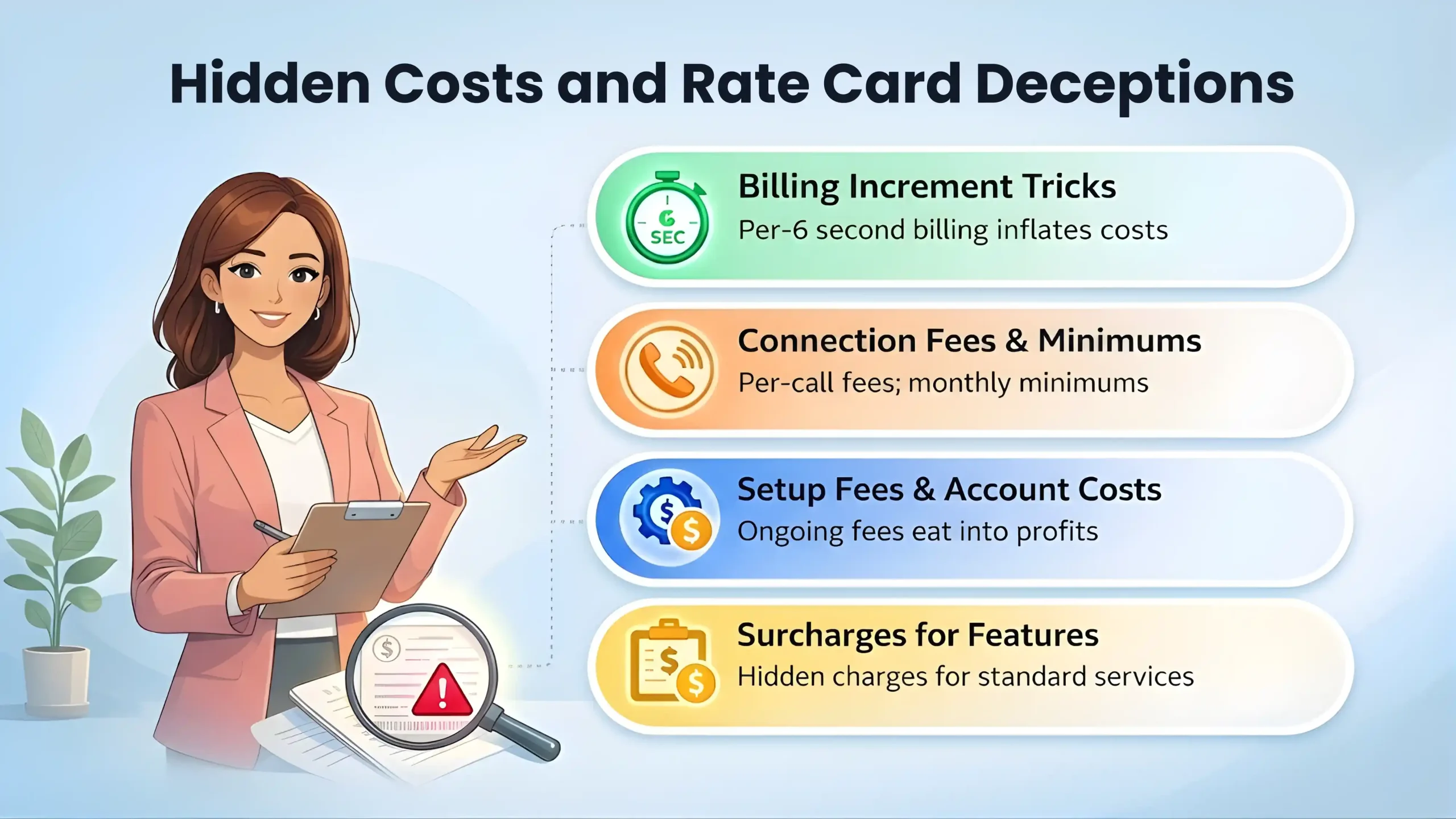
Some wholesale providers bury additional charges in fine print. Here’s what to watch for.
Billing Increment Tricks
A provider might advertise $0.01/min but charge per 6-second minimum. A 10-second call gets billed as 30 seconds. That $0.01/min becomes $0.03 on a short call. Most wholesale providers bill per-second with no minimums. If a provider quotes per-minute or per-6-second minimums, their ‘lower’ per-minute rate might actually cost more.
Connection Fees and Minimums
Some providers charge per-call connection fees ($0.01-$0.05 per call). On high-volume operations with short calls, this adds up. Others have monthly minimums ($200-$500) or per-month/per-customer minimums. Modern providers like MCM have no minimums and no connection fees, but always verify.
Setup Fees and Account Costs
Setup fees ($0-$500) are usually one-time and quickly amortized. More problematic are ongoing account fees ($10-$50/month) that aren’t related to usage. These reduce your margins on low-volume operations. Check for hidden maintenance fees.
Surcharges for Features
Call recording surcharge? Echo cancellation surcharge? Some providers add $0.005-$0.02/min on top of base rates for features you expect to be standard. MCM and most modern providers include basic features without surcharges. Clarify what’s included vs. what costs extra.
Reading a Rate Card: Practical Interpretation
Here’s how to evaluate a real rate card effectively. Don’t just look at the headline rate—dig into the details.
The MCM Rate Card Example
MCM publishes rates showing: destination, landline rate, mobile rate, direct route premium, and volume discount tiers. You can pull exact rates for your mix. Say you call 10,000 min/month to India (6,000 landline, 4,000 mobile). Your cost: (6,000 × $0.012) + (4,000 × $0.024) = $72 + $96 = $168/month. Clear, predictable, verifiable.
Compare Apples to Apples
When comparing providers, ensure you’re comparing the same thing. Provider A quotes $0.010/min India landline. Provider B quotes $0.008/min India. Looks like B is cheaper. But Provider A offers per-second billing with no minimums. Provider B charges per-minute minimum. On your actual call mix, A might be cheaper. Always calculate actual cost using your real numbers.

Rate Negotiation Strategies
As a wholesale customer with meaningful volume, you have negotiating power. Here’s how to use it.
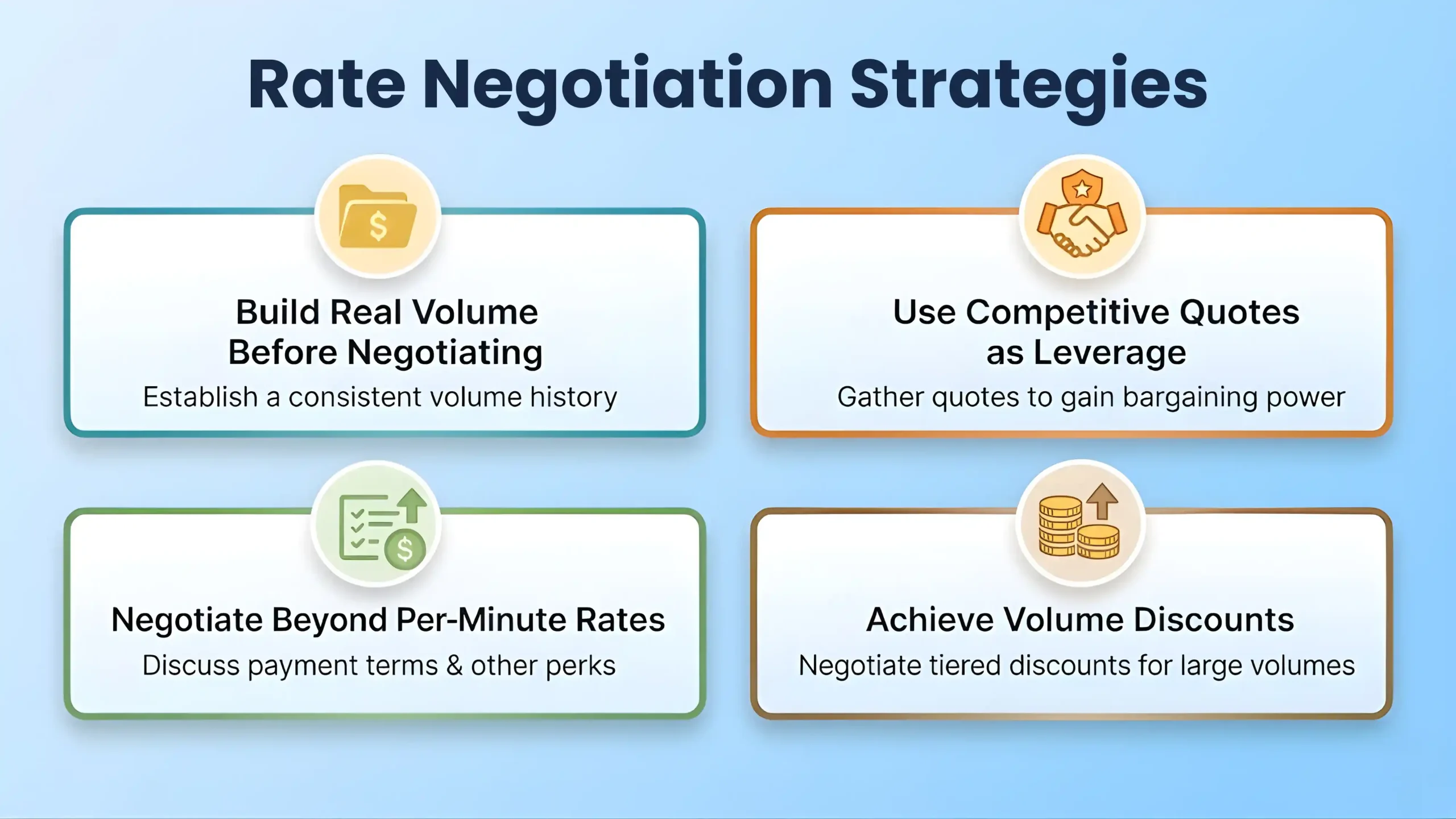
Build Real Volume Before Negotiating
Wholesale providers negotiate rates based on actual volume and customer reliability. Once you have 3-6 months of history showing consistent call volumes, you’ve earned credibility. That’s when rate negotiations are productive.
Use Competitive Quotes as Leverage
Get quotes from multiple providers. A legitimate competing offer gives you leverage. Tell your current provider: ‘Provider X offered me $0.018 for India mobile. Can you match or beat that?’ Most providers will at least discuss it. They’d rather keep your volume at lower rates than lose you entirely.
Negotiate Beyond Per-Minute Rates
Price isn’t the only negotiable point. Negotiate volume discount tiers, payment terms, onboarding support, and priority customer service. Sometimes a 5% rate discount for 30-day payment terms makes more financial sense than a 10% per-minute discount.
MCM customers at 100,000+ monthly minutes average 15-20% rate reductions through volume negotiation.
Cost Optimization Beyond Rates
You can’t negotiate rates lower than the market supports, but you can optimize cost through intelligent routing and destination strategy.
Smart Destination Prioritization
Some calls have high per-minute cost (mobile termination, expensive destinations). Others cost pennies (domestic USA). Route strategically: premium quality routes for important calls, budget routes for less critical communication. This balances cost and experience.
Multi-Provider Strategy
Use different providers for different destinations. Provider A might be cheap for India. Provider B might dominate Brazil. Route accordingly. Requires technical sophistication but can reduce average cost by 10-15%.