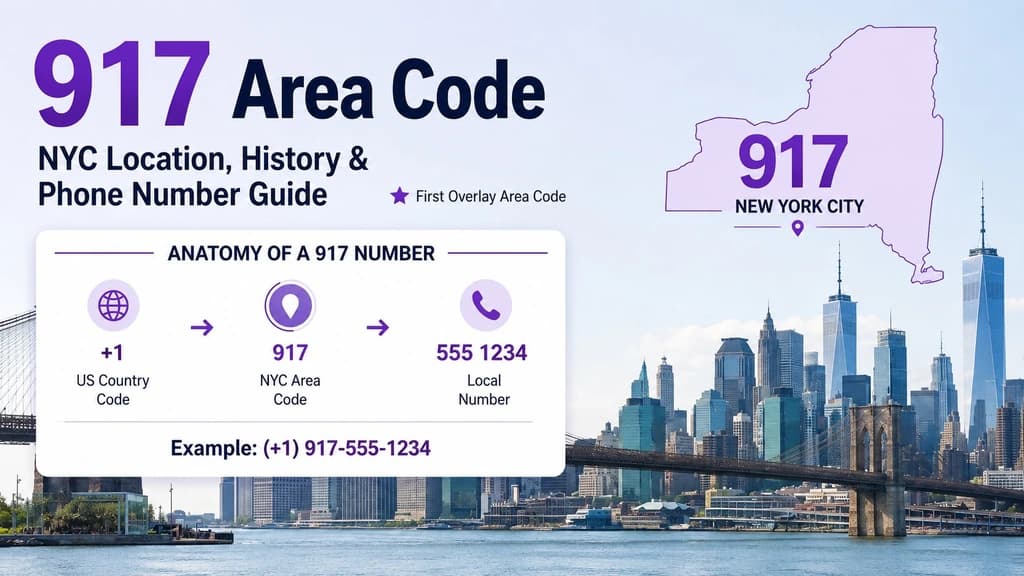
Quick answer: The 917 area code is New York City's first overlay and the first overlay area code in NANP history — launched on February 4, 1992, originally for cell phones and pagers. Unlike 212 (Manhattan) or 718 (outer boroughs), 917 is borough-neutral: it covers all five NYC boroughs at once and sits across both the Manhattan complex (212 / 646 / 332) and the outer-borough complex (718 / 347 / 929 / 465). The region runs on Eastern Time and 10-digit dialing is required. Because 917 has been active for 34+ years, fresh inventory is scarce — and that scarcity is exactly why the prefix still carries weight.
Why the 917 area code means "mobile" to all of New York City
Here's something most New Yorkers know in their gut but couldn't explain: a 917 number feels like a cell phone. A 212 feels like an old Manhattan landline. A 718 feels like the outer boroughs.
That instinct isn't random. The 917 area code was built, from day one, to be the city's mobile prefix — and it still carries that identity today.
This post takes a different look at 917. Instead of just listing facts, we'll explain what makes this prefix unique among NYC codes, why it signals mobility and reach, and how a 917 number works for a modern business.
The code that was born for cell phones

Most area codes started life on landlines. The 917 area code did not — and that origin story shapes everything about it.
It launched on February 4, 1992, as the first overlay area code in all of North America. New York City was running out of numbers, and 917 was the fix.
What made it different
When 917 arrived, the city's cell phones and pagers were moved onto it. That freed up 212 and 718 numbers for landlines.
- 917 became the default for mobile devices city-wide
- It was the first code not tied to a single borough
- It set the template every later NYC overlay would follow
That's why, decades later, 917 still reads as the "phone you carry," not the phone on a desk.
One code, all five boroughs

This is the single most useful thing to understand about 917: it isn't tied to any neighborhood.
A 212 number says Manhattan. A 718 number says Brooklyn, Queens, the Bronx, or Staten Island. A 917 number simply says New York City — all of it.
The boroughs it spans
The prefix works identically across every part of the city.
| Borough | What 917 signals |
|---|---|
| Manhattan | A mobile-era NYC presence |
| Brooklyn | City-wide reach, not just one area |
| Queens | Same — borough-neutral |
| The Bronx | Same — borough-neutral |
| Staten Island | Same — borough-neutral |
Why borough-neutral helps
If your business serves clients across the city, a borough-specific code can box you in. A 917 number keeps you tied to the whole NYC market.
917 area code ZIP codes by borough
Because 917 overlays all five boroughs, it covers hundreds of ZIP codes across the city. The table below lists the key zones by borough — useful if you're targeting a specific neighborhood or verifying whether a 917 number originates from a particular area.
| Borough | Key ZIP codes | Notable neighborhoods |
|---|---|---|
| Manhattan | 10001, 10002, 10003, 10004, 10005, 10006, 10007, 10009, 10010, 10011, 10012, 10013, 10014, 10016, 10017, 10018, 10019, 10021, 10022, 10023, 10024, 10025, 10026, 10027, 10028, 10029, 10036, 10044, 10065, 10075, 10128, 10280 | Midtown, Chelsea, SoHo, TriBeCa, Upper East Side, Upper West Side, Harlem, Washington Heights, Financial District, Hell's Kitchen |
| Brooklyn | 11201, 11205, 11206, 11211, 11215, 11216, 11217, 11221, 11222, 11231, 11238, 11203, 11209, 11220, 11223, 11224, 11225, 11226, 11229, 11230, 11235 | Williamsburg, Park Slope, Bushwick, Greenpoint, Crown Heights, Bedford-Stuyvesant, Red Hook, Brighton Beach, Sunset Park, Coney Island, Bay Ridge |
| Queens | 11101, 11102, 11103, 11104, 11105, 11106, 11354, 11355, 11368, 11372, 11373, 11374, 11375, 11377, 11385, 11411, 11415, 11432, 11691 | Astoria, Long Island City, Flushing, Jackson Heights, Elmhurst, Rego Park, Forest Hills, Woodside, Jamaica, Far Rockaway, Ridgewood |
| The Bronx | 10451, 10452, 10453, 10454, 10455, 10456, 10457, 10458, 10460, 10461, 10462, 10463, 10466, 10467, 10468, 10469, 10471, 10472, 10475 | Mott Haven, Fordham, Riverdale, Pelham Bay, Co-op City, Kingsbridge, Belmont, Hunts Point, Tremont |
| Staten Island | 10301, 10302, 10303, 10304, 10305, 10306, 10307, 10308, 10309, 10310, 10312, 10314 | St. George, Port Richmond, Stapleton, New Dorp, Tottenville, Great Kills, Eltingville |
Note: A 917 number does not indicate which specific ZIP code or borough the subscriber is in — that information is not publicly exposed through the area code alone.
Ready when you are
Protect your business line.
MCM's local numbers ship with verified caller ID and smart call filtering — customers always know it's really you, and spam never reaches your team.
How 917 fits into the NYC overlay puzzle

New York City's numbering is genuinely complex, and 917 sits at the center of it.
It belongs to two overlapping overlay groups: the 212 / 646 / 332 Manhattan complex and the 718 / 347 / 929 / 465 outer-borough complex. 917 overlays them all.
The 465 code joined the 347/718/917/929 overlay on June 18, 2026, adding roughly eight million fresh numbers to the pool. For existing 917 holders, nothing changes — your number stays exactly as it is.
What that means in practice
Because so many codes share the same geography, a few rules apply.
- Ten-digit dialing is required for every local call in NYC
- New 917 numbers are scarce, since the code has been active since 1992
- A 917 number remains highly recognizable precisely because it's been around so long
The scarcity angle
Fresh 917 numbers are harder to come by than newer codes like 332. That scarcity is part of why the prefix still carries weight.
Time zone and reach
The 917 area code operates on Eastern Time (UTC-5, shifting to UTC-4 during daylight saving). That's standard for New York.
What matters more is reach. Because 917 says "New York City" rather than one borough, it travels well — on a business card, in an ad, on a website seen nationwide.
Practical scheduling note
If you serve clients beyond the East Coast, plan around the time gap.
When it's 9 AM in NYC, it's 8 AM in Chicago and 6 AM in Los Angeles. A city-wide number is only useful if someone is there to answer it.
What a 917 number does for a modern business

The mobile DNA of 917 makes it a strong fit for how businesses actually operate now — distributed, app-based, and rarely tied to one desk.
A virtual 917 number isn't a physical line. It rings wherever you want: a mobile phone, a laptop, a team of agents, or all three.
Real advantages
A city-wide mobile-style prefix delivers a few concrete benefits.
- Credibility — it reads as an established NYC presence
- Flexibility — it routes to any device, from anywhere
- Neutrality — it doesn't pin you to one borough's reputation
Businesses on the My Country Mobile (MCM) network use local numbers like this across 190+ countries — the goal is always the same: look local, operate anywhere.
How to get a 917 number
You don't need a Manhattan office — or any New York office — to use a 917 number.
The process
A virtual number provider makes this quick.
- Search availability for the 917 prefix
- Pick from the numbers offered
- Choose a plan sized to your call volume
- Activate and set up routing
If 917 numbers are unavailable
Because 917 inventory is tight, you may not always find one. A 646 or 332 number gives you a Manhattan-area presence as a strong alternative.
Once active, layer on call routing, voicemail, and business hours so the number works the way you do.
Final thought
The 917 area code is more than a New York City prefix — it's the city's original mobile identity, borough-neutral by design and recognizable for over three decades.
For a business that wants to feel native to all of NYC without committing to a single neighborhood, that neutrality is the whole point. Check what 917 numbers are open, and if none fit, a 646 alternative keeps you in the Manhattan orbit.
Curious what's available? Browsing open numbers takes a couple of minutes — no signup, no commitment.
Got a call from a 917 number?
Not every 917 call is someone you know. Caller ID spoofing is common in New York City's overlay region, which means a local-looking 917 number isn't proof the caller is actually based in NYC.
If you received an unexpected call from a 917 number:
- No voicemail left? Let it go. Legitimate callers leave a message.
- Want to know who owns the number? Use our Phone Number Lookup to see the carrier, line type, and registration details.
- Received the same number repeatedly? Run it through our Reverse Phone Lookup to identify the caller and decide whether to block.
Both tools are free and return results in seconds.
Ready when you are
Ready to sound local everywhere you sell?
MCM activates business numbers in minutes, with call routing, analytics, and CRM-ready integrations. Start your free trial — no card to browse inventory.
Frequently asked questions
What makes the 917 area code different from 212 or 718?
917 was created in 1992 specifically for cell phones and isn't tied to a single borough.
212 is associated with Manhattan landlines and 718 with the outer boroughs, while 917 covers all of New York City.
Is the 917 area code only for cell phones?
It was originally assigned to mobile phones and pagers and is still the standard for cellular numbers, but it is occasionally assigned to landlines, most often in Manhattan.
What area does the 917 area code cover?
It covers the entire city of New York — all five boroughs: Manhattan, Brooklyn, Queens, the Bronx, and Staten Island.
Why are 917 numbers hard to get?
The code has been active since 1992, so much of its inventory is already assigned. Newer overlay codes like 332 have more numbers available.
Do I need a New York office to get a 917 number?
No. A virtual 917 number can be set up from anywhere and routed to your existing phone or team, giving you a New York City presence without a local office.
What time zone does the 917 area code use?
It uses Eastern Time, UTC-5 during standard time and UTC-4 during daylight saving time.
Can I forward a 917 number to a mobile phone?
Yes. A virtual 917 number can route calls to a mobile phone, desk phone, laptop, or a group of agents, and the routing can change anytime.
Get a 917 number for your business
A New York City presence used to mean leasing space in Midtown. Now it's a few-minute signup — and 917 is the prefix that says "New Yorker" no matter which borough you actually serve.
My Country Mobile offers 917 (and 646 / 332 as Manhattan-area fallbacks) virtual numbers with call forwarding, voicemail-to-email, SMS, and AI call transcription. Calls route to any device worldwide, and over 17,500 businesses already trust MCM with their virtual phone presence.