
SIP 487 Request Terminated: What It Means and How to Fix It
You pull a call detail record, see "487 Request Terminated," and assume something broke. Often nothing did — 487 is frequently the protocol working exactly as designed. But sometimes it is the symptom of a real problem.
This guide explains what a SIP 487 Request Terminated response actually signals, when it is harmless, when it is not, and how to track down the cause when your 487 rate climbs.
Written by the My Country Mobile (MCM) carrier engineering team. 7-minute read.
WHAT A SIP 487 RESPONSE ACTUALLY MEANS
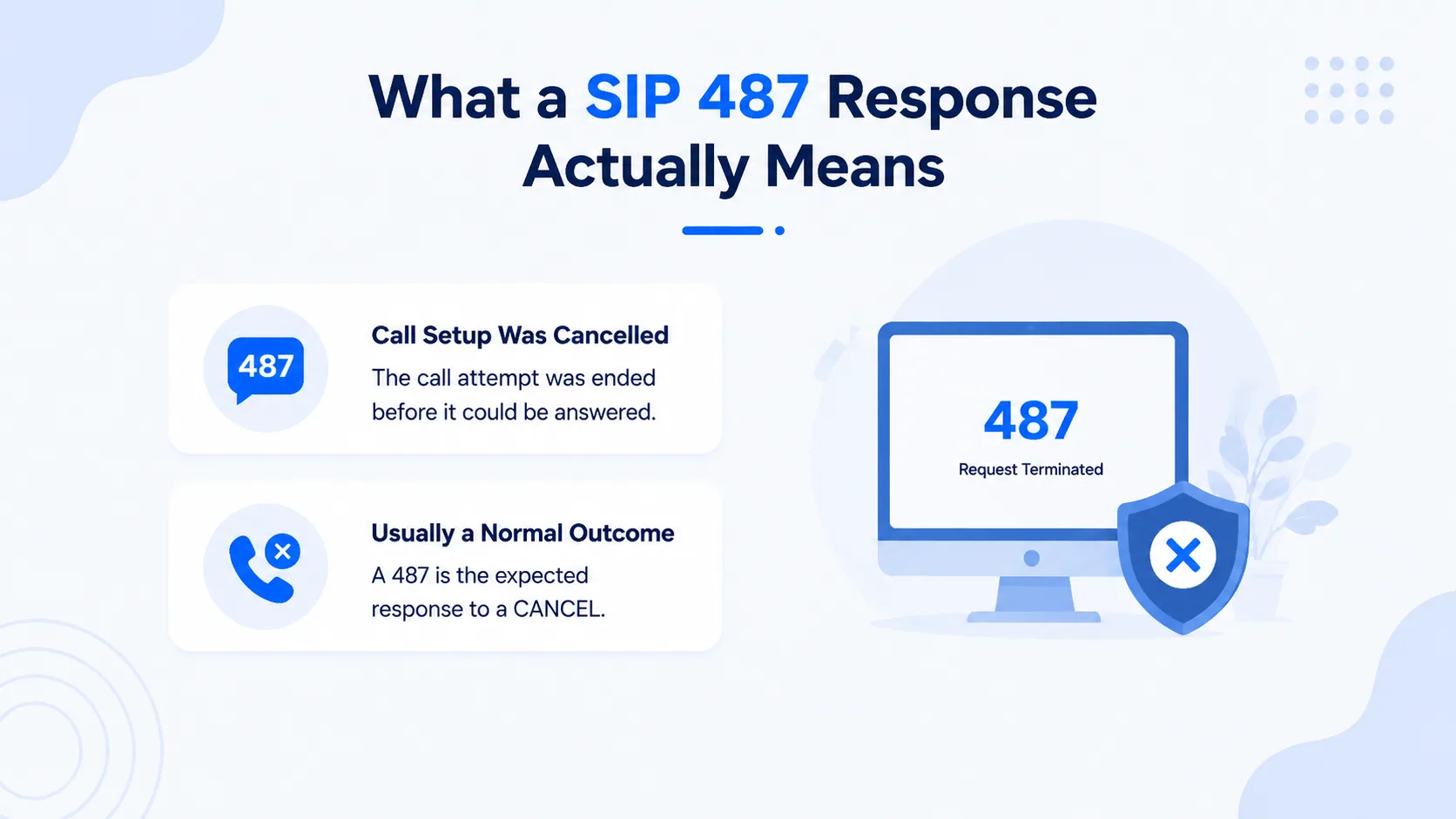
In the Session Initiation Protocol, 487 is a 4xx-class final response. It tells the calling side that a pending request — almost always an INVITE — was terminated before it could be answered.
The plain-English version: the call setup was cancelled. Someone or something ended the attempt before the called party picked up.
It Is Usually a Normal Outcome
Here is the part that surprises people. A 487 is the expected response to a CANCEL.
When a caller hangs up before the other end answers, their device sends a CANCEL. The receiving side acknowledges by responding 487 to the original INVITE. That is correct behavior, not a fault.
THE CANCEL / INVITE TRANSACTION BEHIND 487
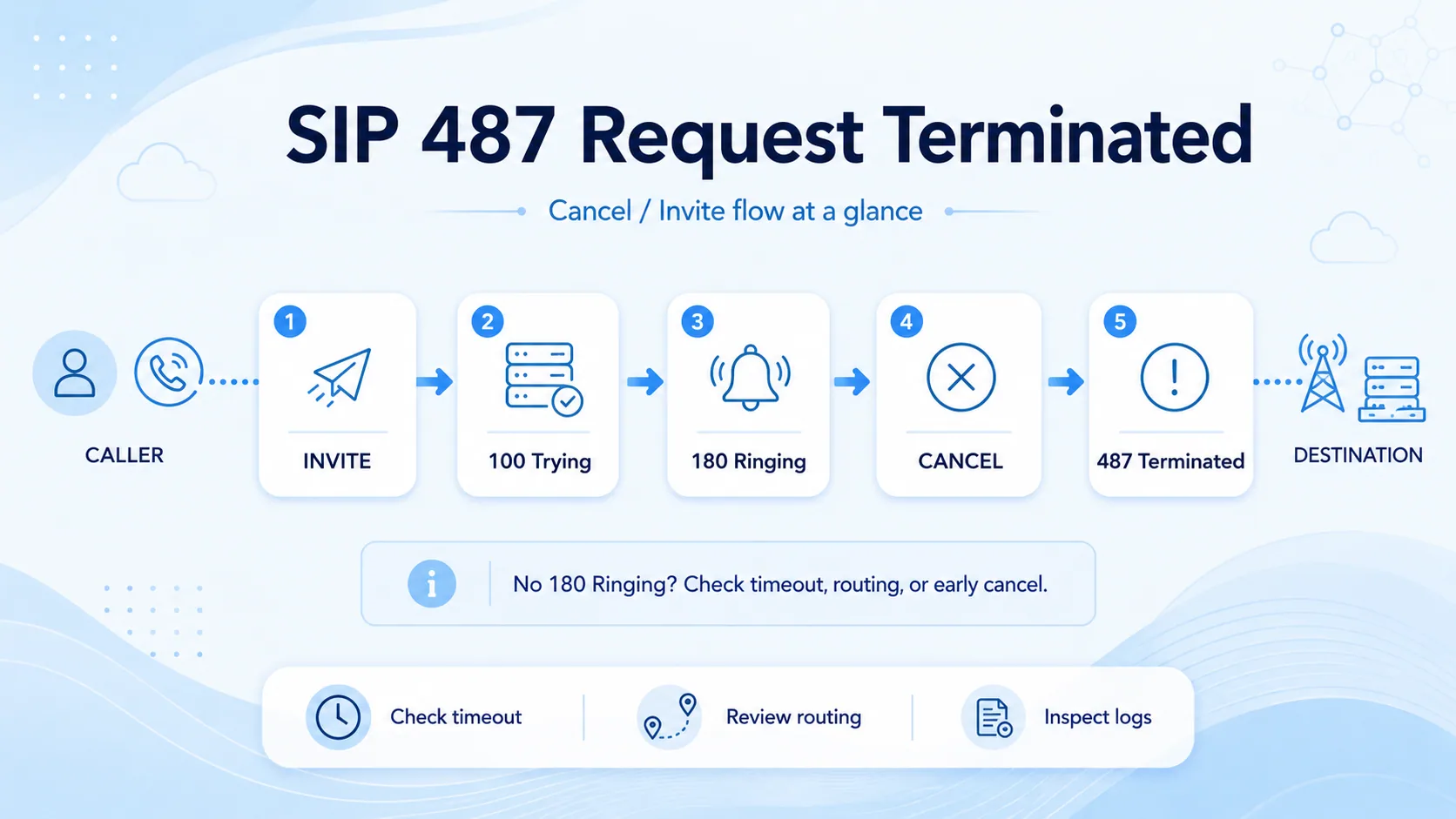
To diagnose 487s you have to picture the SIP message flow. It is a short, predictable exchange.
The Normal Sequence
A clean cancelled call follows these steps.
- Caller's device sends an INVITE.
- The far end replies 100 Trying, then often 180 Ringing.
- The caller hangs up — their device sends a CANCEL.
- The far end responds 200 OK to the CANCEL, then 487 Request Terminated to the INVITE.
The Abnormal Sequence
A 487 with no 180 Ringing beforehand is the warning sign.
It means the called party was likely never alerted — the caller gave up, or a network element killed the call, before ringing ever started.
Ready when you are
Protect your business line.
MCM's local numbers ship with verified caller ID and smart call filtering — customers always know it's really you, and spam never reaches your team.
WHAT TRIGGERS SIP 487 ERRORS
Most 487s trace back to one of a few causes. Knowing which one you are facing points straight to the fix.
Caller Abandonment
The caller simply hung up before the call connected. Common, and rarely a problem on its own.
High Post-Dial Delay (PDD)
This is the big one for carriers and call centers. PDD is the gap between dialing and hearing ringback.
If PDD is long, callers get impatient and hang up — generating a 487. PDD and 487 rates rise together; a climbing 487 rate is often a PDD problem in disguise.
Forking and Race Conditions
When an INVITE forks to multiple endpoints, one leg answers and the others are cancelled — each cancelled leg returns a 487. Expected, but it inflates raw counts.
Network or SBC Behavior
A session border controller, proxy, or firewall can cancel a call due to call timers, transport issues (UDP vs TCP), failure policies, or firmware bugs.
Fighting high PDD and 487 rates on your routes? MCM's carrier-grade network uses intelligent least-cost routing and 24/7 monitoring to keep post-dial delay low. Explore wholesale voice at mycountrymobile.com — built for call-center-grade traffic.
HOW TO DIAGNOSE A SIP 487
When 487s exceed your normal baseline, work through this sequence. The goal is to find who sent the CANCEL and why.
Step 1: Capture the Full Message Flow
Pull a SIP trace or PCAP for affected calls. Timestamps are critical — you need the exact order of INVITE, provisional responses, and CANCEL.
Step 2: Identify the CANCEL Originator
Check whether the CANCEL came from the end user's device or from a network element such as an SBC or proxy.
A user-originated CANCEL points to abandonment or PDD. An element-originated CANCEL points to configuration.
Step 3: Check for the Missing 180
If 487s arrive without a preceding 180 Ringing, the called side was never alerted.
That isolates the problem to routing, the upstream carrier, or a setup timeout — not the end user.
Step 4: Correlate With PDD
Compare current PDD against your historical baseline.
If PDD has crept up, attack that first — lowering PDD usually pulls the 487 rate down with it.
HOW TO FIX A RISING 487 RATE
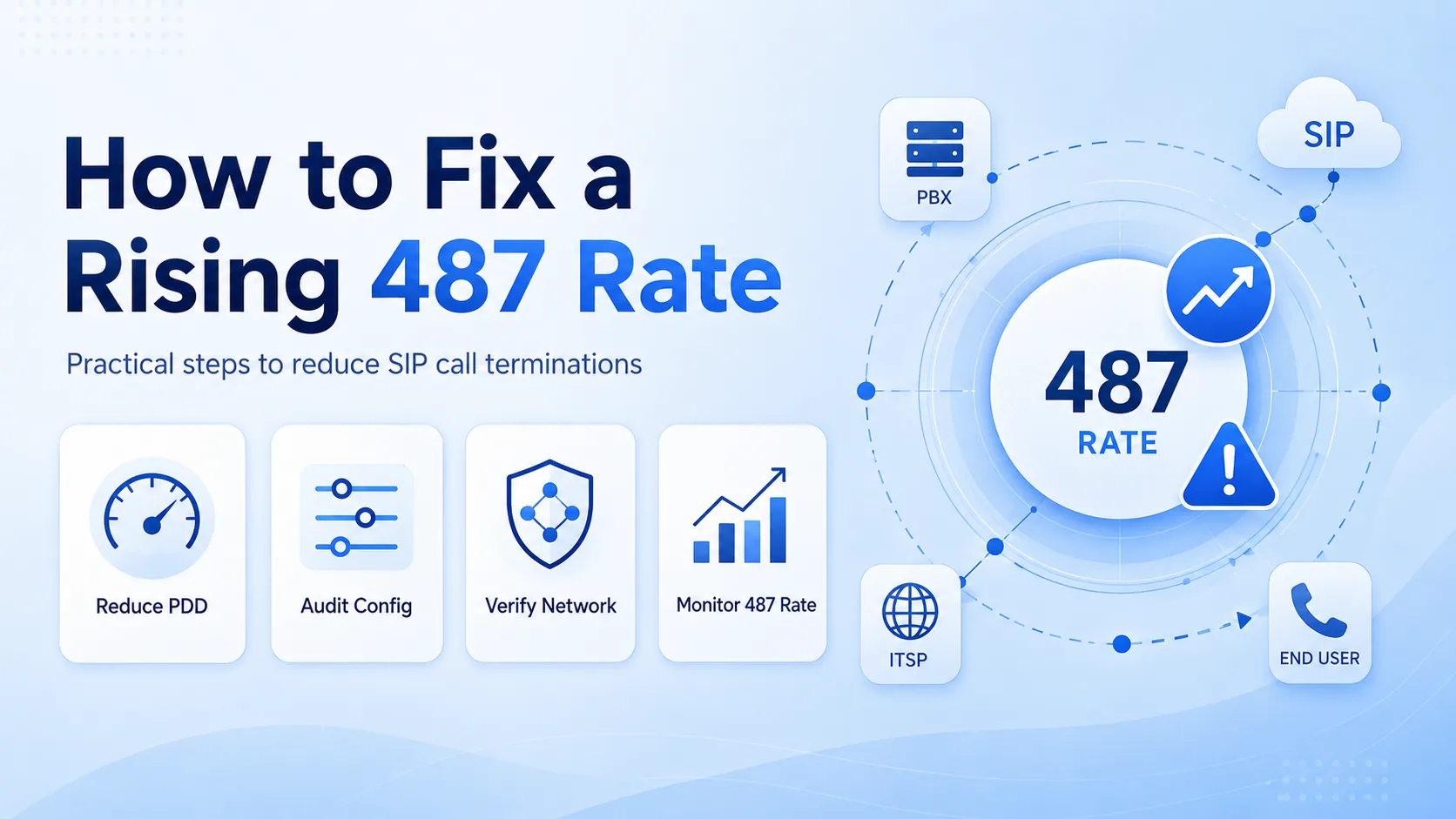
Once you know the cause, the fixes are concrete. Match the fix to what your diagnosis found.
Reduce Post-Dial Delay
Review routing for slow upstream carriers and re-route traffic through faster paths.
A quality wholesale route with low PDD is the single most effective lever for cutting abandonment-driven 487s.
Audit Network Element Configuration
On the SBC or proxy, review call timers, failover policies, forking rules, and SIP transport settings.
Confirm firmware is current — known bugs cause spurious CANCELs.
Verify Network Stability
Check that no firewall rule is blocking or delaying SIP signaling, and confirm signaling and media paths are consistent.
Monitor the 487 Rate Continuously
Treat the 487 percentage as a live quality metric. A sudden spike is an early warning — catch it before customers feel it.
Want routes that keep 487s low by design? MCM monitors call quality, latency, and PDD across every route in real time. See how our voice network works — carrier-grade routing, no long contracts.
THE TAKEAWAY
A SIP 487 Request Terminated response is not automatically an error — most of the time it is the protocol cleanly handling a cancelled call. The real signal is the rate and the pattern.
When 487s climb, trace the message flow, find who sent the CANCEL, and check PDD first. Fix the post-dial delay and the route quality, and the 487 rate almost always follows.
Running high-volume voice traffic? Talk to MCM about low-PDD routing — built for carriers and call centers that can't afford abandoned calls.
Ready when you are
Ready to sound local everywhere you sell?
MCM activates business numbers in minutes, with call routing, analytics, and CRM-ready integrations. Start your free trial — no card to browse inventory.
FAQs
What does SIP 487 Request Terminated mean?
It is a final SIP response telling the caller that a pending request — usually an INVITE — was terminated before the call was answered, typically because of a CANCEL.
Is a SIP 487 always an error?
No. A 487 is the correct, expected response when a caller hangs up before the call connects. It only signals a problem when the rate is abnormally high.
Why does high post-dial delay cause 487 errors?
Long PDD means callers wait too long for ringback and give up. Their hang-up sends a CANCEL, which produces a 487. PDD and 487 rates move together.
How do I tell if a 487 is abnormal?
Check for a 180 Ringing before the 487. If ringing never happened, the called party was never alerted — that points to routing or a timeout, not normal caller behavior.
Can a firewall or SBC cause SIP 487 errors?
Yes. An SBC, proxy, or firewall can cancel calls due to call timers, transport mismatches, failover policies, or firmware bugs. Audit those settings if the CANCEL originates from a network element.
What is the difference between SIP 487 and SIP BYE?
A 487 terminates a call still in setup (before answer). A BYE ends a call that was already connected and active.
How can I reduce my 487 rate?
Lower post-dial delay by routing through faster carriers, audit SBC and proxy configuration, ensure network stability, and monitor the 487 percentage as a live quality metric.


