How to Call the Philippines: A Step-by-Step Dialing Guide
You've got the number. You dial it. Nothing — or worse, a recorded error in a language you don't speak. Calling abroad shouldn't feel like a puzzle, yet international dialing trips up first-timers every day.
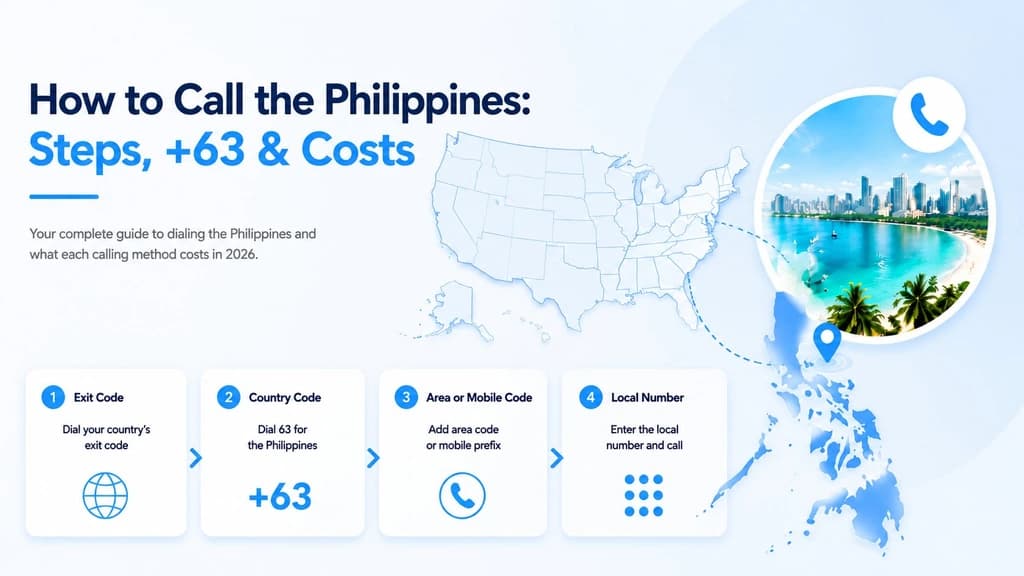
Calling the Philippines is genuinely simple once you know the four pieces: your exit code, the country code, the area or mobile code, and the local number. Miss one and the call dies. Get all four and it connects on the first ring.
This guide walks through exactly how to call the Philippines — the dialing sequence, the area codes for major cities, and what each method costs per minute in 2026 so you don't get surprised by your bill.
WHAT YOU NEED BEFORE YOU DIAL
A working international call has four parts in a fixed order. Have these ready before you touch the keypad.
- Exit code — the prefix that tells your network to route a call abroad
- Country code — 63 for the Philippines
- Area or mobile code — the regional or mobile prefix
- Local number — the subscriber's actual number
Line those up correctly and the rest is just pressing dial.
STEP 1: ENTER YOUR EXIT CODE
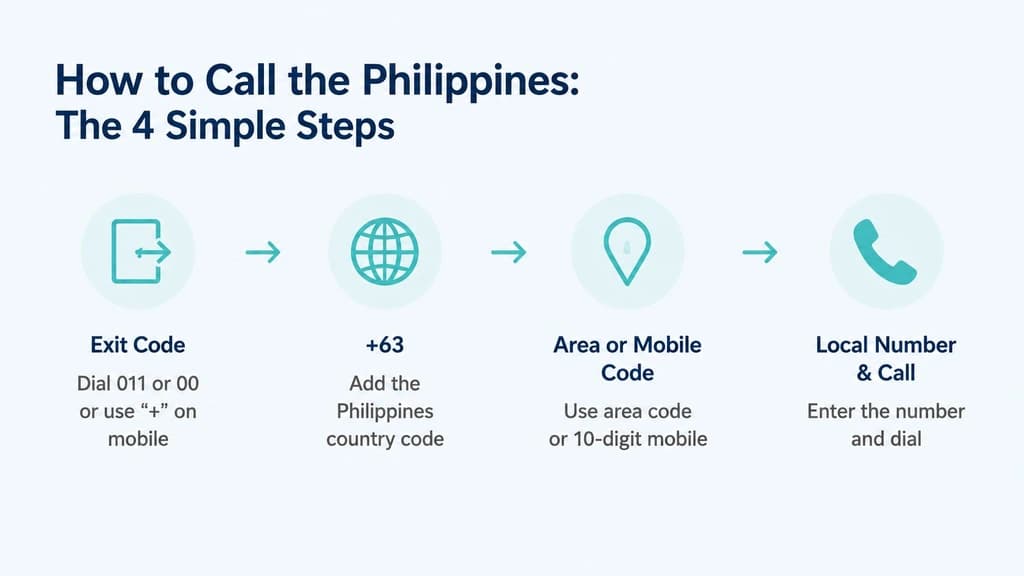
The exit code is your network's "go international" signal. It changes depending on where you're calling from.
From the US, Canada, and the rest of the North American Numbering Plan, dial 011. From most of Europe, Australia, and New Zealand, dial 00.
On any mobile phone, you can skip the exit code entirely and press the "+" symbol instead. It auto-translates to the correct exit code wherever you are — the simplest, most reliable option.
Ready when you are
Protect your business line.
MCM's local numbers ship with verified caller ID and smart call filtering — customers always know it's really you, and spam never reaches your team.
STEP 2: ADD THE PHILIPPINES COUNTRY CODE
After the exit code (or the "+"), enter 63. That's the country code that routes your call into the Philippine network.
So your number now starts with 011 63 from the US or +63 from a mobile. Never add both the exit code and the "+" — pick one.
This two-digit code is the single constant in every call to the country, no matter the city or carrier.
STEP 3: ADD THE AREA CODE OR MOBILE CODE
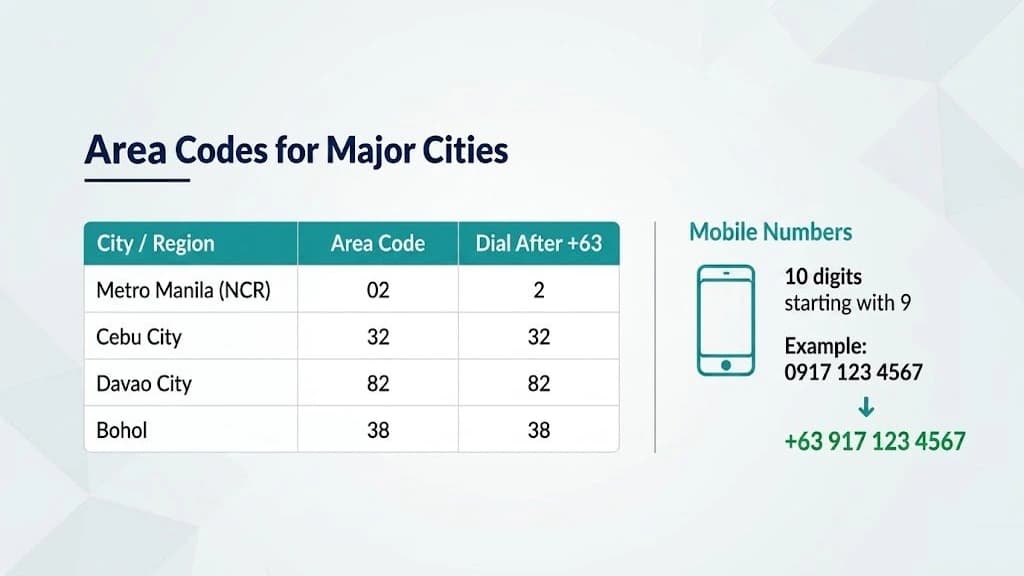
This is where landline and mobile calls split. The middle code depends on which type of number you're reaching.
Calling a Landline
Landlines use a geographic area code. After +63, add the area code without its leading 0.
| City / Region | Area Code | Dial After +63 |
|---|---|---|
| Metro Manila (NCR) | 02 | 2 |
| Cebu City | 32 | 32 |
| Davao City | 82 | 82 |
| Bohol | 38 | 38 |
So a Metro Manila landline you'd write locally as 02 8XXX XXXX becomes +63 2 8XXX XXXX from abroad.
Calling a Mobile
Philippine mobile numbers don't use a geographic area code. Every mobile number is 10 digits and starts with 9.
From abroad you simply add +63 and drop the leading 0: a local 0917 123 4567 becomes +63 917 123 4567.
STEP 4: ENTER THE LOCAL NUMBER AND CALL
Finish with the subscriber's local number, then press dial. Two worked examples make the pattern clear.
Manila landline from the US: 011 63 2 8123 4567
Manila mobile from a phone using "+": +63 917 123 4567
That's the whole sequence. Exit code, 63, area or mobile code, local number — every time.
Tip: Save the number in your phone in full +63 international format. Once it's stored correctly, you never have to rebuild the sequence again — it works from any country you travel to.
WHAT IT COSTS TO CALL THE PHILIPPINES IN 2026
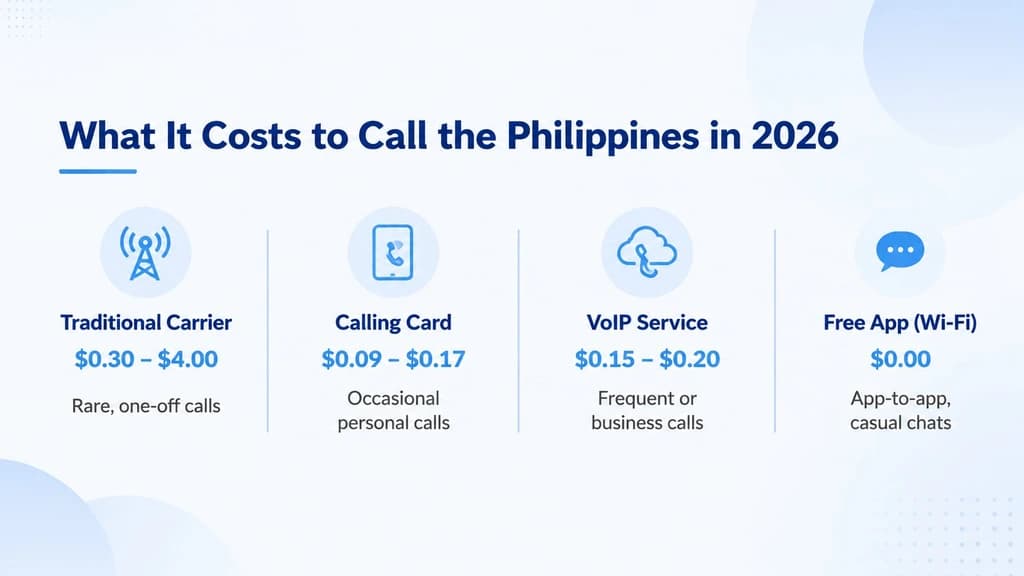
Now the part that actually varies: price. The dialing steps are the same for everyone, but the per-minute cost swings wildly by method.
Traditional Carriers Are the Expensive Option
Calling from a standard landline or mobile plan, expect to pay roughly $2.49 to $4.00 per minute with some carriers, and $0.30 to $0.50 per minute with more competitive ones.
For a single quick call that's tolerable. For regular contact with family or a remote team, it adds up fast.
VoIP and Calling Cards Cut the Bill
Internet-based calling is dramatically cheaper. VoIP services typically run $0.15 to $0.20 per minute, and calling cards land around $0.09 to $0.17 per minute.
Free apps over Wi-Fi cost nothing — but both callers need the same app and a stable connection, which isn't always practical for business.
Quick Cost Comparison
| Method | Approx. Cost / Minute | Best For |
|---|---|---|
| Traditional carrier | $0.30 – $4.00 | Rare, one-off calls |
| Calling card | $0.09 – $0.17 | Occasional personal calls |
| VoIP service | $0.15 – $0.20 | Frequent or business calls |
| Free app (Wi-Fi) | $0.00 | App-to-app, casual chats |
For anyone calling the Philippines regularly, VoIP is the clear value pick — predictable rates and no contract surprises.
HOW BUSINESSES CALL THE PHILIPPINES AT SCALE
If you're not making one call but thousands — a support team, a sales floor, a BPO — per-minute consumer rates won't work. You need wholesale routing.
My Country Mobile (MCM) handles high-volume voice traffic into the Philippines through a carrier-grade network covering 190+ countries, with routing tiers that balance call quality against cost. That's the difference between a $4/minute consumer call and fractions of a cent at volume.
For teams, the smart move is a virtual phone number and cloud calling instead of personal phone plans — one system, one bill, predictable rates.
Ready to set up reliable, affordable calling? Explore MCM's calling solutions built for international voice.
COMMON DIALING MISTAKES TO AVOID
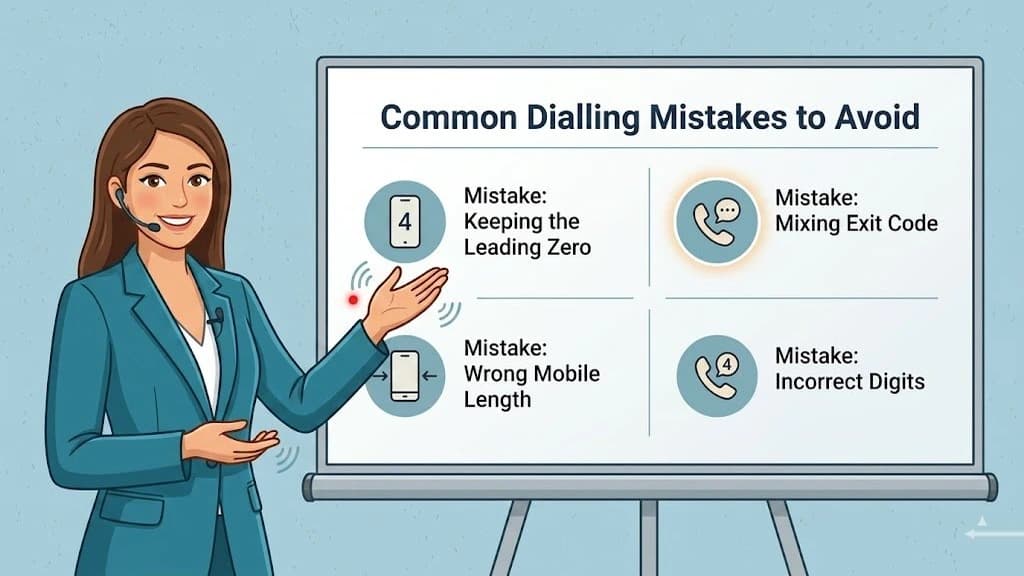
Most failed calls trace back to the same handful of slips. Check these before you blame the network.
Keeping the Leading Zero
Philippine area and mobile codes are written locally with a 0 — 02, 0917. Drop that 0 when dialing internationally; the +63 replaces it.
Mixing Exit Code and "+"
Dialing 011 +63 won't work. Use either the exit code (011/00) or the "+" symbol, never both together.
Wrong Mobile Length
A Philippine mobile is always 10 digits starting with 9. If your number is shorter or longer, recheck it before dialing.
Ready when you are
Ready to sound local everywhere you sell?
MCM activates business numbers in minutes, with call routing, analytics, and CRM-ready integrations. Start your trial — no card to browse inventory.
FAQs
What is the country code to call the Philippines?
The country code for the Philippines is 63. You dial it right after your exit code — for example, 011 63 from the US — or after the "+" symbol on a mobile, giving you +63.
How do I call a Philippine mobile number from the US?
Dial 011, then 63, then the 10-digit mobile number starting with 9 (drop the leading 0). Using a mobile phone, simply press "+63" followed by the same 10 digits.
Do I drop the 0 in the area code when calling the Philippines?
Yes. Area codes and mobile prefixes are written with a leading 0 for domestic dialing only. When calling from abroad, the country code +63 replaces that 0, so you leave it out.
Why does my call to the Philippines keep failing?
The usual causes are keeping the leading 0, combining the exit code with the "+", or an incorrect digit count. Rebuild the number as exit code, 63, area or mobile code, then local number.
What's the cheapest way to call the Philippines?
Free apps over Wi-Fi cost nothing if both people use the same app. For phone-to-phone calling, VoIP services (about $0.15–$0.20 per minute) and calling cards are far cheaper than traditional carriers.
Is the dialing format the same for landlines and mobiles?
The first part is identical — exit code, then 63. The difference is the middle: landlines use a geographic area code, while mobiles use a 10-digit number starting with 9 and no area code.
THE BOTTOM LINE
Calling the Philippines is a four-part sequence you only need to learn once: exit code, 63, area or mobile code, local number. Master that and the connection is automatic.
The real decision isn't how to dial — it's what to dial with. For occasional calls, an app or calling card is fine. For regular or business calling, VoIP saves real money over consumer carrier rates.
Calling the Philippines often for work? See how MCM's calling solutions deliver clear, low-cost international voice.